
Pinned Tweet
John Hoey
3.1K posts


John Hoey
@hoeyjohn
A lover of good music. Bowie-Petty-Seger-Lynne- Lennon and many more, also witty people, empathetic people and fun people.❤️⚘️🍻
Ireland Joined Eylül 2010
601 Following818 Followers
What’s the song???
“On the first part of the journey
I was looking at all the life
There were plants and birds and rocks and things
There was sand and hills and rings
The first thing I met was a fly with a buzz
And the sky with no clouds
The heat was hot & the ground was dry"
English

English

@irishpatriot91 Do not miss this evening, a special UK patriot is gonna be hosting... it is gonna be lit 🔥
English

Communities in the North are now standing up to the INVASION!
They will push and push but when the North rise they are in bother no harm to any of them.

English
John Hoey retweeted
الأرجنتين - انجلترا 1986 . بعد حرب الفوكلاند ١٩٨٠ .
@grok عطني سرد تاريخي للقاءات الأرجنتين وانجلترا بعد هذه المباراة !؟
العربية


John Hoey retweeted

John Hoey retweeted

▶️ Take a look at the VAR check that saw Celtic awarded a late penalty at Motherwell for handball.
At 6pm on @SkyFootball watch Scottish Football VAR Review to hear what the SFA's head of refereeing Willie Collum made of it 📺
English

Pure class❤️
Football Tweet ⚽@Footballtweet
🇧🇷 The 1970 Brazil team in 4K is quite something.
English
@leatherneck559 @UnearthedHQ Those who know do not say and those who say do not know.
English

While certainly one of the most impactful & innovative buildings in recorded history, it is not the mystery this post suggests.
Even in school, we studied the Pantheon extensively (LSU School of Architecture).
For perspective on that era, the Architect of Rome, Vitruvius ... who served Julias Ceaser circa 50 BC & wrote a book called, "The Ten Books of Architecture".
Every modern school of architecure is modeled to some greater or lesser degree on book & what all it espouses an architects education should entail.
The Pantheon was designed and built under the Emporer Hadrian circa 125 AD or so .. after nearly 200 years of established design excellence in the Empire.
We really don't know exactly who designed it, but most professionals today agree that it was Hadrian himself.
Some speculate that Apollodorus of Damascus may have built it, but Hadrian exiled him and killed ... so... we really won't ever know that part .. there is THAT mystery.
But the concrete roof panels, not so much. Very ingenious .. but not mysterious.
As the panels move toward the center, they get smaller, and lighter, but the strategy of placing the panels in an overlapping, cantilevered, pattern - not new by a long shot at time of building.
English

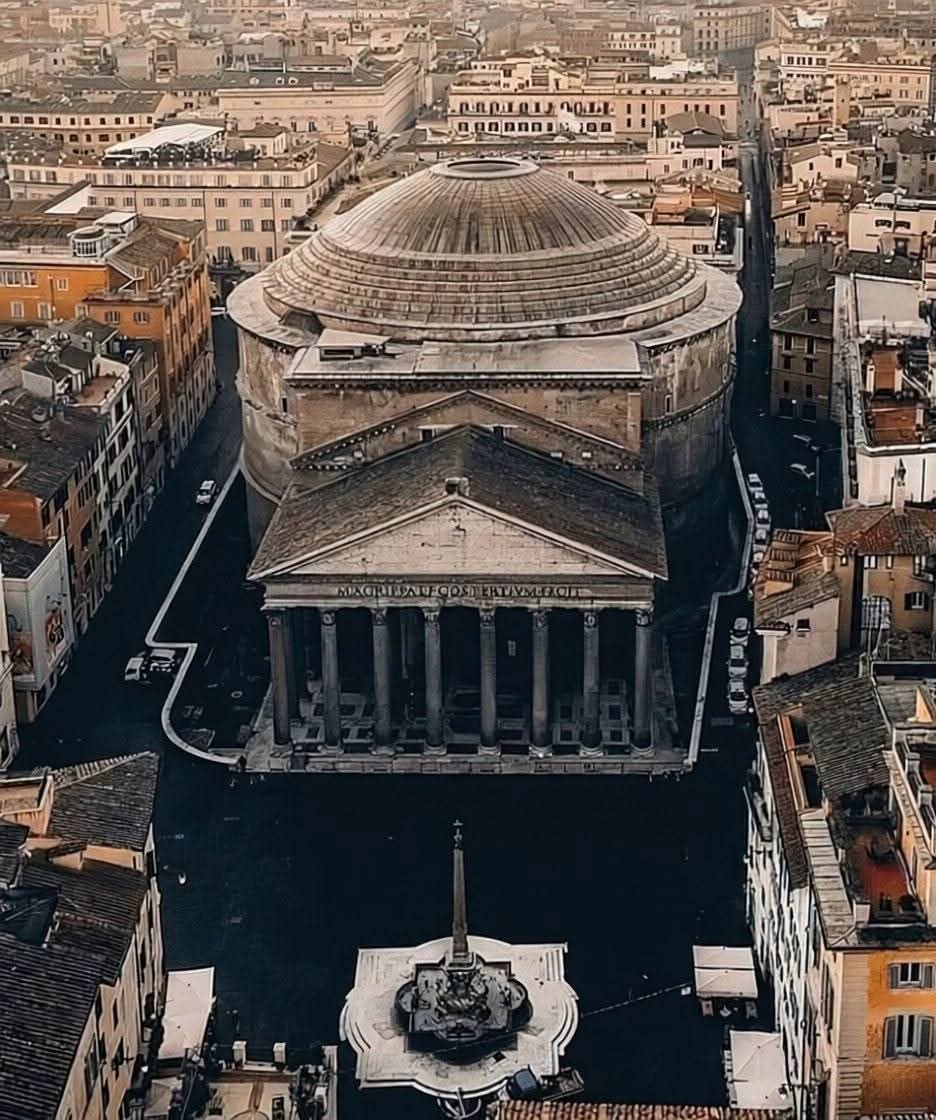
🛑 The Romans Built This 2,000 Years Ago… And Modern Engineers Still Can’t Fully Explain It
Standing in the heart of Rome, the Pantheon has survived wars, earthquakes, invasions, and the collapse of an entire empire. Yet nearly 2,000 years after it was built, it still holds a secret that continues to puzzle architects and engineers around the world.
Its massive dome remains the largest unreinforced concrete dome ever created. No steel skeleton. No modern technology. Just ancient Roman knowledge… and something we may still not completely understand.
Commissioned by Emperor Hadrian around 125 AD, the Pantheon was built on the site of an older temple first constructed by Marcus Agrippa in 27 BC. But what makes this monument truly mysterious is not just its age — it’s how impossibly advanced it was for its time.
The giant dome appears almost weightless, as if floating above visitors who step inside. At its center is the famous oculus, a huge open circle that allows sunlight to pour into the temple like a spotlight from the heavens. When rain falls, it enters freely through the opening, disappearing through hidden drains beneath the floor. Even today, the design feels futuristic.
Historians believe the Romans used a special concrete mixture that became lighter toward the top of the dome, helping prevent collapse. But the exact formula remains one of history’s greatest lost technologies. Some scientists still study the Pantheon, hoping to uncover the secret behind its unbelievable durability.
Think about it… modern stadiums and buildings often need constant repairs after only decades. The Pantheon has stood strong for almost two millennia.
Was this simply brilliant engineering… or knowledge far ahead of its time?
The next time you see a modern skyscraper, remember: an ancient civilization once built a dome so perfect that humanity still struggles to match it.
English
John Hoey retweeted

There is a room in Málaga that was built to be the closest thing on earth to standing inside heaven.
It is called the camarín of the Virgin of Victory, and it is hidden at the top of a tower inside the Santuario de la Victoria. To reach it, you climb and the ascent is the entire point...
The building you are climbing through was completed in 1700, and it was designed as a single argument made in stone. At the bottom lies a crypt: a black chamber crowded with white plaster skeletons, a meditation on death and the brevity of life.
From there a staircase rises, and as you climb it the light grows stronger and the imagery changes from bones to saints. The architects of the time understood this ascent as the soul's own journey, the dark crypt as the stage of penitence, the staircase as the stage of spiritual progress, and the room at the very top as the final stage: the union of the soul with the divine.
That room at the top is the camarín, and its dome is one of the most extraordinary interiors in Spain...
Every surface is covered in white and gold plasterwork. There is no empty space anywhere. The Baroque called this horror vacui, the horror of the void: the conviction that a space meant to represent heaven should not contain a single bare patch of stone.
Out of that plasterwork emerge angels, flowers, birds, and mirrors. The mirrors are not decoration alone. They catch the light pouring in through the windows of the drum and throw it around the chamber, so that the gold seems to move and the whole room appears to shimmer and breathe.
This wonder was built by people who believed that if you wanted to show a human being what heaven might feel like, you did not describe it to them. You built a room, and you let them climb into it...
-- -- --
If you enjoyed this, I write a weekly newsletter read by over 50,000 people who love rediscovering the beauty of the past. You can join us here:
James-lucas.com/welcome
If you'd like to support my work, a paid subscription is what makes it possible.
English
John Hoey retweeted
The Colosseum had a retractable roof, operated by a crew of sailors, almost 2000 years before any modern stadium.
It was called the velarium: an enormous awning of canvas and rope that could be drawn across the open top of the arena to shade fifty thousand spectators from the Roman sun.
It was so large and so complex that ordinary labourers could not manage it. The Romans brought in sailors from the imperial fleet, men who spent their lives handling rigging and sail, and stationed them at the top of the structure to extend and retract the canvas as the day moved.
A building that has stood, roofless to our eyes, for centuries was in fact designed to be covered.
That is the pattern with the Colosseum: almost everything about it was way more advanced than it looks today...
Construction began around 72 AD under the emperor Vespasian. Once completed, it was the largest amphitheater in the Roman world: an elliptical structure of stone, concrete, and travertine, 189 meters long, rising as high as a modern fifteen story building. It could hold around 50,000 people and the staircases allowed that entire crowd to enter and leave with a speed that modern stadium designers still study.
Beneath the arena floor lay the hypogeum, a hidden labyrinth of tunnels, cells, and machinery. Animals and gladiators waited there in the dark. Numerous trap doors opened in the wooden floor above them, and through hidden lifts and ramps a lion, a leopard, or an armed man could rise into the daylight as if from nowhere, in front of tens of thousands of people.
The Romans knew that they had built something that would outlast them so completely that the Colosseum became, for the people who came after, a measure of the world's own endurance. In the 8th century, an epigram attributed to the Venerable Bede offered a prophecy that has never lost its allure:
"As long as the Colosseum stands, so shall Rome; when the Colosseum falls, Rome shall fall; when Rome falls, so falls the world."
If you enjoyed this, I write a weekly newsletter read by over 50,000 people who love rediscovering the beauty of the past. You can join us here:
James-lucas.com/welcome
If you'd like to support my work, a paid subscription is what makes it possible.
English

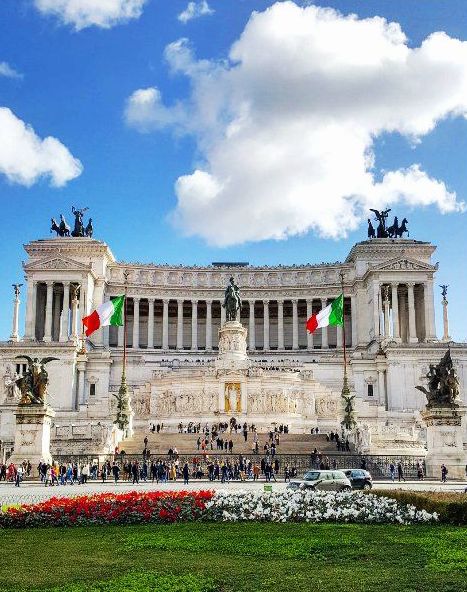
What's the biggest mistake Americans make when visiting Italy? 🇮🇹
English
John Hoey retweeted
Today at noon thousands of red rose petals will flutter down through the oculus of the Pantheon in Rome. This spectacular tradition is held each year on the feast of Pentecost.
English


Delighted to see #BoltonWanderers promoted to the Championship. As a young Irish lad 🇮🇪 way back in time living in Bolton, I used to watch them play in #BurndenPark and have many happy memories of that time .👍🧡
English