Outputlayer

637 posts

Outputlayer banner
Outputlayer

Outputlayer

@outputlayer

Turning onchain data into growth insights | Building @PredGraph | Custom dashboards & analytics | DMs open
16.04 Joined Ağustos 2019
2.3K Following671 Followers
Pinned Tweet
Outputlayer
Outputlayer@outputlayer·
Built a CLI for RWA (@OndoFinance) agent-based portfolio management, current MVP runs on top of @JupiterExchange @solana p.s. If you can help with whitelisting or want to collaborate, DM me.
English
2
0
5
467
Outputlayer
Outputlayer@outputlayer·
@skooookum Literally me the first time I touched ai {i’m so smart}
Outputlayer tweet media
English
0
0
1
293
skooks
skooks@skooookum·
“I { built | vibecoded } a { website | dashboard } that lets you { interact with | visualize } <some publicly available data>”
skooks tweet media
English
74
269
5.3K
116K
Outputlayer
Outputlayer@outputlayer·
@MrWasabi00 @Polymarket Depends on their risk tolerance and strategy, though. But I agree that this apy might be hard to achieve with large capital compared to my small amounts.
English
0
0
0
10
Outputlayer
Outputlayer@outputlayer·
I made a mistake earlier, (I didn’t include the Wrapped Collateral contract). Thanks to @JW_Seoul for pointing that out. The correct number for active positions is $471,362,035, and the total is $611,100,077 ! Also check his latest post: x.com/JW_Seoul/statu…
Outputlayer@outputlayer

@Polymarket is migrating from bridged USDC.e to a brand-new collateral token: Polymarket USD. According to my latest data, Polymarket currently holds $409,772,828 (proxies balances + active positions). This switch will allow them to earn 5–7% yield → $20.5M – $28.7M annually.


English
0
0
4
255
Outputlayer
Outputlayer@outputlayer·
@JW_Seoul Good catch! I forgot about 0x3A3BD7bb9528E159577F7C2e685CC81A765002E2 (Wrapped Collateral)
English
1
0
0
27
J.W.
J.W.@JW_Seoul·
@outputlayer Hmm I think open positions are already over $400M
English
2
0
1
26
Outputlayer retweeted
Andrej Karpathy
Andrej Karpathy@karpathy·
Wow, this tweet went very viral! I wanted share a possibly slightly improved version of the tweet in an "idea file". The idea of the idea file is that in this era of LLM agents, there is less of a point/need of sharing the specific code/app, you just share the idea, then the other person's agent customizes & builds it for your specific needs. So here's the idea in a gist format: gist.github.com/karpathy/442a6… You can give this to your agent and it can build you your own LLM wiki and guide you on how to use it etc. It's intentionally kept a little bit abstract/vague because there are so many directions to take this in. And ofc, people can adjust the idea or contribute their own in the Discussion which is cool.
Andrej Karpathy@karpathy

LLM Knowledge Bases Something I'm finding very useful recently: using LLMs to build personal knowledge bases for various topics of research interest. In this way, a large fraction of my recent token throughput is going less into manipulating code, and more into manipulating knowledge (stored as markdown and images). The latest LLMs are quite good at it. So: Data ingest: I index source documents (articles, papers, repos, datasets, images, etc.) into a raw/ directory, then I use an LLM to incrementally "compile" a wiki, which is just a collection of .md files in a directory structure. The wiki includes summaries of all the data in raw/, backlinks, and then it categorizes data into concepts, writes articles for them, and links them all. To convert web articles into .md files I like to use the Obsidian Web Clipper extension, and then I also use a hotkey to download all the related images to local so that my LLM can easily reference them. IDE: I use Obsidian as the IDE "frontend" where I can view the raw data, the the compiled wiki, and the derived visualizations. Important to note that the LLM writes and maintains all of the data of the wiki, I rarely touch it directly. I've played with a few Obsidian plugins to render and view data in other ways (e.g. Marp for slides). Q&A: Where things get interesting is that once your wiki is big enough (e.g. mine on some recent research is ~100 articles and ~400K words), you can ask your LLM agent all kinds of complex questions against the wiki, and it will go off, research the answers, etc. I thought I had to reach for fancy RAG, but the LLM has been pretty good about auto-maintaining index files and brief summaries of all the documents and it reads all the important related data fairly easily at this ~small scale. Output: Instead of getting answers in text/terminal, I like to have it render markdown files for me, or slide shows (Marp format), or matplotlib images, all of which I then view again in Obsidian. You can imagine many other visual output formats depending on the query. Often, I end up "filing" the outputs back into the wiki to enhance it for further queries. So my own explorations and queries always "add up" in the knowledge base. Linting: I've run some LLM "health checks" over the wiki to e.g. find inconsistent data, impute missing data (with web searchers), find interesting connections for new article candidates, etc., to incrementally clean up the wiki and enhance its overall data integrity. The LLMs are quite good at suggesting further questions to ask and look into. Extra tools: I find myself developing additional tools to process the data, e.g. I vibe coded a small and naive search engine over the wiki, which I both use directly (in a web ui), but more often I want to hand it off to an LLM via CLI as a tool for larger queries. Further explorations: As the repo grows, the natural desire is to also think about synthetic data generation + finetuning to have your LLM "know" the data in its weights instead of just context windows. TLDR: raw data from a given number of sources is collected, then compiled by an LLM into a .md wiki, then operated on by various CLIs by the LLM to do Q&A and to incrementally enhance the wiki, and all of it viewable in Obsidian. You rarely ever write or edit the wiki manually, it's the domain of the LLM. I think there is room here for an incredible new product instead of a hacky collection of scripts.

English
1.1K
2.7K
26.1K
6.7M
Outputlayer
Outputlayer@outputlayer·
I don’t see this as the root cause but as a byproduct of adoption and the compromises made to achieve it, which ultimately led to this degradation. The scale of the sector’s growth confirms that trade-off. That dynamic explains why the sector leaned heavily on incentives and aggressive marketing to attract and retain users, effectively cultivating latent gambling tendencies among younger audiences. Compare CEX and DEX platforms before and after the rise of leverage-driven trading.
English
0
0
1
89
Matt Liston
Matt Liston@no__________end·
Crypto VCs will tweet "where are all the visionary founders??" then fund another sports betting interface because an identical one closed a round last month and they weren't in it. The founder is 23, went to MIT, did a year at Citadel, and Paradigm is already in. Building in crypto in 2026, you have exactly four options: — Build hypergambling and call it financial democracy — Rebuild TradFi with a compliance layer and a token — Leave for AI and retroactively pretend you always cared about agents — Build something genuinely new and get treated like a science fair project Almost everyone picks the first three because VCs will actually fund those...
English
49
36
462
29.1K
Outputlayer
Outputlayer@outputlayer·
Why we need @OndoFinance whitelist: Right now all trades go through Jupiter’s public MM layer. This creates hard constraints: - orders under ~$1.50 get rejected - 3%+ slippage gets blocked in thin liquidity - multiple retries needed just to get a fill - no visibility into remaining daily limits - market makers can disappear mid-execution - no structured order history, only raw on-chain logs With direct RFQ access: - single reliable execution endpoint, no MM routing issues - clear visibility into limits before placing orders - deterministic pricing at quote time - full order history from Ondo’s system What this unlocks: - autonomous rebalancing, agent computes and executes portfolio diffs - stop-loss and take-profit logic based on P&L thresholds - DCA strategies with scheduled execution - LLM agents interacting via MCP, full execution loop without manual steps - native limit order behavior based on price conditions
Outputlayer@outputlayer

Built a CLI for RWA (@OndoFinance) agent-based portfolio management, current MVP runs on top of @JupiterExchange @solana p.s. If you can help with whitelisting or want to collaborate, DM me.

English
0
0
2
160
Outputlayer
Outputlayer@outputlayer·
Built a CLI for RWA (@OndoFinance) agent-based portfolio management, current MVP runs on top of @JupiterExchange @solana p.s. If you can help with whitelisting or want to collaborate, DM me.
English
2
0
5
467
Outputlayer
Outputlayer@outputlayer·
@subinium @_chenglou Noticed most of your projects are in Rust. Do you have any internal Rust development skills for your agents, so they follow consistent coding standards?
Outputlayer tweet media
English
0
0
0
75
vibhu
vibhu@vibhu·
You can buy Tesla on Solana now with @xStocksFi or @OndoFinance, transfer it to a friend, lend it on @kamino, and swap it for Microsoft without ever touching USD or a bank account None of these were possible with real assets in the entirety of human history until a year ago
English
60
47
449
24.8K
Castle Labs 🏰
Castle Labs 🏰@castle_labs·
Welcome to the new Castle Labs!
English
104
56
371
34.6K
Outputlayer
Outputlayer@outputlayer·
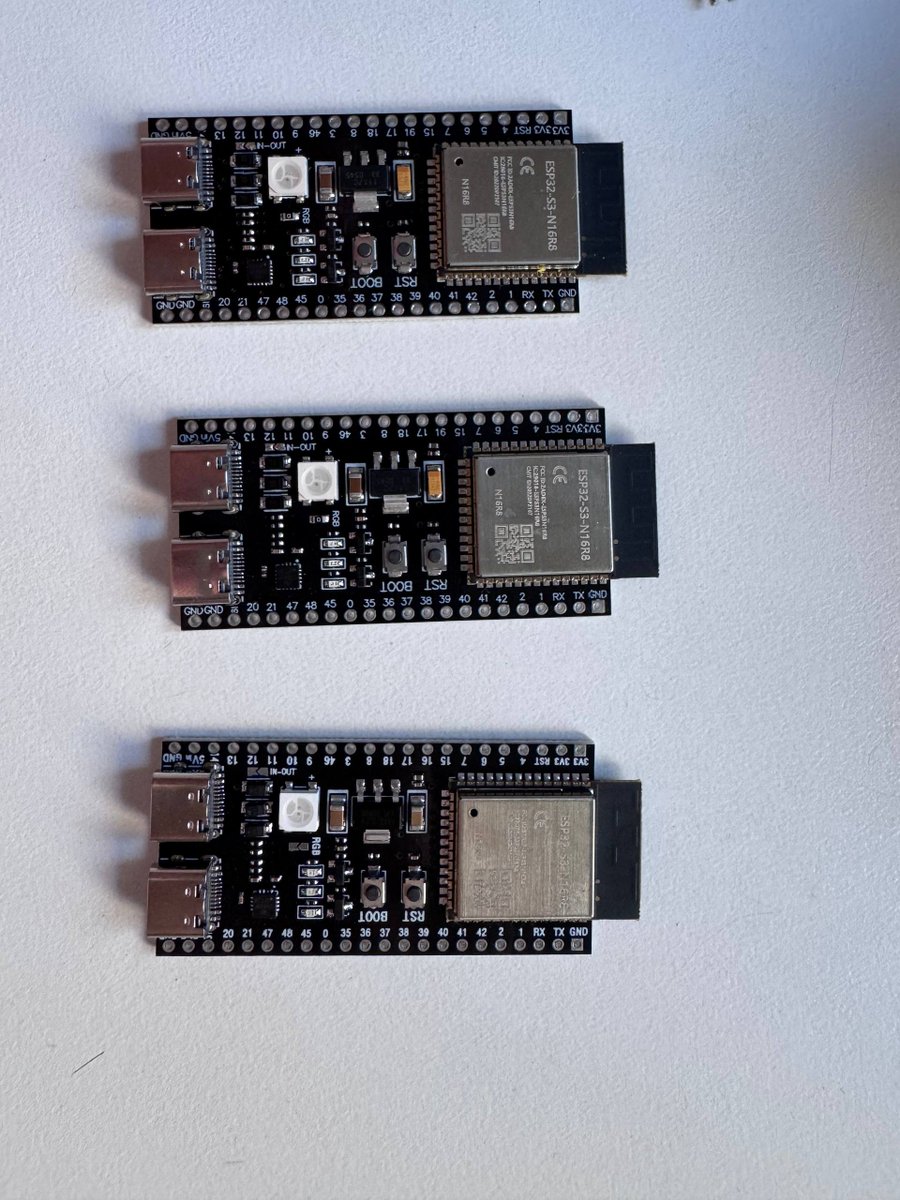
btw it all started from checking trending repos and finding @rUv ruvnet / RuView and wanting to play. crazy how far it went though, but happy with the result! (p.s. you can’t do a lot of the stuff he showed there with just an x3 ESP32-S3 and expect to see real motion like it’s actually 3D or something.)
Outputlayer tweet media
English
0
0
0
167
Outputlayer
Outputlayer@outputlayer·
Built a WiFi-only room monitor this weekend. No cameras, no wearables just 3 ESP32-S3 boards and a CNN running pure Rust inference in ~1ms. The system captures how WiFi signals bounce off people (Channel State Information, 168 subcarrier amplitudes from 3 nodes) and classifies: empty, lying, sitting, walking. Dashboard shows real-time status, activity timeline, and patient alerts. The hard part nobody warns you about CSI drift. Your model works great for a few hours, then next morning predicts "lying" for everything. Baseline shifts from temperature changes, humidity, radio gain drift, neighbor WiFi. CSI-Bench 2024 documented a 41 F1-point drop across sessions. What we tried and rejected: heuristic overrides, variance-based adaptive baselines, template matching all felt like duct tape. What actually worked: L2 normalization (drift metric 1.28 → 0.001), per-session baseline subtraction, manual recalibration API, and training on data from multiple sessions so the CNN learns drift-invariant features. Current results: empty F1=0.96, lying F1=0.91, walking/sitting still confuse each other. More sessions and adversarial training next. Stack: ESP-IDF C firmware → UDP → Rust/Axum server (zero ML framework dependencies) → WebSocket → browser. Runs in Docker on 128MB RAM. github.com/outputlayer/es…
Outputlayer tweet media
English
1
0
0
227
Subin An
Subin An@subinium·
1/3 Introducing tui.builders - a visual editor for Rust terminal UIs. Drag widgets onto a canvas, set properties in an inspector, export working Rust code. No coordinate math, no recompile loops.
English
6
1
20
1.3K