
Pinned Tweet
theWeb3CloudGuy.icp ∞
303 posts


theWeb3CloudGuy.icp ∞
@theweb3cloudguy
🌐 Cloud Engineer (7+ yrs) | Web2 → Web3 | Exploring ICP, ETH, BTC, HBAR | Tech believer & enthusiast 🚀
Berlin, Germany Joined Ağustos 2025
254 Following32 Followers
@Zero2HeroZombie Any update to what is wrong with dashboard?
English

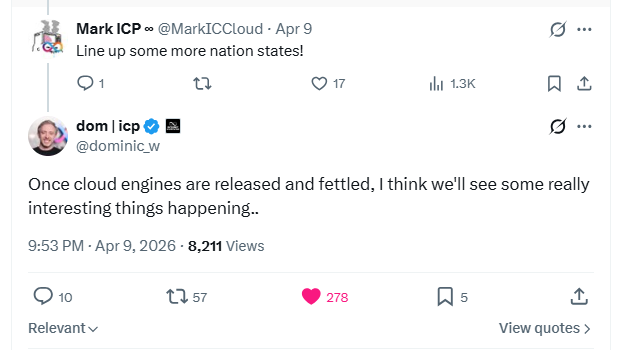
@Zero2HeroZombie Definitely a glitch, dashboard currently not loading for me ATM.
English
theWeb3CloudGuy.icp ∞ retweeted

Big step toward national sovereignty in the digital space: dashboard.internetcomputer.org/proposal/141651
English
theWeb3CloudGuy.icp ∞ retweeted

Cloud Records now supports video playback entirely on chain 🎥📺⛓️
No AWS. No S3. No CloudFront. No IPFS gateway. No YouTube embed.
Just a canister on @dfinity — the smart contract is the host.
Link in reply ⬇️
A Cloud Foundation Production ♾☁️🎧 $ICP
English
theWeb3CloudGuy.icp ∞ retweeted


ORIGYN is now on Instagram!
💟 Follow $OGY for insights into the technology, RWA use cases, and how we’re bringing assets onchain!
instagram.com/origynprotocol

English
theWeb3CloudGuy.icp ∞ retweeted

Internet Identity will soon gain verifiable credentials = prove your age without sharing who you are
International Cyber Digest@IntCyberDigest
🔐 Proton CEO Andy Yen warns that the global push for age verification is the quiet death of online anonymity, because every passport scan, selfie, and biometric uploaded for "verification" inevitably ends up leaked, hacked, or monetized. He argues Big Tech and governments cannot be trusted to act as gatekeepers, and the only real protection for ID data is to never collect it in the first place.
English
theWeb3CloudGuy.icp ∞ retweeted
Internet Computer's 5th birthday on May 10th, 2026.
To celebrate, DFINITY will demo "cloud engines," including agentic builds, AI nodes, and more. This is a very big deal for ICP, cloud and agentic R&D. Engines will be the 1st frontier cloud/compute technology the wild⏱️
English
theWeb3CloudGuy.icp ∞ retweeted
Someone got Wordpress running 100% from the Internet Computer! Not as easy as it sounds, as it's designed to run on traditional tech, not frontier serverless cloud, so big shout out to ICP community member @miadey 🔥
forum.dfinity.org/t/wordpress-ru…
English
theWeb3CloudGuy.icp ∞ retweeted

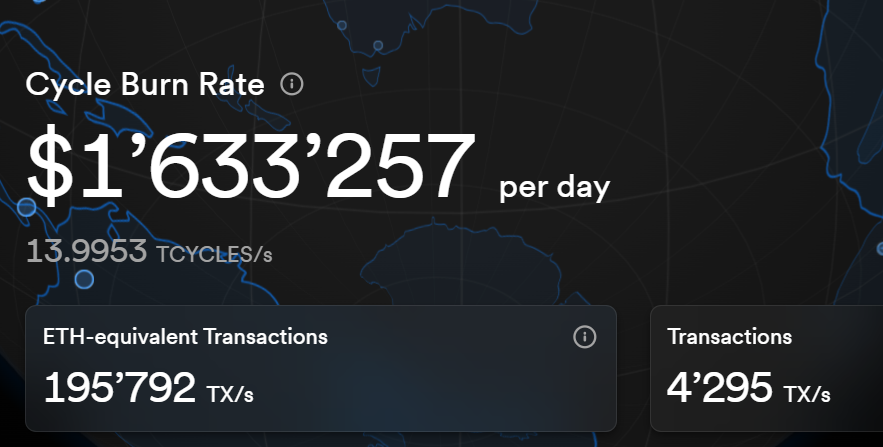
.@dfinity just crossed 280 BILLION transactions
That's 280B+ transactions powering an agents-first cloud network for building performant apps and services
📊 chainspect.app/chain/icp

English
theWeb3CloudGuy.icp ∞ retweeted

theWeb3CloudGuy.icp ∞ retweeted
For more than 10 yrs, I've worked on "frontier compute." I've worked on this since the "world computer" vision was first mooted.
Nowadays, the terms "crypto," "web3" and "blockchain" are inextricably linked to speculative assets. But this is 1 niche application of the tech. 🧵
English
@PierreSamaties @BlockchainPill @Bankless @PierreSamaties massive marketing campaign is required, the tech is good, people just need to be informed. Why has @dfinity intentionally refused to do this, @dfinity has the responsibility to educate the masses and not wait for these VCs backed organizations to do that.
English

Oh my…
@Bankless writing a whole thread on “Solving Crypto’s Frontend Problem” without once acknowledging that full‑stack, tamper‑proof internet services (frontend, backend, and data) have been running on decentralized cloud networks for years is actually insane. Crypto doesn’t only have a frontend problem, it has a glaring journalism credibility problem.
Who, in 2026, still talks about “frontend hosting” like it’s unsolved while ignoring architectures where the application runs end‑to‑end on a decentralized compute network and is served directly over HTTP, with no Web2 servers and no reliance on traditional DNS as a security choke point? Human‑error attack surfaces get radically smaller when there’s no web2 backend to phish or socially engineer.
Y’all hyping tiny bytecode tweaks on legacy L1s like they’re groundbreaking while the real full‑stack, decentralized cloud solution has been live since 2021.
The blind spot is embarrassing. Or is it intentional?
Bankless@Bankless
DNS hijacks are spiking in crypto. CoW Swap and eth (dot) limo were both hit. You visit a frontend, everything looks normal, you sign a transaction and funds go to an attacker's wallet. The defense isn't better detection. It's frontends that STRUCTURALLY can't be cracked. Two approaches already exist: > IPFS + ENS: Your frontend lives on a distributed file network instead of a server. Point your web3 domain (ENS) at that file. No DNS, no central server to compromise > Fully onchain (ERC-4804): The app itself lives inside smart contracts. The frontend is served directly from Ethereum Sadly though, regular browsers can't load either. That’s why we have web3 browsers like: > Freedom Browser: open-source browser that loads ENS domains and IPFS sites natively, the same way Chrome loads (dot) com addresses > EVM Browser: built around the web3:// protocol, loads apps served directly from smart contracts on Ethereum or any EVM chain The proof of concept is already live. @z0r0zzz built zSwap is a DEX frontend deployed ENTIRELY into Ethereum contract bytecode for under $5. Anyone can load it through EVM Browser. In other words: No servers, No DNS, Nothing to hack. Every DeFi project should ship a permanent onchain frontend as a fallback. Best security is just to go straight to the contract. The tools exist. Build toward it.
English
theWeb3CloudGuy.icp ∞ retweeted

theWeb3CloudGuy.icp ∞ retweeted

The 1990s gave us the Internet Service Provider model.
Cloud Engines are bringing it to compute.

English

Your app lives in Caffeine. Now your code can too - on your terms.
A lot of you have been asking for this. You want to open your codebase in your own editor, version it properly, work with your existing tools, and bring it back into Caffeine when you're done. That's exactly what GitHub import lets you do.
Export to GitHub, tweak it however you want, and pull it straight back in.
Your workflow, your tools.

English
@kristoferlund In simpler terms, when we get vulnerable npm packages, and my app uses them, I should also be worried like the rest of web2 apps? How does running on $icp save me from those vulnerabilities?
English

@mert Bro just chill, there is no justification for having a 12 man council decide the outcome of a supposedly decentralized platform, a network should have a way for network to vote autonomously.
internetcomputer.org/network/govern…
English

decentralization is coordination without central authority
a thought experiment:
assume the most decentralized blockchain in existence. hundreds of thousands of nodes, run at home, with distributed mining power and coin supply.
now assume, hypothetically, that if North Korea is able to move funds from Wallet A to Wallet B on this chain in a time period T, then it's tied to an automatic switch such that NK is able to detonate nuclear weapons in a majority of countries in the world simultaneously
(remember, it's a thought experiment)
finally, assume that the blockchain was able to fork such that Wallet A funds were frozen and billions didn't die
now: was that blockchain decentralized or not?
well, given that the incentive of humans is to not die, they were able to coordinate under a shared incentive to prevent this
so while the chain itself is decentralized, that does not imply that the chain is disorganized
put differently: decentralization actually means coordination without central authority
if the cost of coordination is functionally zero, then it's centralized
however, if the cost is infinite, then technically speaking, it is still not decentralized because you can not even apply that terminology to a non functional system (i.e you can't even process state transitions if the nodes don't coordinate to make blocks)
mert@mert
reminder
English