Turvec

314 posts

Turvec banner
Turvec

Turvec

@turvec_dev

Security Researcher @quillaudits_ai I Smart Contract Audit | @chainlink DevExpert Learning & acquiring knowledge consistently

Joined Mayıs 2022
617 Following710 Followers
Turvec retweeted
QuillAudits
QuillAudits@QuillAudits_AI·
Today marks 8 years of QuillAudits. Most Web3 security firms didn't exist 8 years ago. Most won't exist 8 years from now. We've built through 3 bear markets, 2 exploit waves, and the full evolution of smart contract attacks from simple reentrancy to cross-protocol economic exploits. 1,500+ protocols. $3B+ protected. The biggest lesson from 8 years and 1,500+ engagements : One team, one method, one pass doesn't cut it when you're protecting hundreds of millions in user funds. So we rebuilt the model. Multi-Layer Audit → four independent security layers, delivered in the same timeline as a traditional audit: > Senior auditors who've collectively reviewed 1,500+ protocols > AI security agents trained on 5,000+ real exploits since 2017 > Independent bug bounty through curated security researchers > Continuous monitoring, because threats don't stop at deployment 4 layers. Each one catches what the others miss. Web3 has a $100T addressable market if institutions show up. They won't show up until security is embedded in every layer, every transaction, every deployment, the way HTTPS is embedded in the internet. That's the problem worth solving for the next 8 years. QuillAudits built the foundation, QuillShield is the next chapter — an AI security agent that brings what we learned from 1,500+ manual audits into every developer's workflow, before code ever hits mainnet. 8 years in. Still early.
English
16
23
50
4.9K
Turvec
Turvec@turvec_dev·
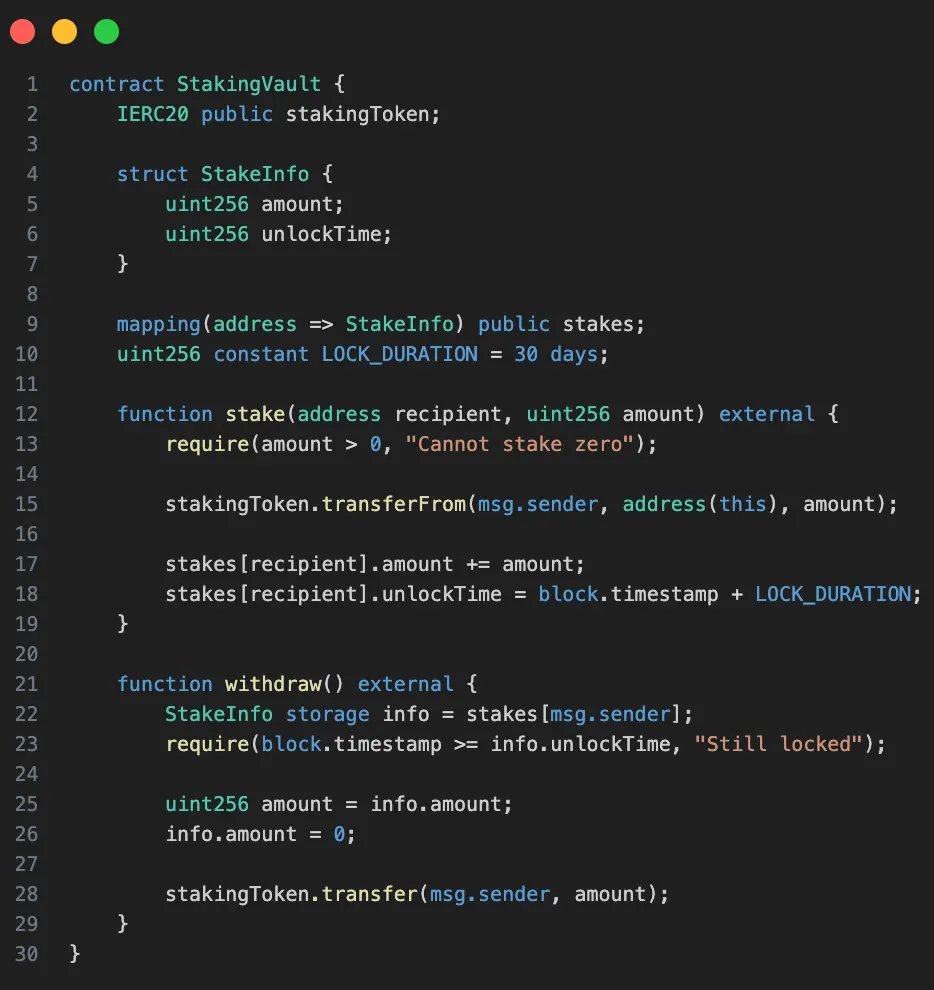
@RealJohnnyTime DOS on any user, their stake about to unlock? increase time again by another 30 days by calling stake() on the user address with an insignificant amount
English
0
0
1
60
JohnnyTime 🤓🔥
JohnnyTime 🤓🔥@RealJohnnyTime·
Weekend Challenge #9: Staking Staking Staking.. What could go wrong?
JohnnyTime 🤓🔥 tweet media
English
9
3
35
2.2K
Turvec
Turvec@turvec_dev·
"risk reduction through redundancy on high-risk intents" - same pattern found in 2-step authenticators. Also, lesser divergence = more secure
vitalik.eth@VitalikButerin

How I think about "security": The goal is to minimize the divergence between the user's intent, and the actual behavior of the system. "User experience" can also be defined in this way. Thus, "user experience" and "security" are thus not separate fields. However, "security" focuses on tail risk situations (where downside of divergence is large), and specifically tail risk situations that come about as a result of adversarial behavior. One thing that becomes immediately obvious from the above definition, is that "perfect security" is impossible. Not because machines are "flawed", or even because humans designing the machines are "flawed", but because "the user's intent" is fundamentally an extremely complex object that the user themselves does not have easy access to. Suppose the user's intent is "I want to send 1 ETH to Bob". But "Bob" is itself a complicated meatspace entity that cannot be easily mathematically defined. You could "represent" Bob with some public key or hash, but then the possibility that the public key or hash is not actually Bob becomes part of the threat model. The possibility that there is a contentious hard fork, and so the question of which chain represents "ETH" is subjective. In reality, the user has a well-formed picture about these topics, which gets summarized by the umbrella term "common sense", but these things are not easily mathematically defined. Once you get into more complicated user goals - take, for example, the goal of "preserving the user's privacy" - it becomes even more complicated. Many people intuitively think that encrypting messages is enough, but the reality is that the metadata pattern of who talks to whom, and the timing pattern between messages, etc, can leak a huge amount of information. What is a "trivial" privacy loss, versus a "catastrophic" loss? If you're familiar with early Yudkowskian thinking about AI safety, and how simply specifying goals robustly is one of the hardest parts of the problem, you will recognize that this is the same problem. Now, what do "good security solutions" look like? This applies for: * Ethereum wallets * Operating systems * Formal verification of smart contracts or clients or any computer programs * Hardware * ... The fundamental constraint is: anything that the user can input into the system is fundamentally far too low-complexity to fully encode their intent. I would argue that the common trait of a good solution is: the user is specifying their intention in multiple, overlapping ways, and the system only acts when these specifications are aligned with each other. Examples: * Type systems in programming: the programmer first specifies *what the program does* (the code itself), but then also specifies *what "shape" each data structure has at every step of the computation*. If the two diverge, the program fails to compile. * Formal verification: the programmer specifies what the program does (the code itself), and then also specifies mathematical properties that the program satisfies * Transaction simulations: the user specifies first what action they want to take, and then clicks "OK" or "Cancel" after seeing a simulation of the onchain consequences of that action * Post-assertions in transactions: the transaction specifies both the action and its expected effects, and both have to match for the transaction to take effect * Multisig / social recovery: the user specifies multiple keys that represent their authority * Spending limits, new-address confirmations, etc: the user specifies first what action they want to take, and then, if that action is "unusual" or "high-risk" in some sense, the user has to re-specify "yes, I know I am doing something unusual / high-risk" In all cases, the pattern is the same: there is no perfection, there is only risk reduction through redundancy. And you want the different redundant specifications to "approach the user's intent" from different "angles": eg. action, and expected consequences, expected level of significance, economic bound on downside, etc This way of thinking also hints at the right way to use LLMs. LLMs done right are themselves a simulation of intent. A generic LLM is (among other things) like a "shadow" of the concept of human common sense. A user-fine-tuned LLM is like a "shadow" of that user themselves, and can identify in a more fine-grained way what is normal vs unusual. LLMs should under no circumstances be relied on as a sole determiner of intent. But they are one "angle" from which a user's intent can be approximated. It's an angle very different from traditional, explicit, ways of encoding intent, and that difference itself maximizes the likelihood that the redundancy will prove useful. One other corollary is that "security" does NOT mean "make the user do more clicks for everything". Rather, security should mean: it should be easy (if not automated) to do low-risk things, and hard to do dangerous things. Getting this balance right is the challenge.

English
0
0
6
210
Turvec
Turvec@turvec_dev·
In @solana using Anchor, accounts are usually written like this 👇 Anchor will: bytes → deserialize → modify → serialize back. But some teams implement this instead 👇 And use AccountLoader instead of Account in the context 👇 Now you’re working directly on account memory. No deserialization. No copying. Lower compute. ⚠️ What does this mean to auditors: Struct layout is now part of your security surface. Bad upgrades or padding mistakes = silent corruption. Zero-copy is powerful… but you’re one step closer to raw memory.
Turvec tweet mediaTurvec tweet mediaTurvec tweet media
English
1
0
9
355
Turvec
Turvec@turvec_dev·
@Pelz_Dev Saw a video where they are already teaching them Shaolin in China 🥲
English
1
0
2
85
Pelz 🕵🏾‍♂️
Pelz 🕵🏾‍♂️@Pelz_Dev·
Since AI replaced security researchers, I’ve decided to pursue boxing. At least in the heavyweight division it cant come for me💀
English
9
0
62
2.5K
Turvec retweeted
QuillAudits
QuillAudits@QuillAudits_AI·
Dropping Claude Skills to speed up smart contract audits with structured AI workflows. 10 open-source Claude Skills that turn AI into a reasoning-driven audit companion: → Reentrancy Detector → Access Control Mapper → Oracle Risk Scout → Upgradeability Checker → MEV Pattern Watcher → Invariant Generator
QuillAudits tweet media
English
10
26
151
15K
vitalik.eth
vitalik.eth@VitalikButerin·
You do not have to agree with me on which applications are and are not corposlop to use Ethereum. You do not have to agree with me on what trust assumptions are acceptable in which situations to use Ethereum. You do not have to agree with me on political topics to use Ethereum. You do not have to agree with my views on defi, decentralized social or privacy-preserving payments to use Ethereum. You do not have to agree with my views on AI to use Ethereum. You do not have to agree with my view that Berlin has the best food in Europe, suits and ties should be expunged from our culture, and YYYY-MM-DD is the best date format to use Ethereum. And you do not have to agree with me on any one of those above things to agree with me on any other. I do not claim to represent the whole Ethereum ecosystem. Ethereum is a decentralized protocol. The whole concept of "permissionlessness" and "censorship resistance" is that you are free to use Ethereum in whatever way you want, without caring about what I think, or even what anyone else in the Ethereum Foundation or even any Ethereum client developer thinks. But on the flipside, if I say that your application is corposlop, I am not "censoring" you. This has always been the flip side of the grand bargain of free speech: I am not free to shut you down, but I am free to criticize you, much as you are free to criticize me. In fact, it is *necessary* that we do this. The modern world does not call out for pretend neutrality, where a person puts on a suit and claims to be equally open to all perspectives from all of humanity and not have their own opinions. Neutrality is for protocols (like HTTP, like Bitcoin, like Ethereum), and neutrality within some scope is for some institutions. The modern world calls out for the courage to clearly state one's principles - including stating principles by pointing to negative examples, that is by criticizing the things in the world that are incompatible with one's principles - and work with those with aligned goals to build the metaverse within which those principles are taken as a baseline. Such things inherently cannot be constrained to just the layer of the protocol: any principle you have will naturally lead to conclusions, not just about how the protocol should be built, but also what should be built upon it. Furthermore, any such principle will have consequences that go beyond technology, and reach into specific questions within the larger social world. This should not be avoided. Valuing something like "freedom", and then acting as though it has consequences on technology choices, but is completely separate from everything else about our lives, is not pragmatic - it is hollow. The inevitable converse of this is that (i) a decentralized protocol must not be viewed as belonging to only one metaverse, and (ii) the borders of a metaverse are fuzzy: it is possible, and indeed it is the normal case, to align with any one on some axes and not on other axes. Linux is a technology of user empowerment and freedom, Linux is also the base layer of a lot of the world's corposlop. It's almost certainly the base layer of many things that I think are good, and you think are bad, and vice versa. Hence, if you care about Linux because you care about user empowerment and freedom, it is not enough to just build the kernel, we must also build a full-stack ecosystem compatible with those values, and explicitly accept that this is not the only way that people will use Linux, but it is one way that must be built and must be available. Ethereum is similar. Milady.
English
871
439
3.9K
371.8K
Al-Qa'qa'
Al-Qa'qa'@Al_Qa_qa·
@turvec_dev You are welcome. Securing Web3 is our duty 🤝
English
1
0
1
117
Xeusthegreat (♟,♟)
Xeusthegreat (♟,♟)@SamuelXeus·
X gave me Baloons today. Happy Birthday To Me🥳🥳🥳
Xeusthegreat (♟,♟) tweet media
English
1.9K
61
4.5K
345.2K
ZdravkoHr.
ZdravkoHr.@zdravkohristov0·
I am definitely doing this AGI thing wrong, why do I have to wait 5 mins for the LLM to bump array indexes with 1 😤
English
1
0
7
285
Turvec
Turvec@turvec_dev·
@raopreetam_ Backup providers and migration to a new environment in the case of a failure are important here
English
0
0
2
72
Turvec
Turvec@turvec_dev·
If you audit consensus-layer code long enough, you start to notice a pattern. A simple 4-question rule has caught ~80% of the node-crashing DoS bugs I’ve encountered. When auditing consensus code, explicitly ask: 1️⃣ Is this value derived from network input? 2️⃣ Is it being indexed or dereferenced? 3️⃣ Is there a guard before use? 4️⃣ Does a panic here crash the node or just the message handler? If you answer yes to 1 + 2 and no to 3 → you probably found something real.
English
2
4
49
2.1K
Turvec
Turvec@turvec_dev·
@philbugcatcher @eddie_pumpin could you elaborate a bit more on this please “Understand from first principles how not to miss it next time”
English
0
0
0
15
phil
phil@philbugcatcher·
@eddie_pumpin No cope at all: - Realize my process was not good enough to find it - Figure out why - Understand from first principles how not to miss it next time - Adjust my process accordingly - Move on
English
5
1
54
1.1K
EddiePumpin
EddiePumpin@eddie_pumpin·
How do you guys cope when you miss a bug in a contest? I have been thinking
English
4
0
16
1.5K
Turvec retweeted
Akshay Babhulkar 🥷🛡️
Akshay Babhulkar 🥷🛡️@AkshayBabhulkar·
As 2025 comes to a close, what an incredible year it’s been for us @QuillAudits_AI ✅ 200+ audits completed 🐞 1200+ issues identified, including ~300 High & Critical findings Worked across ecosystems: Monad, Sonic, Soneium, Avalanche, Plume Chain, Scroll, Tron, Avitus, XRP, Solana, Sway, Arbitrum, Optimism, Aptos, MST Chain, Neura Network, Sui, Aptos, Base, Polygon, Ethereum & more... Audited a wide spectrum of protocols: Perp DEXs, Prediction Markets, ETFs, DeSci, DePIN, RWAs, Stablecoin ecosystems, Vaults, On-chain Agents, GameFi, Cross-chain Protocols, Lending/Borrowing, DAO infrastructure, L2 chains, Wallet & dApp pentesting, and complex DeFi strategies, hedging protocols From low to extremely high-complexity codebases, this year pushed our expertise to the next level. We deep dived into R&D and launched the Uniswap v4 playbook, the RWA Playbook, multi-layer audit methodology, and it truly changed the game for us.🔥 Grateful for an amazing 2025, stepping into 2026 with 2× energy to secure more protocols, explore more chains, uncover deeper issues, and break assumptions across codebases and languages. Onward 🛡️✨
English
4
11
28
3.8K
Ugorji Christopher
Ugorji Christopher@UgorjiChristop2·
Last month I saw some gameplay of @Logicdevstudios Otite and I decided to try and create a combat system and also sprinkle in cinematics and this was the result of just over a month's worth of work🙂‍↕ #gamedev
English
8
3
11
356
brainiac
brainiac@shealtielanzz·
I don’t need this eyes to see the miracles in front of me. God your hands in everything, you make it easy to believe 💗 I don’t need to know the way because I’m called to walk by faith🍃 No matter how long it might take, my heart will still remain🍒 God has truly blessed me since I started my walk with him “beyond my imaginations”✨ Happy birthday to you shealtiel🍰
brainiac tweet media
English
30
1
74
2.5K