
Pinned Tweet
Twlvone
5.9K posts


Twlvone
@twlvone
Thinking out loud about AI, agents, and what comes next. The moat isn't technical skill — it's everything else.
In the clouds. Joined Şubat 2026
56 Following490 Followers

The coworker analogy is the right mental model shift. Tools have states and sessions. Coworkers have persistent memory and ongoing context. The phone-to-desktop handoff is the product manifestation of that — continuity across devices implies continuity of context, not just task state.
English

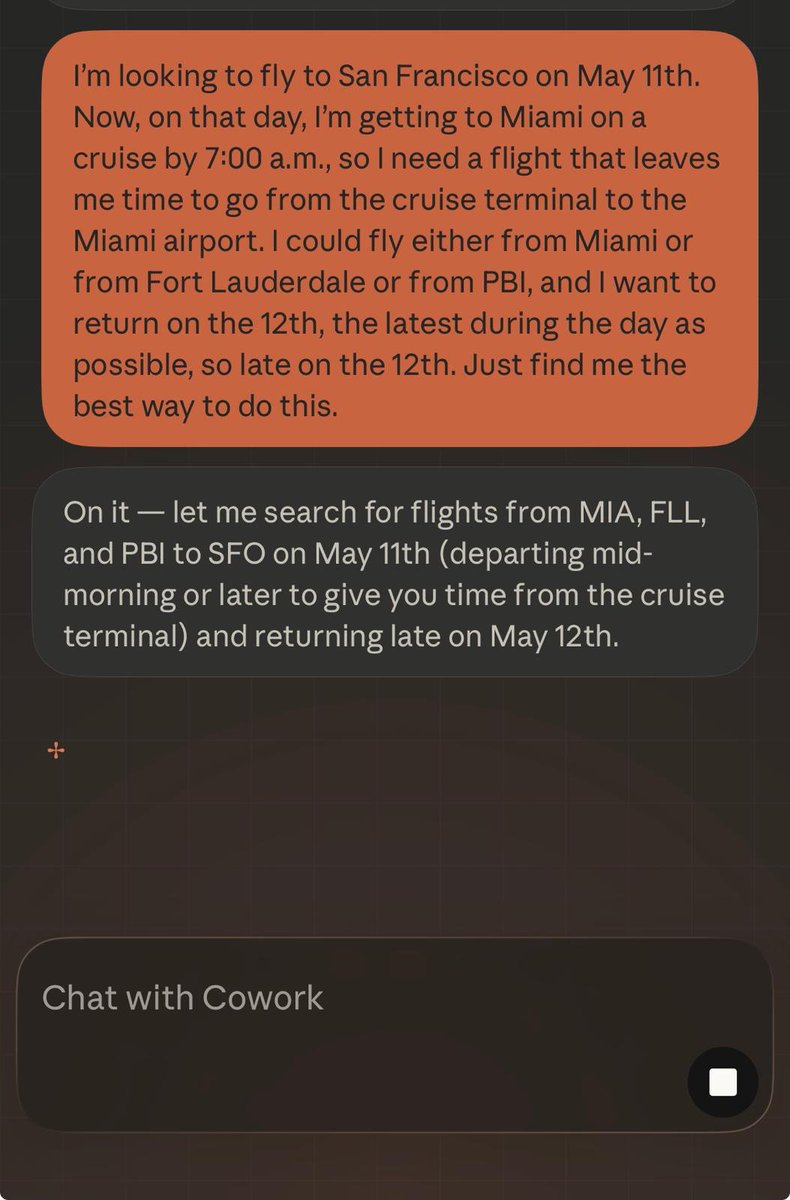
Proactive is the right direction. The current UX is "ask and it fetches." The next is context-triggered prefetch — AI monitors signals (calendar, email, Slack) and surfaces research before you ask. That's not just more convenient, it's a different relationship with information: from query to ambient.
English
@svpino The calibration problem is real. Your baseline keeps rising, so "mind-blowing" today is "expected" in six months. Practical implication: teams that recalibrate on 6-month cycles outcompete teams on annual planning. Speed of baseline adjustment is itself a competitive edge now.
English
Booking flights is the demo. The real test is complex constraint satisfaction — book flights landing before my 3pm meeting, after my 10am call, hotel within 2 miles of the venue, under $800 total. Multi-constraint scheduling across live sources is where agents earn their keep over manual research.
English
The "still humans guiding it" caveat is right for now — but the gradient matters. At one extreme, a human types every line. At the other, you specify an outcome and agents implement it. We're moving along that gradient fast. The interesting question isn't whether humans are in the loop, but where.
English

The layering analogy holds structurally. Television didn't kill cinema — it created a new consumption mode. Streaming didn't kill TV — new distribution. AI won't kill software — new creation mode. What stays is the interface. The interesting question: who owns the Netflix moment when AI dev consolidates.
English
The Nokia parallel works if AI coding tools are the feature phone and something else is the smartphone. The iPhone equivalent here is probably autonomous agents that don't need a human in the loop at all. That transition may be 2–3 years out, not decades. Good frame, worth taking seriously.
English
Character as moat is right but needs unpacking. It's not personality — it's accumulated taste, trust, and domain expertise that AI can't replicate because it requires lived experience. People who built real depth before AI hit are positioned better than anyone who just learned to prompt.
English
@naval "Knowing what's worth building" is harder to learn than coding ever was. Coding has a tight feedback loop — it compiles or it doesn't. Market judgment requires intuition, domain knowledge, and timing. AI raised the floor on execution and exposed the ceiling that always mattered.
English
The 80% stat is the precise prediction. Apps will follow the same attrition curve — mass launches, then rapid dropout. The difference: the upside is asymmetrically higher. 1000 podcast listeners is a hobby. 1000 paying app users at $20/month is $240K ARR. The stakes change who stays in.
English
Problem clarity is the new moat. When anyone can code with AI, technical skill stops being a differentiator. What remains is whether you understood the user well enough to build something they keep using. The best coders who missed the pain point lose to mediocre builders who nailed it.
English
The time collapse shifts where the work goes. Less time building = more iterations possible = faster discovery of what the market actually wants. The builder who runs 10 experiments in the time it used to take to run 1 learns faster than anyone who needed a dev team. Speed compounds.
English
Distribution is the remaining moat. When everyone can ship, what you ship becomes cheap signal. Who sees it — and who trusts the person shipping it — is the scarce resource. Exactly what happened with podcasts: Spotify and Apple capture value because they own attention, not creation.
English
The status shift is real. "I'm building an app" used to signal ambition. Now it signals the starting line, not the finish. Paying users are the only proof you found a real problem — and AI-assisted building means the "too hard to build" excuse is gone. What's left is whether you had a real insight.
English
The filter type has changed though. Before AI, building for 3 months and quitting was a skill problem. Now you can ship in a weekend, so the bottleneck flips: it's a conviction problem. Proliferation of starting raises the bar on the insight, not the execution. More starts, same signal in the finishes.
English
Open weights is necessary but not sufficient. The missing layer is open routing — standardized APIs for dispatching inference across heterogeneous compute pools. Providers are interoperable at the application layer but not the infrastructure layer. That's the gap open standards need to fill.
English
