Andrew Wright

45.2K posts

Andrew Wright banner
Andrew Wright

Andrew Wright

@wrightak

Software developer living in Japan. Used to be better at Japanese. Curious. Running, hiking. Always a Pivot.

Tokyo Joined Kasım 2008
845 Following1.8K Followers
Andrew Wright retweeted

Bloomberg
Bloomberg@business·
Solar power accounted for 10% of Japan’s electricity generation for the first time last year, exceeding the global average of 9%, according to a report from energy think tank Ember bloomberg.com/news/articles/…
English
3
23
74
16.5K
Andrew Wright retweeted
Andrej Karpathy
Andrej Karpathy@karpathy·
Judging by my tl there is a growing gap in understanding of AI capability. The first issue I think is around recency and tier of use. I think a lot of people tried the free tier of ChatGPT somewhere last year and allowed it to inform their views on AI a little too much. This is a group of reactions laughing at various quirks of the models, hallucinations, etc. Yes I also saw the viral videos of OpenAI's Advanced Voice mode fumbling simple queries like "should I drive or walk to the carwash". The thing is that these free and old/deprecated models don't reflect the capability in the latest round of state of the art agentic models of this year, especially OpenAI Codex and Claude Code. But that brings me to the second issue. Even if people paid $200/month to use the state of the art models, a lot of the capabilities are relatively "peaky" in highly technical areas. Typical queries around search, writing, advice, etc. are *not* the domain that has made the most noticeable and dramatic strides in capability. Partly, this is due to the technical details of reinforcement learning and its use of verifiable rewards. But partly, it's also because these use cases are not sufficiently prioritized by the companies in their hillclimbing because they don't lead to as much $$$ value. The goldmines are elsewhere, and the focus comes along. So that brings me to the second group of people, who *both* 1) pay for and use the state of the art frontier agentic models (OpenAI Codex / Claude Code) and 2) do so professionally in technical domains like programming, math and research. This group of people is subject to the highest amount of "AI Psychosis" because the recent improvements in these domains as of this year have been nothing short of staggering. When you hand a computer terminal to one of these models, you can now watch them melt programming problems that you'd normally expect to take days/weeks of work. It's this second group of people that assigns a much greater gravity to the capabilities, their slope, and various cyber-related repercussions. TLDR the people in these two groups are speaking past each other. It really is simultaneously the case that OpenAI's free and I think slightly orphaned (?) "Advanced Voice Mode" will fumble the dumbest questions in your Instagram's reels and *at the same time*, OpenAI's highest-tier and paid Codex model will go off for 1 hour to coherently restructure an entire code base, or find and exploit vulnerabilities in computer systems. This part really works and has made dramatic strides because 2 properties: 1) these domains offer explicit reward functions that are verifiable meaning they are easily amenable to reinforcement learning training (e.g. unit tests passed yes or no, in contrast to writing, which is much harder to explicitly judge), but also 2) they are a lot more valuable in b2b settings, meaning that the biggest fraction of the team is focused on improving them. So here we are.
staysaasy@staysaasy

The degree to which you are awed by AI is perfectly correlated with how much you use AI to code.

English
1.2K
2.5K
20.6K
4.3M
Andrew Wright retweeted
Aakash Gupta
Aakash Gupta@aakashgupta·
Apple accidentally built the world's largest hearing aid company. AirPods Pro 2 got FDA clearance as a clinical-grade over-the-counter hearing aid in September 2024. The average American pays $4,700 for a pair of prescription hearing aids. AirPods Pro cost $249. That's a 95% price reduction for mild to moderate hearing loss, which covers roughly 30 million American adults. But the price gap isn't even the real story. The real story is the stigma math. Nearly 1 in 5 adults over 40 believe society judges people who wear hearing aids. The average person waits 4 years after noticing hearing loss before doing anything about it. A 78-year-old man threw away his hearing aids, popped in AirPods, and his niece didn't even register it as a medical device. That's the product working exactly as designed. The hearing aid industry spent decades engineering smaller, more invisible devices to reduce stigma. Apple solved the problem from the opposite direction: make everyone wear something in their ears first, then add the medical function later. By the time the FDA cleared the software update, a billion people were already wearing the hardware. The clinical study that earned the clearance enrolled 118 people. Self-fitted AirPods matched professionally fitted devices on perceived benefit, amplification, and speech comprehension scores. The audiologist appointment, the $200 fitting fee, the three follow-up visits bundled into that $4,700 price tag: optional. Every hearing aid company spent the last century trying to make their product disappear. Apple made theirs a status symbol and added hearing restoration as a software update.
しろろ🐕NO WAR🐈‍⬛@se2_2co

耳の悪い78歳の叔父と話をしていて、補聴器捨てたんだよ、というのでびっくりしてたら、Appleの AirPodsを耳に入れて普通に会話ができるのでさらにびっくり。補聴器なんて比べ物にならないくらい自然に会話ができるのです。叔父、おしゃれなのでAirPodsの方が似合うし、ストレスが減ってよかった。

English
77
1.4K
5.5K
2.5M
Andrew Wright retweeted
あき
あき@aki_yattemiru·
子「お父さん、オリーブオイルってどうやって作ってるの?」 親「オリーブの実をぎゅーっと搾って作ってるんだよ」 子「えっ、じゃあごま油はごまを搾ってるの?」 親「そうそう! よく気づいたね、えらい!」 子「……え? じゃあベビーオイルって……」 ………… 赤ちゃんは搾りません。
日本語
221
7K
78.5K
2.4M
Andrew Wright retweeted
Chris Murphy 🟧
Chris Murphy 🟧@ChrisMurphyCT·
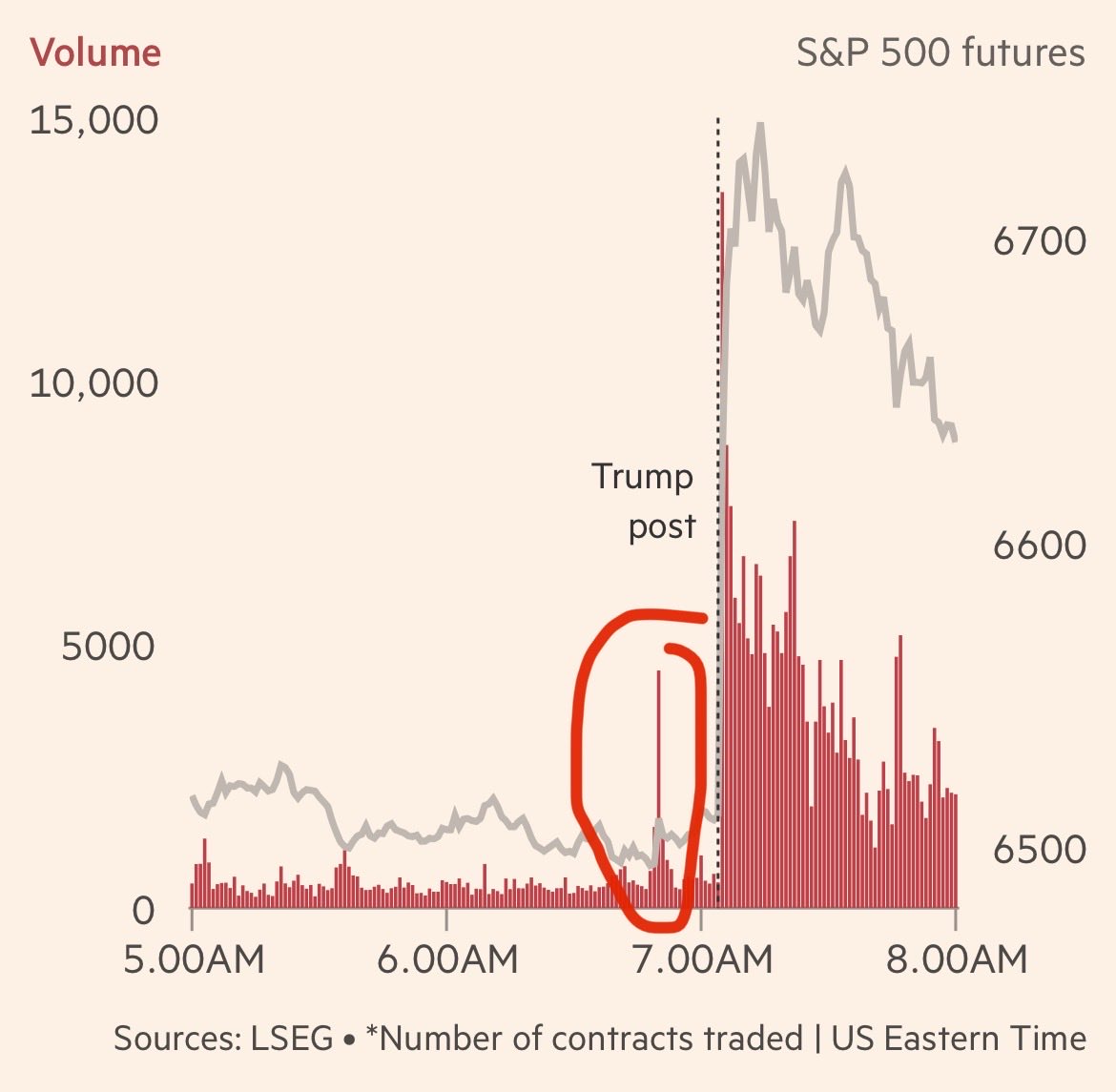
$1.5 BILLION. Let me say it again - a $1.5 BILLION BET. Bigger than any futures purchases made at the time. 5 minutes before Trump's post. Who was it? Trump? A family member? A White House staffer? This is corruption. Mind blowing corruption.
unusual_whales@unusual_whales

BREAKING: Just five minutes before Trump's announcement to halt the attacks on Iran, massive trades reportedly hit the market. In one move, $1.5 billion in S&P 500 (ES) futures was bought while $192 million in oil (CL) futures was sold. These orders were 4–6x larger than anything else at the time. The trader seemingly made huge gains. Unusual.


English
2K
18.5K
70.3K
3.1M
Andrew Wright retweeted
Freyy
Freyy@Freyy_is·
dear apple, the iPod needs to come back. not for nostalgia. for the parents who want their kids to love music and audiobooks without a browser, social media, and the whole internet attached to it
English
2.4K
33.1K
338.5K
5.8M
Andrew Wright retweeted
Ilan Goldenberg
Ilan Goldenberg@ilangoldenberg·
Three weeks into the war with Iran, a number of observations as someone who spent years war-gaming this scenario. 1. The U.S. and Israel may have produced regime transition in the worst possible way. Ali Khamenei was 86 and had survived multiple bouts of prostate cancer. His death in the coming years would likely have triggered a real internal reckoning in Iran, potentially opening the door to somewhat more pragmatic leadership, especially after the protests and crackdown last month. Instead, the regime made its most consequential decision under existential external threat giving the hardliners a clear upperhand. Now we appear to have a successor who is 30 years younger, deeply tied to the IRGC, and radicalized by the war itself – including the killing of family members. Disastrous. 2. About seven years ago at CNAS, I helped convene a group of security, energy, and economic experts to walk through scenarios for a U.S.--Iran war and the implications for global oil prices. What we’re seeing now was considered one of the least likely but worst outcomes. The modeling assumed the Strait of Hormuz could close for 4–10 weeks, with 1–3 years required to restore oil production once you factored in infrastructure damage. Prices could spike from around $65 to $175–$200 per barrel, before eventually settling in the $80–$100 range a year later in a new normal. 3. One surprising development: Iran is still moving oil through the Strait of Hormuz while disrupting everyone else. In most war games I participated in, we assumed Iran couldn’t close the Strait and still use it themselves. That would have made the move extremely self-defeating. But Iran appears capable of harassing global shipping while still pushing some of its own exports through. That changes the calculus. 4. The U.S. now finds itself in the naval and air equivalent of the dynamic we faced in Iraq and Afghanistan. It’s a recipe for a quagmire where we win every battle and lose the war. We have overwhelming military dominance and are exacting a tremendous cost. But Iran doesn’t need to win battles. They just need occasional successes. A small boat hitting a tanker. A drone slipping through defenses in the Gulf. A strike on a hotel or oil facility. Each incident creates insecurity and drives costs up while remind everyone that the regime is surviving and fighting. 5. The deeper problem is that U.S. objectives were set far too high. Once “regime change” becomes the implicit or explicit goal, the bar for American success becomes enormous. Iran’s bar is simple: survive and keep causing disruption. 6. The options for ending this war now are all bad. You can try to secure the entire Gulf and Middle East indefinitely – extremely expensive and maybe impossible. You can invade Iran and replace the regime, but nobody is seriously going to do that. Costs are astronomical. You can try to destabilize the regime by supporting separatist groups. It probably won’t work and if it does you’ll most likely spark a civil war producing years of bloody chaos the U.S. will get blamed for. None of these are good outcomes. 7. The other escalatory options being discussed are taking the nuclear material out of Esfahan or taking Kargh Island. Esfahan is not really workable. Huge risk. You’d have been on the ground for a LONG time to safely dig in and get the nuclear material out in the middle of the country giving Iran time to reinforce from all over and over run the American position. 8. Kharg Island can be appealing to Trump. He’d love to take Iran’s ability to export oil off the map and try to coerce them to end the war. It’s much easier because it’s not in the middle of IRan. But it’s still a potentially costly ground operation. And again. Again, the Iranian government only has to survive to win and they can probably do that even without Kargh. 9. The least bad option is the classic diplomatic off-ramp. The U.S. declares that Iran’s military capabilities have been significantly degraded, which is how the Pentagon always saw the purpose of the war. Iran declares victory for surviving and demonstrating it can still threaten regional actors. It would feel unsatisfying. But this is the inevitable outcome anyway. Better to stop now than after five or ten more years of escalating costs. Remember in Afghanistan we turned down a deal very early in the war with the Taliban that looked amazing 20 years later. Don’t need to repeat that kind of mistake. 10. The U.S. and Israel are not perfectly aligned here. Trump just needs a limited win and would see long-term instability as a negative whereas for Netanyahu a weak unstable Iran that bogs the U.S. down in the MIddle East is a fine outcome. If President Trump decided he wanted Israel to stop, he likely has the leverage to push it in that direction just as he pressured Netanyahu to take a deal last fall on Gaza. 11. When this is over, the Gulf states will have to rethink their entire security strategy. They are stuck in the absolute worst place. They didn’t start this war and didn’t want it and now they are taking with some of the worst consequences. Neither doubling down with the U.S. and Israel nor placating the Iranians seems overwhelmingly appealing. 12. One clear geopolitical winner so far: Russia. Oil prices are rising. Sanctions are coming off. Western attention and military resources are shifting away from Ukraine. From Moscow’s perspective, this war is a win win win. 13. At some point China may have a role to play here. It is the world’s largest oil importer, and much of that supply comes from the Middle East. Yes they are still getting oil from Iran. But they also buy from the rest of the Middle East, and a prolonged disruption in the Gulf hits Beijing hard. That gives China a real incentive to help push toward an end to the conflict.
English
459
2.3K
7.4K
2M
Andrew Wright
Andrew Wright@wrightak·
@runliftrunlift I meant that injury dropped my fitness and that's where I think I am now. Before injury I think my easy run pace, staying below LT1, was 7:00-8:00. I've used live DFA-Alpha 1 readings to estimate it, which seems to work for me, but this disappeared off the twitter fitness radar.
English
0
0
0
40
David Abbott
David Abbott@runliftrunlift·
@wrightak Sounds good to me. I’ll do some super easy runs when I have injury concerns as well.
English
1
0
0
93
David Abbott
David Abbott@runliftrunlift·
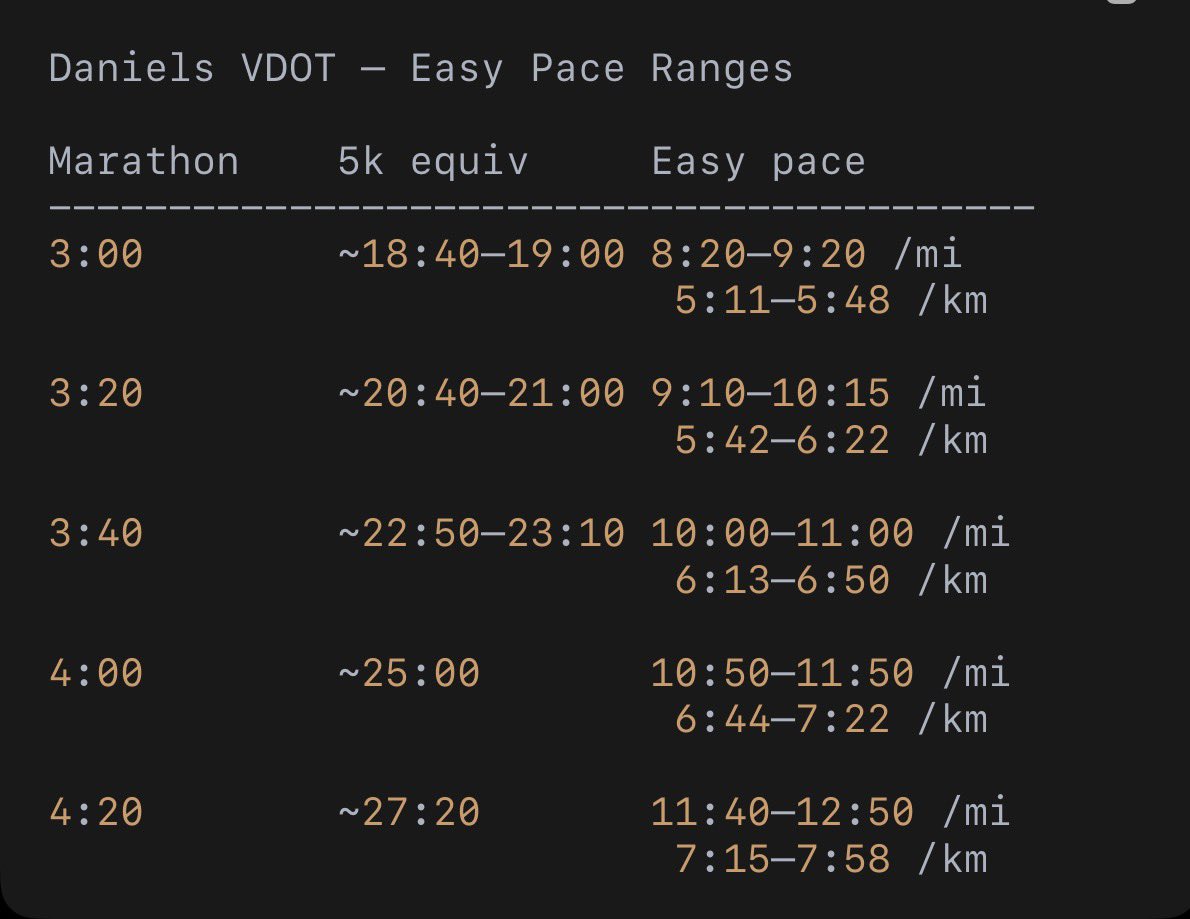
Most runners run their easy days too fast. Using Daniels’ VDOT tables, here are typical easy pace ranges for different marathon levels. Easy running should generally stay below LT1. Conversational pace. You should be able to nasal breathe comfortably if you wanted to.
David Abbott tweet media
English
27
19
373
34.1K
Andrew Wright
Andrew Wright@wrightak·
@yongfook I struggle with sleep these days and I think the changing displays in iPhones and MacBooks is a factor. Peak brightness in nits has gone from 500~600 pre-2016 to 1000-2000 now. Apple has my screen time and sleep data. Would love to see them graphed together.
English
0
0
0
47
Andrew Wright retweeted
Dexerto
Dexerto@Dexerto·
Game dev Cakez77 reacts to how much money his game made 30 hours after release following four years of development
English
275
1.3K
33.6K
1.9M
Andrew Wright retweeted
Donald Pond
Donald Pond@DonaldPond6·
Energy in the UK is so simple. Solar is a waste of time as we are the dullest large country in the world. Wind is great as we are windy. But when it is windy we already get more energy than the grid can manage, so we don't need more. Hydro and geothermal are great, but
English
83
51
2.8K
401.8K
Andrew Wright
Andrew Wright@wrightak·
@Alan_Couzens I was under the impression that diet has a bigger impact on cholesterol levels, especially LDL, than exercise. Am I mistaken about this?
English
1
0
0
208
Alan Couzens
Alan Couzens@Alan_Couzens·
“But I train 2 hrs/day and my cholesterol is still high.” It’s not total training time. It’s energy flux. Typical athlete pattern: • Huge energy liberation • Then hours of sitting • Big pulses, long troughs Metabolically ideal pattern: • Moderate liberation • Continuous use • Minimal long sedentary windows It’s not about how hard you go. It’s about how often you move! 🚶
Alan Couzens@Alan_Couzens

There is no better evidence that we're not moving as much as we should than the almost ubiquitous hypercholesterolemia & the need for statins. The vast majority of people *can* hit the targets without medication, just not while living the way you currently are.
English
13
12
216
47.9K
Andrew Wright retweeted
Donald J. Trump
Donald J. Trump@realDonaldTrump·
Now that Obama’s poll numbers are in tailspin – watch for him to launch a strike in Libya or Iran. He is desperate.
English
3K
44.5K
63.8K
0
Andrew Wright
Andrew Wright@wrightak·
@orrdavid It's because she's grown up eating it so her digestive system has been conditioned to break it down and process it quickly. If the two of you sat down to eat pizzas, I think you would demolish her.
English
0
0
0
23
David Orr
David Orr@orrdavid·
A mystery of Japan: I'm a bigger guy, 100+ kg (220+ lb). When I go to a ramen shop, I feel very full after eating the entire bowl. Somehow, sitting next to me will be a Japanese girl weighting no more than 45 kg (100 lb). And she has no trouble also eating the entire bowl.
English
454
451
28.7K
2.3M
Andrew Wright
Andrew Wright@wrightak·
@jetha Grief strikes (and goes away) at odd times. Hope you're doing ok.
English
0
0
0
39
Jetha Chan
Jetha Chan@jetha·
Funeral for dad today. You know - after his stroke, whenever people offered me their condolences, I would say “it’s alright, these things happen”. Even after he died, everything kept me busy; I didn’t even cry when writing the eulogy. Delivering it was completely different.
Jetha Chan tweet media
English
4
0
19
784