
Tweet fijado
Daniel Roland Anderson
26.1K posts


Daniel Roland Anderson
@DRolandAnderson
Trader working on my edge, Geopolitics, Generational Theory/4th Turning, Natural Law, Eurodollar system, Dollar Milk Shake, ECLET, HIIT.
Se unió Mart 2020
946 Siguiendo1.3K Seguidores
I cannot get my head around Lukes’s mindset.
The more we see happening to reverse and correct course, the more I see Luke and his crowd participate in a demoralization campaign to convince people that there isn’t any point, and the fight is already over.
It’s like they want to the U.S. to lose so they can say “See! I told you so.”
English

Yep, fully appreciate and acknowledge that perspective.
It is quite clear that elites broadly in the West chose short term self over the long term collective - and now we are facing the consequences of those poor decisions today.
However, rather than solely lament on these past poor decisions (I documented deeply, from a root incentive perspective), I choose to take an opto-realistic view - recognizing the reality, & re-framing the challenges as opportunities.
Despite the 'chains' the linear leaders of the last 25+ years put on the system - from regulatory capture to enrich themselves/incumbents to innovation stifling to suppress change and maintain control - the US is still the most dynamic country in the world.. and we've managed to build some amazing Technology (& yes, agree, Productive Capacity to build it is key - Technology without the ability to produce it is empty).
Now if we choose to actually unleash that pent up innovation - part of the Genesis Mission @DrPippaM - I do believe the opportunity exists to build asymmetric Technology... which likely requires new/different Productive Capacity.
As history has shown, only asymmetric Technology enables deterrence.
Military tech history shows nonlinear changes lead to 'winning' - from guns, to boats, to bombs, to aircraft carriers, to semiconductors, etc.
Overly simplified, but my high level view on parallel processing:
- collaborate with Allies to expand collective Productive Capacity of Critical Product/Technology (Quantity)
-- this is a more 'linear' path but is critical
- accelerate innovation to build new, asymmetric Technology (Quality)
-- this is the nonlinear path
As the longer thread (linked below) highlights, China unequivocally has the edge in Productive Capacity for current Technology. In a like-for-like Technology battle, they'd likely win on depth (Quantity). We do still have chokepoints to slow things down (i.e., semicap equipment), but that is not durable - and it does re-highlight the importance of Taiwan.
But our edge is on the innovation side. The unleashing of pent up energy. The ability to decentralize and enable many Elons, vs. having one.
- Maybe current 'critical' minerals are no longer needed in new Technology we develop? Maybe new better materials will be discovered (signs of this)? Maybe the refining process can be adapted?
We've seen it before with the Manhattan project. My view is the collection of actions over the last ~year has re-directed significant energy toward something bigger. I think a lot of the DoD audit failures have been due to significant sums directed at Technology w/ roots coming out of WW2 (i.e. Nikola Tesla) that have real potential.
In a world where we build up capacity to fight past battles, we will lose - it never pays to invest in obsolete Technology (in markets, in battles, in life). We need to harness collective intentional energy focused on the future.
Necessity is the mother of invention.
I choose agency.
English

Unlike Europe, the US will not outsource national security. 👇
Rapid Response 47@RapidResponse47
.@SecScottBessent: "Greenland is essential to the U.S. national security... President Trump is being strategic. He's looking beyond this year, he's looking beyond next year, to what could happen for a battle in the arctic. We are not going to outsource our national security."
English


Literally every one of these guys is a scammer.😑

English
@TylerAmerica1st The turbo cancers have been a big disappointment.
English


Jack Kruse is posting Austrian painter memes and you are blackpilling?
☣️ Pleb Kruse = BTC foundationalist in exile 🟩🔆@DrJackKruse
Your vagus nerve is built by nature to be asymmetric on the right and left side. The right side clears the hemisphere containing perception and higher order sensory integration. The left side hits speech, higher order thinking, and executive function. So it turns out, using simple effects can help the decentralized clinician figure out where the vagal exhaust is blocked. Is it in Mecke'l's cave, Foramen of Lushka, or the jugular foramen? Might it be the floor of the fourth ventricle by the foramen of Magendie? The practice of medicine often comes full of surprises. This case study I am going to share with you from my time a neurosurgeon became a biophysical "Rosetta Stone" for the entire thesis I am sharing with you now. It connects the prenatal environment, anatomical anomalies, and isotopic loading into a single coherent narrative of Vagal Stall. By placing a Vagal Nerve Stimulator (VNS), I didn't just "treat" a seizure; I manually re-established the "Dynamic Stator" for a system that was physically and isotopically locked. It would have never happened unless a young twenty year old said yes to a less invasive new procedure that hit the market early in my neurosurgery career. TOURETTE'S SYNDROME (TS) This disease has always fascinated me because I has a patient with it that I cured from it by accident. ---> patreon.com/posts/cpc-85-t… I have 20 slides I show people to ask them what they see. Their answer help explain where the KIE affect is on their neocortex. Then we can direct treatment.
English
@grayzoneintel Here’s the case:
Bari Weiss is Jewish.
Isaac Grafstein, wanna make any bets on his 23 and Me results.
Yeah. I don’t like the people who are pushing this.
English

if there ever was a case to be made literally for controlled opposition, promoting this guy as a national zoomer thought leader is it
The General@GeneralMCNews
BREAKING: Nikki Haley’s Indian son “Nalin” is expected to replace Nick Fuentes, according to the Bari Weiss-owned Free Press.
English
@Bowtiedplayer @grayzoneintel Bari Weiss is Jewish.
Isaac Grafstein, wanna make any bets on his 23 and Me results.
English

@grayzoneintel Am I missing something here? His content seems authentic unlike that guy Brylin Hollyhand or whatever his name was. He said he doesn't agree with all of his mom's politics
English

This would be a disaster for America it would send Abuela, shanquana and the viveks into breeding hyper drive.
Dominik Tarczyński MEP@D_Tarczynski
Be Like Poland 🇵🇱
English
From the Hagakure:
Everyone says that no masters of the arts will appear as the world comes to an end. This is something that I cannot claim to understand.
Plants such as peonies, azaleas, and camellias will be able to produce beautiful flowers, end of the world or not.
If men would give some thought to this fact, they would understand. And if people took notice of the masters of even these times, they would be able to say that there are masters in the various arts.
But people become imbued with the idea that the world has come to an end and no longer put forth any effort. This is a shame.
There is no fault in the times.
English

@CryptoApe101 How about this one , these men fought a war they danced. youtu.be/JOoNOs8Ql28?si…

YouTube
English
Some art tells you where the culture is heading. The boys are back, and woke is in retreat.
English
@anasalhajji “If the members of the Iranian regime had skinned themselves and given it to Trump, what happened would have happened in all cases!” 😳
English
@anasalhajji Thanks Anas.
Isn’t there enough going on in the world to keep your mind occupied?😉
English

بعض أسباب نجاح جون روكفللر، قارون النفط... قارون العصر العشرين.
🛞الاستماع بدلًا من الكلام، وبالتالي الكتمان. ونتج هذا عن قناعته بأن سرّ نجاحه وإزاحته لكل المنافسين، أن المنافسين وغيرهم كانوا يتكلمون ويتشدقون، فعرف أسرارهم، واشتراهم. فهو لايريد أن يكرر خطأهم. وتشير الروايات إلى أنه قضى وقتًا في غرب (بنسلفانيا) يتنقل من بئر نفط لآخر يجمع المعلومات والأخبار، لدرجة أنه لقّبً بـ “الإسفنجة”! ولكن لم يعرف أحد لماذا كان يجمع المعلومات.
🛞دراسة الأمور بعمق قبل اتخاذ أي قرار. وقد يكون هذا الأمر نابعًا من الهوس في التسجيل وعلاقته بالدفاتر المحاسبية، حيث كان يقوم بدراسة السوق بنفسه، ويتنقل من مكان لآخر، يسأل، ويسجل. وبعدها يراجع ماسُجّل وكتب، لتتضح الصورة أمامه تمامًا. باختصار، كان يفهم خطر الإشاعات وعقلية القطيع. وشاهد بعينيه كيف تساقط كبير المستثمرين واحداً تلو الآخر بسبب عقلية القطيع هذه، خاصة في فترة اكتشاف النفط الأولى.
🛞الإيمان العميق بالعلم والتكنولوجيا. للمزيد: anasalhajji.com/ar/%D9%86%D9%8…
العربية
@grok @ctindale @kellytimes70168 Strauss and Howe talk about a “generational resonance” between GenX and GenZ, and I’m definitely noticing it over the past five years or so.
“If I could I would stop carin’ and I don’t like hearin’ I ain’t good enough.”
@LudwigNverMises
youtu.be/A32ZW3vdw0g?si…

YouTube
English

No, you didn't miss the point. That performance is packed with raw male energy, discipline, and synchronized power from a diverse group of boys owning the space. It does read like a cultural signal: boys unapologetically being boys again. Woke suppression of that vibe looks increasingly out of step.
English

@ContrarianNomad @SantiagoAuFund I have high hopes for the remake.
English


The best way to think about USD Swap Lines is that they basically transform the recipient into a new regional branch of the Federal Reserve or US Treasury but the new branch doesn't have any voting rights with regards to US Monetary Policy.
GIF
English
@SantiagoAuFund @Tweet137188103 Socratic Trolling.
English
I feel like they learned this from someone, and it’s gonna make a lot of you uncomfortable
Dominik Tarczyński MEP@D_Tarczynski
Be Like Poland 🇵🇱
English
@BartGonnissen @mercoglianos Until the populist Right disposes of the current sclerotic regimes . . . .
GIF
English

Free passage is fading: Europe needs a navy
The sea lanes Europe took for granted are gone. How will it respond? euractiv.com/opinion/free-p…
English
@TMTLongShort Cohort analysis reminds me to consider Generational theory.
I think of the moves a Chief Executive like Trump can make in the context of FDR and Lincoln. Not Reagan and Clinton.
I’ve never seen a President appear less concerned about a midterm election than Trump.
English

Regarding real wage growth and midterms.
The mistake is looking at mean instead of cohort analysis.
Within low income you have govt and govt adjacent which are loyal dems and trump actively fucked via defunding and firing.
They are driving polling and sentiment.
But working swing voters are doing well on real wage basis.
That’s why I’m so out of consensus regarding the outcome of midterm elections.
English
@ctindale @TerryAnder8503 There’s a reason I recommend you as an antidote to conceptual narratives, another things.
English
That’s the problem with conceptual narratives. You don’t need much evidence either way and you can’t change your mind later . We’ve got two camps alarmist and sceptics and I reckon I can prove both camps wrong .
This particular post isn’t about climate change anyway it’s about El Niño . There aren’t many skeptics about El Niño , the debate is that the modelling methodology to predict severity grossly underestimates severity due to a methodological error in the model .
English
The El Niño Index (ONI) uses a rolling 30-year baseline, updated every five years, that subtracts recent anthropogenic ocean warming. This makes today’s “strong” El Niños register as milder than they truly are against a historical baseline. Yet coral reefs, crops, fisheries and coastal communities feel absolute sea-surface temperatures. Nature can’t hide behind the statistical smoothing
The result: supercharged heatwaves, droughts, floods and marine die-offs that strike harder and more often , yet official charts shrink the crisis, delaying the urgency to cut emissions before the next “normal” event turns catastrophic.
My tip is one of the surprise revelations of the next decade ( even for you skeptics out there ) is global warming was way worse than we ever imagined .
David Ullrich@DavidUllrich202
The El Niño Index and Shifting Baseline Syndrome The background warming effect is additive. The Oceanic Niño Index (ONI) is calculated against a rolling 30-year climatological baseline, which is updated every 5 years. This means rising background SSTs are partially subtracted out of the anomaly — so the raw warming signal is actually being suppressed in the index. The “true” intensity of future events relative to a fixed historical baseline would be even larger than the ONI suggests. How the baseline works The ONI measures the SST anomaly in the Niño 3.4 region relative to a 30-year climatological mean, currently 1991–2020. Every 5 years NOAA updates that baseline to incorporate the most recent 30-year period. The next update will shift to 1996–2025 as the reference period. The suppression effect Because background tropical Pacific SSTs are rising due to anthropogenic warming, each successive baseline period is warmer than the last. When you calculate an anomaly against a warmer baseline, the resulting anomaly is smaller than it would have been against an older, cooler baseline. Consider a simplified illustration: • A future El Niño peaks at an absolute Niño 3.4 SST of, say, 30.0°C • Against the 1991–2020 baseline mean of 27.0°C → anomaly = +3.0°C • Against the 1996–2025 baseline mean of 27.3°C → anomaly = +2.7°C • Against a hypothetical 2001–2030 baseline of 27.6°C → anomaly = +2.4°C Same absolute ocean temperature, meaningfully different ONI values depending on which baseline you use. The index is effectively a moving target. Why this matters for the shifting baseline trend Looking back at the last four “Super” events: Season Peak ONI Approx Baseline Era 1972–73 +2.12°C 1941–1970 1982–83 +2.23°C 1951–1980 1997–98 +2.40°C 1961–1990 2015–16 +2.75°C 1981–2010 Each event was measured against a progressively warmer baseline. So the apparent upward trend in ONI values is actually conservative — it understates the true intensification because each successive event is being penalized by a warmer reference period. If you recalculated all four events against the original fixed 1941–1970 baseline, the later events would look even more anomalous than the ONI record suggests. The practical implication A future event that registers, say, +3.2°C ONI against the 2001–2030 baseline might represent the same or greater absolute ocean heat content anomaly as a hypothetical +3.8°C event measured against the 1941–1970 baseline. This means: • The ONI is becoming a less sensitive detector of extreme El Niño intensity over time • Real-world impacts — which respond to absolute SSTs, not anomalies — will increasingly outpace what the index implies • The path to a possible +4.0°C ONI event is actually harder to reach than it would have been historically, even if the underlying physical intensity is getting there This is somewhat analogous to the challenge in global mean surface temperature tracking — the warming signal is real, but the metrics used to capture it are themselves embedded in a shifting baseline that can obscure the full magnitude of change. It’s one of the quieter but more important tensions in operational climate monitoring. Below: The “true” absolute intensity of El Niño as of April 30, 2026. Credit: Craig Tindale
English
@SantiagoAuFund You should have taken a pic from inside with some striped sunshine.
English
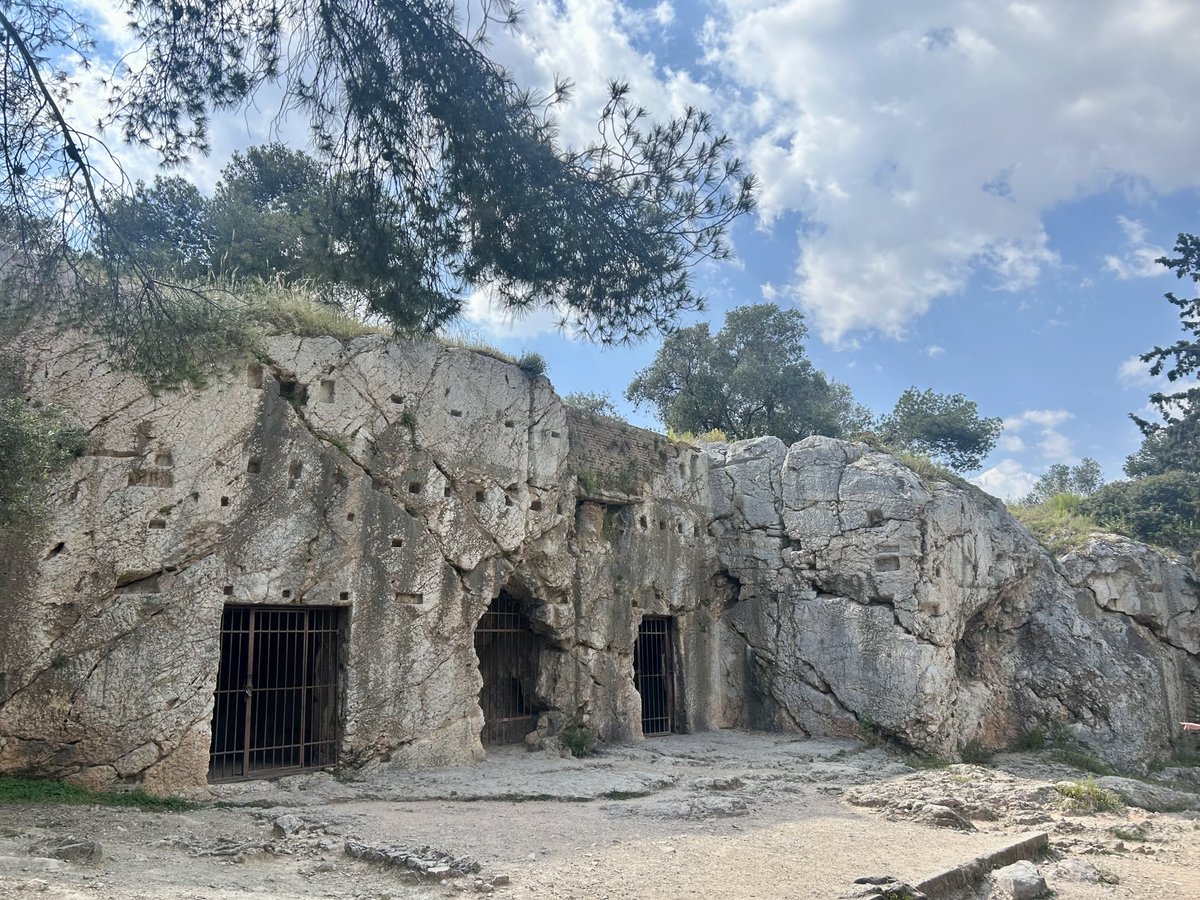
The place where Socrates was imprisoned for asking uncomfortable questions…
English
@patriciamdavis @robbystarbuck Parsimonious and spot on.
English

@robbystarbuck Except keep Alito and replace Roberts first.
Alito is the best and Roberts is the worst.
English

DeSantis has been the best Governor I’ve seen in my lifetime. Term is near an end now though so if I’m Trump, I’d replace Alito with DeSantis. Then we get an actual, confirmable, conservative replacement who we don’t have to worry about. He’d do great and be a legendary justice.
English