www.SelfLegalAid.com

23.3K posts

www.SelfLegalAid.com banner
www.SelfLegalAid.com

www.SelfLegalAid.com

@ProSeSelfHelp

#FifthCircuit #Section230 brief https://t.co/hbq4fIZCIl #GameOver

United States Se unió Haziran 2023
0 Siguiendo215 Seguidores
www.SelfLegalAid.com
www.SelfLegalAid.com@ProSeSelfHelp·
You just said "that would just mean that X would not be able to invoke the DMCA safe harbor defense to his copyright infringement claim." Thank you. That's the point. Without safe harbor, X is exposed to full copyright liability for hosting infringing content with knowledge. That's what this entire case is about. You just conceded the core of it. You said you're not sure what statutory requirement I'm referring to. It's 17 U.S.C. § 512(c)(1)(C). Upon receiving a valid DMCA takedown notice, a service provider must act expeditiously to remove or disable access to the allegedly infringing material. That's not a "shall" clause in (c)(1)(C) specifically because it doesn't need to be — the obligation is structural. If the provider doesn't comply, they lose safe harbor protection under § 512(c)(1). That's not a defense X can invoke when it's convenient and ignore when it's not. It's a condition. They didn't meet it. You keep saying there was no adjudication that Riddle was likely to prevail. The DMCA doesn't require a court adjudication before a platform acts. That's the entire purpose of the statute. Congress created a pre-litigation mechanism so copyright holders could get infringing material removed without going to court first. You're imposing a judicial prerequisite that the statute specifically eliminated. You also keep referencing X Corp's brief as though the defendant's own arguments are findings of fact. They're not. A motion to dismiss is the defendant's position. It's not evidence. It's not a ruling. It's a filing. So here's where we are. You've now: - Admitted the copyright claim is potentially meritorious - Admitted the legal theory is proper - Conceded that if Riddle is correct about the DMCA notices, X loses safe harbor - Cited a law review article that categorizes literal copying of photographs with no fair use defense as the easy case for copyright enforcement - Argued that a 50-year-old federal statute is unconstitutional with no supporting case law - Told the actual plaintiff in the case that he's beyond educating At what point does the person who built a global transaction ledger look at the actual transaction data in this case and recognize what's in front of him?
English
0
0
0
28
David 'JoelKatz' Schwartz
As usual, it doesn't matter. Let's assume for the sake of argument that Riddle was completely correct about all of his DMCA claims. That would just mean that X would not be able to invoke the DMCA safe harbor defense to his copyright infringement claim. But X had several other defenses that had not been ruled on yet. I'm not sure what statutory requirement you think you're referring to. You mentioned (c)(1)(C) but that has no "shall" clause and just explains what a service provider has to do to have a DMCA defense. Again, there had been no adjudication that Riddle was likely to prevail on the copyright infringement claim because X raised issues of law and fact about their liability, even assuming they have no DMCA defense. That would make a prior restraint unconsitutional. Again, X explained all this in their brief in the section I referred you to at least twice now.
English
2
1
2
306
Legal Mindset
Legal Mindset@TheLegalMindset·
Yet another example of unfair business practice by Twitch through selective enforcement, slamming Christian Vtuber @celestiumart with a suspension with no explanation (likely because she expressed her genuinely held religious beliefs) while freely allowing promotion of violence and terrorism by their Maoist Golden Boy.
Celestium ☦️💎☕@celestiumart

twitch denied my appeal

English
123
414
4.2K
76.2K
www.SelfLegalAid.com
www.SelfLegalAid.com@ProSeSelfHelp·
Let's just rewind for a second. They have a process, he followed it. The process has a statutory requirement. Did they follow it? Let's not skip so far ahead let's just start there. Do you believe that there is a statutory requirement that upon notification of infringing material, X Corp had a statutory obligation to expeditiously remove it, or do you believe that's still a question of law that hasn't been settled?
English
1
0
0
177
www.SelfLegalAid.com
www.SelfLegalAid.com@ProSeSelfHelp·
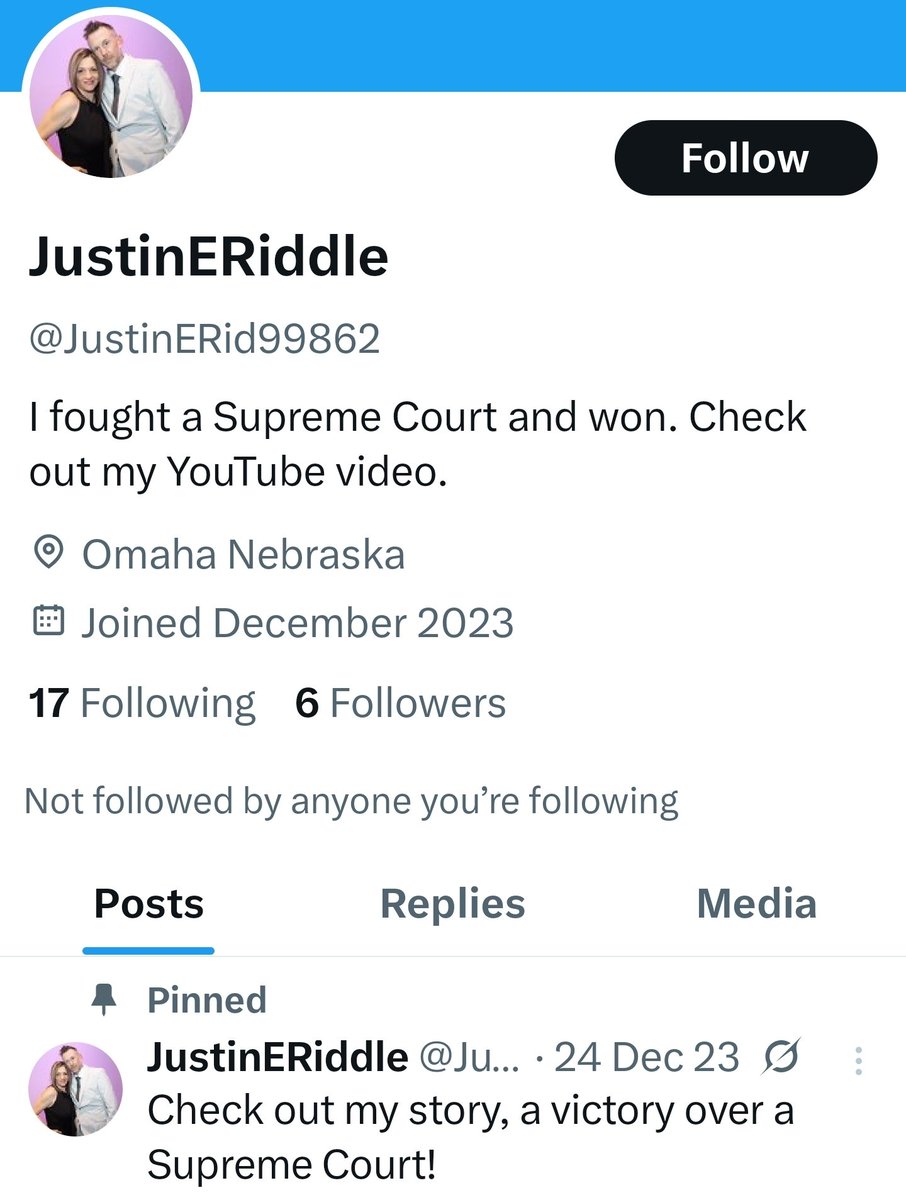
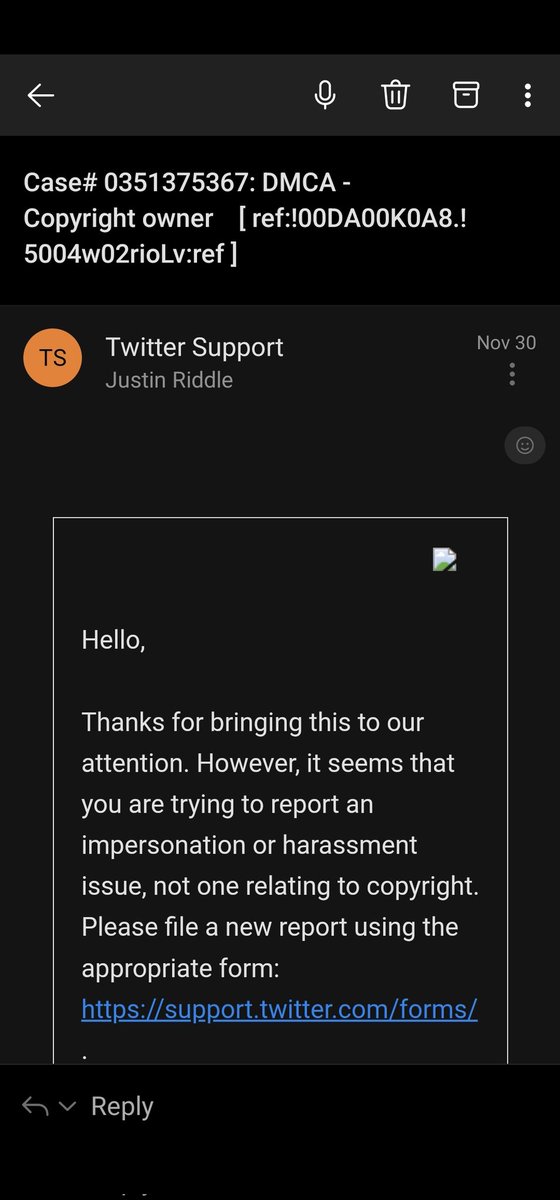
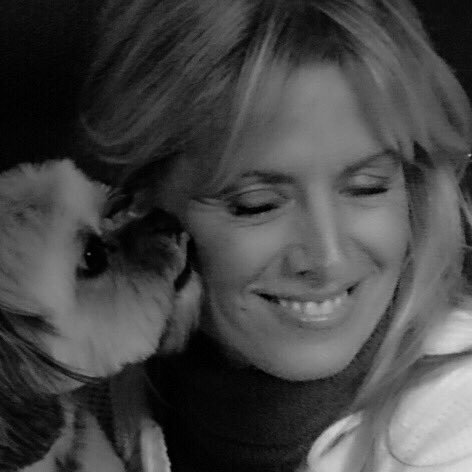
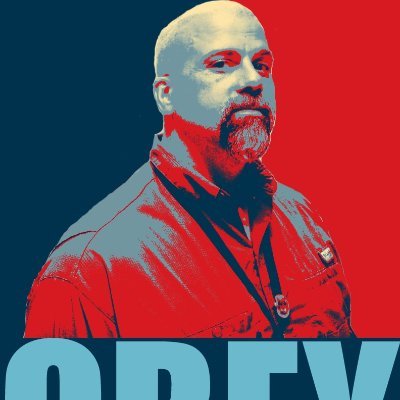
Copyright infringement isn't that complicated when the infringing account is also claiming to be the individual in the infringed work. According to the record, there's an image, a copyright, an unauthorized individual using it, and multiple valid DMCA takedown requests. I understand that you like to keep pleading ignorance to the actual facts while simultaneously casting full assessment with decided opinions and outcomes of your own, but, I'm not sure a more basic example of copyright infringement has ever existed ever. Someone took an image from Facebook, brought it to Twitter, pretended to be riddle, did not claim that it was parody, there is no fair use that covers this, and you believe there's some sort of potential unanswered question of fact or law here? So if you're the court instead of some guy on Twitter, and what you have in front of you is what you see right here, someone that's not just infringing but also impersonating, does the US copy right document itself, presented on record, change anything about your assessment, or do you still believe that there is some sort of unanswered question of law? If so what is that question? I mean you can say there's an unanswered question of law repeatedly, but if you can't tell me what that unanswered question is while simultaneously ignoring black letter law and clear statutory requirements, then you're just choosing to ignore the facts for your feelings.
www.SelfLegalAid.com tweet mediawww.SelfLegalAid.com tweet mediawww.SelfLegalAid.com tweet mediawww.SelfLegalAid.com tweet media
English
1
0
1
140
David 'JoelKatz' Schwartz
You are confusing things that have nothing to do with each other. Riddle did not establish that X's speech was unprotected because there were still open questions of fact and law. Thus Riddle cannot get a prior restraint to silence X's speech. Whether or not a court enjoining speech is unconstitutional is a purely constitutional issue. The DMCA issue has nothing whatsoever to do with it. Whatever you might think about X's compliance or lack of compliance with the DMCA, it has nothing to do with whether or not X's speech is constitutionally protected. So it has nothing to do with whether the First Amendment allows a prior restraint. The speech was not judged unlawful yet, so no injunction could issue. There's no indictment of what happened in the lower court. The court tried to save Riddle's potentially meritorious copyright infringement claim but Riddle insisted on filing vexatious and voluminous motions and briefs that it would have been a manifest injustice to ask X to keep replying to.
English
1
0
1
167
Dc
Dc@gldnrulelivinit·
@RyanAFournier I agree completely She has made amends, taken care of herself, and became a better human and a better mother! This was done to her, out of vengeance by her ex-boyfriend Dakota Everyone deserves a second chance.
English
20
0
6
7K
Ryan Fournier
Ryan Fournier@RyanAFournier·
Well I just got The Bachelorette canceled for the season. 💀 You’re welcome, America 🇺🇸
Ryan Fournier tweet media
English
1.4K
1.2K
25.3K
1.2M
HisHolinessTheCope
HisHolinessTheCope@Davidskylarkk·
@Notwokenow Yeah 25 is an unbelievable amount of time for a kid. That’s 7 years more than he’s been alive… I think 10 or 15 woulda driven the point home.
English
10
0
7
3K
Kentucky Girl
Kentucky Girl@Notwokenow·
This 18 year old man’s family breaks down when they hear the judge issue a 25 year sentence for armed robbery. Caden Fontenette and 2 other young men used firearms to rob the Bulldog Convenience store. Judge West said, “Things have just changed in such an incredibly dangerous way with young people doing what I just saw you do on that screen. I cannot imagine the fear that person had that was working in that store. Just trying to go to work, make a living and go home. He has three people come in and not just grab a little quick something and run out, but terrorize him for quite some time. Pulling him around, yanking him around, putting guns in his face. All three of you.” Judge Raquel West also pointed out that Fontenette has been involved in violent altercations since he has been in jail following his arrest. He will be eligible for parole after serving 50% of his sentence. Well before he turns 40.
English
1.5K
3K
22.7K
133.5K
www.SelfLegalAid.com
www.SelfLegalAid.com@ProSeSelfHelp·
You just said the litigation "never got that far" to establish likelihood of success on the copyright claim. That's not a defense of X Corp. That's an indictment of what happened in the lower court. You're describing a case where the merits were never evaluated — which is exactly what Riddle has been arguing. You then cited pages 12-13 of X Corp's own motion to dismiss as evidence that there are "open questions of fact and law." That's the defendant's brief. Of course the defendant argues the facts don't support liability. That's what motions to dismiss are. That's not a judicial finding. That's not evidence of anything other than X Corp hiring lawyers. As for the prior restraint argument — the Lemley & Volokh article you cited specifically distinguishes between cases involving creative adaptation or fair use disputes and cases involving literal, identical copying with no fair use defense. Riddle's photograph was copied identically. No transformation. No commentary. No fair use claim was ever raised by anyone. The article you cited categorizes this as the easy case. But more fundamentally — nobody asked for a prior restraint. Nobody asked for a preliminary injunction. Riddle filed DMCA takedown notices, which is the statutory mechanism Congress created under 17 U.S.C. § 512 for exactly this situation. X Corp didn't need a court order to act. They had a statutory obligation to act and chose not to. The prior restraint framework you keep invoking doesn't apply to a platform's voluntary compliance with DMCA notices. You're building an elaborate constitutional defense for a question nobody asked. The question isn't whether a court can order speech removed before adjudication. The question is why X Corp received four statutory copyright notices and reclassified them to avoid responding. Oddly enough you're trying to do the same thing right here in order to avoid that simple question. According to you, a dmca takedown request is merely a suggestion. It carries no weight whatsoever. Because if it did you wouldn't even bother making this silly argument. You're literally trying to argue that somehow somebody's rights would be violated if they weren't allowed to violate Federal copyright law.
English
1
0
0
86
David 'JoelKatz' Schwartz
X's speech is presumptively protected by the First Amendment's prohibition of prior restraints at the very least until Riddle can definitively establish that his copyright infringement action against X is likely to succeed. So no prior restraint is possible until that's estlablished. That might have happened at some point in the litigation but the litigation never got that far. See X's response to the motion to dismiss, pages 12 and 13. There are open questions of fact and law relating to all three theories of copyright infringement (direct, contributory, and vicarious). See especially II B 1 titled "Speech May Not Be Restrained Until a Final Judicial Determination That It's Unprotected by the First Amendment" in the article I linked. All we have is Riddle alleging that X is liable for copyright infringement and X arguing that the facts and law support no theory of liability.
English
1
0
2
156
Dr. Merle Vernon Porter
Dr. Merle Vernon Porter@RealSavageRight·
Guys how cool is this! @elonmusk has legit followed me and hit me up from multiple accounts! How lucky am I?! 🙏🏼 RP if this has happened to you because I bet it hasn’t! 😛 (No but seriously why are there so many of them and what is the goal 💀)
Dr. Merle Vernon Porter tweet media
English
5
2
35
12.8K
OKnowJUSThearMEout
OKnowJUSThearMEout@JodyJeffers11·
@dom_lucre It seems contrived and strange. But if just laughing and not some strange leftist thing then enjoy
English
1
0
0
40
Dom Lucre | Breaker of Narratives
🔥🚨DEVELOPING: Gen-Z and Millennial Americans have started a growing trend of attending “Laughter Clubs” where you can go meet up with other adults to laugh on command with each other to help deal with stress. This practice started in 1995 but seems to be gaining a lot of traction with the two youngest adult generations.
English
935
88
629
186.9K
www.SelfLegalAid.com
www.SelfLegalAid.com@ProSeSelfHelp·
You cited a Lemley & Volokh law review article without explaining how it supports your position. I read it. It doesn't. The article argues that preliminary injunctions in copyright cases involving creative adaptation, fair use disputes, and nonliteral copying raise First Amendment concerns because courts may be restraining speech that turns out to be protected. That's the article's thesis. Here's what the article explicitly says is NOT problematic: literal copying with no plausible fair use defense. The authors specifically carve out "clear cases of piracy" and cases involving identical or near-identical copying as situations where preliminary injunctions are appropriate. Direct quote from the article: a preliminary injunction should be permissible "whenever the defendant has made identical or nearly identical copies of the plaintiff's works, and there is no claim of fair use." Riddle's copyrighted photograph was taken and used without authorization on impersonation accounts. That's literal copying. No transformation. No commentary. No fair use defense. Under the framework of the very article you cited, this case falls into the category where injunctive relief is least constitutionally problematic. The article also explicitly states that permanent injunctions after a final adjudication are constitutional. And it's a law review article — academic theory, not binding authority. 17 U.S.C. § 502 remains the law. Every circuit applies it. It has never been struck down. You cited a source that distinguishes Riddle's exact fact pattern as the easy case where copyright enforcement is clearly permissible. You might want to read it before linking it next time.
English
1
0
0
86
www.SelfLegalAid.com
www.SelfLegalAid.com@ProSeSelfHelp·
Got to love when people argue on behalf of a massive corporations rights to do something that literally isn't actually what they're allowed to do, while simultaneously saying that an unchallenged law that's been used for 50 years is somehow unconstitutional. No real explanation as to how it would be unconstitutional to Force the takedown of copyright infringing material, but there must be some way😅
David 'JoelKatz' Schwartz@JoelKatz

Bluntly, you're beyond educating. I've tried. I give up. The analysis is as simple as I said it was. The only point you made that has any conceivable merit is that it's possible there might be some slight non-economic harm but not even conceivably sufficient to outweigh the presumed irreparable harm of censoring speech not yet adjudicated illegal. Such an order would have been clearly unconstitutional regardless of what any Federal statute says.

English
0
0
0
10
www.SelfLegalAid.com
www.SelfLegalAid.com@ProSeSelfHelp·
"Clearly unconstitutional regardless of what any Federal statute says." You just argued that 17 U.S.C. § 502 — a federal statute that has been on the books since 1976, applied by every circuit court in the country, and never struck down — is unconstitutional. With no supporting case law. No circuit split. No Supreme Court opinion. Just your confidence. And then you said I'm the one beyond educating. For anyone following this thread: he started by calling this case garbage and vexatious nonsense. He ended by admitting the copyright claim is meritorious, conceding the legal theory is proper, and arguing that a 50-year-old federal statute is unconstitutional because it conflicts with his understanding of the First Amendment. Appreciate your time, David.
English
1
0
1
174
David 'JoelKatz' Schwartz
Bluntly, you're beyond educating. I've tried. I give up. The analysis is as simple as I said it was. The only point you made that has any conceivable merit is that it's possible there might be some slight non-economic harm but not even conceivably sufficient to outweigh the presumed irreparable harm of censoring speech not yet adjudicated illegal. Such an order would have been clearly unconstitutional regardless of what any Federal statute says.
English
1
0
6
255
www.SelfLegalAid.com
www.SelfLegalAid.com@ProSeSelfHelp·
You said ordering X to remove copyrighted content would be an "unconstitutional prior restraint" and cited Near v. Minnesota and Organization for a Better Austin v. Keefe. Let's walk through why that's wrong at every level. 17 U.S.C. § 502 explicitly authorizes federal courts to grant injunctions to prevent or restrain copyright infringement. Congress wrote that statute. Courts apply it routinely. Preliminary injunctions in copyright cases are issued every single day in this country. If your theory were correct — that ordering removal of infringing content is an unconstitutional prior restraint — then every copyright injunction ever issued is unconstitutional, the entire DMCA takedown framework is unconstitutional, and 17 U.S.C. § 502 itself is unconstitutional. That is not the law. That has never been the law. Your cases don't support you. Near v. Minnesota involved the government censoring a newspaper that criticized public officials. Organization for a Better Austin v. Keefe involved an injunction against distributing pamphlets. Neither case involves intellectual property. Neither case has ever been applied to hold that copyright enforcement constitutes prior restraint. You cited First Amendment speech cases for a copyright infringement dispute — the exact analytical error you've been making this entire thread. Copyright is not a First Amendment issue. Copyright exists in Article I, Section 8, Clause 8 of the Constitution. It predates the First Amendment. The Supreme Court addressed this directly in Eldred v. Ashcroft — copyright's built-in protections (fair use, idea/expression dichotomy) are the First Amendment safeguards. A court enforcing copyright is not "the government censoring potentially protected speech." It's the government enforcing a constitutional right that exists alongside the First Amendment. You also claimed "the harm of copyright infringement is strictly economic." Wrong. Copyright protects economic and non-economic interests. The Copyright Act provides statutory damages under 17 U.S.C. § 504(c) precisely because harm extends beyond quantifiable economic loss. And in this case, the copyrighted photograph was being used for impersonation — the harm is reputational, personal, and ongoing. Reducing that to "strictly economic" is either ignorant or deliberately misleading. You said "the only reason to order X to remove it is to save X from harm to X that X's own decision might do" and that it "provides no legal benefit to Riddle." Removing infringing content provides no legal benefit to the person being infringed? The person whose copyrighted photo is being used to impersonate them? That's the argument you want to make in front of your audience? You said you'd walk me through "the very simple constitutional analysis" but wouldn't bother because I "won't concede it." You were right not to bother — but not for the reason you think. The analysis you laid out isn't constitutional law. It's a misapplication of speech precedent to a copyright claim, which is the same mistake you've been making since your first post. You've now spent this entire thread: - Calling the case garbage, then admitting it has a meritorious claim - Arguing editorial discretion for a copyright dispute - Citing prior restraint cases that have nothing to do with intellectual property - Claiming copyright harm is "strictly economic" when the statute says otherwise - Telling Riddle he doesn't understand the law while misidentifying the constitutional basis for copyright At some point you have to ask yourself whether you're analyzing this case or just defending a conclusion you reached before you read anything.
English
1
0
1
143
David 'JoelKatz' Schwartz
"Because that would have been an unconstitutional prior restraint. I'd walk you through the very simple constitutional analysis, but I know you don't care and won't concede it no matter how obviously wrong you are. So why would I bother." For anyone who does care: The harm of copyright infringement is strictly economic. X could easily pay for any damages Riddle might suffer. X could remove the content at issue at any time without the court ordering it to. So the only reason to order X to remove it is to save X from the harm to X that X's own decision might do. It provides no legal benefit to Riddle. Weighing against that is that such a court order would require X to remove speech without any court holding that the speech was unlawful in an adversarial proceeding. This is presumptively irreparable harm under the First Amendment. So this would have been the government censoring X's potentially protected speech just to save X from causing itself economic harm. Obviously, that's wholly incompatible with freedom of speech. (See Near v. Minnesota and Organization for a Better Austin v. Keefe.)
English
1
0
5
280
www.SelfLegalAid.com
www.SelfLegalAid.com@ProSeSelfHelp·
"I obviously don't know exactly what was going on, but I think the most likely explanation from the publicly known facts is that Riddle wanted this to be an attack on the First Amendment and was not willing to stick to his potentially meritorious claims." Which part of the First Amendment protects against copyright infringement? The "tone" issues, the backwards traveling metrics, the employee account discovery, all of that came after the court sat on this for months. So when he approached an attorney specifically about copyright infringement, why would you think that any of those things that had not yet occurred would have affected an attorney looking at clear copy right infringement from a huge corporation and saying "yeah this seems like an easy one"? This is my whole point. You're literally trying to argue free speech when the actual complaint was copyright infringement. Something completely and specifically excluded from one a protection. So why do you believe that a social media Giant keeping copyrighted infringement up for the purposes of harassment and impersonation somehow Harms freedom of speech? Because in order to accept your framing, that necessarily must be true. You believe that a social media company is protected to harm whomever they want and it doesn't matter if the actual first amendment protects that, the first amendment protects it for them. Is that pretty much where we're at here? Officially you've avoided placing any liability on X Corp, despite the fact that they've never disputed that the statements made on record about certain things, are in fact true. They lied about their employees and then deleted those accounts Within days of riddle pointing it out on record that those accounts were modifying his ads. They said those aren't our employees and they're not affiliated with us while simultaneously those accounts have the affiliated with that badge. None of this seems to matter to you, just that somehow preventing copyright infringement harms the first amendment.
English
0
0
0
12
David 'JoelKatz' Schwartz
"Riddle explicitly explains in his brief that he approached multiple attorneys, offered payment, in a situation where normally a contingency would be a great opportunity for an attorney, somehow they all had no interest, or conflicts. That much is on the record. So your entire premise about that aspect fails on the surface." I obviously don't know exactly what was going on, but I think the most likely explanation from the publicly known facts is that Riddle wanted this to be an attack on the First Amendment and was not willing to stick to his potentially meritorious claims. Lawyers refused to work with what appeared to be a nightmare client. Of course, this might be wrong. I don't know. But it's 100% consistent with the known facts and seems very plausible to me. Riddle seems obsessed with how angry he was at X and how wrong he felt X's editorial decisions were. He didn't want to win a meritorious legal claim, he wanted to go on a crusade. No lawyer should have gone along wth that. "If that's the case, and he was forced to represent himself, then why do you believe that leniency doesn't apply as is written many times? Probably most importantly and it's the one that you simply will not answer, if the court tried to help riddle by offering up plausible contributory infringement, why wouldn't they immediately at that exact moment tell X that they needed to remove that content pending the conclusion?" Because that would have been an unconstitutional prior restraint. I'd walk you through the very simple constitutional analysis, but I know you don't care and won't concede it no matter how obviously wrong you are. So why would I bother. "If x knew that they might be on the hook for contributory infringement, what intelligent attorney would recommend to their client not to take that down and to leave it up instead? That would indicate that every single day after that it was left up, if the court follow through on a merits-based evaluation, they would have intentionally been adding daily harm based on what they already knew. So if they knew that a decision against them means that their choice to leave that up equals daily harm compounding from the day at a minimum that the judge stated as much, why would they leave it up?" My guess is that they knew that claim would fail on the facts. Again, the claim is legally plausible, that's why it survived the motion to dismiss. It's likely not frivolous, but I can't be sure. But likely X felt they had a sound defense based on the facts. It's perhaps even possible that X wanted to make sure not to reward Riddle for his shenanigans in the complaint even if they felt the claim might survive. X is well-known for digging in against attacks on their First Amendment rights. "Why instead did the court acknowledge that somebody was potentially harming riddle, scold riddle for being annoyed that this is going on for 2 years, and then stay the case pending an unrelated issue of ISP pipelines?" Because Riddle litigated the case *very* poorly and refused to focus on the arguments that were winnable. Look at all his filings after the ruling on the motion to dismiss. "Your entire argument hinges on the manner in which one victim presented the truth to the court, while simultaneously ignoring literally every single truth that was presented to the court. If you believe that the law was designed for the more clever party to win based on anything other than the truth, you should just say so, because right now you're not arguing on behalf of the law, you're arguing on behalf of who knows the rules better." There was simply no way the court could have required X to respond to the nonsensical and vexatious motions and briefs that Riddle repeatedly filed. It's utterly unjust and way beyond the leniency that can reasonably be extended to pro se litigants. It's still possible that the court of appeals will resurrect Riddle's potentially meritorious claims if Riddle promises to litigate it on its actual legal merits. Then we'll find out if the facts actually support it.
English
2
0
4
274
www.SelfLegalAid.com
www.SelfLegalAid.com@ProSeSelfHelp·
Riddle explicitly explains in his brief that he approached multiple attorneys, offered payment, in a situation where normally a contingency would be a great opportunity for an attorney, somehow they all had no interest, or conflicts. That much is on the record. So your entire premise about that aspect fails on the surface. If that's the case, and he was forced to represent himself, then why do you believe that leniency doesn't apply as is written many times? Probably most importantly and it's the one that you simply will not answer, if the court tried to help riddle by offering up plausible contributory infringement, why wouldn't they immediately at that exact moment tell X that they needed to remove that content pending the conclusion? If x knew that they might be on the hook for contributory infringement, what intelligent attorney would recommend to their client not to take that down and to leave it up instead? That would indicate that every single day after that it was left up, if the court follow through on a merits-based evaluation, they would have intentionally been adding daily harm based on what they already knew. So if they knew that a decision against them means that their choice to leave that up equals daily harm compounding from the day at a minimum that the judge stated as much, why would they leave it up? Why instead did the court acknowledge that somebody was potentially harming riddle, scold riddle for being annoyed that this is going on for 2 years, and then stay the case pending an unrelated issue of ISP pipelines? Your entire argument hinges on the manner in which one victim presented the truth to the court, while simultaneously ignoring literally every single truth that was presented to the court. If you believe that the law was designed for the more clever party to win based on anything other than the truth, you should just say so, because right now you're not arguing on behalf of the law, you're arguing on behalf of who knows the rules better.
English
1
0
0
88
David 'JoelKatz' Schwartz
Riddle's case was garbage, vexatious nonsense, and incompatible with US law. That he had one potentially meritorious claim buried deeply in it that can be rooted out at great effort changes none of that. The court tried to get Riddle to focus on the meritorious claim and failed utterly. No matter what the court did, Riddle continued to file dozens of pages of rhetoric that basically amounted to not liking the law. They were not arguments based on current law and they were not good faith arguments for changing the law. Under those circumstances, the court was well within its discretion to dismiss Riddle's remaining claim with prejudice. Riddle refused to litigate it. I would be surprised if an appeals court finds otherwise. I will say, about the only way I could conceivably see an appeals court finding otherwise is if Riddle credibly represents that a future case will focus solely only on whether X violated the DMCA and won't involve filing dozens of pages of invective unrelated to any alleged plausibly unlawful conduct by X. Before you file a complaint in court, you need competent counsel to separate out what you are mad about from what potentially viable legal claims you have. Riddle just outright refused to do that. It would be manifest injustice to expect X to reply to the kinds of motions and briefs Riddle was filing.
English
1
0
4
203
www.SelfLegalAid.com
www.SelfLegalAid.com@ProSeSelfHelp·
Let's recap where this thread has gone. You started by calling Riddle's case garbage, vexatious nonsense, and incompatible with US law. An example of what to never, ever do. You've now conceded: - The copyright claim survived Section 230 - The legal theory is proper - The claim is potentially meritorious - Riddle could have legitimately advanced it in a lawsuit Your only remaining argument is that Riddle pled it badly. That's a style critique from someone who isn't a party, wasn't in the courtroom, and hasn't read the full docket. But here's the deeper problem with your position. You argue the law matters — passionately — when it protects X Corp. Editorial discretion. First Amendment. Section 230. You cite these like scripture. But then when someone points to laws that cut the other direction, suddenly those don't seem to register. Pro se litigants are held to a less stringent standard under Haines v. Kerner. That's binding Supreme Court precedent. Does that law matter? X Corp received four DMCA takedown notices and reclassified them from copyright complaints to impersonation complaints to avoid acting on them. There is no provision in Section 230 or anywhere else that authorizes a platform to deliberately misclassify a statutory copyright notice to dodge its obligations under 17 U.S.C. § 512. Does that law matter? Federal rules governing evidence preservation exist. Spoliation doctrine exists. Fraud statutes exist. Do those laws matter? Or do laws only matter when they protect billion-dollar platforms from the people they harmed? You've spent this entire thread arguing that the rules of procedure for a self-represented litigant are the single dispositive issue in this case — while ignoring every substantive law that creates the underlying liability. That's not legal analysis. That's deciding who you want to win and working backward. For what it's worth, the claim you just called meritorious is on appeal in the Fifth Circuit right now. Riddle appreciates you documenting your concessions in front of your audience.
English
1
0
0
155
David 'JoelKatz' Schwartz
"So thank you for streamlining my case. The content was illegal. X was notified. X didn't act. That's the whole claim. Everything else you've been arguing about — editorial discretion, First Amendment, freedom of the press — is irrelevant to a copyright infringement claim, which you've already admitted survived Section 230 and has merit." Bingo. So the problem isn't that there's something wrong with the law, it's that Riddle plead his case terribly and ignored every opportunity to fix the pleading deficienciency. To be clear, I don't necessarily agree that the content was illegal, that X was properly notified, and that X failed to act as the law requires. But I do agree that's a proper legal theory for a potentially meritorious claim that Riddle could have legitimately advanced in a lawsuit. Riddle chose to make the case about X's exercise of editorial discretion instead, something protected by the First Amendment.
English
1
1
6
221
www.SelfLegalAid.com
www.SelfLegalAid.com@ProSeSelfHelp·
Well I've said it once before at least, you have the knowledge to look at the data that I have and see for yourself that they disconnect ad spend from ad delivery, and that they use bot Farms to fake engagement to advertisers. For example, can Android Gingerbread communicate with the current SDK?
English
0
0
0
14