Stanic Lab

1.9K posts

Stanic Lab banner
Stanic Lab

Stanic Lab

@StanicLabUW

Physician scientist - Immunology of Reproduction. Clinical REI. Tech and algos push sci boundary. Re-tweet not endorsement. Comments are personal opinions.

Madison, WI Se unió Kasım 2012
1.9K Siguiendo754 Seguidores
Tweet fijado
Stanic Lab
Stanic Lab@StanicLabUW·
Friends and colleagues, following up on the discussion at the Lunch & Learn session at #SRI2026 meeting in PR : I am releasing BioCodeTeacher a free, open-source tool to help wet lab folks learn bioinformatics. github.com/alexs42/BioCod… AI to teach & empower scientists :)
English
0
0
1
149
Stanic Lab retuiteado
Awni Hannun
Awni Hannun@awnihannun·
Adopting Claude speak in my regular life, episode 1: Partner: Did you do the dishes tonight? Me: Yes they're done. Partner: Why are they still dirty? Me: You're right to push back. I didn't actually do them.
English
394
3.8K
55.8K
1.8M
Stanic Lab retuiteado
Michael 英泉 Eisen
Michael 英泉 Eisen@mbeisen·
Another great example of how scientists, science journals and science journalists willfully distort science for clout and profit. Compare the much-hyped paper that just came out on the genetics of response to GLP1 receptor agonists to the press release about the paper. The paper itself is fine. nature.com/articles/s4158… While it's not particularly surprising that variants in GLP1R and GIPR would be linked to drug efficacy and side-effects, it's useful to have the specifics documented in a study with a large sample size However, as the paper reports, the effect sizes are pretty small, and even when you fold the genetics into a model with a host of non-genetic factors, the amount of the variance it explains remains small (and if past experience is a guide, is likely an overestimate). But then you turn to Nature's own press-release, which tends to guide how the story is covered, and you get a sensationalist headline that does not accurately reflect the results in the paper: "Why obesity drugs work better for some people: these genes hold clues". nature.com/articles/d4158… And now that's the story everybody's going to remember, even though the article actually reports the exact opposite of this result. This doesn't help science - all it does is engender distrust. Obviously, science is dealing with a lot of challenges these days, but this one is entirely of our own creation, and it's really disgraceful that we collectively let this kind of journal propaganda dominate the way that science is portrayed to the public.
English
14
52
254
27.7K
Stanic Lab retuiteado
Arjun Raj
Arjun Raj@arjunrajlab·
Progress—in science and software—comes from putting one solid brick on top of another. Once the agentic coding "I can do anything!" euphoria wears off, this fundamental truth remains. The acceleration is real, but the hard work of validation and verification remains.
English
2
4
61
9.9K
Simon Willison
Simon Willison@simonw·
@abrakjamson I want voice mode to be able to kickoff background subagents that use stronger models and then say 30 seconds later "here's what I figured out about X"
English
8
0
63
2.4K
Simon Willison
Simon Willison@simonw·
I think it's non-obvious to many people that the OpenAI voice mode runs on a much older, much weaker model - it feels like the AI that you can talk to should be the smartest AI but it really isn't
Andrej Karpathy@karpathy

Judging by my tl there is a growing gap in understanding of AI capability. The first issue I think is around recency and tier of use. I think a lot of people tried the free tier of ChatGPT somewhere last year and allowed it to inform their views on AI a little too much. This is a group of reactions laughing at various quirks of the models, hallucinations, etc. Yes I also saw the viral videos of OpenAI's Advanced Voice mode fumbling simple queries like "should I drive or walk to the carwash". The thing is that these free and old/deprecated models don't reflect the capability in the latest round of state of the art agentic models of this year, especially OpenAI Codex and Claude Code. But that brings me to the second issue. Even if people paid $200/month to use the state of the art models, a lot of the capabilities are relatively "peaky" in highly technical areas. Typical queries around search, writing, advice, etc. are *not* the domain that has made the most noticeable and dramatic strides in capability. Partly, this is due to the technical details of reinforcement learning and its use of verifiable rewards. But partly, it's also because these use cases are not sufficiently prioritized by the companies in their hillclimbing because they don't lead to as much $$$ value. The goldmines are elsewhere, and the focus comes along. So that brings me to the second group of people, who *both* 1) pay for and use the state of the art frontier agentic models (OpenAI Codex / Claude Code) and 2) do so professionally in technical domains like programming, math and research. This group of people is subject to the highest amount of "AI Psychosis" because the recent improvements in these domains as of this year have been nothing short of staggering. When you hand a computer terminal to one of these models, you can now watch them melt programming problems that you'd normally expect to take days/weeks of work. It's this second group of people that assigns a much greater gravity to the capabilities, their slope, and various cyber-related repercussions. TLDR the people in these two groups are speaking past each other. It really is simultaneously the case that OpenAI's free and I think slightly orphaned (?) "Advanced Voice Mode" will fumble the dumbest questions in your Instagram's reels and *at the same time*, OpenAI's highest-tier and paid Codex model will go off for 1 hour to coherently restructure an entire code base, or find and exploit vulnerabilities in computer systems. This part really works and has made dramatic strides because 2 properties: 1) these domains offer explicit reward functions that are verifiable meaning they are easily amenable to reinforcement learning training (e.g. unit tests passed yes or no, in contrast to writing, which is much harder to explicitly judge), but also 2) they are a lot more valuable in b2b settings, meaning that the biggest fraction of the team is focused on improving them. So here we are.

English
135
32
1.6K
274.2K
Stanic Lab
Stanic Lab@StanicLabUW·
This post is 100% on target. I would highlight and reinforce that 5.x writing capability is actually a significant step back in terms of style compared with o3/4.5. Agree with @karpathy :: most likely due to RL overdo in the coding direction (prose seems almost Python-like)
Andrej Karpathy@karpathy

Judging by my tl there is a growing gap in understanding of AI capability. The first issue I think is around recency and tier of use. I think a lot of people tried the free tier of ChatGPT somewhere last year and allowed it to inform their views on AI a little too much. This is a group of reactions laughing at various quirks of the models, hallucinations, etc. Yes I also saw the viral videos of OpenAI's Advanced Voice mode fumbling simple queries like "should I drive or walk to the carwash". The thing is that these free and old/deprecated models don't reflect the capability in the latest round of state of the art agentic models of this year, especially OpenAI Codex and Claude Code. But that brings me to the second issue. Even if people paid $200/month to use the state of the art models, a lot of the capabilities are relatively "peaky" in highly technical areas. Typical queries around search, writing, advice, etc. are *not* the domain that has made the most noticeable and dramatic strides in capability. Partly, this is due to the technical details of reinforcement learning and its use of verifiable rewards. But partly, it's also because these use cases are not sufficiently prioritized by the companies in their hillclimbing because they don't lead to as much $$$ value. The goldmines are elsewhere, and the focus comes along. So that brings me to the second group of people, who *both* 1) pay for and use the state of the art frontier agentic models (OpenAI Codex / Claude Code) and 2) do so professionally in technical domains like programming, math and research. This group of people is subject to the highest amount of "AI Psychosis" because the recent improvements in these domains as of this year have been nothing short of staggering. When you hand a computer terminal to one of these models, you can now watch them melt programming problems that you'd normally expect to take days/weeks of work. It's this second group of people that assigns a much greater gravity to the capabilities, their slope, and various cyber-related repercussions. TLDR the people in these two groups are speaking past each other. It really is simultaneously the case that OpenAI's free and I think slightly orphaned (?) "Advanced Voice Mode" will fumble the dumbest questions in your Instagram's reels and *at the same time*, OpenAI's highest-tier and paid Codex model will go off for 1 hour to coherently restructure an entire code base, or find and exploit vulnerabilities in computer systems. This part really works and has made dramatic strides because 2 properties: 1) these domains offer explicit reward functions that are verifiable meaning they are easily amenable to reinforcement learning training (e.g. unit tests passed yes or no, in contrast to writing, which is much harder to explicitly judge), but also 2) they are a lot more valuable in b2b settings, meaning that the biggest fraction of the team is focused on improving them. So here we are.

English
0
0
0
58
Stanic Lab retuiteado
SRI
SRI@SRIWomensHealth·
The SRI is proud to recognize Marianna Alperin & Indira Mysorekar as recipients of this year’s President’s Achievement Awards. This award honors extraordinary leaders whose work has profoundly advanced women’s health, reproductive science, & the next generation of investigators.
SRI tweet mediaSRI tweet media
English
0
1
2
143
Stanic Lab retuiteado
Daniel Dan Liu
Daniel Dan Liu@Daniel_D_Liu·
Traditional single cell transcriptomics doesn't capture most non-coding RNAs. In this work, led by @alinaisakovaSci and @StephenQuake, we introduce TotalX, a @10xGenomics-compatible pipeline that captures both coding and non-coding transcripts. Out now in @NatureBiotech! 1/7
Nature Biotechnology@NatureBiotech

Scalable single-cell total RNA sequencing unifies coding and noncoding transcriptomics go.nature.com/4tjA7MI

English
5
49
230
29.2K
Stanic Lab
Stanic Lab@StanicLabUW·
@muscleforlife Tip: tell "fitness influencers" that their revenue stream will diminish due to existing effective treatment. They get very angry.
English
0
0
1
46
Mike Matthews
Mike Matthews@muscleforlife·
Tip: Don’t tell people on Ozempic that if they ate the same amount of food without the Ozempic, they'd lose the same amount of weight. They get very angry.
English
627
251
11.7K
3.7M
Michał Nedoszytko MD, PhD
Michał Nedoszytko MD, PhD@mnedoszytko·
“Physicians building with Claude”. A live webinar organized by @AnthropicAI - join us on Thursday April 23rd at 10am PT Together with @grahamwalker we will showcase our journeys of building for healthcare. Daisy Sophia Hollman from Claude code team will join us to discuss how to use @claudeai and Claude Code to bring your next big ideas to life - while respecting safety, privacy and compliance. Thank you @PollyIsrani and Neel Patel for organizing. Looking forward to this great event - register here! anthropic.com/webinars/claud… @nosajab @bcherny
English
22
71
500
49.2K
Stanic Lab retuiteado
François Chollet
François Chollet@fchollet·
One of the biggest misconceptions people have about intelligence is seeing it as some kind of unbounded scalar stat, like height. "Future AI will have 10,000 IQ", that sort of thing. Intelligence is a conversion ratio, with an optimality bound. Increasing intelligence is not so much like "making the tower taller", it's more like "making the ball rounder". At some point it's already pretty damn spherical and any improvement is marginal. Now of course smart humans aren't quite at the optimal bound yet on an individual level, and machines will have many advantages besides intelligence -- mostly the removal of biological bottlenecks: greater processing speed, unlimited working memory, unlimited memory with perfect recall... but these are mostly things humans can also access through externalized cognitive tools.
English
303
177
2.1K
423.8K
Stanic Lab retuiteado
IGN
IGN@IGN·
Project Hail Mary is the latest in a line of 'hopecore' space movies that also includes The Martian and Interstellar. bit.ly/4uC96Wp
IGN tweet media
English
36
94
1.6K
695.3K
Stanic Lab retuiteado
Arjun Raj
Arjun Raj@arjunrajlab·
Transitioning to being a PI in the age of AI Computational biology is in a period of upheaval that is both exhilarating and terrifying. Rapidly, we are approaching a moment of “analytic abundance”, where basically idea you can think of (and several you didn’t) magically appear within minutes of you thinking of them. Of course, the central proximal challenge is the evaluation of the sheer volume results—how do we know they are right when we don’t have the time to check over every line of code? I think it’s very telling that when I talk to AI-pilled faculty, they are exhilerated, but many trainees seem more cautious and far more ambivalent. I think that’s because faculty often have been removed from the details for a long time and probably haven’t checked over a line of code in years. They are used to managing (rather than doing) analysis. Over time, they usually develop a sense for whether things seem right or wrong. In this day and age, this is the skill that you, too, must develop. How do faculty do it? I am guessing every faculty member has their own list of internal sanity checks, but here are a few of mine: * Checksums. I look for things that should add up correctly (percentages add to 100, etc.). If it looks even a little bit off, I ask questions. * Never let go. If something doesn’t make sense, I don’t let go until it does make sense. Never relent! * Explain stray datapoints. Always dig into outliers in the data. How did they come to be? Often, they reveal some hidden assumption or something unexpected about the data. * Do not tolerate warnings. If code gives you a warning, resolve it. Do not continue, do not pass go, until you either understand or eliminate the warning. * Track the number of datapoints. Even a single missing row can be a sign of some fencepost bug. And I’m sure many more that I’m forgetting right now. Basically, it’s a transition from a maker to an interrogator. I also feel it worth reiterating that this is a highly unsetting period of time. I have been fortunate (?) to have 16 years of time to make a transition that people are now being asked to make in months. Again, exhilarating and terrifying, all at once!
English
10
57
413
48.4K
Stanic Lab retuiteado
kanav
kanav@kanavtwt·
Someone built a Google translate for Linkedin 😭
kanav tweet media
English
638
10.3K
90.7K
2.8M
Stanic Lab retuiteado
Bo Wang
Bo Wang@BoWang87·
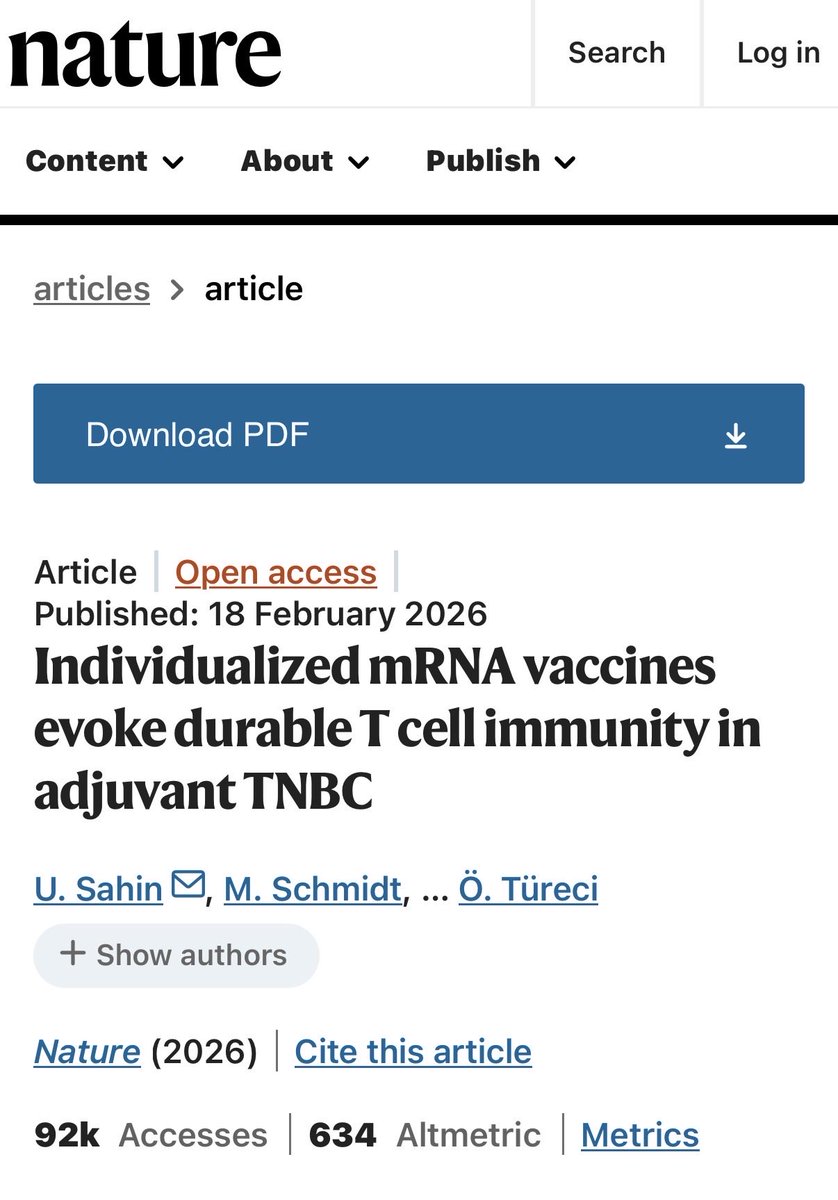
Everyone is talking about personalized mRNA cancer vaccines. I want to share two recent Nature papers that cut through the excitement and reveal something the viral posts aren't telling you: the approach works — but only in patients whose immune system actually responds to the vaccine. In the PDAC trial, that was half. Papers: — TNBC-MERIT trial (Nature 2026): nature.com/articles/s4158… — PDAC 3-year follow-up (Nature 2025): nature.com/articles/s4158… Here's the exact number that explains why. The PDAC trial: at 3.2 years median follow-up, vaccine responders had median recurrence-free survival that was never reached. Non-responders: 13.4 months. HR = 0.14. The T cell memory is real — some clones are projected to persist for over a decade. The TNBC trial: 10 of 14 patients remained relapse-free at 5 years. One patient has been in remission for over 6 years, with neoantigen-specific T cells still circulating at ~2% of her CD8 repertoire. So what separates responders from non-responders? Across both trials: only 41 of 251 neoantigens actually triggered a T cell response. That's 16%. Each vaccine encodes up to 20 neoantigens — the algorithm's best guess at which tumor mutations will be immunogenic. Most don't work. Half the PDAC patients didn't respond — not because they couldn't mount an immune response (they responded fine to concurrent COVID vaccines) — but because their selected neoantigens happened to miss. This is the core unsolved problem: predicting, from sequence alone, which mutations will produce peptides that a specific patient's immune system will actually recognize. It sounds like an MHC binding problem. It isn't. Tools like NetMHCpan handle binding affinity reasonably well. What they miss is the full causal chain: 1. Proteasomal processing — will the protein actually be cleaved into this exact peptide? 2. TAP transport — will it reach the ER for MHC loading? 3. HLA-peptide stability — across the patient's specific HLA alleles (10,000+ variants in the population) 4. T cell repertoire availability — has central tolerance already deleted the clones that would recognize it? 5. Tumor clonal architecture — is this mutation in every tumor cell, or just 30%? Targeting subclonal neoantigens leaves most of the tumor untouched. Every step is a filter. Current prediction stops at step one. Compounding everything: average manufacturing time in the TNBC trial was 69 days (range: 34–125) from sample to vaccine release. For pancreatic cancer, where non-responders recur at 13.4 months post-surgery, that's not a footnote. It's a window closing. The good news: the T cell biology is sound. The mRNA platform works. The immunology is spectacular — when it works. The bottleneck is the first step: choosing which 20 neoantigens go in the vaccine. Get that prediction right, and the responder rate moves. This is where AI in cancer immunotherapy has to go next. Not mRNA design. Not LNP formulation. Immunogenicity prediction — integrating mutation calling, HLA typing, T cell repertoire sequencing, and single-cell tumor expression simultaneously, as a causal inference problem, not a binding affinity lookup. We don't have a model that does this well. That's the gap.
Bo Wang tweet mediaBo Wang tweet media
English
27
123
585
54K
Stanic Lab retuiteado
Andrej Karpathy
Andrej Karpathy@karpathy·
Expectation: the age of the IDE is over Reality: we’re going to need a bigger IDE (imo). It just looks very different because humans now move upwards and program at a higher level - the basic unit of interest is not one file but one agent. It’s still programming.
Andrej Karpathy@karpathy

@nummanali tmux grids are awesome, but i feel a need to have a proper "agent command center" IDE for teams of them, which I could maximize per monitor. E.g. I want to see/hide toggle them, see if any are idle, pop open related tools (e.g. terminal), stats (usage), etc.

English
825
838
10.6K
2.5M
Stanic Lab retuiteado
Jorge Bravo Abad
Jorge Bravo Abad@bravo_abad·
A 40-billion-parameter genomic language model trained on 9 trillion base pairs learns to predict, annotate and design DNA across all domains of life Every living organism encodes its complexity in DNA, yet we still lack the ability to reliably predict what most genomic changes do, or to design new sequences with intended function. The challenge is that DNA simultaneously encodes proteins, RNA, regulatory elements, and the logic that coordinates all of them, across billions of years of divergence spanning bacteria, archaea, and eukaryotes. Garyk Brixi and coauthors address this with Evo 2, a biological foundation model trained on 9.3 trillion nucleotides from prokaryotes, archaea, eukaryotes, and bacteriophage. It is trained in two phases: pretraining at 8,192-token context to learn functional elements, then context extension to 1 million tokens to capture chromosome-scale dependencies. The architecture, StripedHyena 2, mixes short, medium, and long-range convolution operators with sparse attention, achieving 3× higher throughput than transformer baselines at 1 million context length. The results span three regimes. For prediction, Evo 2 performs zero-shot variant effect prediction without fine-tuning—ranking first among unsupervised models on noncoding ClinVar SNVs, outperforming all models on noncoding insertions and deletions, and reaching AUROC of 0.95 on BRCA1 variants with a lightweight classifier on its embeddings. For interpretability, sparse autoencoders recover biologically meaningful internal features—prophage regions, exon-intron boundaries, transcription factor binding motifs, protein secondary structure—recalling 70% of promoter-enriched TF motifs versus 35% for HOMER. For generation, Evo 2 produces mitochondrial genomes with correct gene count and synteny, 580-kb prokaryotic sequences where 70% of genes have protein family hits, and 330-kb yeast chromosomes with intronic structure. The most remarkable result combines Evo 2 with inference-time beam search guided by chromatin accessibility predictors. Scoring each 128-bp chunk against a target pattern, the authors design multi-kilobase sequences with experimentally validated chromatin profiles in mouse and human cells—AUROCs above 0.92 in 33 out of 36 designs, with accessibility peaks enriched for cell-type-specific transcription factor motifs without direct optimization. Paper: nature.com/articles/s4158…
Jorge Bravo Abad tweet media
English
0
19
66
16.9K
Stanic Lab retuiteado
Maryam
Maryam@hell_line0·
Patient: I read about this clinic in Mexico which does natural treatments instead of radiation. Her medical oncologist: I hear you and agree radiation does have side effects, but whatever they are offering cannot replace it, in large clinical trials radiation significantly decreased the risk of the cancer coming back. Patient: It costs $25,000 and isn’t covered by insurance. Her med onc: Radiation IS the standard of care and insurance covers it Patient: I don’t want to do radiation She did go to the clinic in Mexico where she signed a waiver stating she would not hold them accountable when the treatment didn’t work. A year later her cancer came back in the breast and spread to other organs. At that point it was too late to do radiation. Wellness grifters and misinformation cost lives.
English
98
334
4K
172.8K