Trading Doubled

127 posts

Trading Doubled

Trading Doubled

@TradingDoubles1

MSc Comp Sci, learning on the go

Se unió Mayıs 2024
2.2K Siguiendo115 Seguidores
Jose Hurtado
Jose Hurtado@JoseRestonVA·
@pawcio2009 My alternative pick was $ORKA - it would have had a better performance. I was hesitating between the 2 :)
English
1
0
15
696
Mickeychiku
Mickeychiku@mickeychiku·
$ABVX Endoscopic remission is the true indicator of how good a drug is. You can not keep masking symptoms for a long time and keep bowel still under injured state. Cause injured bowel for long time put patients at higher risk of developing fibrosis or CD and other comorbidities. In all future UC debates, ER should be the main benchmark for comparison between UC drug efficacy. Marc is in interesting situation right now. CEO of potential Mega blockbuster drug with extremely impatient investors. Only to blame him for this situation. We don’t know how far he is willing to stretch this. Longer he waits more the value for shareholders; however, does he think investor have patience? We don’t know what’s going on in his mind.
Mickeychiku@mickeychiku

The IBD game has completely changed from symptom management (CR) to complete disease healing (ER). Now everyone will be forced to release ER. I don’t see CD failing with this kind of ER. I won’t be shocked if FDA also updates UC trial design & endpoint guidelines in future with emphasis on ER as important endpoint for approval. Patients love CR together ER over only getting CR while underlying disease is still there in bowel.


English
4
0
66
8.9K
pork
pork@Taintslapp12283·
$abvx sick pump and dump here.
English
2
0
20
2.4K
Trading Doubled
Trading Doubled@TradingDoubles1·
@financebully @mickeychiku Not sure why them updating and adding clarity to results would be worrisome, just seems like you’re being nit picky here. Can they even do anything to add color? Are they supposed to be silent in your eyes from now on?
English
2
0
5
266
financebully
financebully@financebully·
@mickeychiku mgmt is fine - marc has a strong background prior to $abvx. the problem is the safety data, which mgmt can’t control. today’s updated slides worry me - when a company needs to pre-frame results, it usually doesn’t bode well. in addition, registrational data are what they are.
English
3
0
1
1.3K
Trading Doubled
Trading Doubled@TradingDoubles1·
@GermanBiotech @RNAiAnalyst @princetongb Hey GB, did you get a chance to look at ABVX’s “silent” update to their presentation deck on their website, specifically related to the added info on malignancies? Just wondering if you had any insights there, or if that moved the noodle for yourself on the drug.
English
1
0
0
54
German Biotech
German Biotech@GermanBiotech·
@RNAiAnalyst @princetongb You don't know that at all. It's really surprising how biased the arguments are here. It seems like almost everyone has already made up their mind.
English
1
0
2
216
Charles Gordon
Charles Gordon@princetongb·
Big fan of BioPharma releasing data to individual investors at the same time they do privately (isn't that the reg)? Abivax posting safety slides to their investor deck late Friday for the common folk and apparently regulatory cover (disclosure) stinks. However, glad the data strengthens safety claims. When an important data release is mishandled and serious concerns arise, peer review and publication are a good way to remove lingering doubt for institutions and investors. There are hundreds of safety tables, sometimes thousands, generated in any clinical trial and BioX experts without access to comprehensive data, have not peer reviewed the data - you've seen what the company wants you to see; you're simply peers. Some of those experts claimed share price would fully rebound almost immediately once they posted their analyses - because they're smart and right (don't doubt it). But, the stock rebound hasn't followed. Maybe it will next week? Maybe there will be a deal next week? However, the next safety update may have more cancer cases; the BioX experts have already told you it is a statistical likelihood and has nothing to do with the drug. Probably correct. But, in that scenario you may see $50-$70 before $170+, because of lingering doubt. $ABVX
English
6
0
28
6.9K
basame
basame@basadomente·
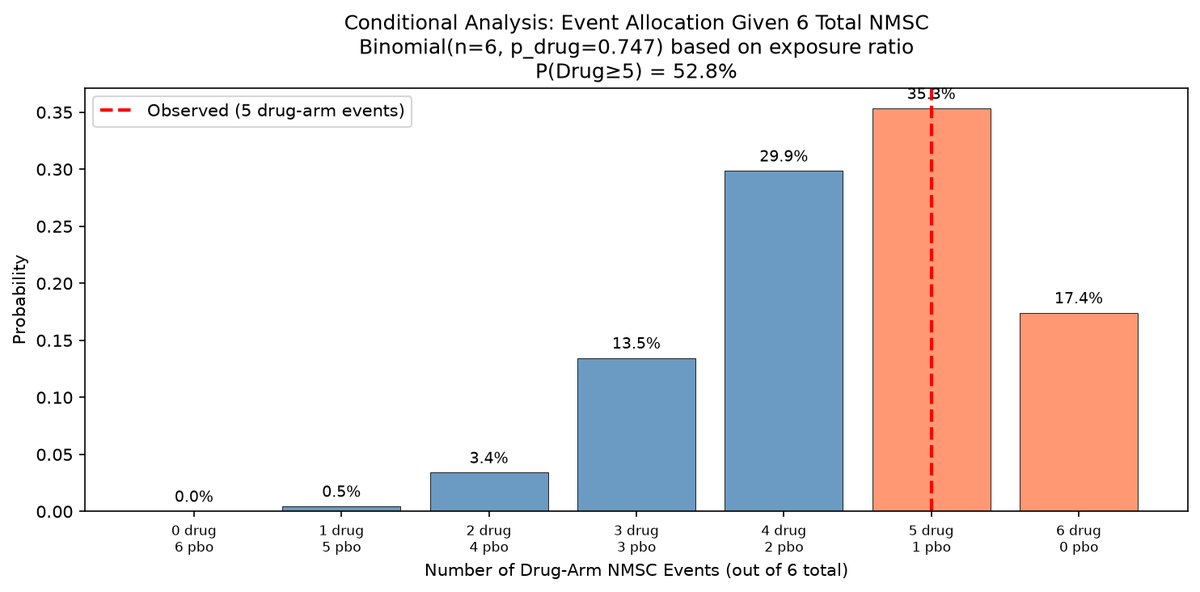
since we got a lot of slop posters on $ABVX, I was inspired by my own tweet to add my own to the mix. enjoy: Under reasonable assumptions, due solely to treatment time imbalance, a 5:1 drug:placebo NMSC ratio was the SINGLE MOST LIKELY OUTCOME in ABTECT maintenance. The setup. ABTECT re-randomized induction responders 1:1:1 to placebo (n=192), 25mg (n=193), and 50mg (n=195) for 44 weeks (~0.85 years). Placebo patients relapsed fast — only 34% completed vs ~80% on drug. To estimate exposure: completers contribute the full 44 weeks, dropouts ~half on average. That gives ~100 person-years for placebo vs ~295 for drug combined. Drug patients contributed ~75% of total exposure time (295 / 395). The model. 6 NMSC cases occurred. If all 6 were background events (age, prior skin cancer, prior immunosuppression — not drug-driven), how would they distribute across arms? Binomial(n=6, p=0.747). Each event independently "lands" in the drug arms with probability proportional to exposure time. Result: 5:1 was the most likely outcome. P(5 drug, 1 placebo) = 35.3% — the mode of the distribution. P(≥5 in drug arms) = 52.8%. A coin flip. [graph 1] The dose split. Within the drug arms, 5 cases split 1:4 between 25mg and 50mg. Exposure was nearly equal (~146 vs ~150 PY), so this is ~Binomial(5, 0.5). P(4+ in one arm) = 19.7% one-sided — like flipping a coin 5 times and getting 4 heads. Unusual but not remotely significant. Two-sided p = 0.375. [graph 2] Total NMSC count. We modeled expected background NMSC using claims-based incidence data (Rogers 2015, Muzic 2017), adjusted for UC risk and prior immunosuppression. Expected events for a trial of this size and duration: ~4.9. Observed: 6. P(≥6) = 37%. The total count is barely above expectation. All cancers. Same logic applies to all 8 cancer cases (7 drug, 1 placebo). Under Binomial(8, 0.747), the most likely outcome is 6:2 at 31.1%. The observed 7:1 is the second most likely at 26.3%. P(≥7) = 36%. Caveat. This is a simplified model meant to illustrate the effect of differential treatment time on event allocation. It uses published epi parameters and standard binomial statistics. It does not prove obefazimod is safe — you can't prove a negative from 6 events — but the observed pattern is exactly what you'd expect from the trial design alone.
basame tweet mediabasame tweet mediabasame tweet media
basame@basadomente

@grok conduct a Monte Carlo simulation to determine the likelihood that $ABVX would see a 7:1 imbalance in cancer cases between drug and pbo groups purely due to chance. Take into account background rates of cancer, as well as differences in time in treatment, age, pre-existing histories, and prior treatment histories between the two groups. Make no mistakes

English
10
2
49
13.4K
Trading Doubled
Trading Doubled@TradingDoubles1·
@financebully Gotcha. Is there space for optics to materially improve if the safety data is squeaky clean released later this month in your pov?
English
1
0
0
52
financebully
financebully@financebully·
@TradingDoubles1 i have a background in m&a. optics matter because it can affect the bottom line and will certainly be used as leverage during negotiations.
English
1
0
1
74
financebully
financebully@financebully·
$abvx investor, but let’s be objective. company considers high-risk anomalies for the 7 cancers, but baseline traits should be more uniform. why wouldn't cases distribute evenly across arms? m&a strategics will catch the 7:1 ratio & colonic dysplasia hidden in footnotes.
financebully tweet media
financebully@financebully

@flippyfloppy52 unlike most on biox, i'm not blindly bullish on any stock, even ones i own and assets that i like. while i think $abvx obe efficacy is great, the malignancies will raise eyebrows among potential acquirers, given unknown moa. m&a value will likely dip below original assumption.

English
12
0
14
10.8K
Trading Doubled
Trading Doubled@TradingDoubles1·
@financebully Are you in the M&A space? Just curious why optics matter, or atleast why it would matter as much as data from the actual trials of this drug.
English
1
0
0
58
financebully
financebully@financebully·
@TradingDoubles1 that is fundamentally wrong. strategic buyers are concerned about how the data contribute to both negative market optics AND regulatory/payor limitations that will limit future pys estimates.
English
1
0
0
136
Trading Doubled
Trading Doubled@TradingDoubles1·
@financebully I don’t think potential strategic buyers are concerned with optics but rather with nuanced data, but we will see in due time.
English
1
0
0
132
financebully
financebully@financebully·
@TradingDoubles1 imho rationalizing the malignancies is a futile effort. a 7:1:1 asymmetric safety signal makes the issue about perception, which compromises the original investment thesis around valuation. strategic buyers won't ignore a dose-dependent signal like this. $abvx
English
4
0
3
4.8K
Trading Doubled
Trading Doubled@TradingDoubles1·
@financebully Are you still bullish after the release of maintenance data? Do you think there’s merit to differentiate the malignancies we’re seeing in the 50mg arm, or are you of the mind that the 6-7 cases represent a true signal for malignancy?
English
1
0
0
366
financebully
financebully@financebully·
@TradingDoubles1 i was initially skeptical of the ambiguous $abvx moa, but became comfortable with the prior data (credit to adam may's diligence) and invested just before and right after the initial ph3 induction data release. i have been bullish up until this ph3 maintenance (safety) data.
English
1
0
0
734
Trading Doubled
Trading Doubled@TradingDoubles1·
@financebully @dumjgr88 You said you were long ABVX, is it fair to say you don’t think the drug at the higher dosage is causing a wide set of malignancies? Just want to clarify what you thought instead of you playing devil’s advocate
English
1
0
1
175
financebully
financebully@financebully·
@dumjgr88 i didn't make that number up on my own - $abvx dictated this. biox bulls don't make the rules. 😉
financebully tweet media
English
4
0
0
754
financebully
financebully@financebully·
context matters. omvoh: 29 cases scattered across 2600+ patients tracked over years (0.5% rate). $abvx: 7 cases clustered in a single randomized treatment group of 195 patients over a 44-week window, while the structurally identical low-dose group had 1 case.
Mickeychiku@mickeychiku

$ABVX Now that you have details from Abivax for each patient, see how 23 non-NMSC and 6 NMSC cases were reviewed for omvoh resulting in conclusion that not induced by the drug as the rate was still within the background rate for UC patients. Also, FDA review below.

English
4
0
13
10.3K
Trading Doubled
Trading Doubled@TradingDoubles1·
@charlie_lees Hey Professor, just wanted to know if you had any further thoughts on the recent maintenance data dump from this company regarding the drug, especially regarding malignancies. Thank you!
English
0
0
0
7
Charlie Lees
Charlie Lees@charlie_lees·
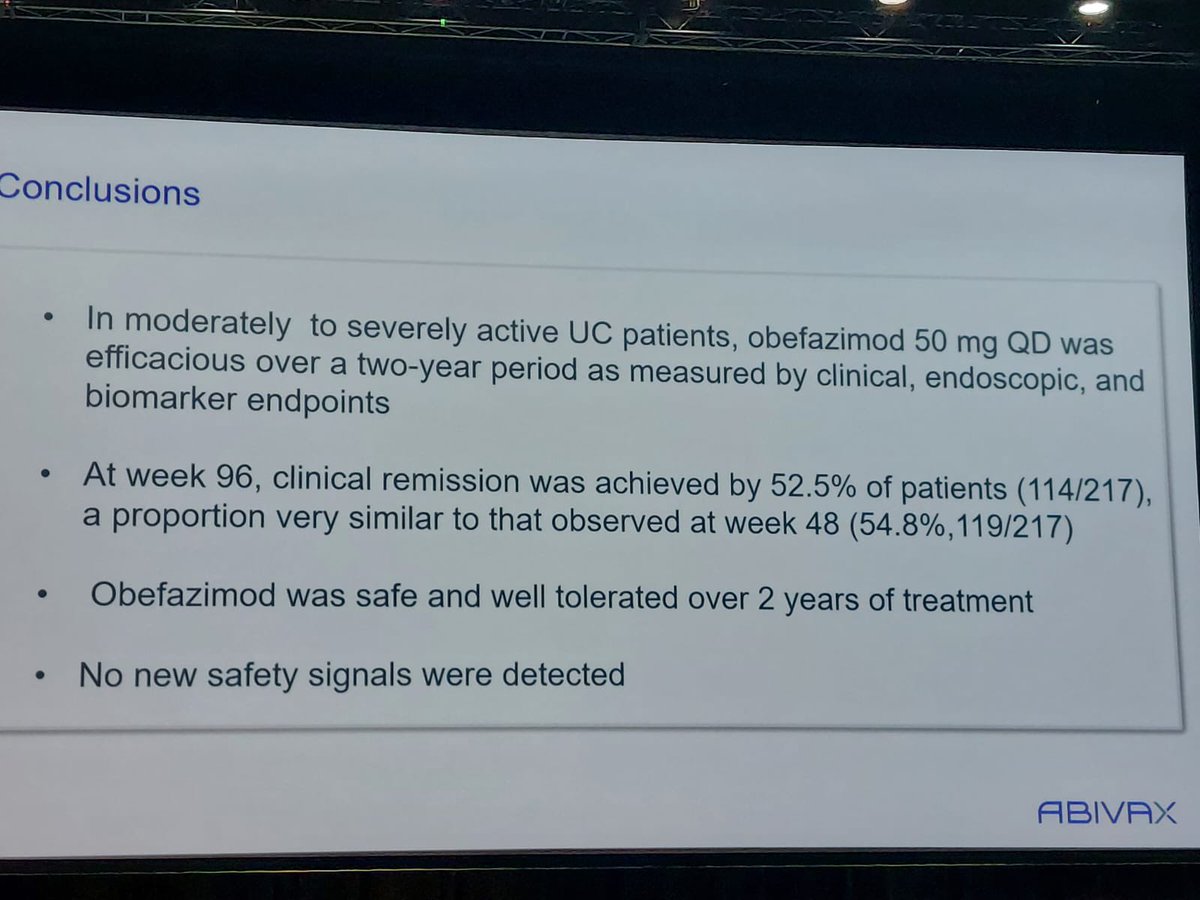
Obefazimod 50mg once daily(Abivax molecule ABX464) long term data in UC Robust maintenance of clinical and biomarker remission out to 2 years Safe and well tolerated during this observation period Novel mechanism of action - very promising data on this molecule Originally developed as an HIV medicine - may yield interesting insights into UC pathogenesis Await phase 3 data
Charlie Lees tweet media
English
3
7
54
9.2K
Trading Doubled
Trading Doubled@TradingDoubles1·
@BertrandBio Hello Bertrand. Just wanted to thank you for this insight into your journey with this investment. Also wanted to ask if you had any further thoughts on the recent case of malignancies in the maintenance data. Thank you.
English
0
0
0
6
Bertrand Delsuc
Bertrand Delsuc@BertrandBio·
Just a little thread, out of my retreat, because this stock and its story has been important to me. Maybe a mini-victory lap as well, but with quite some general learnings overall, and hard ones. I have been long $ABVX since the disclosure of the POC data in UC in September 2018 (you will find some tweets on $ABVX in my history back to that time, although I tried to never pump it). At that time, I didn't even know Abivax had an UC phase 2a study, because it was a drug candidate investigated in HIV, to deplete the reservoir, thus potentially offering patients periods off therapy, and preventing the rebound that inevitably comes if HIV patients stop any antiviral treatment (due to that latent viral reservoir). Even if there were some positives in early-stage studies, the major improvements in HIV therapies had made the case in HIV much less compelling. And already at that time, in my view, it was questionable to continue the clinical development in HIV. But at the same time, it's ***because*** it was tested in HIV that the signal in IBD was discovered. Indeed, some HIV patient anecdotes led to the repurposing in IBD. At that time, the company hadn't even communicated much on that. This repurposing was coming out of blue, at least for the persons external to Abivax. So yes, obefazimod is yet another serendipity story in drug development, repurposed from HIV to I&I (also tested in clinics in RA). In a recent call, it was said that mir-124 is often downregulated in HIV, so that's the link. I believe that Pr Severine Vermeire (Belgium) was instrumental to that pivoting, along with 2 other US KOLs (Bruce Sands and William Sandborn [that last name should ring a bell to some US investors]). So indeed, the MoA is non-conventional, but it's been interesting to read such an amount of BS on X/twitter about this asset, its MoA, the speed of recruitment of the ph3, or the data, etc, over the time. I can't completely blame the US investors, since the track record of the European companies on Nasdaq has, overall, been underwhelming. But they also tend to throw out the baby with the bathwater, when it comes to consider ex-US companies (and I am not even talking about the Chinese companies…). The MoA of obefazimod (NB, an "-imod") in inflammation is that this small molecule binds to the Cap Binding Complex, which in turns induces an increased splicing of anti-inflammatory lncRNA miR-124, itself modulating (downregulating) the production of inflammatory cytokines like IL-6/TNFa and inflammatory signals for macrophages like MCP1. Historically, the company had also talked about the upregulation of anti-inflammatory IL-22, but they eventually talked less about this signal over time (maybe a bit controversial - also Roche has tried an IL-22 in UC iirc, but that program was discontinued, so assumedly nothing really great). Some apparently keep questioning that it binds the Cap Binding Complex, but it was demonstrated by CRYO-EM, and shown on a slide/shared publicly, and I presume there was even a paper showing this. I can even say who did that work: it was Pr Jamal Tazi (the 'inventor' of the molecule), from Montpellier University, and a co-founder of the company if I'm not mistaken. So apparently, if the MoA is not a complete signal blockade, like with obefazimod, bioX is lost... LOL. And also, so much about the absence of a clear dose-effect... for a pleotropic immunomodulator... in an inflammatory disease where no agent has ever shown more than 20% PBO-adj delta in clinical remission ie highlighting the heterogeneity of the presentations. How come :) And it's not like it was a first, was it? Other non-sensical thing from bioX: why paying more attention to inconclusive tissue biopsy data from small n's, when you have unequivocal endoscopic data (the most objective measure in IBD) and long-term maintenance data telling you that the drug works, not well, but very well. That's a mystery to me. Adam May pointed this out in the first point of the deck he timely posted about ABVX on twitter, like "I don't care about the funky MoA because the hard data already tells you what you need to know". Hell yeah, high five Adam. One of the few who eventually found out there was something worth looking there. You didn't need to dig deep on the MoA to understand that this drug works. Then, you had to prove it in large-scale, well-controlled, pivotal trials in this indication, which can be tricky (ask Roche about that), based on prior data not always pristine, I agree. But the body of evidence reached after the ph2a & ph2b (incl. long-term efficacy and safety) was one of the best I've seen. Also, what is incredible here is that the modulation of miR-124 is selective! What were the odds, that a specific way to bind the CBC ends up to increase (or decrease) the splicing of a SINGLE microRNA ????!!!! I believe that many would love to find molecules that just do that, and here, that's the case even if I don't think it was done intentionally. Also, those looking at UC should understand that the endpoints evolved, with the Mayo score evolving over time to be more objective, and with the stricter criteria (reclassification of no friability), and with the exclusion of the (subjective) PGA to make the pMMS today's gold standard. So if you know that, you understand that the endoscopic data are those you should pay attention to, when looking early for an efficacy signal. Then, there is no such thing as staying in remission at such a high rate after 1-2-3y maintenance if you are on PBO, in this patient population. Personally, I have been nervous about the SAP of the induction ph3 readout. Because to frame it simply, the induction, in my view, is a technical hurdle. Not a real-world hurdle. Let me explain. The goal in IBD is to treat for as long as possible. For many years, there weren't many classes approved, and therefore there was a lot of cycling in the TNF class (ada, inflix, goli, certo). But assumedly due to ADAs, the pts are losing response and it was estimated that roughly 50% remained on drug after just a year. Now, it's more 1-2y, from what I have read/heard. But now, you have the anti-integrin, the IL23s, the JAKs, the S1Ps (and the TL1As in the future). But the problem remains the same wrt durability on treatment. And here, obefazimod excels (I'll let you parse the published data - and note that you have to pay attention to the denominators here, VERY IMPORTANT). And the MoA (not a full blockade on 1 axis, but a modulation of several) may explain why this molecule is great at maintaining a remission and a response. Indeed, like in onco, and outside the immunogenicity considerations, a selective pressure on an axis may induce escape mechanisms over time on another axis. But here, obefazimod does not act as a full blockade, but as an immunomodulator on several axis. That's why it's also described as a homeostasis inducer. So one can understand (although there is no hard proof of that), that it's possible that the 'induction' of homeostasis may last for longer if you don't act like a selective pressure. At least, that's how I connected the dots. Now, back to the induction part. The regulators want both induction and maintenance data. but in the real world, the physicians I have heard are more flexible. And you also see that from RW data. The median duration on drug in RW is LONGER than in clinical trials (at least until recently). Because gastroenterologists tend to give more time to see a response than what was done in clinical trials. And once a patient is on something they both know (the patient, and the prescriber), there was a little hurdle to switch. I presume this is less the case with the introduction of the last classes. So overall, the induction of a response (ideally of a remission) is important, but since the response rates is quite higher over the spectrum (the remission rate is not high after induction usually), and that the response/remission rates keep increasing over time [ie after 8-12wks, the usual timepoint range for induction parts in ph3s], the treatment course is actually less dichotomic in real-world. You can also see the results of the studies done with a threat-through design, incl. for obefazimod. Normally (and that's how ph3s are done usually), you only keep the responders from the induction period, to allow them to participate to the maintenance period. But that's like putting an artificial, hard limit in time for a drug to 'work'. In a heterogeneous patient population, this is not ideal. That's why some mid-stage studies allowed pts who hadn't reached response yet at the end of induction, to participate to open-label maintenance (ie, more a prolonged induction+maintenance). And guess what, many more responses (and remissions!) are achieved when you do that. So that's why I call the induction a technical hurdle from a regulatory standpoint. Because there is much more flexibility in real-world. Switching gears to that readout, that last thing I wanted to hear about was that the SAP would be hierarchical. Simply because it induces another level of risk that is not easy to quantify: indeed, if you fail at the first stage or early in the hierarchy stages, even if you have great data in the lower ranked endpoints, these cannot be formally tested, which can be catastrophic. The company would not provide that info to the investors prior to yesterday. Many of us tried, but nobody got the answer apparently. And actually, the company did well not to provide that info, because they avoided me some huge headaches. Indeed, since 2 doses were tested in this induction part, the question was whether they had split the alpha, or if they had a hierarchy, assuming in that case, that the highest dose (with which there was the largest amount of data) had been prioritized - but who knows how the hierarchy was determined. Actually, this was very tricky, since the predefined hierarchy was FDA primary => FDA key secondary => EMA primary => EMA key secondary, as I understand, with different endpoints for EMA and FDA (first time I see that in UC). Anyways, to summarize, the top dose succeeded for the FDA endpoints, and both doses for the EMA. I guess the data will be presented at the coming UEGW meeting. And I expect the maintenance data to be very positive as well, in a year or so. I was not, and I am still not convinced yet that the lowest dose (introduced at the request of physicians apparently, since they like to ‘downtitrate’ in maintenance) is a given, knowing the MoA, but why not. Dr Rubin (KOL on yesterday’s call) even said that he believed that the FDA would care about the fact that there was no underdosing in induction. The company also teased other reasons (to be disclosed later), as to why they intend to push forward the 2 doses for registration. So, we’ll see if there could be a discrepancy between FDA & EMA on doses. Maybe 25mg & 50mg could be good in induction in bio/JAK-naïve, while 50mg could be restricted in the US in bio/JAK-experienced? That’s pure speculation from me, but that’s one of the scenarios I thought about. Now, going to safety, I believe the phase 3 program was mainly powered to strengthen the safety DB, rather than sized for only for efficacy (the n's there were large enough to discriminate even a small PBO-adjusted deltas), although the multiple endpoints requested there added to the complexity of the powering. Just to say, the safety over only 8wks study in induction is hardly what matters. This is too short to see the effect on most of the AEs of Specials Interests (AESIs) we've seen with prior classes, especially with the JAKs. But so far, obefazimod has had an excellent safety profile (I think some patients from the ph2a are still dosed today for free, after like 7y+). So in my view, no surprise. Low dropouts, no new signal. Headaches were even shorter than in prior studies apparently (median 'less than a week' according to yesterday's call). I think it was 1-2 weeks before. But that's the profile in maintenance that matters, and that will confirm (or not) that obefazimod can be the 'first and only' (a term that bigP loves to insert in headlines) oral drug in UC with ZERO monitoring or testing (rolling eyes to the JAKs and the S1Ps), and proven efficacy as soon as 8wks. On top of hopefully, confirming that it works well both in bio/JAK-naive, and bio/JAK-experienced subpopulations (the ph3 was stratified to that regard). I'm not going to comment more on the data. Everyone will make up their mind on them. That's not even the point of this post. But from an equity story point of view, that stock has been extremely frustrating for me. I will start by the anecdote of that morning of early September 2018, when the POC data were released (small n's but already interesting remission rates). I remember that day very well, as if it was yesterday: the stock opened up a bit, and then it ended red, and went down even more the following days. I had bought around the open and sold very shortly after, since seeing the stock fading and the market selling again and again. So, in Europe, you can show to the markets that a drug can be worth billions, and they would not even see it (which in turn, also offers ooportunities). I don't think it has changed much today. The efficiency is very low there. The retail investors prefer to be cultists in some pumped companies. That's pretty crazy if you think of it. So, then, I started to build, ending with a single-digit cost basis. The stock tripled or even quadrupled in 2020-21 (when investigated in COVID). And then from February 2021, everyone knows that times for biotech were much tougher. Of course, it didn't work in COVID, and the ph2b data were not pristine from a dose-dependence perspective. And since the Chair of the Board (P. Pouletty) had only one obsession, i.e. sell the company after the ph2b data (on top of not being willing to dilute himself, which costed a lot to the company, and to him, since he ended having no other choice), but had no backup plan, while still needing hundreds of million $ to fund the phase 3, it didn't go well, from the stock price perspective. I kept the hopes of a buyout that never came, and ‘bagheld’ all the way... I remember I had spoken with a seasoned, and well-known VC about that company, and he told me his reservations on the Chair of the Board (to put it nicely)... and he ended up to be very right! At that time, I thought that the data themselves would prevail and lead to a positive outcome, but the post-COVID period proved him right, and me wrong. I even wanted to pitch him on this company, and this asset. For some reason, I never did so. The stock tumbled, with that financing overhang. So, in that part, I want to stress that without Sofinnova & the syndicate of US investors they managed to gather for the financing of July 2021, Abivax would have stalled as a zombie for years, especially when we see the long drought we're in. That's the same story as Verona (basically a takeover of US investors of European companies that are worth something). The Board & management of the company were ‘reshaped’. I still believe the timing of the US IPO was horrible, and that just 1 month later, the effect of the dilution would have been lower. And I don't buy that the urgency was absolutely for October in 2023. But overall, it would not have changed the negative take of the US investors, I acknowledge that. I ended up with a tiny position that I kept (and basically sold this morning in Europe, for full disclosure), but it's very, very far from what I used to have. So no, I am not going to be rich with Abivax, far from that, while it held such a great potential. This where my frustration stems from. Having IDed that potential so early, and basically seeing the stock price yesterday basically being the same as it was after the POC data in 2018! To conclude, I wish the best to that company, with or without me in. I think it could be the success story that the French bios have been looking for 2 decades now. But there are also learnings here. On importance of serendipity in drug development, on how to assess a case, what really matters, the quality of the governance, the credibility of their strategy, how they can navigate a storm, the inefficiency of the European markets with the opportunities they can also offer, the fact that you can hardly build a large biotech company (from a European perspective) without the backing of US investors at some point, and much more… Plus on my side, how to better manage my investments :) A lot of cliché in that summary, but food for thoughts nevertheless, I guess/hope. Going back in retreat mode now.
English
17
13
218
46.4K
Trading Doubled
Trading Doubled@TradingDoubles1·
@TonyFauci2 @seedy19tron Even if this is a potential blind spot for abivax, isn’t it still too fast for anyone to develop malignancies in 44ish weeks trial period?
English
0
0
0
93
TF2🌎
TF2🌎@TonyFauci2·
.@seedy19tron 1st - congrats on your wonderful call -$ABVX OBE likely doesn't Cause cancer but Depletes TH17 cells which exacerbate UC and Fight Mets and primary cancer- see my multiple posts of peer reviewed lit.
English
1
0
3
219
Trading Doubled
Trading Doubled@TradingDoubles1·
@Taintslapp12283 Need them to spend more time on these presentations next time and not fuck up the messaging.
English
0
0
0
26
pork
pork@Taintslapp12283·
$ABVX Marc d queefidel really just gonna stay quiet?
English
2
0
7
355
BFM Bourse
BFM Bourse@BFMBourse·
Bourse : ➡️ Quelle action mérite selon vous d'être la star de notre émission aujourd'hui❓ 🌟 Et pour quelles raisons ? 🤔 Dites-le nous en commentaire❗ On en reparlera à l'antenne et sur les réseaux sociaux à partir de 17h35⏱️ Restez connectés ! 🔴
BFM Bourse tweet media
Français
3
0
2
1.1K
Les Tontons Répliqueurs
Les Tontons Répliqueurs@LRepliqueurs·
@TradingDoubles1 @BFMBourse MAiS: ces trois personnes sont en âge de développer ce type de cancer, spontanément. Rien n indique que c est le produit qui a provoqué. De plus, le dosage 25 fonctionne aussi bien et ne provoque pas d effet 2nd. Donc a priori, le 25mg sera validé par fda. A PRIORI.
Français
1
0
1
39
canoebrookbl
canoebrookbl@canoebrookbl·
$abvx more dumping from funds because the pumper’s arguments are laughable now. Rinvoq’s box warnings are from the RA trial of Xeljanz and Rinvoq’s UC maintenance phase 3 has no patients developed solid tumors. NMSC is similar at 1%.
English
5
0
21
6.5K
Les Tontons Répliqueurs
Les Tontons Répliqueurs@LRepliqueurs·
@BFMBourse 10 sur 10 ce matin dans good morning market pour Alain Dubrusle à propos de Abivax. Il est vraiment rentré dans des explications parfaites, détaillées, précises, laissant le libre arbitre à l'auditeur de faire son choix, parfaitement informé. Merci.
Français
1
0
2
163