Gem Hunter 💎
5.1K posts

Gem Hunter 💎
@spaceking01
Accumulating the hottest gems in the hottest narratives! DYOR
Se unió Ekim 2012
533 Siguiendo220 Seguidores

English

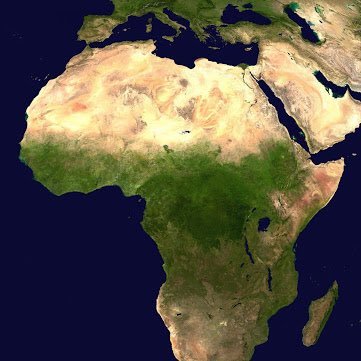
🚨20 VESSELS INCLUDING CHINESE & IRANIAN HAVE PASSED THROUGH THE STRAIT OF HORMUZ IN 24 HOURS
Iranian and Chinese tankers are moving through the strait.
WHERE IS THE BLOCKADE?
English
Gem Hunter 💎 retuiteado

Tokenised deposits and real-world assets have crossed $100 billion. For banks and capital markets firms, operationalising tokenisation without dismantling what already works is now the defining challenge.
Our partnership with Murex addresses that directly. Integrating Quant's programmable money infrastructure into MX.3 means institutions can issue, settle and manage tokenised deposits and digital bonds within their existing operational framework, with the same risk management, compliance and post-trade processes they already rely on.
As @gverdian puts it: 'The next generation of capital markets infrastructure will not replace what works. It will make what works programmable.'
Read the full piece in @ATeamInsight: a-teaminsight.com/blog/how-murex…
#Tokenisation #DigitalAssets #ProgrammableMoney #CapitalMarkets
English
Gem Hunter 💎 retuiteado

Today, the same stablecoin exists separately on 10 chains with liquidity fragmented across all of them.
Fusion connects those chains into a single network, making an asset issued on one chain accessible across all of them - no wrapped versions, no bridge transfers, and liquidity that stays whole.
The chains remain, but the fragmentation between them does not.
English
@nubianroots @elshredo Are you concerned at all about Swift’s new ledger?
English

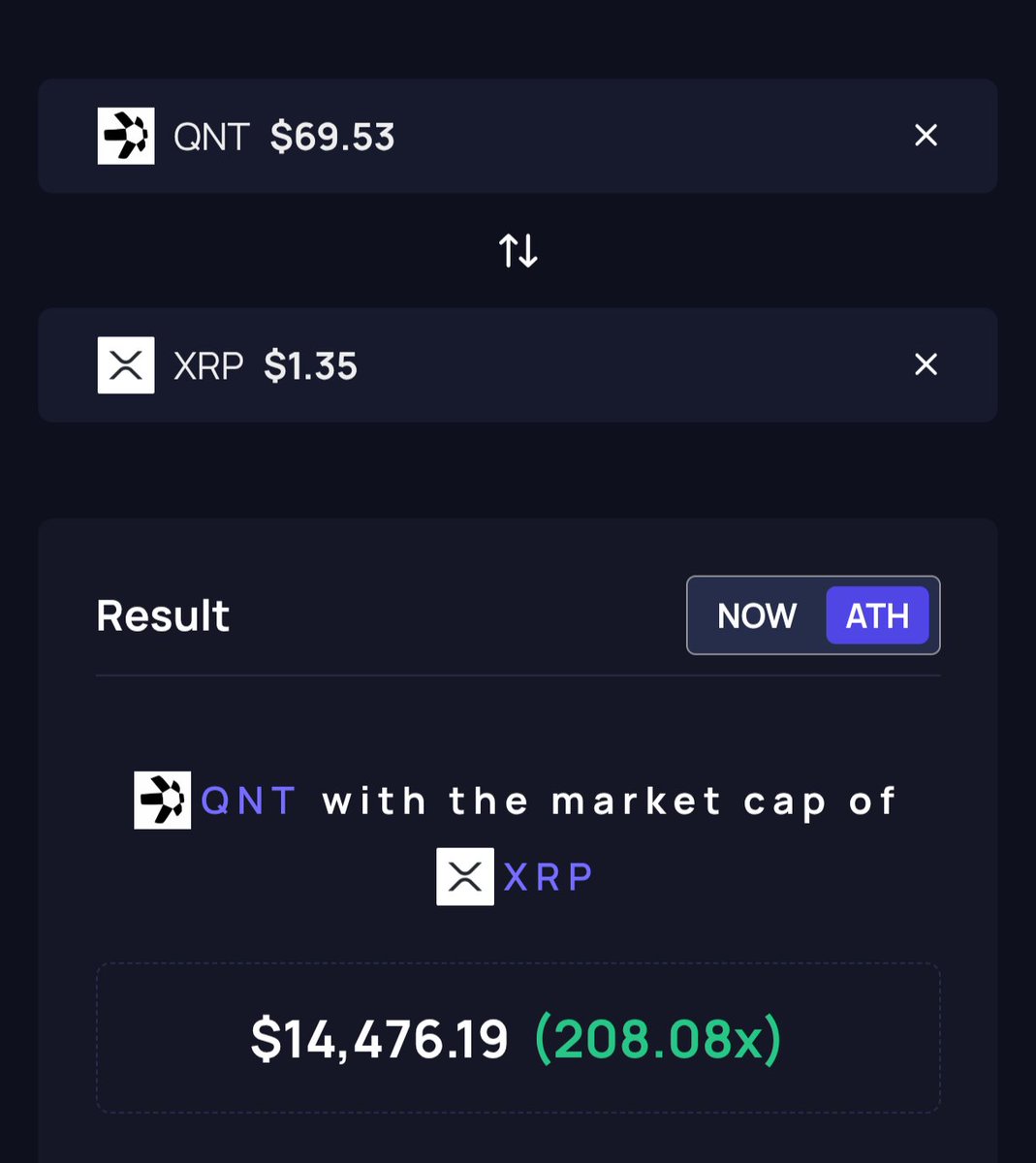
@JussSef @MindCrypto_ @Krane6983041 You buy the license and they get locked up for a year. If they continue with the license, they keep getting locked and if they don’t, then they enter back into circulation. There is no burning. This is infrastructure - once companies get a license they will likely renew.
English

@MindCrypto_ @Krane6983041 So thats a yes or no?..Just so im clear 🤔
English

🧿💥 $QNT been an absolute age since the last QNT tx' I've posted.
2 tx's from CB to private wallet of 1700 QNT
Possible license lock-up.
No ETH - No Outflows - Only Holds QNT.

English
@Krane6983041 @Tokenicer In his video he talks about the token being put back into circulation after the year lock up. He forgets that these licenses will be renewed as they are critical infrastructure. Also more companies will acquire licenses. He also mentioned nothing about staking and scarcity.
English

@Tokenicer Have you seen the last QNT video from @CryptoBellWether? Very interesting, perhaps concerning regarding QNT. Maybe we’re missing something. You should check it out.
English
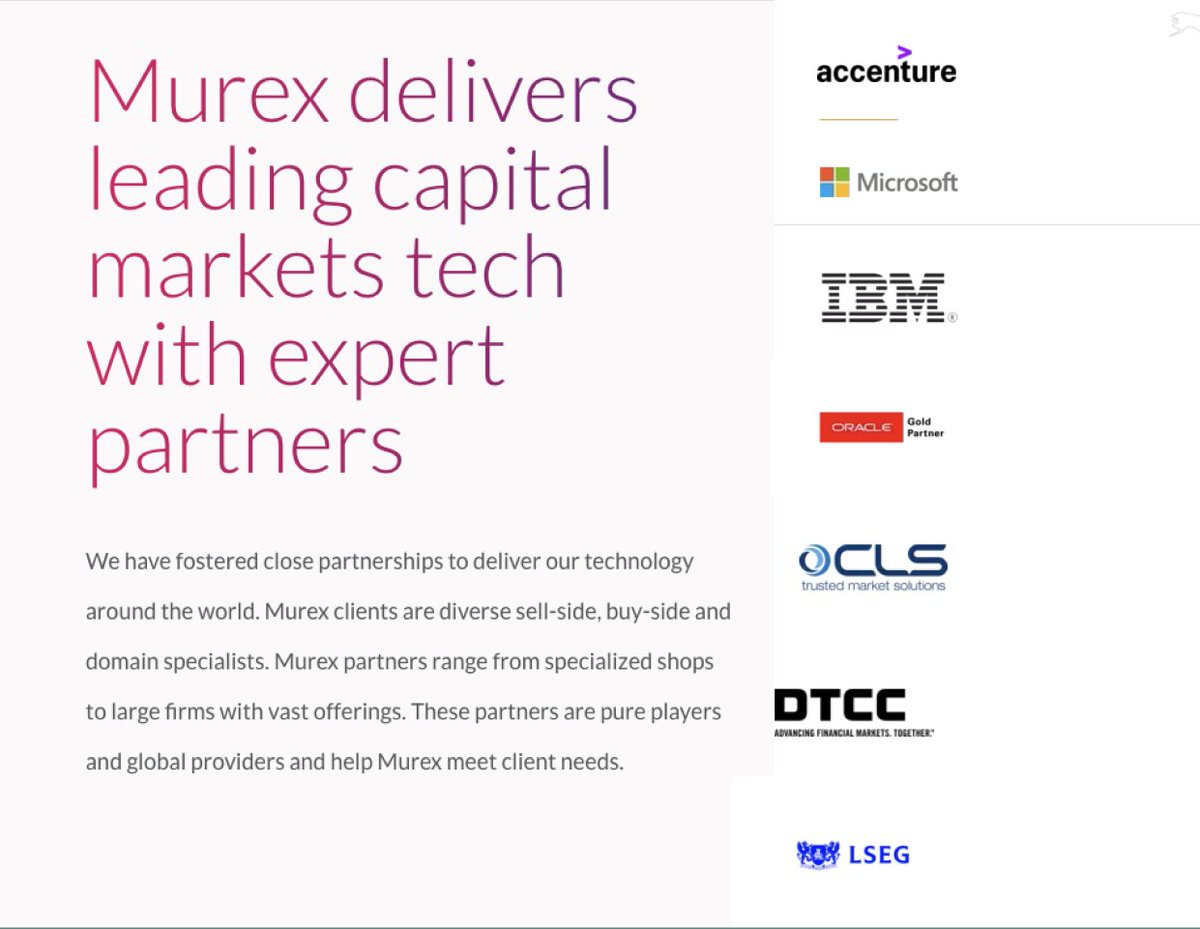
Safe to say $QNT bagged a financial giant via the Murex partnership
Just look at the partners/integrations
• Accenture
• Microsoft
• IBM
• Oracle‼️
• CLS
• DTCC
• LSEG
Most of retail probably hasn't heard of Murex
And there's a reason to that.
They operate in the backend as critical financial infrastructure for capital markets.
They're not meant for retail use or knowledge.
Exactly like how Overledger is positioned🧠
English
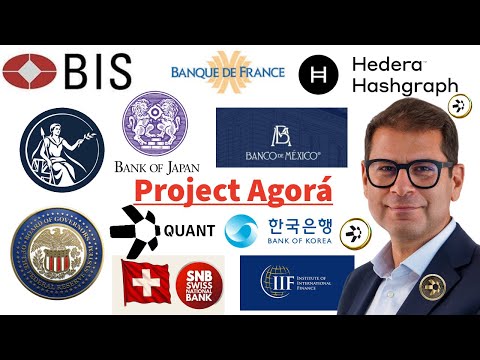
@Tdaddy49 @GMB271 @Teo7913 Ignore that imbecile! Look who's already chosen $QNT — Bank of England, ECB (Digital Euro), Bank of Japan, BIS, Project Agorá, Oracle, Murex, SIA & 11 major banks in the RLN to name a few. Sandboxes are going live. QNT is the interoperability layer of the new financial system.
English


Gem Hunter 💎 retuiteado



@PaulSla91786654 @Steph_iscrypto Should we believe you or Gilbert Verdian who has contributed to global financial and technology standards spanning ISO 20022, ISO/TC 68, and ISO/TC 307?
English

@Steph_iscrypto This is Apperantly not true and QNT is gaslighting us all. Just because it says it on the website don’t mean it’s real don’t you know what pilot means bro 😂😂 (sarcasm)
English

NEW: 🇬🇧7 major UK banks (HSBC, Barclays, Santander) launching tokenized deposits in Q2–Q3, powered by Quant.

English
Gem Hunter 💎 retuiteado
Here's a list of major companies that utilize @Oracle 👀
UnitedHealth Group — Uses Oracle Cloud ERP and other solutions for healthcare operations.
CVS Health — Relies on Oracle Cloud ERP for financial and operational management.
Netflix — Uses Oracle for database and cloud needs.
Microsoft — A major customer for Oracle Database and cloud services (despite being a competitor in some areas).
Intel — Employs Oracle solutions extensively.
eBay — Uses Oracle ERP and database technologies.
JPMorgan Chase — Known user of Oracle Database.
Cigna — Leverages Oracle Cloud ERP.
General Electric (GE) — Uses Oracle ERP.
Toyota — Relies on Oracle for various enterprise systems.
Coca-Cola — Uses Oracle solutions.
FedEx — Employs Oracle ERP for logistics.
Walmart — Uses Oracle ERP in retail operations.
Nike — Known to use Oracle ERP.
Airbnb — Uses Oracle technologies.
LinkedIn — Relies on Oracle for certain backend needs.
Zoom — Uses Oracle Cloud Infrastructure.
Bank of America — Uses Oracle Database and related tools.
Cisco — Employs Oracle solutions.
$QNT

English
@Primordialvibez @ZavenTheRapper I’ve seen his videos. He’s about selling a product.
English


Everyone is bullish on $QNT
Literally everyone.
Reveal yourself if you are not…
English
English


I’ve been stacking $QNT for a while now, almost at 600. Someone told me about $QNT overledger on twitter a year ago and ever since I been buying. Whoever posted a tweet about $QNT thank you 😊🙏🏿

English
@AndrewWood1967 @nubianroots That’s exactly the kind of structure that creates sustained price pressure over time.”
English
@AndrewWood1967 @nubianroots With Quant Network, enterprises don’t just ‘use and return’ tokens casually — licenses are prepaid, usage scales, and access to Overledger requires ongoing demand.
So no — it’s not infinite supply.
It’s fixed supply with recurring enterprise demand.
English
Gem Hunter 💎 retuiteado

What will happen if suddenly every internet gateway that uses the free open BGP routing protocol has to pay license for BGP usage, and that license is in a form of a token with a 14.8m fixed supply, that they have to pay in fiat to acquire ?
What will be the price of that token looks like?
I will tell you … that token price will go on the price chart straight up from 0 to 1m+ dollar, maybe even way more, not in a week not in a month in a single DAY candle.
The biggest candle ever seen on any chart.
English
Gem Hunter 💎 retuiteado
HERE IT IS: :)
Why a normal software license model falls short technically in the special case of Quant Overledger platform?
With a traditional software license (think Microsoft or IBM), the vendor can:
∙Issue unlimited licenses at will
∙Change pricing arbitrarily
∙Revoke licenses unilaterally
∙Require trust in a central authority to validate your license
This creates a fundamental problem for a multi-ledger interoperability platform: who do you trust to validate that a participant has the right to operate on the network?
If Quant Network just issued API keys or software licenses, every connected blockchain, enterprise, and developer would need to trust Quant Network the company as the single source of truth. That reintroduces centralization — the very problem blockchain tries to solve.
Why $QNT solves this technically?
1. Trustless license validation
Because QNT tokens are on-chain (Ethereum), any node, any connected network, or any smart contract can verify whether a gateway operator holds sufficient QNT without asking Quant Network the company. The token makes license validation cryptographically verifiable and decentralized.
2. Supply constraint creates honest signaling
$QNT has a fixed supply (~14.8M tokens). This is crucial: it means the total number of “licenses” that can exist at any moment is mathematically capped. With a traditional license system, the vendor could flood the market with licenses, diluting their value. The fixed supply means gateway operator commitment is credible — holding $QNT is a costly, verifiable signal.
3. Metering without a trusted intermediary
For transaction fees specifically, the token allows the network to meter usage programmatically. A smart contract can enforce “X $QNT must be locked to process Y transactions” without any Quant Network server needing to be online or trusted. The protocol itself enforces the rules.
4. Skin in the game / Sybil resistance
This is perhaps the most technically important argument. If licenses were just software keys, a bad actor could cheaply spin up thousands of fraudulent gateways. Because $QNT must be locked (not just held) to run a gateway, attacking or spamming the network has a real economic cost. The token is essentially functioning as Sybil resistance mechanism — the same reason proof-of-stake systems require validators to stake tokens.
5. Atomic cross-chain coordination
When Overledger orchestrates a transaction across, say, Ethereum + Hyperledger + Bitcoin simultaneously, something needs to coordinate the “go/no-go” signal atomically. $QNT locking can serve as that coordination signal across chains — something a traditional license key simply cannot do because it has no native on-chain presence on those networks.
For people arguing: “The token isn’t just a monetization layer bolted on — it’s load-bearing infrastructure.”
That’s correct. Without $QNT:
∙License validation requires trusting Quant Network centrally
∙Gateway operators have no credible commitment mechanism
∙Sybil attacks become cheap
∙Cross-chain atomic coordination loses its neutral on-chain anchor
∙The platform becomes, technically, just a proprietary API broker — indistinguishable from a traditional middleware company
The token transforms those trust problems into cryptoeconomic guarantees.
The honest counterargument.
To steelman the other side: Quant could theoretically replace $QNT with a permissioned validator set or a consortium model (like R3 Corda does). That would work — but it would mean the network’s security and neutrality depend entirely on who controls the validator set, which reintroduces political and legal risk for every enterprise building on it.
English

Gem Hunter 💎 retuiteado
🚨Let’s start building generational wealth together. There is a technological shift happening throughout the banking structure globally. We are moving into a 24/7 365 environment of INSTANT PAYMENTS in the context of moving money globally so investing in that infrastructure could be life-changing. The only way to truly change the trajectory of your life is to invest in infrastructure as things are being laid, and then capitalize off of that infrastructure being utilized $$$ Trillions of dollars a day will flow through the system! @gverdian @quantnetwork @OverledgerDev #overledger #ISOTC307 #ISO20022
To watch the whole Quant Network $QNT video Click the link is below 👇🏾
youtu.be/scT0gtlFXBo?si…
YouTube
English