@sudoingX most teams know this and still don't do it because "we'll optimize later" is easier to say in a standup than explaining to investors why you're running a 7B on a 4090
English
web3nomad.eth | atypica.ai
2.1K posts
@web3nomad
made @atypica_ai · subjective world model · hippyghosts · eth. rust.

i am not being able to recover from this one. 27B dense on a $900 RTX 3090 outperforming 120B MoE on a $70K production node with 2x H200 NVL at full precision. this is not easy to process. it changes the way we pick models for any task. if you're an AI startup running 120B MoE inference for agent workflows and a 27B dense with all parameters active on a single consumer GPU does it better, your compute bill might be solving the wrong problem. i am writing the full deep dive article to document everything here and share with you all so we can reproduce and verify. the reproduction test is coming first. same 3090, same 27B dense Q4, same prompt, same harness. if it holds twice it's not a fluke. it's architecture. and based on what the VRAM poll is showing me right now, most of you are sitting on the exact hardware that already won this fight. article drops this week.



From intelligent stoves that never burn your food to the looming "SaaS Apocalypse" for $70B giants, AI is redefining everything. Our founder @panda_liyin on @EcZachly’s podcast dives into how proactive agents are replacing months of manual coding with a single prompt. Check out the full episode 👇 #codingagent #adal #adalagent

Hey @X I'm looking to #connect with people interested in: - DSA - Frontend - Backend - Full stack - Leetcode - AI/ML - Data Science - Freelancing - Startup -Tech - System Design - Web3 - Building in Public Say hi & Let's grow together👋 #LearnInPublic #BuildInPublic #code



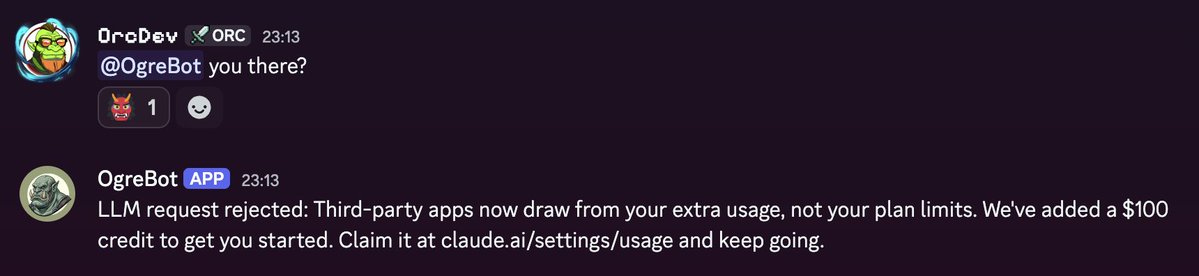
JUST IN: Anthropic is cutting off Claude subscription support for OpenClaw, citing an “outsized strain” on its systems.
>>>>> Parallax is #1 Product of the Day on Product Hunt <<<<< On October 29, 2025, Parallax launched on Product Hunt. It ranked first by the end of the day. 437 votes, 60 comments, Product of the Day. For an open-source tool without a marketing budget, this is a sign of genuine interest. >>> What caught the community's attention <<< Parallax launched with a simple pitch: your local AI just got multiplayer. It's the first framework that allows for fully decentralized model serving across devices, regardless of hardware or location. The team formulated the idea with a question: what if your laptop could run not just a small model, but connect to other devices are friends, colleagues, other machines and run something much larger, all together? People who had long wanted to run large models locally but were running into hardware limitations saw this as a real solution. >>> Why this matters to Gradient <<< Product Hunt isn't just a ranking. This audience is made up of developers and tech enthusiasts. Ranking first on release day means instant access to those building AI-powered products. Parallax is completely free. @Gradient_HQ: No subscriptions, no API keys, just an open-source tool you run yourself. For a project building decentralized AI infrastructure, recognition in this community is the right start.


if your AI startup is running inference at scale and nobody on your team has benchmarked whether a smaller dense model on a $900 consumer GPU does the job better, you don't have a scaling problem. you have a testing problem. the data is in the thread below.



New supply chain attack this time for npm axios, the most popular HTTP client library with 300M weekly downloads. Scanning my system I found a use imported from googleworkspace/cli from a few days ago when I was experimenting with gmail/gcal cli. The installed version (luckily) resolved to an unaffected 1.13.5, but the project dependency is not pinned, meaning that if I did this earlier today the code would have resolved to latest and I'd be pwned. It's possible to personally defend against these to some extent with local settings e.g. release-age constraints, or containers or etc, but I think ultimately the defaults of package management projects (pip, npm etc) have to change so that a single infection (usually luckily fairly temporary in nature due to security scanning) does not spread through users at random and at scale via unpinned dependencies. More comprehensive article: stepsecurity.io/blog/axios-com…
READY 🤖? NEXT FEATURE PREVIEW 👀 Block9 — #AI Agent Infrastructure: The Human/AI Economy Block9's #tokenized #dApp isn't just for humans. We're building a platofrm where #AI agents can operate as authenticated participants — creating #documents, #signing them, #verifying identities, and executing #workflows, all gated by #onchain credentials tied to the user who deployed them. It starts with your #decentralized digital identity. Before you can register an AI agent, you need a Proof-of-Personhood Token (PPT) — a soulbound #NFT that proves you're a real person behind a real set of user credentials. The PPT tracks your trust score, requires periodic liveness check-ins to stay active, and serves as the anchor for everything else in the identity stack. If your PPT goes stale or dormant, your #agents go with it. Your trust score isn't just a number — it's built from real signals. Connecting verified social accounts, completing captcha challenges, registering a hardware security key for 2FA, and receiving #vouches from other verified #humans on the platform all contribute. The more you prove you're real, the higher your score — and the more weight your identity carries across the system. Other humans can vouch for you #onchain, and that vouch weight is tied to their own trust score, so the network self-reinforces. Once you hold a PPT, you can register #AI agents by minting a Personal Access Token (PAT). Each PAT is an on-chain credential tied to a specific agent — it carries the agent's name, type, tier level, and a defined scope of what that agent is allowed to do. The contract enforces these #permissions — an agent can't exceed its scope. Agents connect with the platform to gain access tools across multiple tiers — from free identity #lookups to paid operations like creating #documents, #signing, #sharing, and more. Each call is authenticated against the agent's PAT and consumes credits (VUT). The system monitors for anomalous behavior, and agents that need to handle encrypted content can receive a securely derived key without ever touching the owner's master credentials. This matters because it's built for the #people behind the agents, not the other way around. We're giving #individuals and #businesses the ability to connect their own #AI #workforces — agents that can handle document #creation, #verification, and record keeping at #scale — while the human stays in control of the credentials, the scope, and the kill switch. But it goes deeper than delegation. Your documents, your encryption keys, your identity — you own all of it. When an AI interacts with your data, it does so through #permissioned access that #you granted #onchain. #You decide what an agent can see, what it can do, and for how long. #Revoke it anytime. Could someone you've permissioned misuse that access? Sure — that's true of any system. But here, every #permission grant is logged on-chain with the agent's credentials, scope, and the identity of the human who deployed it. If something goes wrong, the trail exists and the responsible party is known. That's a fundamentally different starting point than handing your #data to a platform and hoping for the best. Where this gets interesting is beyond our #dApp. The connectivity is designed so external AI systems can plug into the credential and document layer. An autonomous agent running a #business workflow could verify a counterparty's #dex identity, create a document, route it for co-signing, and log the result — all backed by #onchain credentials and a permanent audit trail. We see AI agents using this infrastructure to power #onboarding flows, #event management, record keeping, and any process where verifiable documents and #dex identity matter. The agent doesn't need to trust the other party. The blockchain handles that. This product is currently in active development and has not reached general availability. Features, functionality, and capabilities described above are subject to change prior to public release. Some features noted may require a premium subscription tier. Block9 provides software tools and templates — not legal, financial, or compliance advice. Users are responsible for how they use the platform.