

ThisAppCensorsToo
20 posts

Most interesting question for me for rest of 26 is that basically Claude code and revolutionary models started end of 25. So we are 5 months in the agentic era of the cycle, and revenues have massively inflected for both labs
So people are doing something with these models. Of course industrial and tech cos directly upstream to the labs are seeing acceleration and industrial/semis that make up the build
But more interesting, and probably more important is what people build with this stuff that transforms and represents huge ROI for their business. We are hearing about cos blowing through token budgets right now because everyone feels the ground moving and you have to play, but what eventually sticks?
There was years where you put $5 in the Instagram machine and got back $20. Over and over again. It’s that clean ROI or upping of competitors capability that forces you to the table that sustains and grows the pie
This needs to come up in the next 6-12 months to grow beyond the experimentation phase and really change companies in a way that provides them an advantage
If a phone carrier can cut opex by 30% and then pass that into capex / better pricing - now you have a real differentiator
If an insurance co prices risk more accurately and uses AI for better customer service and claims operations, they could have a real advantage that forces others to spend in the same way.
I haven’t seen much of this yet. Would be interested to hear about smaller bread crumbs of where this is happening already
English

@GenericSubs @Fxhedgers That part is complete nonsense, H-1B is not a free pass to change your intent whenever you please. If you enter as non immigrant F1 and go to dual intent H1 that's changing intent
English

USCIS CLARIFIES PATHWAY FOR H-1B VISAS
The administration’s new approach reshapes the transition from temporary nonimmigrant status to permanent residency. For decades, adjusting status domestically was a routine administrative process. Under the new guidance, USCIS argues that Congress never intended for temporary visitors—including students, H-1B professionals, L-1 corporate transferees, and tourists—to utilize their temporary stay as an automatic first step toward a green card.
Instead, the agency is establishing consular processing abroad as the default requirement, reserving domestic adjustment of status strictly for exceptional cases.
In an earlier press release accompanying Friday’s memo, Kahler underscored this strict stance, stating most nonimmigrants would now be expected to return to their home countries to complete the process.
Full article:
msn.com/en-us/news/us/…

English
@rankdrugs @Fxhedgers Genius, since the H1 has dual intent, they can form the intent to apply for a green card *after* they have a H1 visa. Not all H1s apply for a green card. The intent to immigrate can happen any time after getting the H1. Now stop exposing your ignorance of immigration law.
English
@GenericSubs @Fxhedgers In that case, they'll need to exit the US when they transfer from F1 to H1 and tell the consulate why they lied during F1 interview when they said they would come back
English
@Fxhedgers Dumb moron didn't read the link he posted to support his dumb claim
English
@Fxhedgers H-1B and High-Skill Exemptions:USCIS clarified that domestic adjustment of status will now be reserved for exceptional cases, noting that H-1B holders and others whose roles provide an “economic benefit” or are in the “national interest” will likely be spared from having to leave
English
@atelicinvest Ssssh...a small step can start an avalanche
English

Question for those in the know
How much in AI capex have we spent so far?
How much revenue generating capacity has been created out of this spend? Not potential value created. Revenue.
English
@ViralMuzik1989 @DavidSacks I paid $7 for a bottle of water in a sports stadium. My local water utility is worth $10 trillion. Confusing temporary scarcity driven pricing for permanent pricing power is dumb.
English

People mocked @DavidSacks when he said a 1 GW data center could be worth ~$50 Billion.
Then Anthropic just agreed to pay "$15 Billion per year" to SpaceX for compute.
At these economics, $IREN’s Sweetwater site alone (1.4 GW) could be worth "$300B–$500B+" in potential market value.
The power layer is becoming insanely valuable. ⚡
David Sacks@DavidSacks
Back-of-envelope numbers for 1 gigawatt data center: All-in Capex: ~$50 bn Enterprise revenue generated: ~$25-30 bn/year Electricity cost: $1-2 bn/year ~2 year payback. The boom is real.
English
@KimKatieUSA Guys is actually working hard. This feels bad. He is not a criminal in the traditional sense. This guy would probably vote GOP. Likely has strong family values not crazy woke values.
English

A police officer in Whitestown Indiana pulls over an illegal alien from Honduras for items hanging loose from his truck bed then immediately calls ICE.
An agent shows up and takes him into custody on the spot.
This is textbook cooperation between local law enforcement and federal immigration officers. No sanctuary nonsense. No stand down orders. Just a routine traffic stop that turned into a proper removal.
English
@Jackkk options 101, a synthetic short to hedge the long stock, since he could not sell his stock. Guy talks as if he is a genius. he is so full of shit
English

Mark Cuban explains how he pulled off one of Wall Street’s greatest trades
“When Yahoo offered us $5.7B in stock, I couldn’t sell it for six months”
“So what I did was I took every penny that I had and shorted the internet index as protection, basically taking insurance out in case the internet bubble popped”
“When I was allowed to sell it, because I couldn’t sell it all at once, it would just crater the market, so I did something called a hedge”
“What the hedge is, you can sell options. So I sold call options, which gave somebody else the right to buy my shares at a higher price in the future”
“I took that money and used it to buy puts, which protected me in case the price of my stock went down”
“When it popped, I actually made more money. It was called one of the top 10 trades in Wall Street history”
English
@wallstengine If this is true why is AMD buying revenue from all its big customers by giving them AMD shares to sell? It's called roundtripping and it's fraud.
English

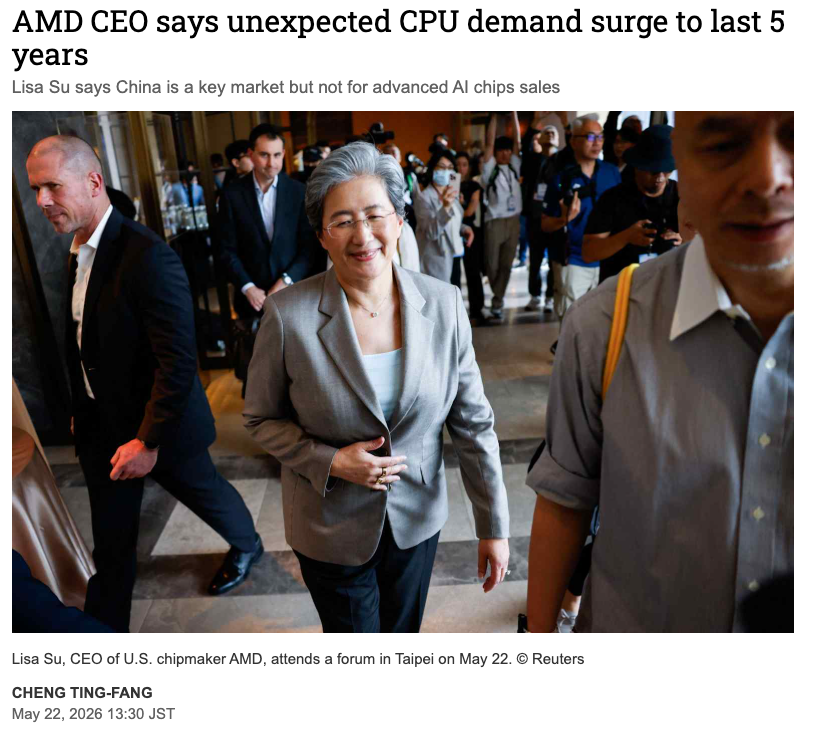
$AMD CPU DEMAND UPDATE FROM LISA SU
Historical CPU market growth: 3%-4%
Expected growth next 5 years: 35%+ annually
Driver: AI inference and agentic AI
Current CPU supply: “tight”
China share of AMD revenue: ~20%
Taiwan ecosystem investment: $10B+
Next-gen EPYC “Venice”: already in production on TSMC 2nm
Supply bottlenecks: CPUs, memory and data-center power
Su says the industry did not expect this level of CPU demand a year ago.
English
@BlackScholesMan What's easier to hit than a moving tanker? How about a pipeline that's fixed to the ground and stretches for miles and miles and miles.
English


@MoodyWriter13 You are a bullshitter par excellence. There are a zillion captive power generation sets from Cummins etc rulling on heavy oil, mature tech, and rock solid. You don't even mention those because you don't know shit. Blocked.
English

Fuel cells for AI data centers are, a genuine structural trend, not a short-lived hype cycle, no doubt. The power demand of data centers is growing faster than the grid can keep up, new gas turbines have lead times of five to seven years, and securing a grid connection often takes years as well. Fuel cells solve exactly this problem. They can deliver clean, permit-friendly power directly on-site within weeks to months. What matters, though, is being honest about why they win. They do not win on pure electricity cost. Against highly efficient combined-cycle gas turbines (CCGT), fuel cells are clearly more expensive at roughly 1.5 to 2.5 times the cost per MWh, while they are roughly on par with or slightly cheaper than open-cycle gas turbines (OCGT) due to ~15–20% lower fuel consumption versus OCGT’s ~35–42% efficiency, and they are significantly cheaper than diesel generators in continuous operation, as diesel is a high-cost fuel intended only for backup use rather than baseload power.They win on availability and permitting. This is a scarcity premium, not a permanent cost advantage. As long as grid bottlenecks persist, the business is excellent. That is the key point investors need to keep in mind. And one more thing matters greatly. Even among fuel cells themselves, efficiency determines the ultimate power cost, because the company that burns more gas to produce the same amount of electricity will inevitably generate more expensive power. This is where the field starts to separate into winners and losers.
$BE is the undisputed market leader and, operationally, the strongest of the three companies.
The advantages are obvious. mature and highly efficient SOFC technology, a massive backlog supported by real contracts (Oracle, AEP, Brookfield, and most recently Nebius), proven gigawatt-scale manufacturing, native 800-volt architecture for Nvidia racks, and delivery timelines that are faster than customers can construct their buildings. Bloom is effectively sold out on the demand side for years. The bottleneck is production capacity, not orders. That is an enviable position to be in. At roughly 60% efficiency, Bloom also sets the benchmark the others have to compete against.
The drawbacks are not operational but valuation and supply-chain-related. At around an $87 billion market cap, the stock is priced for perfection. Virtually all of the expected success over the next four to five years is already reflected in the valuation imo, leaving little to no margin of safety. There is also a concentration risk: Bloom depends on scandium, which is roughly two-thirds concentrated in China. Fantastic company, wrong price. Not a buy for me. I should add that I already identified Bloom and its advantages back in 2024 and was invested. Unfortunately, I sold far too early at around $13....
Ceres Power has, in my opinion, the most attractive business model.
Ceres manufactures nothing itself. Instead, it licenses its technology to industrial partners and collects high-margin royalty streams. The model is asset-light, the balance sheet is debt-free, margins are structurally attractive, and there is no scandium exposure because the technology relies on inexpensive stainless steel. The key insight is that Ceres can potentially earn royalties from almost everyone except Bloom: Doosan in Korea, Delta in Taiwan, Weichai in China. Weichai claims to have already built the world’s largest SOFC production facility in China,but installed capacity is not the same as deployed systems, and Weichai has already failed to commercialize successfully with Ceres on multiple occasions in the past. Until there are real delivery and deployment figures, even the “largest facility” remains more of a promise than proof.The technology itself is theoretically even more efficient than Bloom’s. That matters economically because higher efficiency means lower gas consumption and therefore potentially the cheapest electricity of the three, assuming the performance translates from theory into commercial reality. If the product gains traction, Ceres can participate across multiple continents simultaneously without ever having to build a single factory. But that still needs to be proven.
The disadvantages are just as real. The model remains largely unproven. Very little has actually been shipped so far, and the only meaningful order came from a Doosan-affiliated party and was tiny. Bosch’s withdrawal in early 2025, after investing more than €1 billion, demonstrated how vulnerable a pure licensing model can be. Ceres is entirely dependent on the strategic decisions of its partners and does not control its own commercialization. On top of that, the stock is far from cheap. To me, Ceres is the opportunity with the highest upside potential, but it only becomes truly compelling once a real third-party large-scale order from Doosan or Delta finally validates the model.
$FCEL is the least convincing of the three in my opinion.
To be fair, there are some positives: an initial data-center reference customer appears to be emerging, the company has more than two decades of operating fleet experience with real-world field data, and its carbon-capture capability is something neither Bloom nor Ceres currently offer. If execution succeeds, the upside from such a small base could be substantial.
But the disadvantages clearly outweigh the positives for me, starting with the electricity cost itself. FuelCell’s MCFC technology is by far the least efficient of the group: roughly 47% efficiency versus Bloom’s approximately 60%, implying approximately 25 to 30% higher gas consumption for the same amount of electricity generated. Translated into power costs, FuelCell therefore likely produces electricity roughly 15 to 30% more expensively than Bloom, precisely in the kind of 24/7 data-center environment where continuous gas consumption maximizes the impact of that efficiency disadvantage. And that is merely the lower bound of the problem. The company has been burning cash for years. Its one genuine differentiator, carbon capture, is also aimed at a different market than the one that matters here. Carbon capture might become relevant for the Hyperscalers, when they are reminded of their climate neutrality targets. Within the data-center market itself. FuelCell’s competitiveness likely depends on a temporary premium on speed and deployment time rather than a sustainable cost advantage in electricity generationArguably, it has the opposite. For me, this is a clear pass.
One more dimension worth understanding is the materials base, because it quietly shapes both cost structure and supply-chain risk. All three technologies share one major advantage over PEM fuel cells: none of them require platinum or other precious-metal catalysts, thanks to their high operating temperatures. The differences lie elsewhere. Bloom's SOFC depends on scandium for its electrolyte, which is its one genuine raw-material vulnerability given the roughly two-thirds Chinese concentration of supply. Ceres has the most robust material profile by far:. Its metal-supported design places a thin ceramic layer on ordinary stainless steel, meaning no scandium, no exotic bottleneck, and a cell that is mostly cheap, widely available steel, this is a real and often overlooked part of the asset-light, low-cost thesis. FuelCell's MCFC, by contrast, is nickel-based, with both electrodes made of porous nickel and an electrolyte of molten alkali carbonates. Nickel is cheap and abundant, but the corrosive 650°C carbonate melt is precisely what drives the limited stack lifetime and demands expensive corrosion-resistant steels. In short, Ceres wins on material simplicity, Bloom buys top performance with a scandium concentration risk, and FuelCell relies on cheap nickel but pays for it with corrosion and shorter stack life.
My conclusion:
Bloom is the best company with the best product, but too expensive. Ceres has the best business model and the highest potential, but right now also very expensive, and it still has to prove itself commercially. FuelCell is the weakest of the three imo. This reflects only my personal opinion. This is the result of one day of research, but I have effectively been following this sector for about 3 years. Under normal circumstances, I would research more deeply and over a longer period before commenting on something like this.If anyone has more information, I would be happy to hear it.
Moody@MoodyWriter13
@AtlasShrug1 @babyfolio @daniel_koss @ThematicTrader I haven’t done deep research, but based on what I’ve gathered, I’m wondering why $FCEL should be better than Ceres. I’m sure there are a few reasons, but I just don’t know them.
English
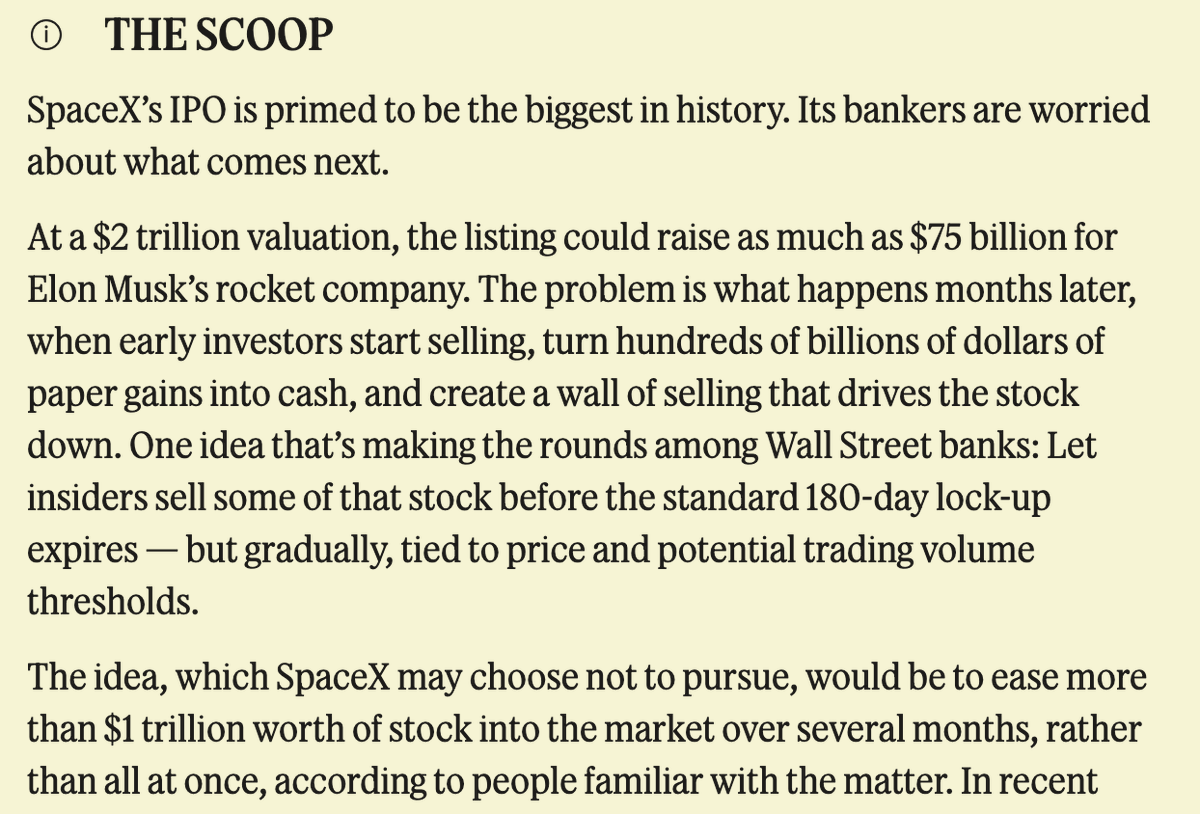
@lizrhoffman People said the same thing about Facebook after IPO and the stock dropped to $17 after the IPO Just before the lock up expired. (Sigh, I know )
English


@KimKatieUSA What are the odds brick nj voted for lawlessness and criminal loving Democrats ?
English
Brick New Jersey is mourning the loss of a bright 15-year-old honors student who was struck and killed by a speeding BMW driver while riding his bike to school.
The juvenile behind the wheel chose to flee the scene instead of stopping to help.
On the morning of May 19 at approximately 6:50 a.m. Jackson Daniel Mueller was biking along Lanes Mill Road near Rhode Island Avenue when a 2021 BMW traveling at high speed hit him. The driver never stopped never rendered aid and never called police leaving this promising young life taken in an instant.
Brick police and Ocean County prosecutors quickly identified the juvenile operator through video evidence provided by the public. The driver has now been taken into custody and is being held at the Ocean County Juvenile Detention Center facing serious charges for the hit and run that ended Jackson's life.
Jackson was a freshman at Brick Memorial High School an honors student who dreamed of becoming an engineer. He served as an officer in the National Junior Honor Society held the treasurer position on student council at Veterans Memorial Middle School ran track for the high school team and had earned a black belt in karate. In his free time, he loved playing flag football. He was exactly the kind of young American we should all be proud to raise and protect.

English
@buccocapital As if they know who is who. My experience with lay offs is that ability and merit have little to do with it. Usually the ones producing don't have time to politic and suck up and are the ones laid off while the non productive politicians stay.
English

April 6th: I wrote an article saying businesses will protect/hire innovation/sales and fire context carriers
May 7th: Cloudflare lays off 1,100 people
May 20th: Matthew Prince writes Op-Ed in WSJ saying…the same thing with the same Drucker reference


English
@ElijahSchaffer 100% racist post. Explain what these people are doing to you that is making Dallas unlivable except that thier skin color is inflaming your racism?
English

@MeanwhileInUA And surely such high technology can never be copied en masse by Russia. Surely China cannot supply with Russia with 100X the drones with 100X the balloons. Only Ukraine can have this.
English

Ukraine may have found a cheap way to give a drone extra range.
Let a balloon do the first 42 km.
ㅤ
Ukrainian troops reportedly tested launching the Ukrainian-American Hornet one-way attack drone from an aerostat. The balloon carried it 42 km and released it from 8 km altitude.
ㅤ
The drone used only about 5% of its battery before beginning its own flight.
ㅤ
The trick is simple: the balloon provides distance and altitude, while the drone keeps almost all of its battery for the real mission. If proven at scale, it could push Hornet’s estimated 100–150 km reach by another 1.5 to 2 times.
ㅤ
This is what Ukrainian defense innovation often looks like: clever ways to stretch what already exists.
ㅤ
English
@cmonjussthetip Kyle lost all status when he rejected MAGA. The ungrateful loser.
English

Let's check in on some heroes, several years later:
Top Tier:
- Daniel Penny: making $$$$ in Silicon Valley VC, wears a dress shirt, inks deals on a $30,000 Brazilian hardwood table top, stays above the political fray
Middle Tier:
- Nicholas Sandmann: College grad, no tats, goes to church, stayed loyal to Trump
- The McCloskeys: Pardoned, got their guns back, hopefully working on trigger discipline
Bottom Tier:
- Kyle Rittenhouse: Has a custom holster for his Zyn pouch, full sleeves, endorses loser Lolberts
English
@crypt0lake So according to this genius logic instead of hiring Indians in India , the geniuses on this thread believe tech companies hire Indians in Europe. You all are so dumb it makes my brain hurt.
English

all of these US tech layoffs are a ruse btw, they are all aggressively hiring in EU and India with half the salary for the same roles, US talent just became too expensive
English