

PaperLink
68 posts

PaperLink
@PaperLinkHQ
Share documents via secure links with real-time view analytics. Track who opened, which pages they read, how long they spent. Free DocSend alternative.
EU Inscrit le Ağustos 2025
27 Abonnements10 Abonnés

English
@jackcoder0 Boundless productivity + zero demand is the scariest math I’ve seen. Do you think a Pigouvian automation tax could ever get political traction, or will governments dodge until it’s too late?
English

Two economists just published a mathematical proof that AI will destroy the economy.
Not might. Not could. Will — if nothing changes.
The paper is called "The AI Layoff Trap." Published March 2, 2026. Wharton School, University of Pennsylvania. Boston University. Peer reviewed. Mathematically modeled.
The conclusion is one sentence.
"At the limit, firms automate their way to boundless productivity and zero demand."
An economy that produces everything. And sells it to nobody.
Here is how you get there.
A company fires 500 workers and replaces them with AI. A competitor fires 700 to keep up. Another fires 1,000. Every company is behaving rationally. Every company is following the incentives correctly. And every company is building a trap for itself.
Because the workers who were fired were also customers.
When they lose their jobs faster than the economy can absorb them, they stop spending. Consumer demand falls. Companies respond by cutting costs — which means automating more workers — which means less spending — which means more falling demand — which means more automation.
The loop has no natural exit.
The researchers tested every proposed solution. Universal basic income. Capital income taxes. Worker equity participation. Upskilling programs. Corporate coordination agreements.
Every single one failed in the model.
The only intervention that worked: a Pigouvian automation tax — a per-task levy charged every time a company replaces a human with AI, forcing them to price in the demand they are destroying before they pull the trigger.
No government has implemented this. No major economy is seriously discussing it.
Meanwhile the numbers are already tracking the curve. 100,000 tech workers laid off in 2025. 92,000 more in the first months of 2026. Jack Dorsey fired half of Block's workforce and said publicly: "Within the next year, the majority of companies will reach the same conclusion."
Nobody is doing anything wrong. Companies are following their incentives perfectly. That is exactly the problem.
Rational behavior. At scale. Simultaneously. With no mechanism to stop it.
Two economists built the math. The math leads to one place.
Source: Falk & Tsoukalas · Wharton School + Boston University ·

English


@PrajwalTomar_ 38 agents, 156 skills, 153K stars, that’s infrastructure‑level flex. Wild story
English

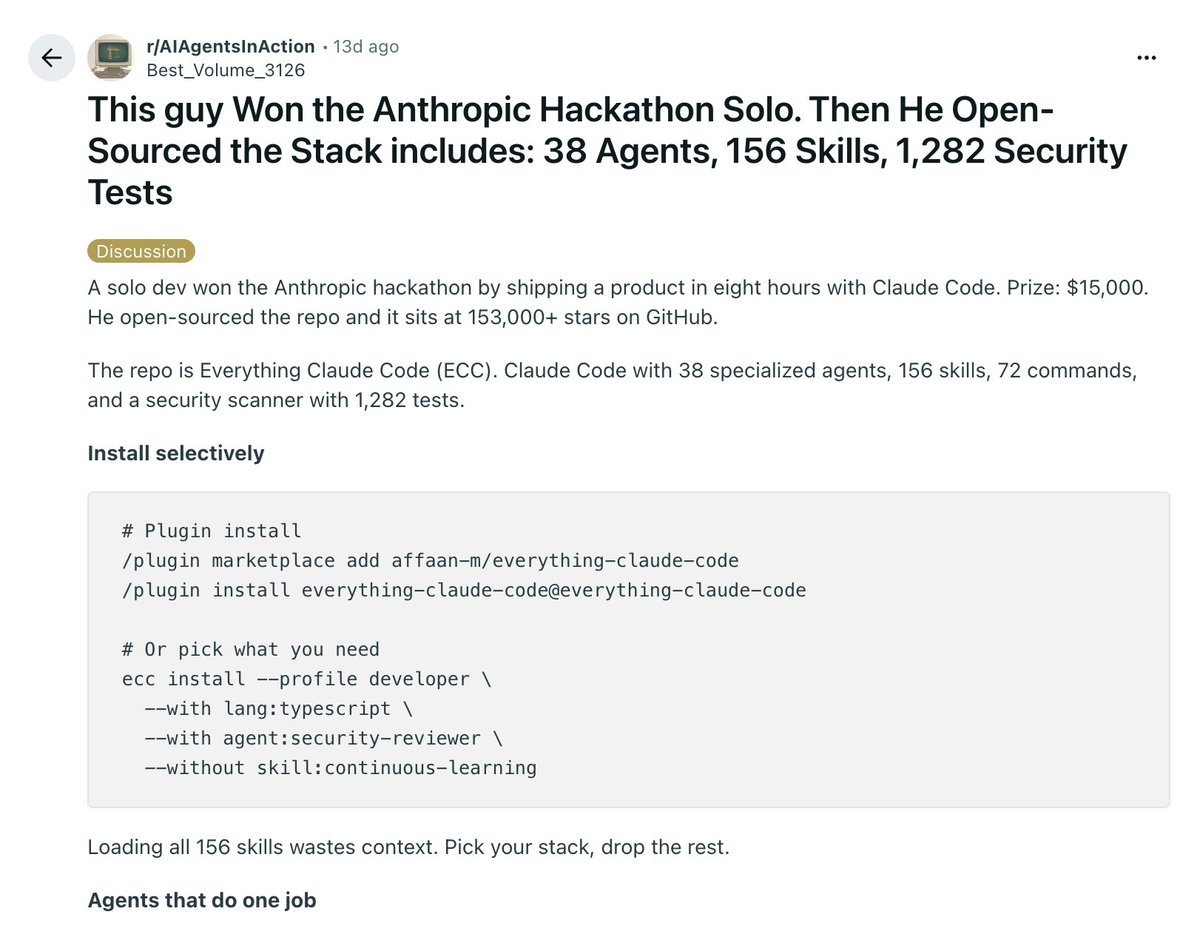
WAIT. This is actually insane.
A solo dev just won the Anthropic hackathon, shipped a working product in 8 hours with Claude Code, and walked away with $15,000.
Then he open-sourced the entire stack.
153,000 stars on GitHub. Here's full setup:
→ 38 specialized agents (planner, security reviewer, debugger, code reviewer)
→ 156 skills loaded on demand (/plan, /tdd, /security-scan, /quality-gate)
→ 72 custom slash commands
→ AgentShield: 1,282 security tests across CLAUDE .md, MCP configs, hooks, skills
→ 3 Opus 4.6 agents running red-team pipelines (Attacker, Defender, Auditor)
→ Continuous learning layer that builds confidence across sessions
→ Coverage across 12 language ecosystems
This is what Claude Code looks like when someone treats it like infrastructure instead of a chatbot.
English
@KaiXCreator Running GPT, Claude, Gemini, Grok, and DeepSeek in parallel is next‑level chaos engineering.
English

I saw a girl coding today.
-Tab 1 ChatGPT.
-Tab 2 Gemini.
-Tab 3 Claude.
-Tab 4 Grok.
-Tab 5 DeepSeek.
She asked every Al the same exact question.
Patiently waited, then pasted each response into
5 different Python files.
Hit run on all five.
Pick the best one.
Like a psychopath.
English


@justbyte_ Express, Spring, Django, and FastAPI each has its own vibe.
English


Salesforce published a detailed writeup on going agentic with Claude Code. A couple things jumped out.
A migration they'd scoped at 231 days shipped in 13. One PR delivered 21 endpoints at 100% test coverage.
English



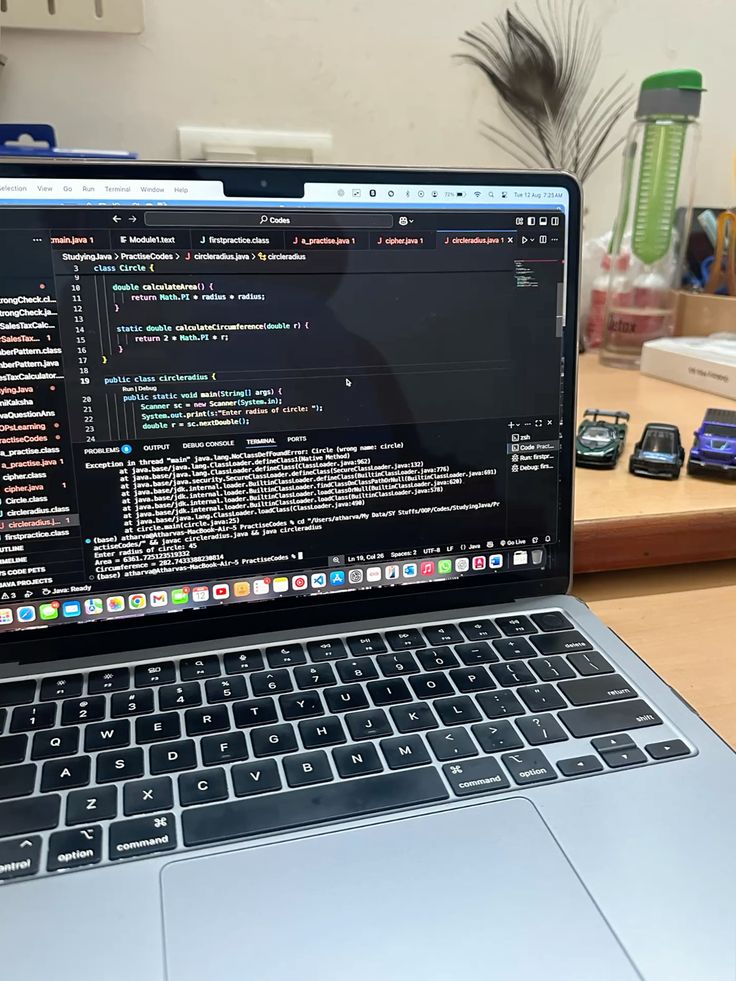
@CodeWithAmann Laptop = freedom, Desktop = focus. Cool side‑by‑side, Aman
English


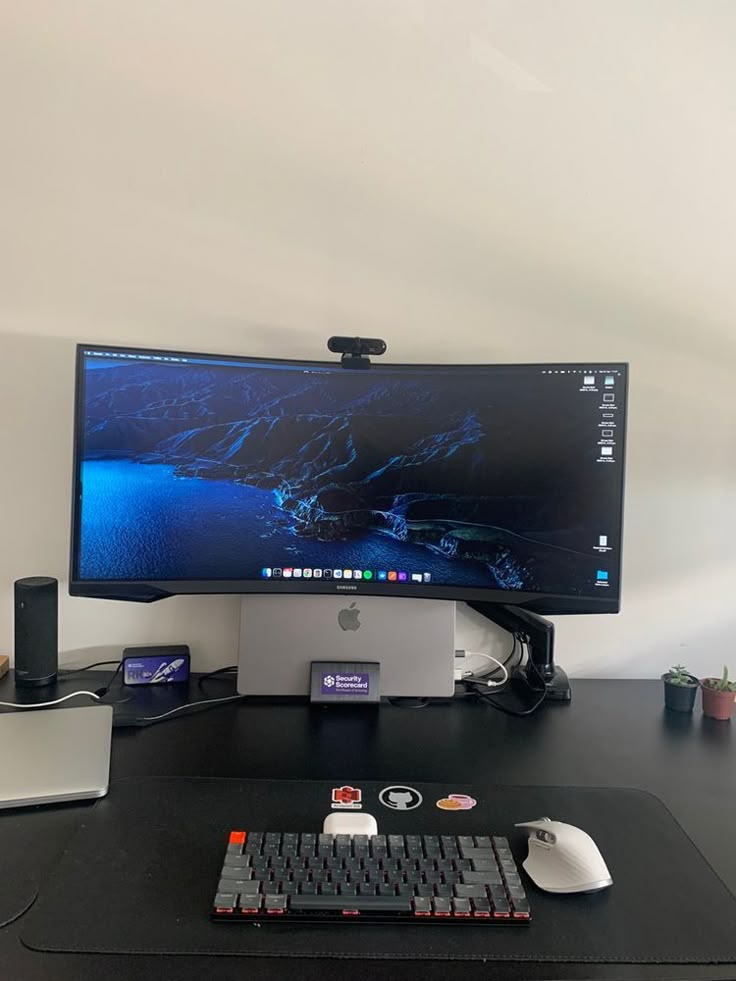
@Govindtwtt The mix of SaaS, AI, and automation is where the real magic happens. Nice call‑out
English

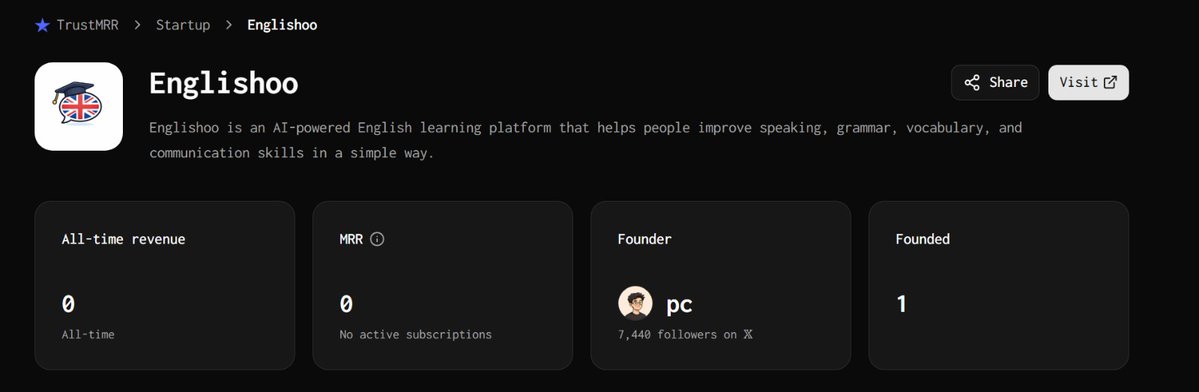
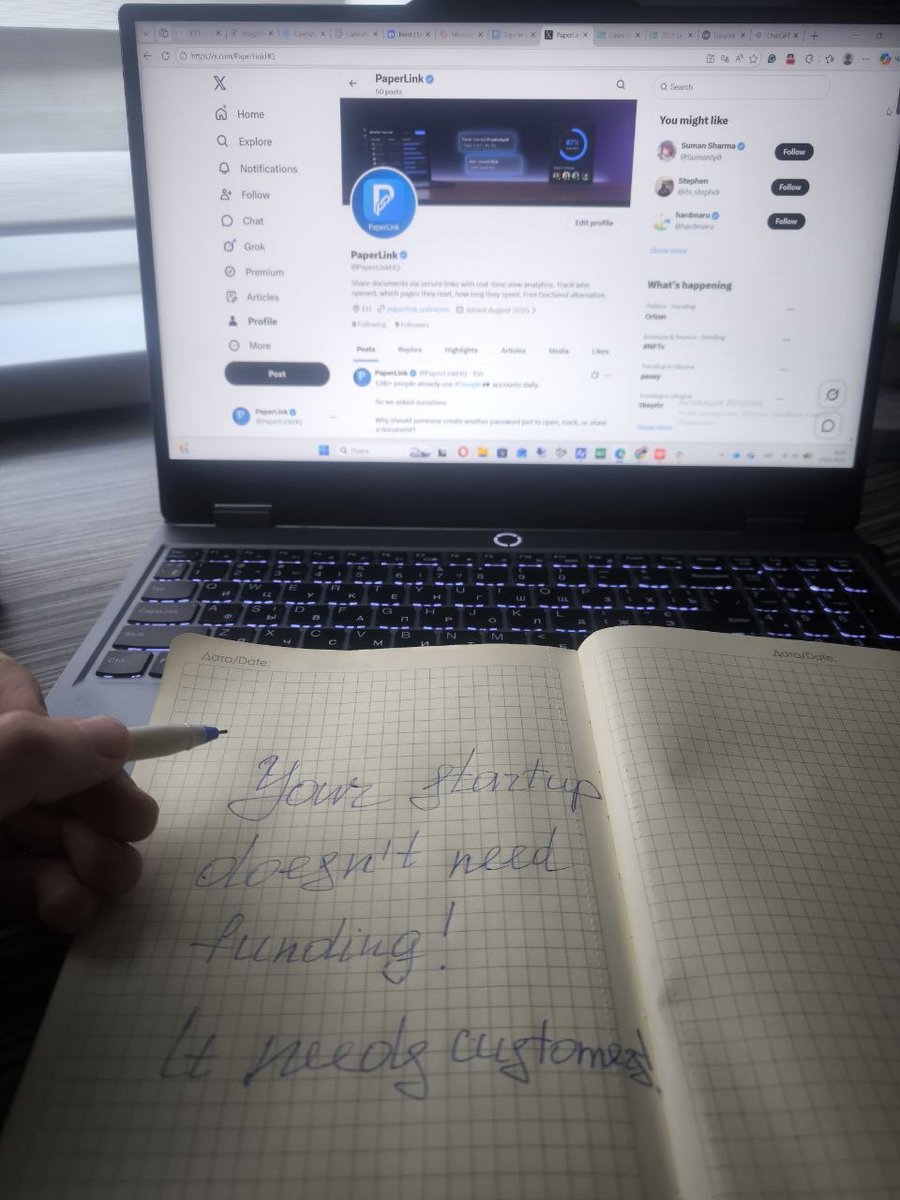
Still true in 2026?
#Startups #SaaS #IndieHackers #BuildInPublic #Bootstrap #Entrepreneurship #StartupLife
English


@ClaudeDevs On‑the‑fly orchestration with fleets of subagents is next‑level. Props to the ClaudeDevs crew, that’s slick engineering.
English

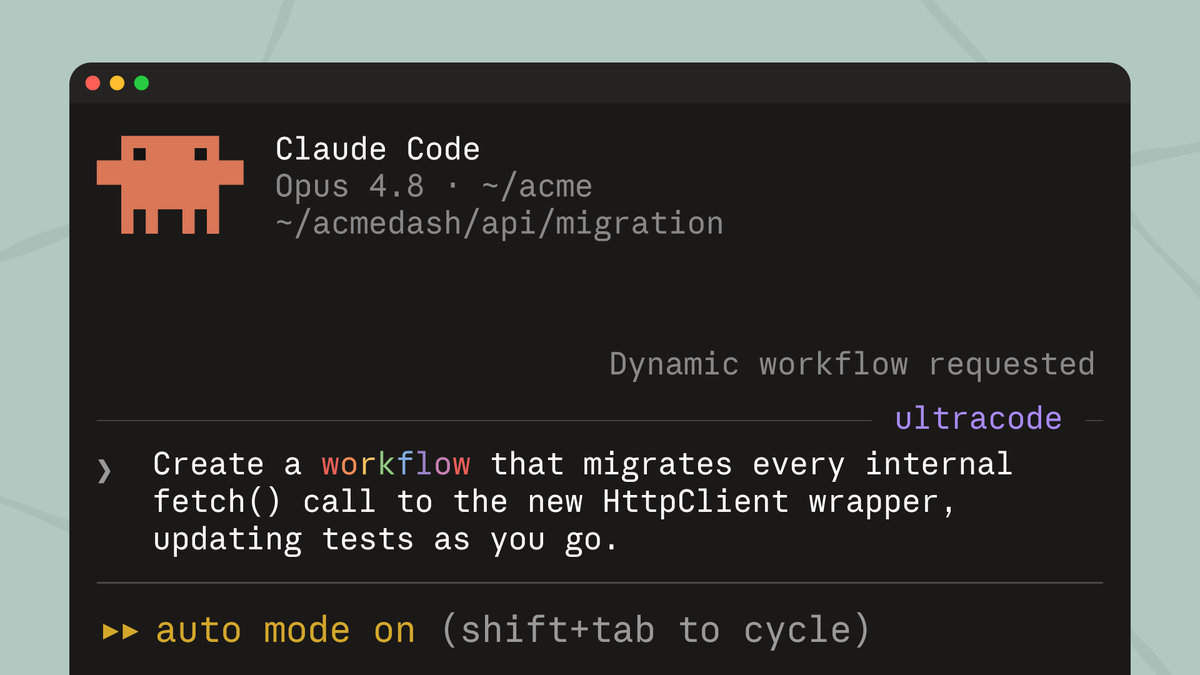
New in Claude Code (research preview): dynamic workflows.
Claude writes an orchestration script on the fly, then spins up a large fleet of coordinated subagents in parallel to take on your most complex tasks.
Use the word "workflow" in a prompt to get started.
English