
Tweet épinglé
albeit
24.4K posts


albeit
@albeit
Atheist Libertarian Bastard Extraordinaire In Training 🗽 🇺🇸 🇮🇪 🇺🇦
United States Inscrit le Temmuz 2008
284 Abonnements339 Abonnés
Destroying capital lowers future employee total compensation.
Because capital competes for employees.
Anytime capital is invested, it’s to get employees to do work.
Make a profit and your capital can do it MORE. The more profits you make, the more you can spend on employees.
Lose money and your capital can’t pay employees as much. It shrinks.
But get absolutely nothing back (the favorite pattern of government) and that capital can’t pay employees to do anything ever again.
The socialists want to divert capital away from innovators and into the hands of grifters who just consume the capital.
That’s how societies get poorer.
English

@paulg The fundamental error of socialism, which smart people still fall for, is shifting capital allocation from highly effective entrepreneurs to astonishingly ineffective government.
This dramatically reduces total goods & services output, which determines our standard of living.
English
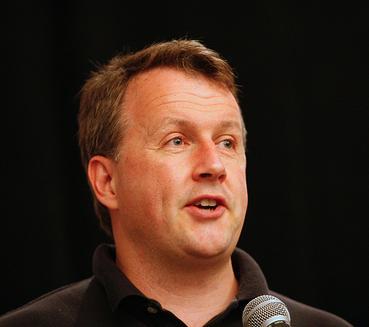
Elizabeth Warren says her wealth tax will "rebuild America's middle class." Amusingly enough, that's true! The reason the middle class has been shrinking is not because more people are becoming poor, but because more are becoming rich. Her tax will reverse that trend.

English
How much the employees of a nation can earn is directly dependent on how capital is deployed in that nation.
The more capital there is, the more competition there is for employees and the higher total compensation is.
But if we let government take capital and GIVE it away in exchange for nothing, there is less capital, less competition for employees and less total compensation.
English

@hashjenni It’s sad that schools don’t teach economics.
You’d be much happier if you understood how the economy actually works and how much you depend on entrepreneurs.
English

Here’s how dumb socialism is.
Mao collectivized farming in China. No more private farms. If you grew a potato for your own family, you would be punished. Possibly even shot.
So it caused a famine.
Brilliant Mao decided SPARROWS were to blame.
They killed millions of sparrows.
They were so proud of themselves, they filmed it for propaganda purposes.
It only made the famine WORSE, because sparrows were no longer around to eat agricultural pests.
Socialism puts dummies in charge.
youtu.be/ojOmUWLDG18?si…

YouTube
English

@APompliano Socialism is not dumb people who think this actually they r dumb. Capitalism is temporary but socialism was there from the very beginning of the civilization and will remain there until doomsday
English

@cafreiman This is the woman who thinks there’s something wrong with people talking to each other without a moderator.
English


@firsttofreewill @tautolog @RobotReorg @RockChartrand How much risk a company faces has nothing to do with who owns it or how much individual shareholders own.
English

@albeit @tautolog @RobotReorg @RockChartrand Even proponents of Capitalism can often admit that extreme concentration of passive wealth can "ossify" into rent-seeking or political privilege that looks feudal in nature.
English

You aren’t “making the company” $2000. You’re participating in a system that required inventory, suppliers, logistics, software, branding, buildings, electricity, insurance, managers, advertising, theft loss coverage, accounting, training, maintenance, taxes, and the capital risk to exist before you even walked in the door.
By this logic, the cashier at an Apple Store “personally produced” the entire value of every iPhone sold during their shift.
If it were really true that the worker alone created all the value, they could simply replicate the business independently tomorrow and keep 100% of the proceeds. Usually they can’t, because the value isn’t just “standing at the register.” It’s the entire productive structure behind the transaction.
Also revenue is not profit. Selling $2000 worth of goods does not mean the company made $2000. In retail, margins are often thin after costs.
The irony is that socialism constantly treats the final visible step in production as if it created the whole thing, while ignoring the years of capital accumulation and coordination that made the sale possible in the first place.
English
English

@RobotReorg @firsttofreewill @RockChartrand I am a capitalist, but at a certain point, the risk becomes insignificant, and they become nobility. The US is founded on the lack of nobility. The oligarchy needs to end.
English

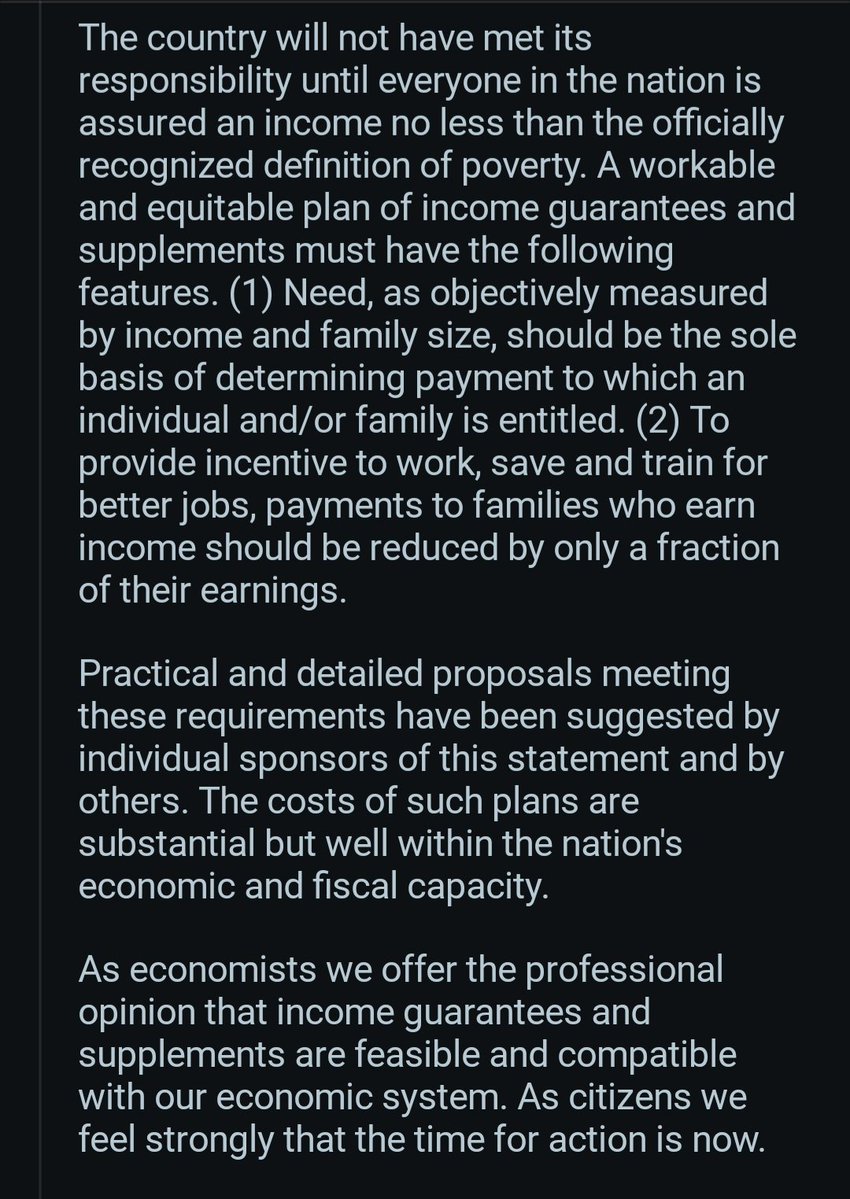
This is the text of the open letter signed by over 1,200 economists from 125+ universities in May of 1968 in support of a nationwide guaranteed basic income.

English

@PatrickC1995 Distributed planning is not central planning.
People offering you choices is not government threatening you with the gulag.
English

Interesting essay, but this section in particular doesn't sit right with me.
Reminds me of this QJAE article.
qjae.mises.org/article/12941-…
Alec Stapp@AlecStapp
Subtle but deep point here: Capitalism is driven more by the entry/exit of small central planners than it is by markets & prices.
English
@hilltowntrader @BasedSavannah @PatAdams96 Simple, clear rule. They couldn’t be bothered.
And they’ll get it through eventually if they follow that rule.
English

@BasedSavannah @PatAdams96 Virginia ran over its own Constitution, like road kill, in its dash to wipe out conservative voter's voices.
so not attractive.
English


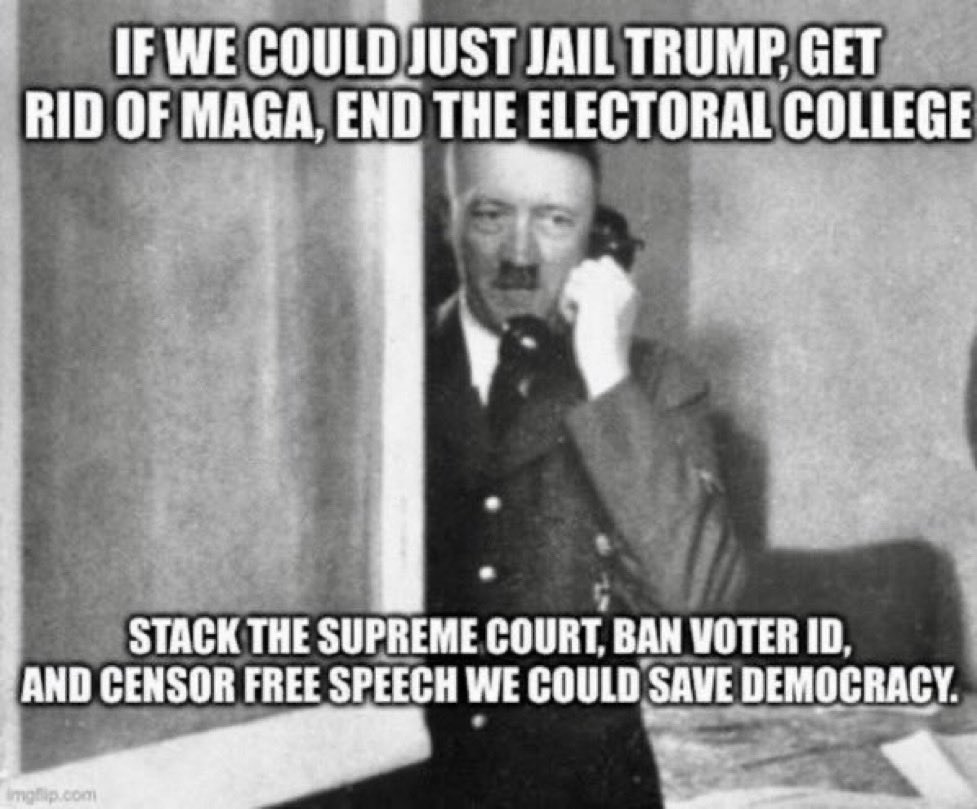
@PatAdams96 @ConceptualJames I thought their lack of screening was how she got her last job to begin with.
English

Seattle Police has released photos of a wanted black male suspect in the killing of a trans @UW student. Liberal media had removed the description of him because they didn’t want to print that he’s black. Antifa & leftists threatened violence against conservatives in reaction, rather than against the killer. thepostmillennial.com/police-seek-su…
English
The worst part is leftists mislead all the young people who haven’t discovered that the left is so fraudulent.
So instead of learning skills to increase their incomes, they carry signs to increase their incomes.
Minimum wage increases only help you when you have few skills and legislatures keep it even with inflation.
If a young person gets convinced that “becoming more productive” is something that only helps employers, they might also “protect” themselves from that alleged scam by not learning anything.
Learning is the number one reason people make real money in the real world.
English

The problem with leftists is they constantly lie. And their top voices never respond to feedback and are unwilling to update beliefs to fit reality. It's such an extremely bad faith group of people, how do you have discourse with them when they're so dishonest and manipulative?

English
@TheRogueGeoduck @VijayInWA @grok Has Howard Schultz of Starbucks supported and funded far left candidates for decades?
English

@VijayInWA That is all well and dandy to say all this in the 11th Hour but these "progressive" CEOs supported and funded far left candidates for decades. And now they cut and run with some criticisms? Disingenuous.
English

Seattle Turns Hostile to the Great Businesses It Made
Starbucks is moving jobs from Washington state to Tennessee, and it isn’t alone in looking elsewhere.
By Howard Schulz
"Washington state has been my home for more than four decades. I arrived in Seattle with dreams and ambition and ended up building Starbucks into a company known around the world. Many Pacific Northwesterners joined me in shaping the culture, benefits and brand of Starbucks—contributing not only to a business, but also the civic and entrepreneurial life of the area.
I am no longer a resident of Washington. My decision to leave had much to do with family choices and my stage of life. Still, I feel a responsibility to speak up about the business and job climate in a city and state that gave me so many opportunities.
Washington’s economic story over the past half century is extraordinary. Microsoft, Amazon, Costco and a host of other new companies transformed the state into a global center of technology, innovation and logistics. Entrepreneurs exported ideas worldwide. Capital flowed. Wages rose. Imported and homegrown talent flourished.
That ecosystem worked because risk‑taking was rewarded, growth was possible, and civic leadership—while imperfect—understood that private enterprise wasn’t the adversary of the public good. It was one engine for improving the public sphere.
That ecosystem is fractured today. Seattle and much of Washington face serious problems: chronic homelessness, disorder in core business districts, persistent budget deficits, declining public-school outcomes and a slowing technology hiring cycle. These challenges aren’t unique to the state—but Washington’s response to them is.
Seattle’s mayor, Katie Wilson, has chosen to cast business as a foil rather than a partner. Her socialist rhetoric vilifies employers, even while she continues to rely on them for revenue. She has encouraged residents who disagree with her policies to leave.
In the state capital, the Legislature and governor have confronted difficult fiscal trade-offs by emphasizing taxation rather than reform or performance management. The theory appears to be that prosperity can be mandated through redistribution rather than generated through growth.
Washington has a broken tax system. The reliance on sales taxes—10.55% in Seattle—is deeply regressive. The state needs to rewrite its tax code across the board in a way that ensures people and businesses alike pay their share.
But instead of reform, those in power have opted to increase the burden on businesses and successful entrepreneurs in ways that discourage them from growing within the state—at a moment when Washington’s economic situation is growing more fragile.
Microsoft and Amazon—once hiring engines—have slowed recruitment and reduced head counts as they race to build data-center capacity and compete globally. Starbucks recently announced it will shift hundreds of corporate roles to Tennessee.
These companies imported global talent at scale for decades, anchoring an interconnected system of suppliers and startups. As those businesses reduce their local role, Seattle has no clear answer to the question of what will provide the next set of jobs and revenue growth.
Cities and states don’t decline overnight. They drift when public safety, fiscal stability and economic vitality deteriorate together. Downtown vacancies reduce foot traffic. Declining foot traffic weakens small businesses. Employment falls. Revenue shrinks. Services erode. Confidence—something that’s hard to build and easy to lose—begins to evaporate.
Entrepreneurs are accustomed to accountability: If we fail to deliver value, we lose customers. If we misallocate capital, we absorb the loss. Government, too, should be judged by results, not intentions. In Washington, steadily increasing government spending hasn’t delivered commensurate results on a range of issues, from addressing homelessness and drug addiction to poor prospects for new high-school graduates.
Entrepreneurs take risks others won’t. We build before certainty exists. We hire before revenue is guaranteed. We invest locally, pay taxes and support civic institutions. When our companies succeed, entire regions benefit. America can’t afford to forget that.
Leaving doesn’t mean abandoning. My family foundation remains invested in Washington’s future, seeking to help the next generation achieve economic mobility and prosperity. But that future is linked to economic growth and job creation. Across the country, other states are competing for capital and talent by simplifying regulation, reforming tax systems and investing in workforce development. One important initiative comes from the bipartisan National Governors Association, helping states craft pro-entrepreneurship policies.
I hope Washington’s leaders will embrace these policies and forge a new compact—one grounded in job creation, sensible taxation and accountable public spending. Washington once embodied the future of the U.S. economy, and it can again. But the current government needs to learn that future entrepreneurs won’t be attracted by ineffective public systems, especially when joined with policy and political rhetoric that demonize businesses.
Mr. Schultz is a former CEO and chairman emeritus of Starbucks."

English
Is that why it’s much cheaper to send junk mail than a first class letter? Because the junk is not being subsidized?
It’s like when you file a change of address. You may even have a domestic situation you had to flee in the middle of the night, like I did.
They ignored it. Could not get them to actually send it to a safe place.
But did they manage to sell my new address to anyone who wanted it?
Oh, sure. No problem!
English

You're missing the plot:
- "junk" mail is responsible for about 20% of USPS revenue, and that revenue more than covers the cost of delivering it (~20-40% "positive contribution" or profit). Banning it means USPS raises rates on everything else.
- Paper industry maintains huge forests for its raw material. Reduced paper demand means that land would be taken out of production and developed. Environmentally, this is almost certainly worse.
English

It is wild to see the ideological reversal associated with USPS.
Hundreds of green socialists crying "No, you have to let the capitalist megacorporations raze hundreds of millions of trees! You have to let the government force-feed consoooomer advertising to your family!"
Palmer Luckey@PalmerLuckey
It is time for the United States Postal Service to ban junk mail. Unsolicited spam calls are already prohibited by the FCC. Emails are heavily regulated by the CAN-SPAM Act of 2003. Junk mail is the majority of mail, 100 million trees per year. Enough!
English
@AAnnecharico @HistoryBoomer But he said other things that can be interpreted as support for the rich paying more.
English
“The subjects of every state ought to contribute towards the support of the government, as nearly as possible, in proportion to their respective abilities; that is, in proportion to the revenue which they respectively enjoy under the protection of the state.”
Proportional. Not progressive.
English

Believing in a progressive system of taxation, which the United States has had since 1913, is not Marxist.
Twitter is filled with cranks and lunatics.
George Kerber@GeorgeKerber404
@HistoryBoomer >> But I do support moderately heavier taxes on the wealthy. Unfortunately you have outed yourself as a Marxist.
English
Let it actually be run by capitalists and all land would be privately owned and no one would be occupying it without paying for it.
Conditions would be much, much better.
And it would be better for the people currently being assisted by government to live an addicted life.
And it would be better for people who can’t afford the standard home, because very minimal basic housing would be legal again.
As would private buses that don’t allow thugs.
Please let the capitalists run things. Let’s all peacefully trade with each other, innovate and solve problems.
English

Los Angeles is run by capitalists.
Eric Bott@EricJBott
This is what Democratic Socialists of America governance delivers.
English