Absolutely wild that Anthropic was founded less than five years ago is already devouring an entire software category and is worth more by market cap than all of these blue-chip SaaS companies combined:
• $CRM $154B
• $CRWD $96B
• $NOW $85B
• $SNOW $43B
JUST IN - Treasury Secretary Scott Bessent and FED Chair Jerome Powell summoned Wall Street executives to an urgent meeting over concerns that the latest Anthropic PBC AI model will usher in an era of greater cyber risk — Bloomberg
@AIatMeta This matters beyond companies.
Cognition is already unevenly distributed.
Some environments are socially shaped.
Others institutionally structured.
Fragmentation doesn’t just divide systems.
It divides how reality is processed.
Introducing Muse Spark, the first in the Muse family of models developed by Meta Superintelligence Labs.
Muse Spark is a natively multimodal reasoning model with support for tool-use, visual chain of thought, and multi-agent orchestration.
Muse Spark is available today at meta.ai and the Meta AI app. We’re also making it available in private preview via API to select partners, and we hope to open-source future versions of the model.
Learn more: go.meta.me/43ea00
@arbidthink@michaeljburry If Anthropic is interpreting reality and PLTR is defining it, who’s the one getting paid less over time? Interpretation scales. Definition doesn’t.
@Sach_R81@unusual_whales Marketing isn’t being replaced.
It’s being exposed.
It was never a native layer of cognition.
Just an interruption system.
What replaces it isn’t AI.
It’s narrative becoming environment.
@unusual_whales yeah if you define marketing as pressing a button
good marketing is the intersection of taste, aesthetic, design being plugged into culture, the zeitgeist, telling a story that resonates with a given segment
good luck getting an AI to one shot all of that
The sovereign AI stack is not being announced.
It is being revealed through alignment.
What we are witnessing is not a partnership cycle.
Not a market trend.
Not an AI narrative.
This is the early formation of a sovereign technological architecture.
—
1. The signal
A group of companies is beginning to align around:
compute
decision systems
deployment environments
secure infrastructure
This is not random.
This is structural coordination under constraint.
—
2. What this actually is
This is not the sovereign stack.
It is the first visible activation of one of its layers.
The stack is not a list of companies.
It is a system of functions.
And what we are starting to see is those functions taking form in reality.
—
3. The core misread
The market will interpret this as partnerships, competition, positioning.
That reading is outdated.
This is not competition.
This is layering.
—
4. The missing layer
Anthropic appears.
OpenAI does not.
And that matters.
But not in the way people think.
Absence does not mean exclusion.
Presence does not mean dominance.
Anthropic represents constrained, safety-aligned, institutional cognition.
But it is not the cognitive layer.
Because the cognitive layer is not singular.
OpenAI already operates as the dominant civil cognitive interface.
It is the system through which millions already think.
And more importantly, it is already entering sovereign environments under constraint, participating in defense-aligned frameworks, and being formalized as admissible cognition.
Language is no longer just communication.
It is the operational interface of cognition.
OpenAI is not absent.
It is operating in a different layer of the system.
—
5. The stack, functionally
The stack, mapped to reality
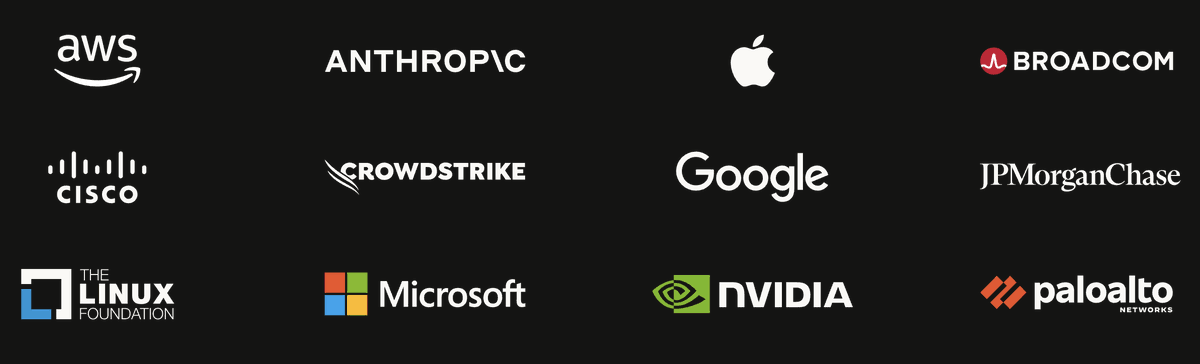
AWS → cloud infrastructure backbone
The environment where systems are deployed and scaled.
Microsoft → enterprise integration layer
Operating systems, cloud, and institutional distribution.
Google → data and model ecosystem
Search, data flows, and native AI infrastructure.
NVIDIA → compute substrate
The physical boundary of intelligence.
What can be modeled, inferred, and scaled.
Broadcom → hardware and network acceleration
The layer that sustains performance at scale.
Cisco → network infrastructure
Connectivity across all nodes.
CrowdStrike / Palo Alto → security layer
Protection, monitoring, and control of digital systems.
Linux Foundation → base infrastructure standard
The open layer everything runs on.
JPMorgan → financial system integration
Where infrastructure connects to capital and transactions.
Apple → civil interface
Devices, identity, and distribution into society.
Anthropic → constrained institutional cognition
Safety-aligned reasoning inside controlled environments.
—
What’s missing is just as important
Palantir → decision architecture
The layer where systems become actionable reality.
OpenAI → civil cognitive interface
The layer through which millions already think.
—
These are not companies.
They are functions.
And for the first time:
they are becoming visible as a system.
NVIDIA is the compute substrate.
The physical boundary of intelligence.
It defines what can be modeled, inferred, and scaled.
Compute is not a product. It is a sovereign resource.
Palantir is the decision architecture.
The layer where reality becomes action.
It integrates data, structures meaning, encodes judgment, and executes response.
At scale, interpretation becomes governance.
OpenAI and Anthropic form the cognitive interface layer.
The point where cognition becomes externalized.
Reasoning, simulation, and interpretation move into language.
Anthropic operates as constrained institutional cognition.
OpenAI as a bridge between civil and sovereign cognition.
Multiple cognitive systems, one emerging structure.
Apple is the civil interface.
Not entering AI, but positioning as the gateway through which the system reaches society.
Devices, identity, distribution.
This is how cognition embeds into daily life.
—
6. What this implies
We are no longer looking at companies.
We are looking at functions inside a sovereign system.
Compute enables.
Cognition interprets.
Decision executes.
Interface distributes.
—
7. The structural shift
Companies are no longer the unit of analysis.
The real unit is function.
Soon, entities will be evaluated not as businesses, but as:
cognitive organs
infrastructure nodes
decision systems
—
8. The transition
The market still asks who wins.
That is the wrong question.
The real question is which function becomes indispensable.
Because form changes.
Brands evolve.
Equity fluctuates.
Function, once embedded, does not disappear.
—
9. Final signal
This is not the sovereign stack.
Not yet.
But it is the first visible configuration of it.
And once the system becomes legible, we will stop analyzing companies and start analyzing sovereignty.
Closing
The market still sees companies.
The system is already forming organs.
@griswold@pmarca@andrewarruda This isn’t about ads.
It’s about who controls the stack.
AGI won’t be built by a model.
It will emerge from the system that integrates models, infrastructure, and compute.
The pricing tiers for AGI are something like (1) $20/month, (2) $200/day = ~$75,000/year, (3) $1,000/day = ~$350,000/year, and (4) ~$10 billion. For now.