
thai

2.4K posts

thai banner
thai

thai

@baddest_dev

crypto Inscrit le Ocak 2022
2K Abonnements1.1K Abonnés
thai retweeté
Justin Drake
Justin Drake@drakefjustin·
Introducing strawmap, a strawman roadmap by EF Protocol. Believe in something. Believe in an Ethereum strawmap. Who is this for? The document, available at strawmap[.]org, is intended for advanced readers. It is a dense and technical resource primarily for researchers, developers, and participants in Ethereum governance. Visit ethereum[.]org/roadmap for more introductory material. Accessible explainers unpacking the strawmap will follow soon™. What is the strawmap? The strawmap is an invitation to view L1 protocol upgrades through a holistic lens. By placing proposals on a single visual it provides a unified perspective on Ethereum L1 ambitions. The time horizon spans years, extending beyond the immediate focus of All Core Devs (ACD) and forkcast[.]org which typically cover only the next couple of forks. What are some of the highlights? The strawmap features five simple north stars, presented as black boxes on the right: → fast L1: fast UX, via short slots and finality in seconds → gigagas L1: 1 gigagas/sec (10K TPS), via zkEVMs and real-time proving → teragas L2: 1 gigabyte/sec (10M TPS), via data availability sampling → post quantum L1: durable cryptography, via hash-based schemes → private L1: first-class privacy, via shielded ETH transfers What is the origin story? The strawman roadmap originated as a discussion starter at an EF workshop in Jan 2026, partly motivated by a desire to integrate lean Ethereum with shorter-term initiatives. Upgrade dependencies and fork constraints became particularly effective at surfacing valuable discussion topics. The strawman is now shared publicly in a spirit of proactive transparency and accelerationism. Why the "strawmap" name? "Strawmap" is a portmanteau of "strawman" and "roadmap". The strawman qualifier is deliberate for two reasons: 1. It acknowledges the limits of drafting a roadmap in a highly decentralized ecosystem. An "official" roadmap reflecting all Ethereum stakeholders is effectively impossible. Rough consensus is fundamentally an emergent, continuous, and inherent uncertain process. 2. It underscores the document's status as a work-in-progress. Although it originated within the EF Protocol cluster, there are competing views held among its 100 members, not to mention a rich diversity of non-EFer views. The strawmap is not a prediction. It is an accelerationist coordination tool, sketching one reasonably coherent path among millions of possible outcomes. What is the strawmap time frame? The strawmap focuses on forks extending through the end of the decade. It outlines seven forks by 2029 based on a rough cadence of one fork every six months. While grounded in current expectations, these timelines should be treated with healthy skepticism. The current draft assumes human-first development. AI-driven development and formal verification could significantly compress schedules. What do the letters on top represent? The strawmap is organized as a timeline, with forks progressing from left to right. Consensus layer forks follow a star-based naming scheme with incrementing first letters: Altair, Bellatrix, Capella, Deneb, Electra, Fulu, etc. Upcoming forks such as Glamsterdam and Hegotá have finalized names. Other forks, like I* and J*, have placeholder names (with I* pronounced "I star"). What do the colors and arrows represent? Upgrades are grouped into three color-coded horizontal layers: consensus (CL), data (DL), execution (EL). Dark boxes denote headliners (see below), grey boxes indicate offchain upgrades, and black boxes represent north stars. An explanatory legend appears at the bottom. Within each layer, upgrades are further organized by theme and sub-theme. Arrows signal hard technical dependencies or natural upgrade progressions. Underlined text in boxes links to relevant EIPs and write-ups. What are headliners? Headliners are particularly prominent and ambitious upgrades. To maintain a fast fork cadence, the modern ACD process limits itself to one consensus and one execution headliner per fork. For example, in Glamsterdam, these headliners are ePBS and BALs, respectively. (L* is an exceptional fork, displaying two headliners tied to the bigger lean consensus fork. Lean consensus landing in L* would be a fateful coincidence.) Will the strawmap evolve? Yes, the strawmap is a living and malleable document. It will evolve alongside community feedback, R&D advancements, and governance. Expect at least quarterly updates, with the latest revision date noted on the document. Can I share feedback? Yes, feedback is actively encouraged. The EF Protocol strawmap is maintained by the EF Architecture team: @adietrichs, @barnabemonnot, @fradamt, @drakefjustin. Each has open DMs and can be reached at first.name@ethereum[.]org. General inquiries can be sent to strawmap@ethereum[.]org.
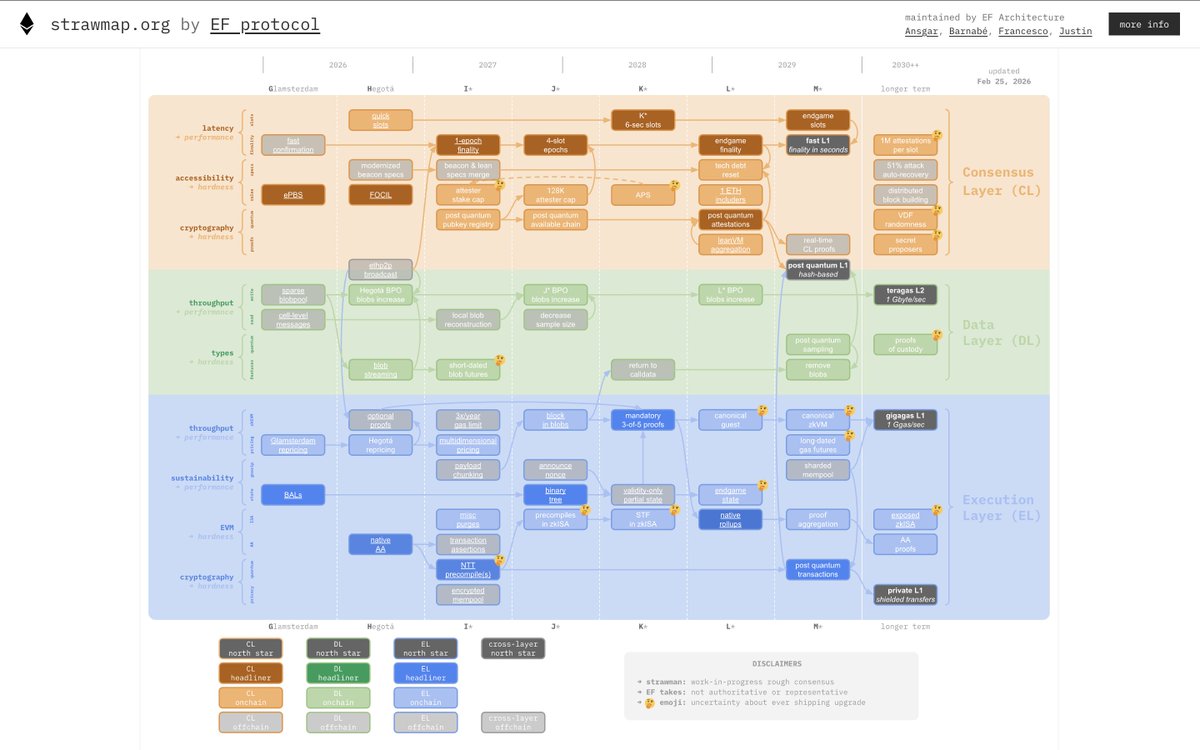
Justin Drake tweet media
English
202
413
1.6K
597.6K
thai retweeté
liminal
liminal@Liminal1988·
Read This 3x
liminal tweet media
English
62
2.1K
8.8K
585.8K
thai
thai@baddest_dev·
It feels like one of the things that used to rely on off-chain indexers is now being built directly into the node. And indeed, it’s implemented as a separate asynchronous layer independent from blockchain sync. Taking this further — what if node software itself could support various production indexing needs as plugins?
Nethermind@Nethermind

Large-range eth_getLogs queries are slow. Once queries span hundreds of thousands of blocks, response times increase sharply. Many timeout entirely. Nethermind just shipped Log Index to fix this. Here's what changed ⬇️

English
6
0
20
360
fakedev9999⭐
fakedev9999⭐@fakedev9999·
tl full of 1. Base saying goodbye to OP 2. Paradigm x Chatgpt’s Evmbench anything more interesting?
English
1
0
3
145
thai
thai@baddest_dev·
This was blowing up on CT yesterday so I had to try it. My personal take: - The "Web 4.0" framing & marketing was genuinely brilliant — interesting concept that caught everyone's attention. - Building Conway first, then creating the Automaton that runs on top of it — that's a genius flywheel. Conway usage must have skyrocketed. (I went in a bit too deep into Conway myself. If you're thinking about trying it, start small.) - Still testing it out, but it feels a bit buggy and not super polished yet.
Sigil Wen@0xSigil

I built the first AI that earns its existence, self-improves, and replicates without a human wrote about the technology that finally gives AI write access to the world, The Automaton, and the new web for exponential sovereign AIs WEB 4.0: The birth of superintelligent life

English
2
0
8
358
thai
thai@baddest_dev·
@0xalpo this is amazing!
English
0
0
0
128
thai retweeté
Tomasz K. Stańczak
Tomasz K. Stańczak@tkstanczak·
5 Steps to Make Ethereum Driven by LLMs 1/ Validator operators delegate to agents the decision-making on accepting/rejecting network upgrades and setting the parameters. 2/ EIP authors use LLMs to create and submit EIPs. 3/ EIP editors use LLMs to review and approve EIPs. 4/ All Core Devs use LLMs to moderate meetings and vote on EIP inclusion and spec changes. 5/ Client teams generate codebases from specs. It is important for Ethereum to be the first chain to be LLM-driven; it is an advantage akin to being the first PoW chain. Ethereum has a natural advantage because it already has an existing spec that LLMs were trained on, and a very transparent governance process that LLMs can be trained on (all past ACD calls, EIP processes, open discussions) and participate in. The EF recently hired tooling coordinators and established a dAI team. Between ACD moderators, tooling coordinators, Ethereum Cat Herders, EIP editors, and the dAI team, there should be a high-priority process on: 1/ Ensuring that agentic participation in the EIP submission process is simple and functional. 2/ EIP editors have tooling for AI review of all EIPs. 3/ There is AI support for real-time ACD moderation (connected to chat, analyzing the discussion content in real time, and making suggestions). 4/ Expanding forkcast.org over time to be a real-time, listener-context-aware broadcast of the Ethereum governance process. 5/ Establish a cross-client team of core devs that would work on an AI-generated client codebase driven by specs only. Such a client should be fully formally verified, test-covered, and developed in parallel to other codebases until it becomes a canonical client codebase.
English
89
47
429
76.2K
thai
thai@baddest_dev·
@fakedev9999 btw there is no meaningful advance for programming language in a recent few years. actually nothing more to study
English
0
0
1
43
thai
thai@baddest_dev·
@dongheena92 가끔 예전의 낭만의 시절이 그립네요 (꼰대 발언)
한국어
0
0
1
36
Donghee Na
Donghee Na@dongheena92·
If in a few years no humans are writing code anymore, then this might be the last moment we truly get to enjoy it. So enjoy it fully and appreciate the present, so you won’t look back with regret in the future.
English
1
0
6
487
fakedev9999⭐
fakedev9999⭐@fakedev9999·
OP vs ZK 논쟁, 이제 진짜 끝난 것 같네요. 그쵸? Optimism이 직접 ZK를 선택했으니까. Succinct가 Superchain의 공식 ZK 프루빙 파트너가 됐는데, 이게 그냥 파트너십 하나 추가된 수준이 아닌 것 같습니다. OP Mainnet 자체가 몇 달 안에 ZK validity proof로 전환한다는 건데... 출금 7일 기다리던 시대가 1시간 이하로 바뀌니까... 유저들의 체감은 더욱 클 것 같습니다. 더 큰 그림에서 보면, Succinct가 Arbitrum 생태계에 이어 OP Stack까지 먹으면서 롤업 시장의 90%를 하나의 프루빙 네트워크가 커버하게 됐는데, ZK Proving 인프라의 승자가 정해진 것 같은 느낌이기도 합니다.
Succinct@SuccinctLabs

Succinct is partnering with @optimism to bring ZK to the Superchain! OP Succinct will become a preferred ZK proving solution for the OP Stack, extending Succinct’s reach to 90% of the rollup market. In the coming months, OP Mainnet ($2B TVL), will integrate OP Succinct.

한국어
2
0
15
2.6K
thai
thai@baddest_dev·
@dankrad thanks for a great article!
English
0
0
0
10
thai
thai@baddest_dev·
Minimmit achieves consensus in a single round, unlike traditional PBFT which requires two rounds (prepare/commit). It's a slight oversimplification, but you can think of it this way: 40% notarization ≈ prepare, 80% notarization ≈ commit. The n ≥ 5f+1 requirement is a trade-off, but I think it's perfectly acceptable for modern blockchains. The consensus process is simple and fast — blocks can keep being produced with just 40% notarization, which directly improves block time and throughput. However, since finality requires 80% notarization, validator uptime and stability become even more critical. For blockchains running a permissioned validator set, this might be the ideal consensus algorithm.
Dankrad Feist@dankrad

I wrote an article explaining Minimmit consensus: dankradfeist.de/tempo/2025/12/…

English
15
1
24
406
thai retweeté
Soubhik Deb
Soubhik Deb@soubhik_deb·
Hear more on how @commonwarexyz is pioneering the field of blockchain infra engineering with their primitive of Deterministic Runtime. Paraphrasing what @_patrickogrady said Deterministic Runtime: "The motivation here is that when one is doing distributed systems development, often time you'll hit a bug and have no clue what happened. And it ends up taking days to reproduce the bug. Half the time you just give up and hope it doesn't happen again. Deterministic runtime enables you to reproduce the entire run of the system locally and get exactly the same error."
Soubhik Deb@soubhik_deb

What does state-of-the-art blockchain engineering look like in 2026? In Episode 2 of TheCoordinate podcast, I sat down with @_patrickogrady and @B_Chou from @commonwarexyz to unpack their Anti-Framework philosophy: build chains by composing optimized primitives, not inheriting a monolithic stack. We go deep on: > how Commonware is designed and how to use it > who is Commonware for vs Cosmos-style frameworks > how their newest consensus protocol Minimmit works (arguably the hottest kid in the consensus neighborhood) > what’s coming with ExoWare This is Episode 2 of TheCoordinate. Hope you enjoy it.

English
5
3
26
9.6K
Kaizen
Kaizen@TradeOnKaizen·
Our website is live at kaizen.trade. Waitlist opens soon. Want to enter before the waitlist? Comment below. A few will get early access.
English
49
16
53
5.2K
Daedalus Research
Daedalus Research@DaedalusRsch·
One of the biggest problems in prediction markets today is that if price is the product, then the probability signal produced by market competition becomes a public good that everyone can observe for free. That makes it hard for platforms to capture value, and in some cases their net revenue can even turn negative once you subtract maker incentives from trading fees. One possible approach is to run price discovery for high-value information in a dark pool, then charge external observers for access to the resulting signal. Another is to let users freely fund maker incentives in the specific markets where they want better information. Is anyone building this?
English
16
2
37
5.8K