frank mitchell
3K posts

frank mitchell
@f_mitchell07
bloodstock writing the way it's meant to be
kentucky Inscrit le Ekim 2009
2.5K Abonnements3.1K Abonnés
frank mitchell retweeté


@Tinky47flat Did Hatton perchance mention which four? I assume Man o’ War, Citation, and Secretariat… Kelso, Count Fleet, Dr. Fager??? Fascinating and insightful anecdote.
English

‡
Is Sovereignty a Great Horse?
The yearning for greatness, and associated rush to anoint individual athletes as such, has become common in all sports. It may be partly the result of the relative paucity of real, high-profile heroes in other aspects of American society, and, perhaps, the understandable, widespread disappointment in political leaders.
In any case, there is certainly no harm in fans expressing exuberance about players, or horses, nor is hyperbole, at least in this context, a particularly important problem. But when debates arise, the arguments presented by those asserting claims of greatness, and those questioning such claims, can have real practical value, and well beyond the narrow confines of the specific athlete or horse.
I say that for two main reasons. The first is that we are living during a period in which hyperbole is used more frequently than ever, and especially by those hoping to benefit financially. This applies not only to horse racing (e.g. breeders hyping stallion prospects, etc.), but broader society, and financial markets in particular.
The second is that how carefully, or not, one assesses the possibility of greatness in a horse, may carry over to the parsing of judgments that are made much more regularly in the game. If a "top" horse were to be judged too quickly to be great, the same potential mistake could be made when judging the quality of an impressive maiden, or allowance winner, or even a two-year-old which breezes fast at a sale, etc.
In other words, the more finely that one is able to assess top horses, the better the judgments of horses in other categories are likely to be. And broadly speaking, viewing the evidence through a skeptical lens helps to lead to more accurate judgments.
***
So what about Sovereignty? Should he have been considered a "great" horse prior to the Travers, as @failedtomenace went so far as to suggest, when saying after that race that "Most of us already knew he was great" ?
If not, did the colt's Travers performance vault him into such rarified air?
I will argue that the answer to both questions is a resounding NO, and that there isn't nearly enough evidence to support claims to the contrary.
As mentioned above, we are living through a period in which hyperbole is far more common than it was decades ago. Within the context of great horses, consider these two remarkable excerpts relating to the iconic DRF columnist Charles Hatton (1907-1975). They were sourced through a piece written by another icon, Bill Nack, the late journalist and author best known for his work at Sports Illustrated, and various books, including one on Secretariat [bold emphasis mine].
The word “great” was sacrosanct in the shedrows that I haunted as a young man.
Example One:
[DRF columnist] Hatton and John M. Gaver, Sr., the Hall of Fame trainer at the storied Greentree Stud, were sipping whiskey with a few other old horsemen in Gaver’s office one day in the late 1950s when someone mentioned the great handicap horse Tom Fool. Under Gaver, the handsome bay had won 10 of 10 races in 1953, all stakes, including the daunting New York Handicap Triple Crown—the Metropolitan Mile and the Suburban and Brooklyn handicaps—while carrying from 128 to 136 pounds, substantial burdens even in those days.
Tom Fool was so dominant that his last four victories—in the Wilson, the Sysonby, the Whitney and the Pimlico Special—were run without wagering. At year’s end, he beat out the immortal “Gray Ghost,” Native Dancer, for Horse of the Year honors.
The discussion in Gaver’s office that day turned to equine greatness—to indubitable giants such as Man o’ War, Count Fleet and Citation—and one of the horsemen raised the name of Tom Fool. “Now he was a great racehorse, don’t you think?” Gaver thought for a moment, Hatton recalled, and finally said, “Well, he was certainly a very good racehorse.”
Example Two:
Hatton wrote his Racing Form column in a private aerie high above the press box at Belmont Park, and I found him there one afternoon in early 1973. He was still sitting at his typewriter long after he had finished his column. I asked him what he was doing so late. “I’m answering a letter,” he said. “A man asked me to name five great racehorses of the century.” Hatton had seen Old Rosebud win the 1914 Kentucky Derby by eight lengths in record time, and had spent the next 60 years at the races, watching champions come and go.
“Five great racehorses?” I said. “That shouldn’t be a problem for you.”
“You’d think so,” Charlie said. “But I can only think of four.”
I included those excerpts because context matters, and much like the word "awesome" has lost its original meaning and power through increasingly careless usage over the last few decades (e.g. "this hamburger is awesome!"), the more recent tendency to anoint racehorses as "great", often times on dubious grounds, has had the effect of diluting the original meaning of the word.
***
Some of the following criteria have long been used to assess good racehorses. I have added one or two, and would suggest that they are all useful to consider while attempting to discern greatness in racehorses:
• What are/were their physical abilities and limitations?
• What are/were their mental abilities and limitations?
• Which important races did they win?
• What was the quality of competition in those races?
• Did they beat any particularly high-class horses?
• Did they record fast times? Repeatedly?
• Did they demonstrate versatility?
• Did they overcome any serious obstacles?
I don't think that anyone would dispute that Sovereignty is an outstanding racehorse, nor that he is better than the average three-year-old Classic winner. But is he even better than that?
Many have noted that he is the first horse since Thunder Gulch (1995) to have won the Kentucky Derby, Belmont, and Travers. But does anyone consider the latter to have been a "great" horse? And if not, what is the actual value of the accomplishment?
Arguments relying on horses having won certain series of races should always be treated with caution. After all, Real Quiet was an inch or two away from winning the Triple Crown, yet no one imagines him to have been anything like a great horse. Would he have magically become "great", given a slightly better judged ride in that one race?
Sovereignty has, to his credit, repeatedly proven superior to Journalism and Baeza, both of which are very good horses. But as tough and honest as the former is, he has yet to show any significant improvement, at least in terms of speed figures, from his March victory in the Santa Anita Derby. There is also a nuanced question about whether 10f. could be a touch beyond his ideal distance, and/or if he may benefit from more patient riding tactics over that trip.
I have been high on Baeza since the Santa Anita Derby, and still believe that he has a good deal of room to improve. But he has yet to finish ahead of either Journalism or Sovereignty, and has also yet to win a stakes race.
So while Sovereignty deserves credit for having proven himself superior to those two horses, it's not nearly as impressive, for example, as Sunday Silence having proven himself narrowly better than Easy Goer, as the latter was a truly top-class opponent.
Prior to the Travers, Sovereignty had yet to record a Beyer figure higher than 109, a number that would barely have put him in conversations about historically outstanding 3yo colts, let alone a "great" horses. He earned a much more notable 115 in the Travers, but on closer inspection, what is the value of that number?
The four horses that he crushed had previously combined for a single Gr. II win, and one (unplaced) Gr. I start. Magnitude, the only one of the four to have previously run notably fast, gave way tamely when pressured in the Travers, and the runner-up, a mere Listed winner, clearly failed to stay the 10f. trip (:26 4/5 final quarter).
It is true that Sovereignty was eased down late in the race, but horses tend to run fast when they dominate deeply inferior opposition, and claims that horses which win comfortably could have run much faster if asked, are always speculative at best.
For the sake of argument, though, let's say that the 115 figure was a reflection of Sovereignty having moved forward in his development, and that it accurately reflects what he would be capable of at this stage of his career, even if up against good competition. Consider that since 1993, there have been at least 30 three-year-old males that have recorded higher Beyer figures in races beyond a mile, and few, if any of them are likely to appear in conversations about "great" horses.
For further context, these are just a few of the 3yos on that list:
119 GENERAL CHALLENGE
119 ALBERT THE GREAT
118 CAPTAIN STEVE
117 ECTON PARK
116 CORONADO’S QUEST
116 OLD TRIESTE
116 CAME HOME
116 DYNEVER
116 SINISTER MINISTER
116 VERRAZANO
Largely forgettable "good" horses, none of which were Champions, let alone great.
To be clear, 115 is a very good number, and 13 of the past 30 Breeders' Cup Classic winners recorded slower figures. But while I am not knocking the number itself, it does not, in context, meaningfully bolster any argument that Sovereignty should already be considered a "great" horse.
What about some of the other, aforementioned criteria?
Sovereignty displayed some versatility while winning the KY Derby over a sloppy track. He has only contested one sprint race, in his debut, and finished fourth. While it should not be held against him, as his trainer was thoughtfully setting the stage for the development that has been unfolding ever since, truly outstanding horses do often strut their stuff even over distances short of their best.
For example, I watched Unbridled break his maiden first-out in sensational style over 6f., winning off by 10 lengths over two subsequent stakes horses. As an older runner, he beat the Champion sprinter Housebuster in a 7f. stakes race at Gulfstream, despite his own best races having been contested over 10f.
Could Sovereignty be versatile enough to win good sprint races? Unfortunately, we are unlikely to ever find out. To his credit, he certainly stays 10f. well, and would likely stay 12f., if given the opportunity. But it is interesting to note that he has been beaten in three of six races shorter than 10f., and though his first two starts might easily be forgiven (as developmental), it does beg the question of whether he may need more of a test of stamina to be seen at his very best.
He does not have a particularly quick acceleration, which is consistent with potential vulnerability over shorter distances. He has been able to overcome the limitation in stamina-testing events, and has yet to be thwarted by a slow pace.
Mentally, he hasn't displayed any notable weaknesses, at least that I have discerned, and is clearly very honest.
He has not faced any particularly difficult obstacles thus far in his career, but as I consider the ability to do so to be a common thread that often ties together truly great horses, I hope that he may have an opportunity to prove himself in that vein.
***
In summary, Sovereignty is an outstanding three-year-old colt, and a clear cut above the average "top" male in that division. He has proven himself superior to Journalist, a tough, consistent, high-class horse. The trajectory of his form, and related figures, are excellent, so there is good reason to believe that he will improve further.
At the same time, he has yet to face an exceptionally fast opponent, or an older runner. He lacks a quick acceleration, and his form suggests that he is at his best in stamina-testing events. He has earned just a single, notably fast speed figure, and in a historical context, even that number, recorded under advantageous conditions, falls well short of denoting greatness.
None of this means that Sovereignty couldn't eventually prove to be a great horse, but I see no remotely compelling evidence to support the suggestion that he has already achieved greatness.
English

By the sire of Kentucky Derby winner Sovereignty and a half-sister to Preakness winner Journalism, hip 165 is a star @FasigTiptonCo ‘s Saratoga selected yearling sale. The scopey is in @DenaliStud consignment for breeder Don Alberto.

English

Thanks, Frank. But you forgot the most important thing: “dog enthusiast.” 😀
frank mitchell@f_mitchell07
One of our great assets in bloodstock coverage is @SireWatch -- a great guy and a famous friend. Whether you are interested in trends in domestic pedigrees or insights into the international scene. This is your man!

English
frank mitchell retweeté

One of our great assets in bloodstock coverage is @SireWatch -- a great guy and a famous friend. Whether you are interested in trends in domestic pedigrees or insights into the international scene. This is your man!
English

nooni shows that 'glory of speed' to jumpstart win win win's potential as a young sire fmitchell07.wordpress.com/2024/08/21/noo…
English
frank mitchell retweeté

@ArnoldPinnock @JRustomjee Arnold, if you're interested in more publications ... not from my personal materials, I can ask a friend if he is still looking to trim the library. He is in Britain.
English

@JRustomjee I inherited a lot of the books a year ago. I am seeing a lot of the pictures for the first time, especially the ones from the publication "Racing and Breeding" from the 1950s, "The British Racehorse"', Courses&Elevage, and "The Thoroughbred Record" 1982 -1986
English

@DRFLivingston @PreaknessStakes @DailyRacingForm @PimlicoRC Oh my! I'm feeling curiouser and curiouser.
English

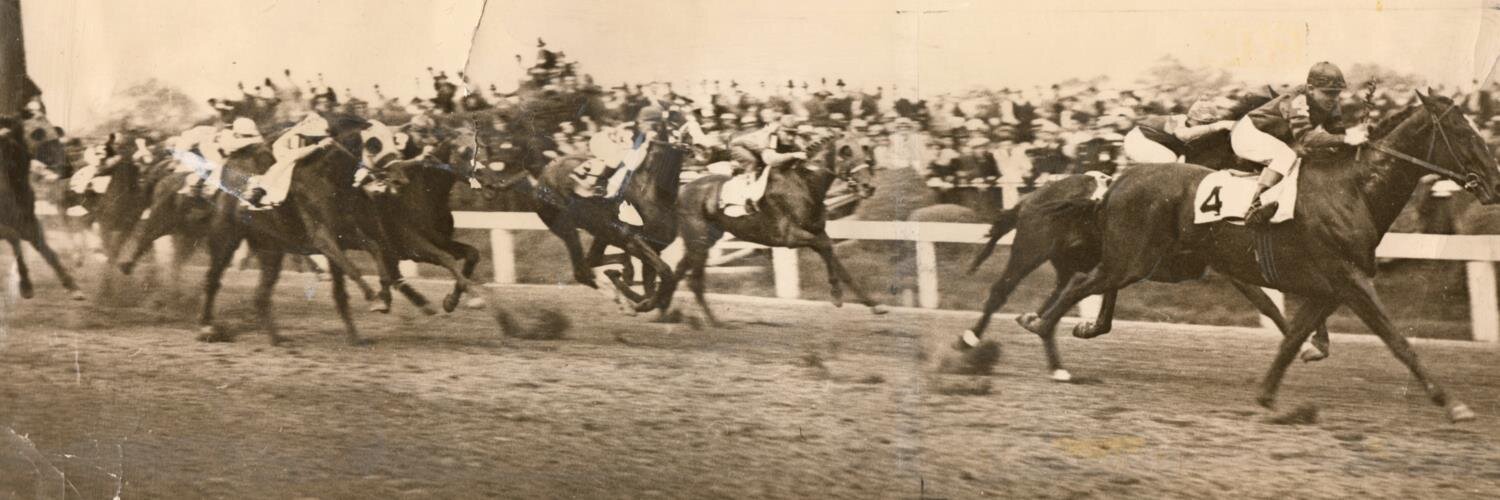
@f_mitchell07 @PreaknessStakes @DailyRacingForm @PimlicoRC It's one of maybe 900 photographs shot between 1916-1923 at NY tracks by an unknown photographer.
They created 6 albums, starting with a 1916-17 volume. Negatives were also therein.
Most are horses whose names I don't know, but Man o' War, 2yo Sir Barton,+ are also therein.
English

@DRFLivingston @PreaknessStakes @DailyRacingForm @PimlicoRC Even a century ago, the youth of America were having a good time at Pimlico. At least, that's what I suppose the writer meant about the Venuses and Adonises, and yesterday, many of them were peeling off their wet clothes and playing in the mud and such.
English
frank mitchell retweeté

Very excited for JERRY & JOHN AMERMAN to have ENDLESSLY in gate #14 in THE KENTUCKY DERBY..
A son of their stallion OSCAR PERFORMANCE who the BRED & RACED..& MIKE MCCARTHY-trained & UNBERTO RISPOLI-jockey
MILL RIDGE-raised/NICOMA-mated
Mill Ridge Farm@millridgefarm
English
frank mitchell retweeté

The Deep Impact memorial gate at Northern Horse Park.
ノーザンホースパーク@northern_horse
昨年6月にオープンした「ディープインパクトゲート」は歴史的名馬 ディープインパクトが残した衝撃と感動にふれられるスポットです。子孫たちも暮らす放牧地を見守るように建つモニュメントを見てふれて、思いおもいの「輝くひととき」をお過ごしください。

English

Lest We Forget: The Tiny Tigress Dark Mirage paulickreport.com/news/thoroughb…
English