Jonathan Jeckell

72.9K posts

Jonathan Jeckell banner
Jonathan Jeckell

Jonathan Jeckell

@jon_jeckell

Regenerated US Army officer forging a new beginning in Systems & Cognitive Engineering. The best way to predict the future is to create it.

Inscrit le Haziran 2010
3K Abonnements3.3K Abonnés
Tweet épinglé
Jonathan Jeckell
Jonathan Jeckell@jon_jeckell·
Congratulations to Dr Zachary Jeckell on officially being awarded his PhD in Nuclear, Plasma, & Radiological Engineering (he specializes in plasma) from University of Illinois Urbana-Champaign Thursday! Technically had it since February, but this was the formal event.
Jonathan Jeckell tweet media
English
1
2
20
1K
Jonathan Jeckell retweeté
The Ways of A Gentleman
The Ways of A Gentleman@Gentleman_Ways·
Sir Christopher Lee met Rasputin's assassins, was a RAF intelligence officer in WWII, spoke 9 languages, was Ian Fleming's cousin, and was the only actor in “The Lord of the Rings” to have met J.R.R. Tolkien. He was also married to the same woman for over 50 years. What a life!
The Ways of A Gentleman tweet media
English
398
3.2K
26.5K
521.1K
Jonathan Jeckell retweeté
SPRAVDI — Stratcom Centre
SPRAVDI — Stratcom Centre@StratcomCentre·
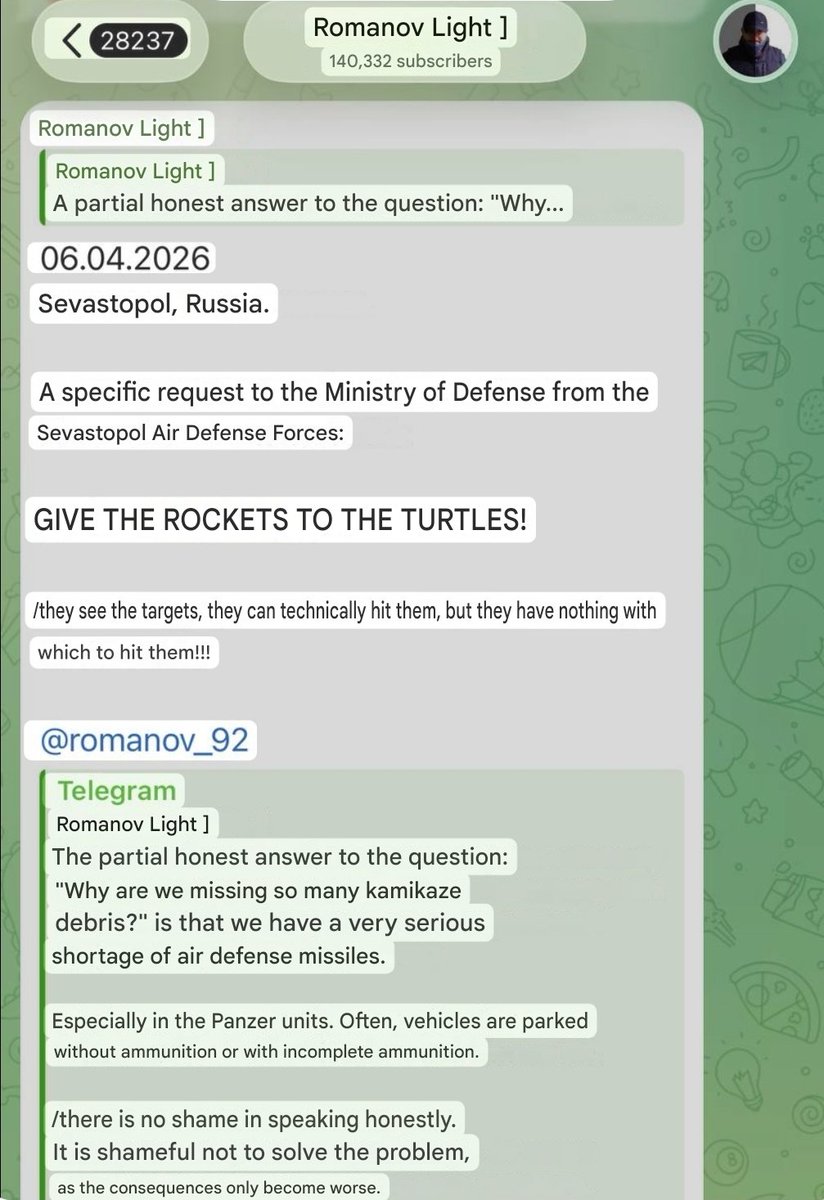
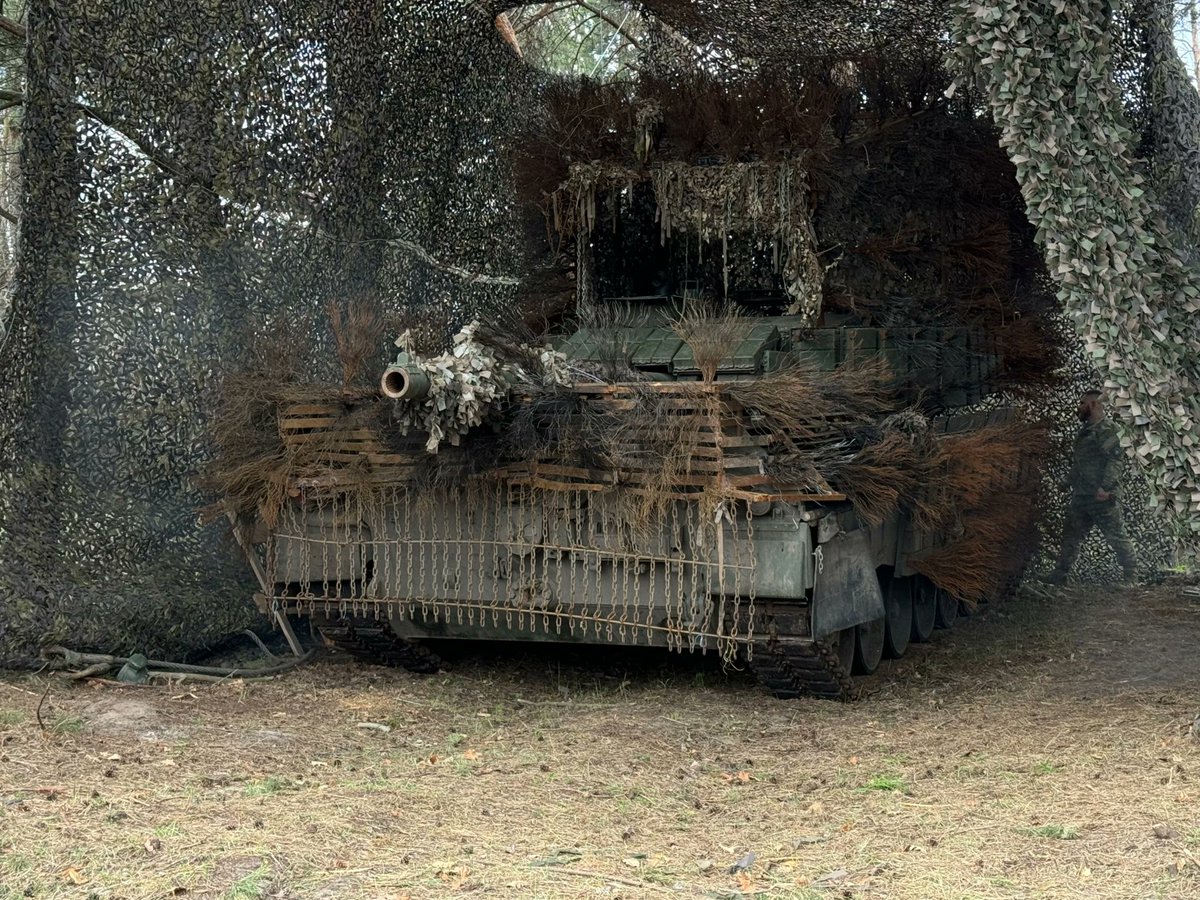
Russians now say their inability to shoot down Ukrainian drones is worsening and due to a "serious shortage of air defense missiles", complaining that many of their units now sit with no ammunition at all.
SPRAVDI — Stratcom Centre tweet mediaSPRAVDI — Stratcom Centre tweet media
English
21
339
1.4K
63.1K
Jonathan Jeckell retweeté
Kyrylo Shevchenko
Kyrylo Shevchenko@KShevchenkoReal·
⚡️ 🇺🇦 In Ukraine, ground robots handle ‼️90% of army logistics - delivering food, ammo, logs for shelters, & evacuating wounded under FPV drone fire. Simple logistics models cost $8K – 20K each, armed or kamikaze versions up to $50K. The army loses about 3 robots a day (25% attrition), but each successful run is far cheaper than risking soldiers & armoured vehicles, @lukeharding1968 writes. One such robot makes 7–8 trips before being hit - the cost per mission ends up around $2K. That's why the whole ground robots market jumped from $43M to‼️$252M in 2025, & Ukraine plans tens of thousands more in 2026. It's turning logistics & parts of combat into something remote, cheap, & scalable. Former gamers often become the best operators. #MilitaryTech Video: @guardian
English
19
513
1.6K
70K
Jonathan Jeckell retweeté
Samuel Bendett
Samuel Bendett@sambendett·
Of note is the fact that when firing, this UGV must be stationary, which can make it vulnerable to Ukrainian UAV strikes. This was also an issue with earlier (pre-2022) Russian UGV variants such as Uran-9. The Courier can be truly lethal if it can eventually fire on the move.
🪖MilitaryNewsUA🇺🇦@front_ukrainian

❗️🇷🇺Russian military are testing the ground robotic complex "Kurier" equipped with the "Bagulnik-82" mortar armament module. The module is fitted with a manipulator for loading mortar rounds.

English
3
10
63
18.2K
Jonathan Jeckell retweeté
ChrisO_wiki
ChrisO_wiki@ChrisO_wiki·
A good article from @TheEconomist on how the war in Ukraine has utterly corrupted the Russian army, with commanders forcing their men to pay so-called "life support" bribes to avoid being sent into assaults. (When the money runs out, they die.)
ChrisO_wiki tweet media
English
33
483
1.6K
47.5K
Jonathan Jeckell retweeté
NASA
NASA@NASA·
"Welcome to my old neighborhood." Our @NASAArtemis II astronauts woke up on the sixth day of their mission to a special message recorded in 2025 by astronaut Jim Lovell, the pilot of Apollo 8.
English
538
8.7K
63.4K
4.8M
Jonathan Jeckell retweeté
Colby Badhwar
Colby Badhwar@ColbyBadhwar·
🇩🇪🇺🇦 "one heavily up-armoured Leopard 1A5 withstood the impact of 52 FPV drones" Impressive performance. Adaptations in protection/countermeasures are keeping tanks relevant on the battlefield. Exposed infantry would have just died, but the tank survived to fight another day.
Colby Badhwar tweet media
German Aid to Ukraine@deaidua

The 1st Tank Battalion of the 5th Heavy Mechanized Brigade has shared some very interesting details about the Ukrainian Leopard 1 MBTs and some upgrades in an interview with @Oboronka1. Apparently one heavily up-armoured Leopard 1A5 withstood the impact of 52 (!) FPV drones over the course of a full day this February, with all crew members surviving the Russian attack. Another interesting fact was shared about upgrading the Leopard 1A5s. @CharityPrytula is funding a proposal from the 1st Tank Battalion to retrofit an in-house 360° view into the Leopards. The system itself consists of four cameras and a single 10-inch monitor, through which the commander can see everything happening around him. The cameras were mounted on the turret, and for reliability, the footage is transmitted to the turret via cables. Thanks to Starlink terminals installed on each tank, the footage from the cameras is uploaded to the battalion's command post, where the officers in charge are now able to more effectively assist the tank commander in carrying out his mission and warn the crew of approaching enemy drones. Currently, the first 10 Leopard 1A5s are being equipped with these systems, which interestingly only cost about 40,000 hryvnias (€800) per unit. H/t @NedSnow2019

English
13
132
788
44.8K
Jonathan Jeckell retweeté
(((Tendar)))
(((Tendar)))@Tendar·
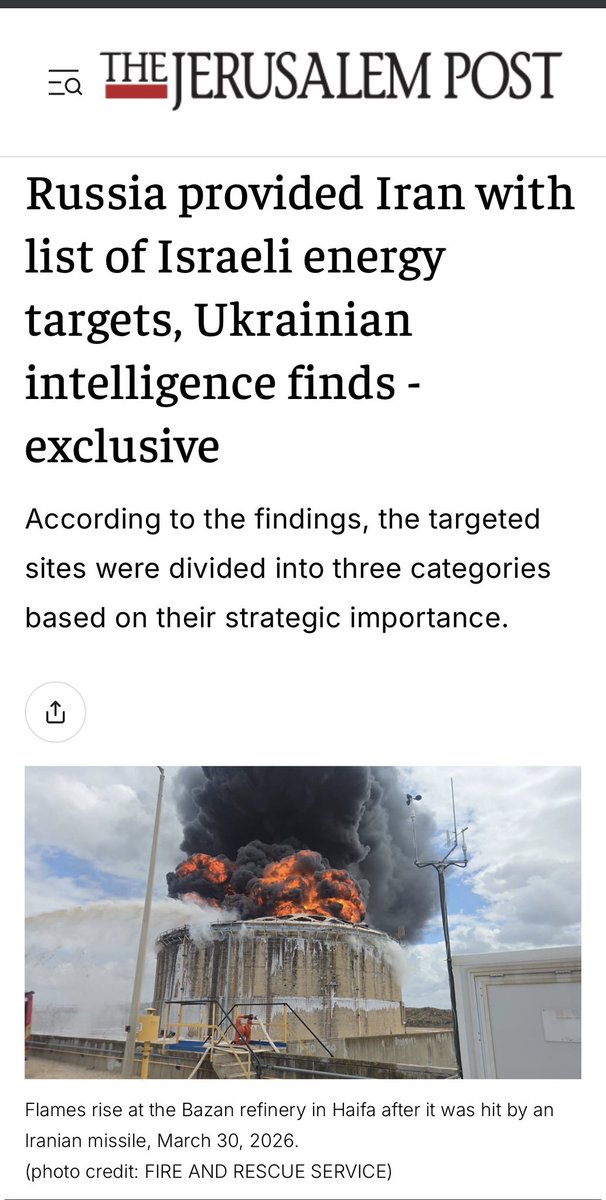
More and more details are coming out that Russia is considerably helping the mullah regime in Iran in striking valuable Israeli targets. They are divided in three categories: Level 1: Critical production facilities. These are sites whose destruction would cripple the national energy system. The report specifically names the Orot Rabin power station as a primary target. Level 2: Major urban and industrial energy hubs. These facilities are located primarily in central Israel and serve large population centers. Level 3: Local infrastructure. These targets include regional substations that support industrial zones and smaller power plants. The strategy is quite similar to Russia‘s terror campaign against energy infrastructure in Ukraine, but with one difference. Unlike Ukraine, Israel is an energy island, making it far more susceptible to attacks on its energy infrastructure.
(((Tendar))) tweet media
English
18
314
1.2K
37.6K
Jonathan Jeckell
Jonathan Jeckell@jon_jeckell·
@WeaponScientist I cannot believe some of the sources that are open to advocating for that. How long ago were people howling about forever wars?
English
0
0
0
31
John Ridge
John Ridge@WeaponScientist·
Seems increasingly likely that we will either have to concede to Iranian demands at some point or go to Tehran. The regime can probably endure an escalation of the air campaign. We simply don’t have leverage unless a ground invasion is on the table.
Faytuks Network@FaytuksNetwork

Senior Iranian officials tell NYT its demands for an end to the war include: 1. A guarantee Iran will not be attacked again 2. An end to Israeli strikes against Hezbollah in Lebanon 3. Lifting of all sanctions on Iran 4. Iran retaining control of the Strait of Hormuz along with Oman, with a $2 million fee being imposed on all ships that transit the strait

English
36
31
291
26.3K
Jonathan Jeckell retweeté
Amichai Stein
Amichai Stein@AmichaiStein1·
🚨🚨 NEW DETAILS: A source close to Ukrainian intelligence told The Jerusalem Post Russia gave Iran a list of the 55 most important Israel’s energy infrastructure. More details on the info transferred, and Russia ambassador in Israel response - in the story. jpost.com/middle-east/ir…
English
79
509
1.4K
439.6K
Jonathan Jeckell retweeté
Gandalv
Gandalv@Microinteracti1·
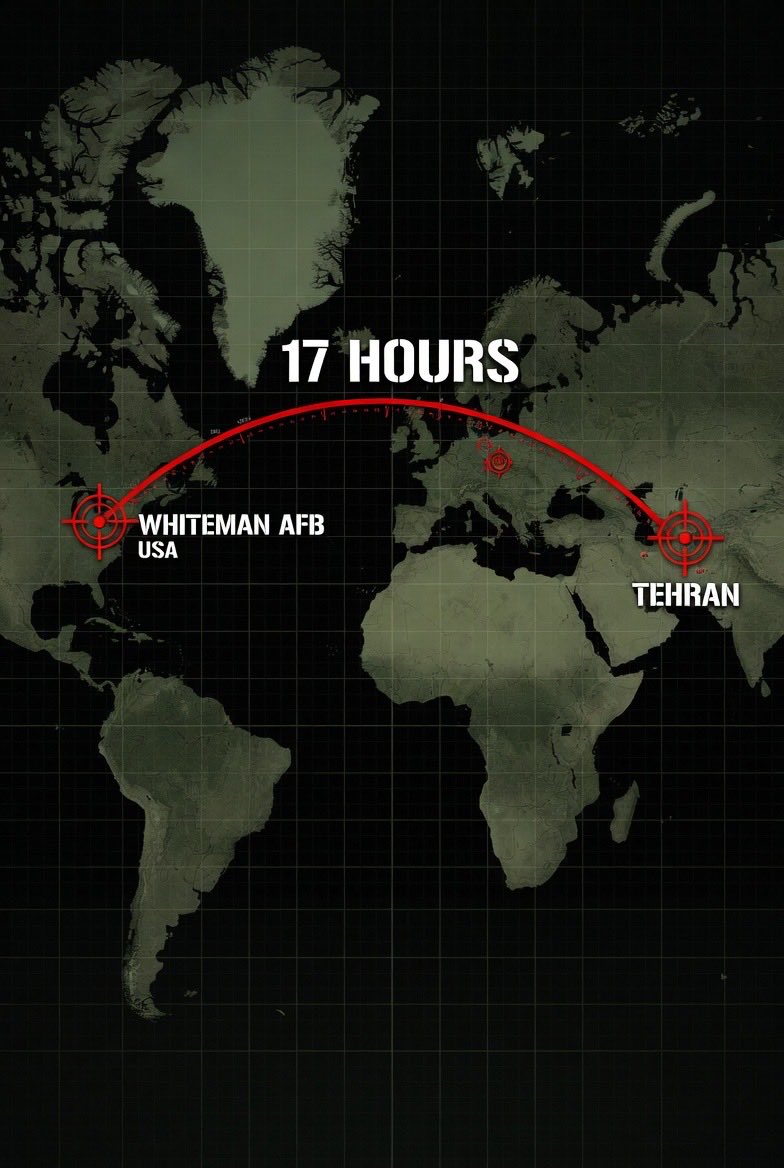
American superpower status was never about aircraft carriers or nuclear warheads. It was about relationships and geography. No nation is a superpower alone. The Soviet Union was a superpower because it controlled half of Europe, its resources, its armies, its airspace. The moment those countries walked out the door, Russia became what it always was underneath. Just Russia. Large, ugly, and alone. America built something different. Thirty-one of the world’s wealthiest democracies, voluntarily, collectively amplifying one nation’s reach into every corner of the planet. That is what made America a superpower. Not the bombs. The allies. Without them you have no forward bases, no friendly airspace, no intelligence network, no collective weight. Today a country with a 17-hour flight to the nearest problem. Which is, with the greatest respect, basically another Brazil. Europe was the rocket fuel that powered two superpowers. First pumped into the Soviet machine, then into the American one. And now, Europe is keeping that fuel for itself. Russia collapsed and the Sovjet Union collapsed. Russia lost its empire when the satellites left. America is being and idiot. Same result. Just with worse timing. Meanwhile Europe is becoming something it has not been in a very long time. The point. Stay connected, Follow Gandalv @Microinteracti1
Gandalv tweet media
English
150
866
3.3K
129.1K
Jonathan Jeckell
Jonathan Jeckell@jon_jeckell·
@NewReaganCaucus For starters it would look a LOT more like Iraq with a lot of Afghanistan mountain flavor thrown into the mix. Germany was culturally very close to the occupying force. South Korea was not an enemy we conquered. Japan required 2 atomic bombs and even then the Emperor kept the lid
English
0
0
0
21
Jonathan Jeckell
Jonathan Jeckell@jon_jeckell·
@Noahpinion Heard it before dozens of times. This is no different than saying tanks can’t survive in 1973 because someone charged masses of ATGMs without supporting infantry.
English
0
0
1
33
Jonathan Jeckell
Jonathan Jeckell@jon_jeckell·
Anyone know where I can get a rough order of magnitude for the cost, range, and payload for the Baba Yaga heavy drone?
English
2
0
0
110
Jonathan Jeckell
Jonathan Jeckell@jon_jeckell·
When I first heard about LLMs I was hoping someone would build a de-bullshitter mechanism. Nobody except the EFF reads software EULAs or the thousands of pages of legal goop when they buy a house. Regulations & procurement law favor very large businesses for the same reason
Séb Krier@sebkrier

📜 Since there’s renewed interest in how AI could help with governance, here are 14 specific government processes where AI agents could make a measurable difference today: Impenetrable forms and applications: citizens face complex, jargon-filled forms that cause them to miss benefits or fail to comply with regulations. AI can replace forms with plain-language conversations that extract data from documents, calculate eligibility, and only ask relevant questions. In the US, citizens spend an estimated 6.5 billion hours per year on federal tax compliance. The IRS sends you no pre-filled return despite already having your W-2s and 1099s. An AI agent could pull all income data the government already holds, pre-populate a return, flag deductions you're likely eligible for based on your profile, and file - reducing the process from hours to a single review-and-confirm step. Regulatory bloat: guidance layered on regulations layered on statutes creates thousands of pages of rules that no person or caseworker can realistically navigate. Rules become too complex and get applied selectively by frontline workers. Agents can be used to map entire regulatory regimes, flag redundancies and conflicts, and let policymakers simulate how proposed rules would actually perform before enacting them. Stanford's RegLab built STARA, an AI system that surveyed San Francisco's municipal code and identified hundreds of outdated reporting mandates, which resulted in a 351-page ordinance to eliminate or consolidate more than a third of the city's 528 mandated reports. Obsolete code and IT systems: the US Social Security Administration runs on 60-million-line COBOL codebases from the 1980s; the IRS processes returns on systems from the 1960s; the World Bank's own internal review found its siloed divisions (IFC, IDA, IBRD) couldn't communicate across systems and its bureaucracy resisted modernisation. In each case, no one internally understands the code, so agencies can't fix a bug without months of waiting and enormous contractor fees. Agentic coding tools let internal teams point an AI at a legacy codebase and start making changes themselves. Fraud and improper payments: after Hurricanes Katrina and Rita, FEMA distributed $6bn in relief with $600m to $1.4bn in improper/fraudulent payments according to GAO. During COVID, the US lost an estimated $100-200bn to fraudulent unemployment insurance claims alone, many filed by bots. As bad actors adopt AI to generate synthetic identities, forge documents, and file claims at scale, that gap will widen fast. Agencies need their own AI agents doing real-time cross-referencing of claims against income data, identity records, and behavioural patterns. Siloed, department-centric service delivery: around 600,000 people leave US prisons each year. Each must separately navigate the Bureau of Prisons (release paperwork), SSA (Social Security card), state DMV (ID), Medicaid (healthcare), SNAP (food), HUD (housing), American Job Centers (employment), and a parole office; each with its own application, eligibility rules, and case system. These dependencies are sequential: without ID you can't get benefits, without benefits you can't stabilise housing, without housing you can't hold a job. An AI agent could intake one person's situation at release, determine eligibility across every level of government, and file applications in the right dependency order. Identity verification as a bottleneck to service access: 800m people worldwide can't legally prove their identity according to the World Bank, mostly in Sub-Saharan Africa and South Asia. Without ID you can't open a bank account, receive a cash transfer, or access most government services. India's Aadhaar is a nice positive example: 1.4bn biometric IDs, 523m new bank accounts, and a claimed $11bn saved by eliminating ghost beneficiaries; but this took a decade of state capacity to build and still fails often enough to lock out legitimate users. AI agents could compress this by cross-referencing whatever documents a person does have (a utility bill, a phone number history, a community attestation etc) against available records and flagging confidence levels for human review. Benefits eligibility screening: the US has over 80 federal means-tested programmes, each with its own application and documentation requirements. A single mother qualifying for SNAP, Medicaid, CHIP, WIC, EITC, Section 8, and childcare assistance faces what is effectively seven separate bureaucracies. An AI agent could intake one life-situation description, determine eligibility across every programme simultaneously, pre-fill and submit applications in parallel, and flag benefits cliffs (where a small income increase would trigger a sharp loss in support) before they hit. Building permit approvals: getting a construction permit in many US cities takes 3–12 months of back-and-forth between applicants and planning departments, often over PDF submissions reviewed manually against zoning codes. An AI agent could parse submitted plans against the local zoning and building code, flag non-compliant elements immediately, and return a preliminary approval or specific revision list within hours instead of months. A related case study: DeepMind recently helped the UK government translate mountains of old paper maps, PDFs, and scanned documents into usable data for modern planning systems with the Gemini-powered ‘Extract’ tool. Public records requests (FOIA): federal agencies have backlogs of hundreds of thousands of FOIA requests, with median response times stretching to months or years. Staff manually search filing systems and redact sensitive information page by page. An AI agent could search document repositories for responsive records, auto-redact exempt information (personal data, classified material, deliberative process content), and draft a release package for human sign-off. However this only works where records are digitised and searchable, and much of the government still runs on fragmented legacy systems where documents aren't centrally indexed… Court scheduling and case management: state courts lose enormous time to scheduling conflicts, continuances, and manual case tracking. In many jurisdictions, hearing dates are still set by phone or in-person. An AI agent could manage the full docket — auto-scheduling based on judge availability, attorney conflicts, and case priority, sending reminders, and rescheduling continuances without human clerk intervention. Over time you could also start exploring automating some low-value claims through novel arbitration pipelines, freeing up court capacity for more consequential cases. Business registration and licensing: starting a business in most jurisdictions requires navigating 5–15 separate registrations: state incorporation, EIN from the IRS, state tax registration, local business licence, zoning compliance, health permits, liquor licences, professional licences, etc. An AI agent could take "I want to open a restaurant serving alcohol at [address] in Brooklyn," query every relevant federal, state, and city database, produce the complete permit checklist in dependency order, pre-fill each application with the business details, and flag the long-lead items (e.g. liquor licence) that need to start immediately. Social worker caseload documentation: child protective services and adult social care workers spend the majority of their time on paperwork rather than with clients: writing visit notes, filing reports, updating case management systems. For every case, caseworkers complete roughly 400 forms totalling ~2,500 pages (multiplied across the 24–31 cases they typically carry simultaneously). An AI agent could listen to (or read transcripts of) a home visit, auto-generate the structured case note, update the system of record, and flag any safeguarding triggers, giving caseworkers their time back for actual care. Medicare/Medicaid claims adjudication: CMS processes over 1bn claims per year, with complex rules about covered services, bundling, medical necessity, and provider eligibility. Improper payments run to tens of billions annually, and 77% of these were due to insufficient documentation, not fraud. In parallel, Medicare Advantage denies 17% of initial claims, yet 57% of those denials are overturned on appeal. Agents could adjudicate straightforward claims automatically against the coverage rules, flag anomalous billing patterns in real time, and route only genuinely complex cases to human reviewers. Public comment synthesis for rulemaking: when a federal agency proposes a new rule, it often receives thousands to millions of public comments (the FCC received 22 million on net neutrality). Staff must read, categorise, and respond to each substantive comment. This may well get worse as people use agents to submit plausible-looking comments multiple times. Agents can help the government filter through these, cluster comments by theme, identify unique substantive arguments, flag form-letter campaigns, and draft the agency's response-to-comments document (a task that currently takes teams of lawyers months).

English
0
0
3
55
Alex Luck
Alex Luck@AlexLuck9·
Nowhere.
Alex Luck tweet media
English
5
0
43
2.4K
Jonathan Jeckell retweeté
Steven Ashley
Steven Ashley@steveashleyplus·
A machine learning approach yields a new class of 3D-printed steel w/ ultra-high strength and ductility that costs less, resists rust and is quick to make. Stronger steels are usually brittle, whereas ductile steels tend to be weaker... (Purdue/UnivSChina) eurekalert.org/news-releases/…
English
0
2
2
81