
Xiao Wang

673 posts

Xiao Wang

Xiao Wang

@xiaowa

Co-Founder/CEO of @chooseboundless - empowering immigrants with technology. Runner, cook, lucky owner of the world's best dog.

Seattle, WA Inscrit le Ağustos 2009
280 Abonnements733 Abonnés
Xiao Wang retweeté
aviel
aviel@aviel·
With the deceptively named Millionaire's Tax and the proposal to do away with the Qualified Small Business Stock exemption, it seems that Olympia is dead set on killing entrepreneurship in Washington State. Unfortunately, it also seems like either nobody has noticed or that nobody cares. Episode 4 of Foundations Almost Live! is our attempt at getting you up to speed in a way that's not boring (if not equally insane to the proposals themselves). seattlefoundations.org/almost-live/
English
7
47
160
5.2K
Xiao Wang
Xiao Wang@xiaowa·
@dadiomov It's the one monopoly America has had on the world that has led to decades of progress and innovation.
English
0
0
3
72
Dimitri Dadiomov
Dimitri Dadiomov@dadiomov·
Making it hard for foreign students to attend American universities is the single dumbest thing the US government can do. It simultaneously makes America weaker, other countries stronger, and the world as a whole less prosperous. Lose-lose-lose. Hope they change their policy.
English
10
10
95
13.1K
Xiao Wang
Xiao Wang@xiaowa·
@RyanDivish I happen to run the leading digital immigration company in the country, live in Seattle, and have been a fan for 30 long years. Can we help?
English
0
0
1
505
Ryan Divish
Ryan Divish@RyanDivish·
Donoven Solano is having visa issues and hasn’t reported to camp yet. The Mariners hope he will be in Peoria by Friday.
English
27
15
451
51K
Xiao Wang
Xiao Wang@xiaowa·
@haridigresses So many thoughts that resonate here. I firmly believe we can win via the services wedge but let's catch up some time and hash it out :)
English
0
0
1
114
hari raghavan
hari raghavan@haridigresses·
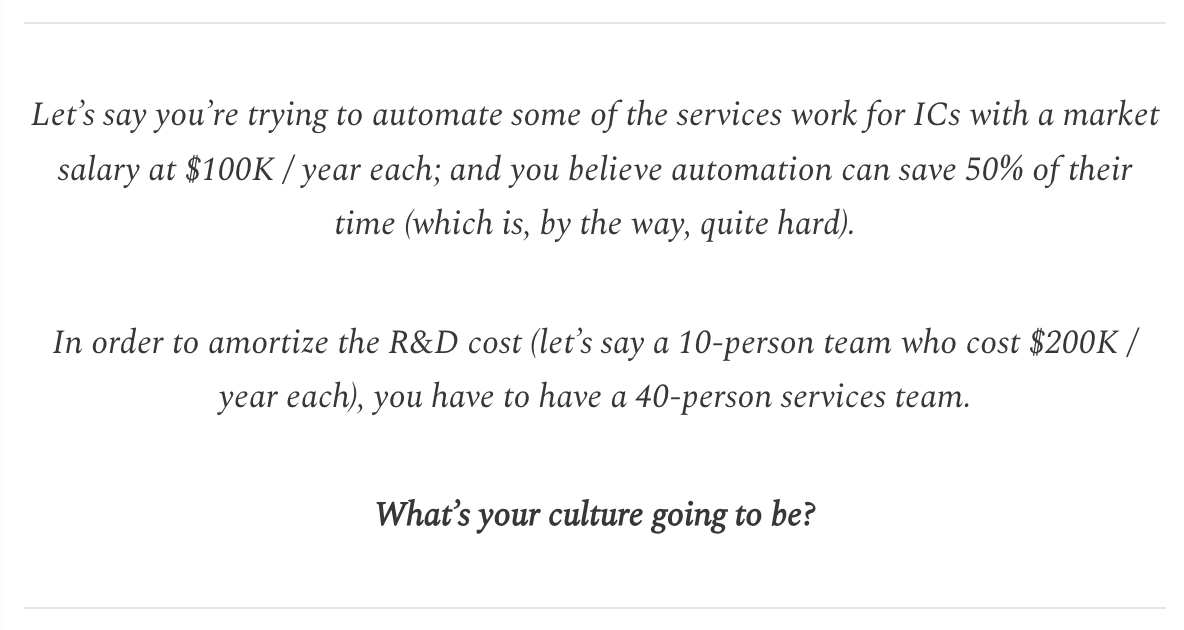
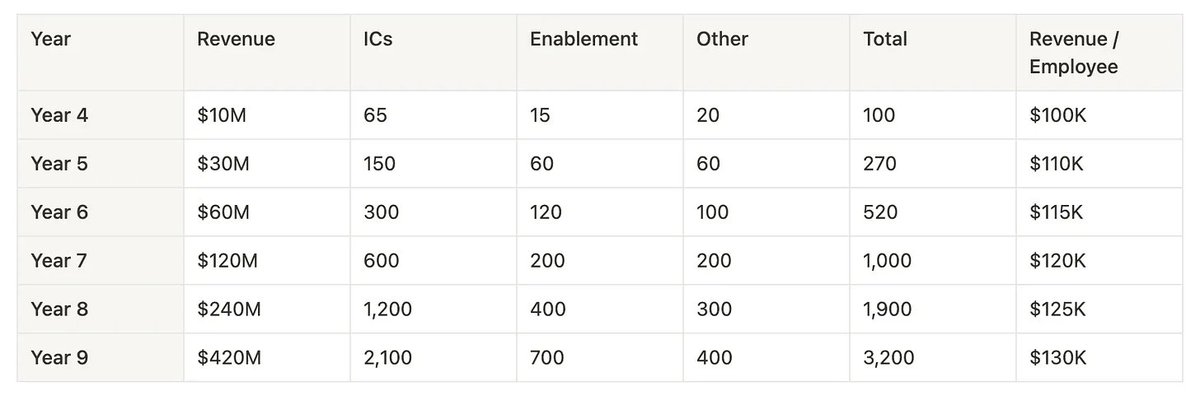
TECH-ENABLED SERVICES AREN'T VENTURE SCALABLE Most of my career has been in professional services. I started my career at BCG, then worked at a fintech startup (Forge) that was more “fin” than “tech”, then founded a tech-enabled services company (AbstractOps). I’ve also advised or invested in 10+ companies that had a meaningful services component. A couple of definitions before we dig in Software vs. Services vs. Agents: - Software companies sell an API call [1]. - Services companies sell a fraction of someone’s time (whether they are tech-enabled or not); trust and the human touch is an intrinsic component. - Agentic companies sell outputs; the customer doesn’t care how it’s done or by whom… they just care that it’s done. Tech-enabled: Your company is counting on automating some of the work that the service-provider is offering in order to improve margins to make them look more attractive to an investor. This is your main competitive advantage compared to “old-school” incumbents. Venture-scalable: A company that suits the venture capital funding model, which typically means: a company which can exit at a $1-5B+ valuation within 7-10 years. - This requires a company to grow really rapidly for several years in a row (2-3x+ / year). - One common benchmark that startups use to meet this cadence is “T2D3” (triple twice, then double three times) — this results in a 72x in 5 years. If an institutional VC leads a seed round, Series A, etc. in a company, they are expecting it to behave in a “venture-scalable” or “venture-backable” manner. (Note: angels or PE / growth investors don’t always have the same expectations.) Things that are not to be confused with tech-enabled services: - Implementation services: offering one-time services to implement software does not count as tech-enabled services. Ultimately, the company is mainly buying your API calls, not your team’s time. - Services marketplaces or BPO firms: if the service providers are not on your P&L (e.g., Uber, TaskRabbit), then you’re a services marketplace not a service provider. The dynamics of that model are totally different. - AI Agents: as mentioned above, an agentic startup is typically trying to sell outputs or well-defined “units” of work. This work is not denominated in hours, and hence is not services from a customer’s perspective. Why might one want to start a services-centric business? You can charge a lot more for services than you can for software. In my experience, customers will usually pay between 5-10x for a person doing the work, compared to software that will do most of the work for them. This is true even if it takes the customer the same amount of time to manage the services provider as the software. [2] As a founder, this probably sounds awesome! “I can charge $2K / mo = $24K / yr for services rather than $200 / mo = $2,400 / yr for software? And I can spend less time coding upfront, iterate more rapidly… I’m sure I can figure out how to make the work efficient later. In the meantime, I can crack $1M in ARR with just ~40 customers and raise a big series A in a year. Simple!” Narrator: It was not simple. BUSINESS MODEL DYNAMICS Gross margin & resulting valuation dynamics Every dollar of revenue is not equal. There are many things affecting “quality of revenue” but two of the most important ones are gross margin and retention. Software businesses usually have gross margins of 70-90% (vs. 30-50% for services), and they typically have high retention & expansion rates (usually expressed as Net Revenue Retention or NRR). Services businesses probably have very high 12- and 24-month retention because of the human touch, but it probably tapers from there (many services get brought in-house over time). Which is why, in order to get to a $1B valuation in a steady state, it might require: - $100-200M in revenue with a “SaaS profile” (80% gross margin, higher NRR) - $300-500M in revenue with a more “transactional” / “services” profile (50% gross margin, lower NRR) So you might be able to charge 5-10x the revenue, but if each dollar of revenue is only “worth” a third as much, you’re getting less benefit than you might think. If you’re curious about the levers here, feel free to play around with my shorthand DCF calculator linked in the reply below. Context switching is the mind-killer (Apologies to Dune for the mangled reference.) From my experience, it’s possible to get services gross margin to 30-35% very quickly based on standardization, templating, and basic automation. But note that in order to get to a $1B valuation with even $400M in revenue, you need 50%+ GM. So how do you get there? 1. If you raise prices, that will (usually) come with higher customer expectations. 2. So perhaps we ask a given service provider to handle more clients? Now, remember that the biggest benefit to having a human in the loop is that they remember and account for the context of a given customer, which they leverage to exercise judgment when handling their needs. This benefit (and hence your right to charge 5-10x more than software) breaks down very quickly when you try to add more clients. For the work we did at AbstractOps — a breadth of back office services ranging from accounts payable, payroll, state compliance, vendor management, contract issuance, etc. — we were able to get from 4 to 6 clients without a problem, but then it completely broke. Going from 6 to 8 clients for even our best OPs (Operations Partners) burned them out within months and destroyed productivity. Humans can typically hold 7 “chunks” in their working memory. This sort of works the same way. Guess what happens next? The burned out employees leave, which means you have a different switching of context — transferring knowledge from one person to another. This is lossy, expensive, and not a great experience for the customer, but it’s inevitable. We had to cycle some clients through 4 OPs in less than a year. Besides the bad CX, the cost of onboarding / training / offboarding hurts your business model further. Management layers and coordination overhead Scaling services does not come with positive returns to scale. It comes with negative returns to scale. The ratios will vary by service model, but let’s say that for every 6 service providers you’ll need to hire a manager, for every 5 managers you’ll need to hire a director, and every 4 directors a VP. This pattern means that the amortized cost of a single service provider IC will increase ~15% → 20% → 25% as your team grows. In other words, you need to improve efficiency by 20-25% just to match your gross margins when you’re starting out. You need to sprint just to stand still. Services are a more fragile business model If you’re running a software business, you can spin down AWS servers to reduce your cost of goods sold. You can’t “spin down” employees. So, during market cycles, the business model is really brittle. Even a bad month or two makes life really difficult. If you have too few people, your employee hurts; and if you have too many, your business model hurts. There is a very narrow Goldilocks zone for capacity utilization. The lack of flexibility makes a services-first business model much less resilient. The really great professional services businesses take decade(s) to build: investment banks, consulting firms, and audit firms are primarily hired based on their brand and credibility. Firms like BCG / McKinsey or Goldman / Morgan Stanley can command 70%+ gross margin (in part because they charge 2x the fees of other strategy or IB firms), and this makes them very resilient to market cycles. But that’s not something a startup can replicate in a few years. All this comes with BIG customer expectations… and churn When the customer expects to interface with a person, their expectations balloon accordingly. “I’m paying you $2K / mo, I expect a lot more than this.” or “If I hired someone for this, I’d expect them to be operating at a much higher level.” People intuitively understand that software is an input-output machine, and it won’t do everything you want. But when your UX is a human being, a “user” is tempted to ask for whatever they want. A customer-minded service provider will often be a people-pleaser, and say yes to things that aren’t actually a good idea, which will lead to broadening scope, worsening service quality, and burnout. It’s really really hard to find people who can make customers happy, exercise judgment in tricky situations… but also be firm and say no when needed. So when (unreasonable) expectations are not met, customers churn, which makes all of your goals above harder. CULTURAL DYNAMICS People repeat mistakes Software is deterministic. If there’s a bug and you fix it, it won’t happen again. But the same person might make the same mistake over and over, and different people will make the same mistake over and over. This sort of quality is nearly impossible to control for, without hiring an army of “drones,” which brings us to… Motivating people is hard in this environment There are so many reasons that retaining your best employees is nearly impossible for this sort of business. Often, the best way to avoid mistakes, create efficiency, and improve margins is to pick a narrow slice of work and do it very well. Effectively, a “productized” service. This means you’re expecting people to be automatons, and no talented person will want to do that for very long. On the other hand if you add variety to the work, it’s harder to standardize and productize, which will hurt you in the long term. The context switching leads to burnout, as we established. Your employees will have the goalposts shifted on them constantly (because your business model will need to iterate rapidly, and the employees are the business model), which will feel very unstable and uncertain. Recently, employees who have never run a business have also come to believe odd things like think that “employment is theft.” One employee believed “I don’t think the company should have the right to upcharge more than 15% for my work,” without internalizing the fact that the company had to absorb the cost of capacity utilization, training, hiring, sales, vendor / equipment expenses, regulatory overhead, professional services and literally everything else it takes to run a business. Needless to say, this is a frustrating conversation to have. Incentives sometimes backfire The way that many long-standing professional services businesses (banking, consulting) solve for motivation is an apprenticeship approach, with timed promotions. But the issue for a new business / startup (even one that’s growing rapidly) is that they can’t dangle the promise of massive comp increases that a bank or consulting firm can offer. MDs / Partners at those orgs make $500K - xM / year. An early stage company will take a long time to build the brand credibility needed to support the pricing (and hence compensation) to sustain that sort of model. This sort of model worked at Forge, because there was a massive pot of money in the investment banking / brokerage business, which are an effective motivator for junior employees to grow and succeed. Apprenticeship and promotions failed miserably at AbstractOps. We promoted quickly (albeit with smaller increases — from $80K to $95K to $110K), which came with the unfortunate side effect of everyone getting obsessed with promotions and comp. We had people get pissed off because they weren’t promoted twice in one year. Your best people leave sooner, and might take your customers with them Your best employees will probably work the hardest and get burned out the fastest. In the meantime, their competence is on full display to their clients. And for clients this is the dream scenario: they get an extended work trial, with another company taking on the burden of training and managing the employee. You probably need to institute a penalty clause in your contract if your clients hire your employees (and even if you do, the pain of offboarding, handoffs, etc. are material). I’m a big believer in freedom of labor, but it doesn’t make this feel any less of a gut-punch when it happens. What will feel worse is when an employee leaves and starts a mini-competitor; becoming a fractional service provider themselves, and working with a bunch of their former clients. This especially sucks because you lose the employee (whom you’ll need to backfill, train, etc.) but you also lose a bunch of clients. Your core competency must become people, not product All this means that your core competency isn’t software, efficiency, or building product. It’s staffing. You need to be world class at hiring, onboarding, training, managing, and firing people. Maybe that’s your happy place, but it was certainly not for me. Every company has a first-class and second-class function (everything can’t be equally important). If you don’t make your services the first-class function and priority, you will have massive attrition, staffing, customer service, and culture issues. But if you try to make your product & engineering, the first class citizen, something weird happens… Your services folks might resist the software At a retreat, I said something I thought was very logical: “Our job isn’t just to serve customers. It’s specifically to serve customers through our product.” There was an uproar. The team was already somewhat burned out, and this felt like a top-down mandate from people who didn’t understand how the work was done (which was not true since my cofounder and I were regularly deep in the weeds on client work, and in fact “owned” several client relationships and we did the work). But there were several understandable reasons, with varying depth and emotion: 1. Getting used to a new product takes time. When you’re stretched thin, you have to pick between getting stuff done the old way, vs. investing time in a “better” way. 2. And for a while it might not even feel like a “better” way! Building good product takes time. Our early versions were full of bugs, which caused a lot of frustration to people who were expected to use it every day. There’s no doubt we could have been a lot better, but I think it’s normal (even healthy) to ship before it’s perfect and iterate in the real world. That doesn’t work very well when your power users are colleagues who are trying to get stuff done. The “normal” way of building feels like teammates are letting each other down. 3. A couple of the team members hinted at the fact that they believed our goal was to automate away all the work and fire everyone. This was absolutely not true; as we grew, even if we achieved tremendous automation and efficiency, there was going to be tons of room for high performing people. But it’s hard (as a non-technical person) to shake the feeling that software is taking away jobs from all knowledge workers. All this builds up to… If you’re services-first / product-second, It’s very hard to have an elite product culture Who sets the priorities at the company? Who speaks for the user internally? If you try to become a product-first company, then the services team will understandably feel like they’re being treated unfairly when — by all measures — they’re driving revenue and growth at the company. I’ll put it more bluntly. You can’t do both well — you need to pick one and focus. And because development work is extremely high leverage, you can’t put them second. But if you put services second, you will have a toxic culture. AFTER ALL THIS... EXPONENTIAL GROWTH IS NOT AN OPTION Let’s say you figure out and solve all the hard parts above, because you’re a legendary founder (certainly would make you better than I was). You still can’t scale this on a venture-scale timeline, when your headcount needs to scale linearly (or worse-than-linearly). Take an example business with $100K / year service providers, for whose services you charge $200K / year in revenue. Let’s say you got to ~$3M in revenue (congrats!) in year 3, with a team of 15 ICs. Now if you want to do the T2D3 (triple twice, double three times) we talked about: This is sort of the revenue path you will be expected to follow if you’re building a venture scale business… but the headcount required is wildly different. By the time you’re in year 7 and beyond, you’ll need 2-3 times as many employees (e.g., $200M ARR public SaaS companies average ~700 employees). The following things should be apparent: 1. Increasing revenue / employee is a slow, painful march. 2. This is a very different business than what you might imagine when you think "startup" or "tech-enabled services". The thing that matters most is whether you can manage well & scale an organization. 3. Maintaining quality while scaling a team to thousands (especially this quickly) is wildly hard. 4. This does not seem fun (at least, it was not fun for me). Note: The higher-value the work you’re automating, the better; automating work with a market salary of $250K is a lot better and high leverage than work with a market salary of $75K. This is often the case with brokering, where the work is comparable whether you’re working on a $500K revenue deal or a $25K revenue deal. So we focused on large deals and scaled to $20M+ in annualized net revenue in a few years, with 50% operating margins. It was an awesome ride for a little while. But (from what I can tell, I was no longer there) a lot of the same cultural and scaling issues kicked in during years 5 - 8. Today, ten years in, the company does $80M in revenue, and will (hopefully) be profitable again soon. SO... WHAT SHOULD YOU DO? Option 1: If you really want to build a company on the venture capital timeline, and swing for the fences with a big exit, you should probably not build a services-centric business. You should probably build a software business, fintech business, etc. Go raise a $1-2M pre-seed (or if you can swing it, skip straight to a $2-3M seed). Option 2 (this is not for the faint of heart): If you want to utterly disrupt a services industry and ride the AI wave, build a product that only offers unitized services, in an agentic manner. This only makes sense for products that are already fixed-price services offerings. For example: - Legal: trademark filings… not general corporate legal services - Finance: bookkeeping… not fractional CFO services - Sales: lead sourcing… not fractional GTM services In the former categories of each, there is an expected deliverable that is a knowable quantity of work. It has a clear input → workflow → output workflow. This was impossible 2 years ago, and now is merely almost-impossible. If you try to build this company, you will probably fail. Especially if you haven’t built an AI product before. It is harder than either Option 1 or Option 2, and you will have serious competition because literally everyone is doing this. Your insights are probably not unique unless you’re a hardcore AI research scientist (there are very few subject matter insights that matter IMHO). You’ll just have to out-execute everyone from a technical perspective, which is a high bar and why you will probably fail. But… You’ll probably still be able to raise a $5-20M seed round if you have great founder-market fit or a prior exit, and obviously that’s a terrible idea and you should not do that (but you’ll probably do it anyway and then regret it). If you somehow manage to build this, it will probably be a generational company, because AI models will improve to the point where they will be able to handle not just trademark filings but also all other corporate legal services… and you will have the ideal foundation to land-and-expand. Option 3: If you want to build a tech-enabled services business, accept the fact that you might not look “venture-backable” and that’s fine. In fact, it can be great, but it’s a totally different path than all your friends’ startups and you have to be okay with that. It might look like: - Bootstrapped, or based off a small angel / F&F round of funding; - Financially modeled to cross $1-2M in revenue and break even within a ~year of operating; - Built in a PE-style model: less agile as a business, slower growth (but still pretty good!). After crossing $2M in ARR, your growth will probably slow to <100% CAGR permanently, so an ambitious goal might be $10M after 4 years, $40M after 7 years, $100M after 10 years — with a steady state gross margin of >50%; - If you do it right, you might generate $1-2M in FCF in year 4 and $25M+ in year 10; - Getting a taste of entrepreneurship and financial freedom with less baggage and fewer expectations; - Building software to improve gross margins, to improve customer stickiness, and to expand ACV; - A lot of your work with automation should probably focus on preserving and presenting a specific customer’s background juxtaposed with your knowledge base to your service provider ICs — this is one of the biggest sources of context switching; - Exiting it for 2-5x revenue when you get it to a critical mass (usually 7-8 figures in revenue). - You might get lucky… once you have a strong brand, and with the advancements of AI models, you might be able to get margins up higher, quicker; or grow faster. But if you aren’t ready and you try to force it, you might kill the golden goose. But if it is ready, services might end up being the best wedge of all; Honestly all 3 options suck because being a founder-CEO sucks, so I don’t know why you’d want to do any of this to yourself. But whichever path you follow, I hope this post helps. Thanks to Adam Spector, Noah Itovitch, and Mitali Gala for reviewing and providing feedback on this post, and to Brett Jackson for some good debate on the topic. [1] h/t Anand Subramani for the pithy definition [2] The reason for this is that a professional service requires zero implementation, no knowledge transfer, no internal training, and has little-to-no platform risk for a company. Additionally, the business case to justify a fractional resource is comparing it to hiring someone, vs. calibrating software to vendor spend (which is a smaller pot of money for whatever reason, though this will change).
hari raghavan tweet mediahari raghavan tweet mediahari raghavan tweet mediahari raghavan tweet media
English
9
4
50
8.9K
Xiao Wang
Xiao Wang@xiaowa·
What's interesting about the MAGA movement is the ambiguity around the time horizon. Making America Better in 2025 (e.g. tariffs) is different than Making America Great in 2035 (e.g. immigration policy to attract the world's best students). I doubt populism can embrace both.
English
1
0
1
269
Xiao Wang
Xiao Wang@xiaowa·
The H-1B debate is hard since everyone has anecdotes. Some only know top performers. Others work with IT consulting shops. Some saw top grads from MIT lose the lottery and leave. Others have seen abusive employers take advantage. The program is critical, as is need for reform.
English
0
0
3
280
Xiao Wang
Xiao Wang@xiaowa·
@elonmusk Absolutely! We help process more legal green card applications than anyone else. Been offering to help USCIS with building an API for almost 8 years instead of mailing millions of paper pages around the country. Want to give us a hand?
English
0
2
5
325
Elon Musk
Elon Musk@elonmusk·
Legal immigration to America is ridiculously slow & difficult, even for super talented people. Needs to be fixed.
English
17K
44.7K
324.8K
46.8M
Xiao Wang
Xiao Wang@xiaowa·
@ianhawes @chooseboundless Thanks Ian! Expanding Parole in Place makes so much sense. As long as you're not a nativist it really is a win for the country as a whole.
English
0
0
2
87
Xiao Wang
Xiao Wang@xiaowa·
For the first time, spouses of U.S. citizens who entered the country without documentation can apply for work permits and obtain legal status. THIS IS GREAT FOR AMERICA OVERALL. boundless.com/blog/biden-par… Rebuttals to arguments in thread (1/4)
English
2
3
5
749
Xiao Wang
Xiao Wang@xiaowa·
Ignoring commentary that says the U.S. citizen should get a divorce because they married a criminal. Will finish with, can you imagine living in the U.S. for 10 years with the love of your life, and never be able to visit your family at home or pursue your career? (4/4)
English
0
0
3
255
Xiao Wang
Xiao Wang@xiaowa·
They're rigging the election! <- these spouses will need to wait at least 2, sometimes 5+ years before being able to apply for citizenship and vote. They're increasing labor! <- that's right! America has a massive labor shortage and inflation; this is helping with both (3/4)
English
1
0
3
322
Xiao Wang
Xiao Wang@xiaowa·
They're opening the border! <- these spouses have lived in the U.S. for at least 10 years, and average 23 YEARS without legal ability to work They're increasing crime! <- these spouses have to go through a rigorous application and generally need a clean record (2/4)
English
1
0
3
380
Xiao Wang
Xiao Wang@xiaowa·
@SeifertESPN Our team had dinner with the Manila Visa office head last night and discussed her case. Can you help put us in touch with @Cambeezy_ to pass along the advice?
English
0
0
0
76
Kevin Seifert
Kevin Seifert@SeifertESPN·
A spokesperson from the office Minnesota Sen. Amy Klobuchar confirmed today that it is working to assist Bynum and his wife, as it does for any constituent that asks. Bynum today: "I'm just being patient and am super grateful for everybody being willing to help."
Camryn Bynum@Cambeezy_

Anyone have connections the US immigration office for my wife? She’s in the Philippines and not able to come to the US until her I-130 spousal visa is granted. We’re going on 2 football season of no games for her. We’ve been denied a tourist visa twice so far RT til she’s home💜

English
11
25
407
87.8K
@jason
@jason@Jason·
What’s the best source of data on immigration (legal and illegal) in the US? Seems to be very hard to quantify what’s happening on the illegal front. Anyone on X an expert on this?
English
53
4
77
170.1K