An Engineer Reacts

1.5K posts

An Engineer Reacts banner
An Engineer Reacts

An Engineer Reacts

@AEngineerReacts

Twitter for the YouTube channel where I react to things. Have as BS and MS in engineering and a Licensed PE in multiple states so someone thinks I know things.

USA Bergabung Haziran 2025
135 Mengikuti23 Pengikut
Tweet Disematkan
An Engineer Reacts
An Engineer Reacts@AEngineerReacts·
Here is a link to my channel where I give my view on things from an engineering perspective. @anengineerreacts?si=ccy4aO4rUvIrNoWH" target="_blank" rel="nofollow noopener">youtube.com/@anengineerrea
English
2
1
3
962
An Engineer Reacts
An Engineer Reacts@AEngineerReacts·
@LibZionistNerd @d_h_sanders Sorry man that is politics as long as one side is determined to instal horrible policies. If they get back to just debating tax rates etc the stakes go down. Welcome to adulthood it's not fun.
English
1
0
4
43
The Nerd the Size of a Man
The Nerd the Size of a Man@LibZionistNerd·
@d_h_sanders People would not like every single election to be some potentially existential crisis that dooms everything we love to complete oblivion.
English
2
0
1
90
Thag Simmons
Thag Simmons@d_h_sanders·
I’m still trying to figure out why for the past 10 years the worst person in the world continually ran for president and many people decided the only alternative they would accept was someone who would fix politics forever in a single election
English
21
172
3.1K
57.1K
An Engineer Reacts
An Engineer Reacts@AEngineerReacts·
@DEF_NOT_DEAF @wisplite @inkysputter @mathsboi42 Got to spread out the cameos one during the lead up episode, one during the landing, and one during the "catastrophe" episode that gets easily solved. Of course Collins gets whichever episode is expected to suck.
English
1
0
3
15
eva
eva@_glorianas·
flat earthers are so funny man "they're lying about the shape of the earth" okay why?
English
634
5.6K
143.2K
2.4M
Twitchy Toes
Twitchy Toes@PennyCrayon5·
@mathsrick_ Without cheating/looking/calculating , I'd say it can't possibly be A, because 2 squared plus 2 squared is 2 cubed And it can't possibly be B And D feels like it'll be too low So I'd say C because it feels about right
English
1
0
4
2.9K
Mathsrick
Mathsrick@mathsrick_·
Choose the correct answer
Mathsrick tweet media
English
750
137
4.4K
2.5M
An Engineer Reacts
An Engineer Reacts@AEngineerReacts·
@SuperRocy See you didn't get the joke. No one is acting like Bush was sensible, he was an idiot led by Chaney to do horrible things. Even with him being that bad, Trump is worse. That's what is being said here.
English
1
0
10
89
SuperApeRocy
SuperApeRocy@SuperRocy·
@AEngineerReacts The jokes sucks and so does he. If the butt of the joke revolves anywhere around trying to act like Bush was more sensible, it's a terrible one already.
English
1
0
0
115
tea-yuh ᙏ̤̫
tea-yuh ᙏ̤̫@thiasaur·
@ethxooo laika’s not in the picture too :( she’s out there somewhere
tea-yuh ᙏ̤̫ tweet media
English
5
9
786
33.1K
An Engineer Reacts me-retweet
Spaceballs The X Account
Now that Artemis II has launched we have 10 days to get everyone on Earth a Planet of the Apes costume so we can do something hilarious when the astronauts return 😁
Spaceballs The X Account tweet media
English
2.2K
17.7K
92.2K
2.5M
KG
KG@KartikGadaATOM·
@OurWorldInData The question is, will this trend continue? It is a 'Moore's Law' for batteries. Another 50-75% reduction in price would be transformative to the world economy.
English
3
0
6
1.2K
Our World in Data
Our World in Data@OurWorldInData·
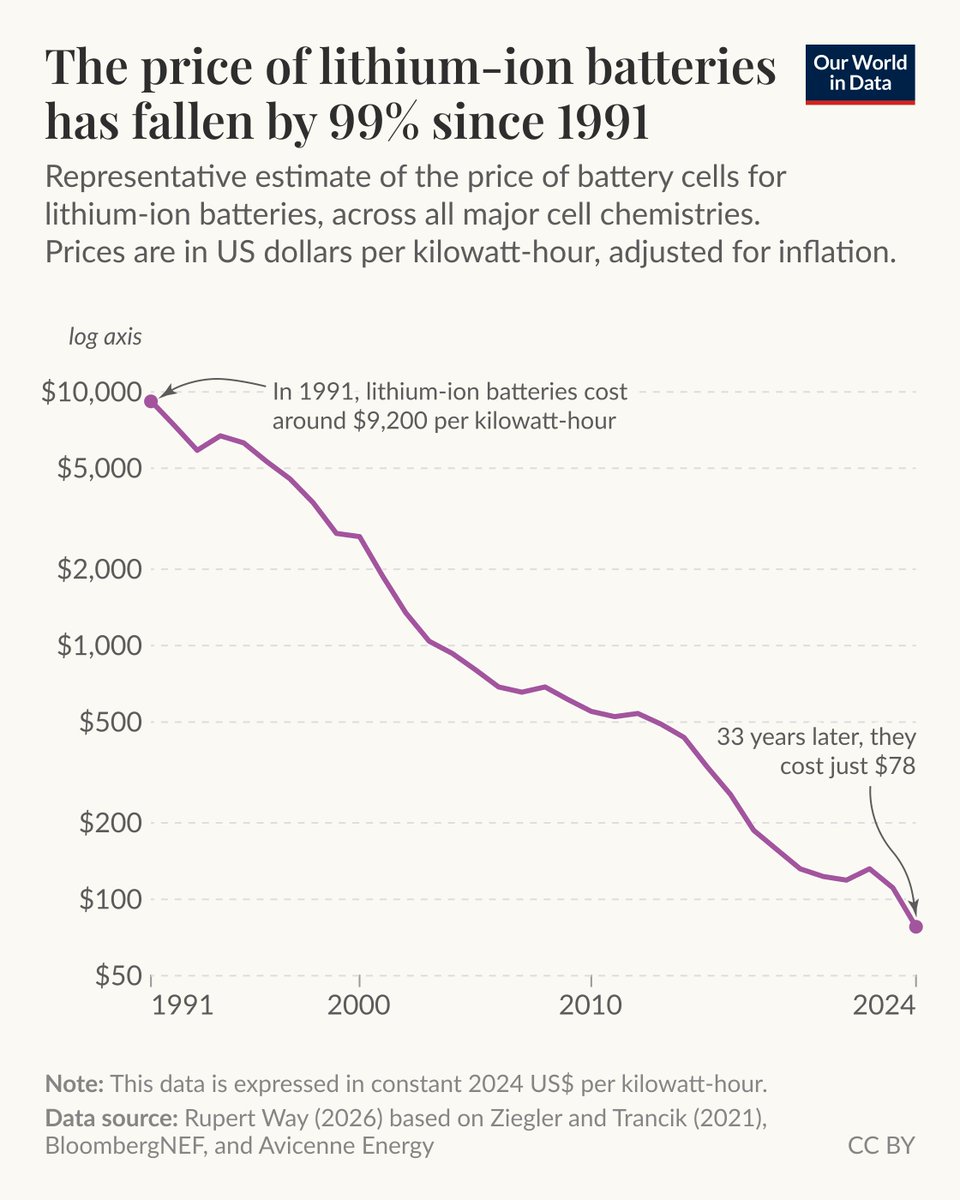
✍️ New article: Battery costs have declined by 99% in the last three decades, making electrified transport a reality— Over 20 million electric cars were sold globally in 2025 — some for as little as $10,000. Even just two decades ago, that would have been impossible. The reason it's possible now? Batteries have gotten *much* cheaper. In 1991, lithium-ion battery cells cost around $9,200 per kilowatt-hour. By 2024, that had fallen to just $78 — a decline of more than 99%. You can see this in the chart. To put that in perspective: the battery cells in a standard electric car today cost around $5,000. In 1991, those same cells would have cost nearly $600,000. There was no single breakthrough behind this. Batteries follow a “learning curve”: as cumulative production grows, thousands of small improvements in chemistry, manufacturing, and supply chains drive prices down. Since 1998, every time global cumulative battery production doubled, the price dropped by roughly 19%. Early progress was driven by consumer electronics — phones and laptops — before the technology became viable for cars, buses, and larger energy storage. Energy density has also more than tripled since the 1990s, meaning batteries can now store far more energy for their volume. The half-a-million-dollar battery was never going to transform transport. The $5,000 battery is.
Our World in Data tweet media
English
64
554
1.6K
1.4M
An Engineer Reacts
An Engineer Reacts@AEngineerReacts·
Great post about the cost of batteries over time.
Our World in Data@OurWorldInData

✍️ New article: Battery costs have declined by 99% in the last three decades, making electrified transport a reality— Over 20 million electric cars were sold globally in 2025 — some for as little as $10,000. Even just two decades ago, that would have been impossible. The reason it's possible now? Batteries have gotten *much* cheaper. In 1991, lithium-ion battery cells cost around $9,200 per kilowatt-hour. By 2024, that had fallen to just $78 — a decline of more than 99%. You can see this in the chart. To put that in perspective: the battery cells in a standard electric car today cost around $5,000. In 1991, those same cells would have cost nearly $600,000. There was no single breakthrough behind this. Batteries follow a “learning curve”: as cumulative production grows, thousands of small improvements in chemistry, manufacturing, and supply chains drive prices down. Since 1998, every time global cumulative battery production doubled, the price dropped by roughly 19%. Early progress was driven by consumer electronics — phones and laptops — before the technology became viable for cars, buses, and larger energy storage. Energy density has also more than tripled since the 1990s, meaning batteries can now store far more energy for their volume. The half-a-million-dollar battery was never going to transform transport. The $5,000 battery is.

English
0
0
0
5
An Engineer Reacts
An Engineer Reacts@AEngineerReacts·
@BenjaminOCall The solution to affordable cars isn't building new cars for rich people, it's building and selling used cars.
English
0
0
2
15
Teslavangelist
Teslavangelist@teslavangelist·
@JessePeltan Nights are easy to solve for. A cloudy day, doable with over capacity. But cloudy *months* when few daylight hours isn't feasible with solar and storage alone.
English
3
0
20
2.1K
Jesse Peltan
Jesse Peltan@JessePeltan·
Believe it or not, Elon has actually known that the Sun doesn’t shine at night since at least 2016, possibly even earlier.
SharpFox@SharpFoxHQ

@elonmusk @JessePeltan Enough surface area, sure. But the grid isn’t ready. Solar works when the sun’s out. Nights and cloudy days? Still need something else.


English
453
404
4.6K
49.1M
Steve Bee
Steve Bee@ItsSteveBee·
Overnight, yes, sure. A cloudy day, probably still doable, but entire months like Dec, Jan. in New England, when panels remain snow-covered, is tough. Residential panels are easy to clean with a roof rake perhaps, but I've never seen people do snow removal on a 200 acre solar farm like Farmington, ME's Most of the world will be fine with solar and some batteries, but places like New England in the winter will have to import massive amounts of power for weeks on end.
English
8
1
20
11.4K
AFC in Tech
AFC in Tech@thetechgooner·
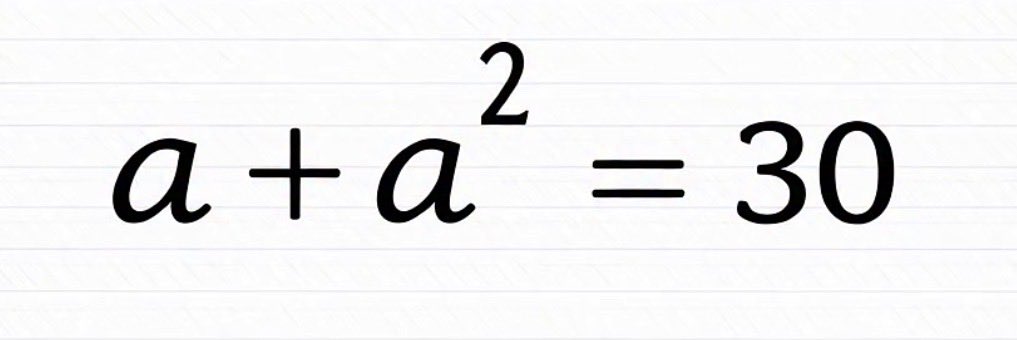
@H0H0v 5 or -6. a + a² = 30 a² + a - 30 = 0 Factors of -30; 1, 30 2, 15 3, 10 5, 6 Only factor with diff of +1 is -5 & +6; a² - 5a + 6a - 30 = 0 a(a -5) + 6(a - 5) = 0 (a - 5)(a + 6) = 0 a = 5 or a = -6 5 + 5² = 5 + 25 = 30. -6 + (-6²) = -6 + 36 = 30.
English
8
0
104
51.1K
KHALID
KHALID@H0H0v·
a=?
KHALID tweet media
3.5K
297
15.9K
11.5M