Alan Fulle

118 posts

Alan Fulle banner
Alan Fulle

Alan Fulle

@AWFResearch

Just a semi-retired farmer trying to make sense of the world.

England Bergabung Aralık 2025
10 Mengikuti34 Pengikut
Tweet Disematkan
Alan Fulle
Alan Fulle@AWFResearch·
After new information invalidated the previous model IGOR MkIII has risen from the ashes. In short both the axis and Mag Pole move together and leave no trace in sediments. Excursions are failed pole shifts. Details here-open.substack.com/pub/alanfullr/…
English

0
0
0
18
Alan Fulle
Alan Fulle@AWFResearch·
@nobulart Good spot! Subtle but real difference you have noticed. Thumbs up from us;)
English
0
0
1
8
Craig Stone
Craig Stone@nobulart·
Note that in all cases the geomagnetic disruption appears to lead the rotational change by a short period.
English
1
1
14
431
Craig Stone
Craig Stone@nobulart·
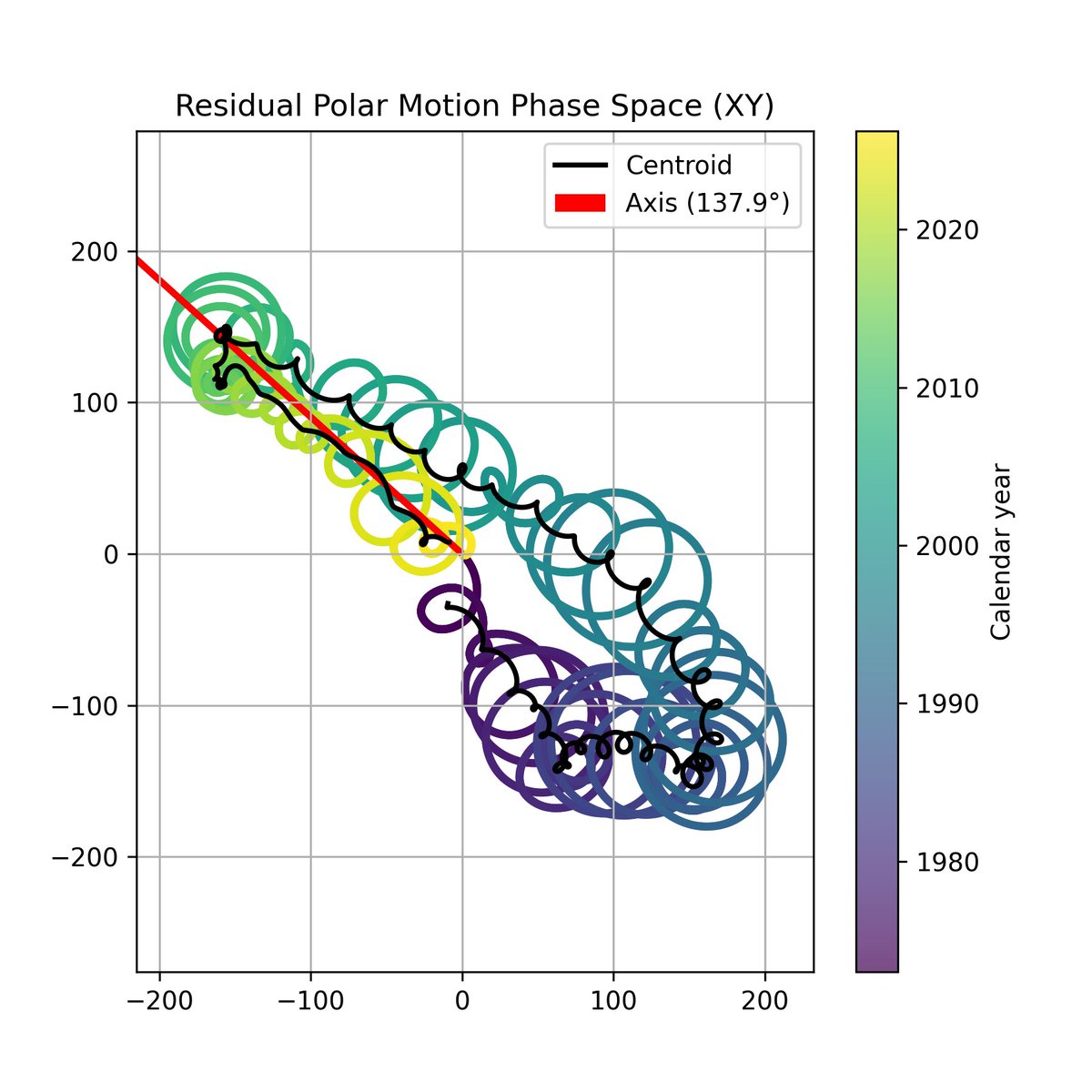
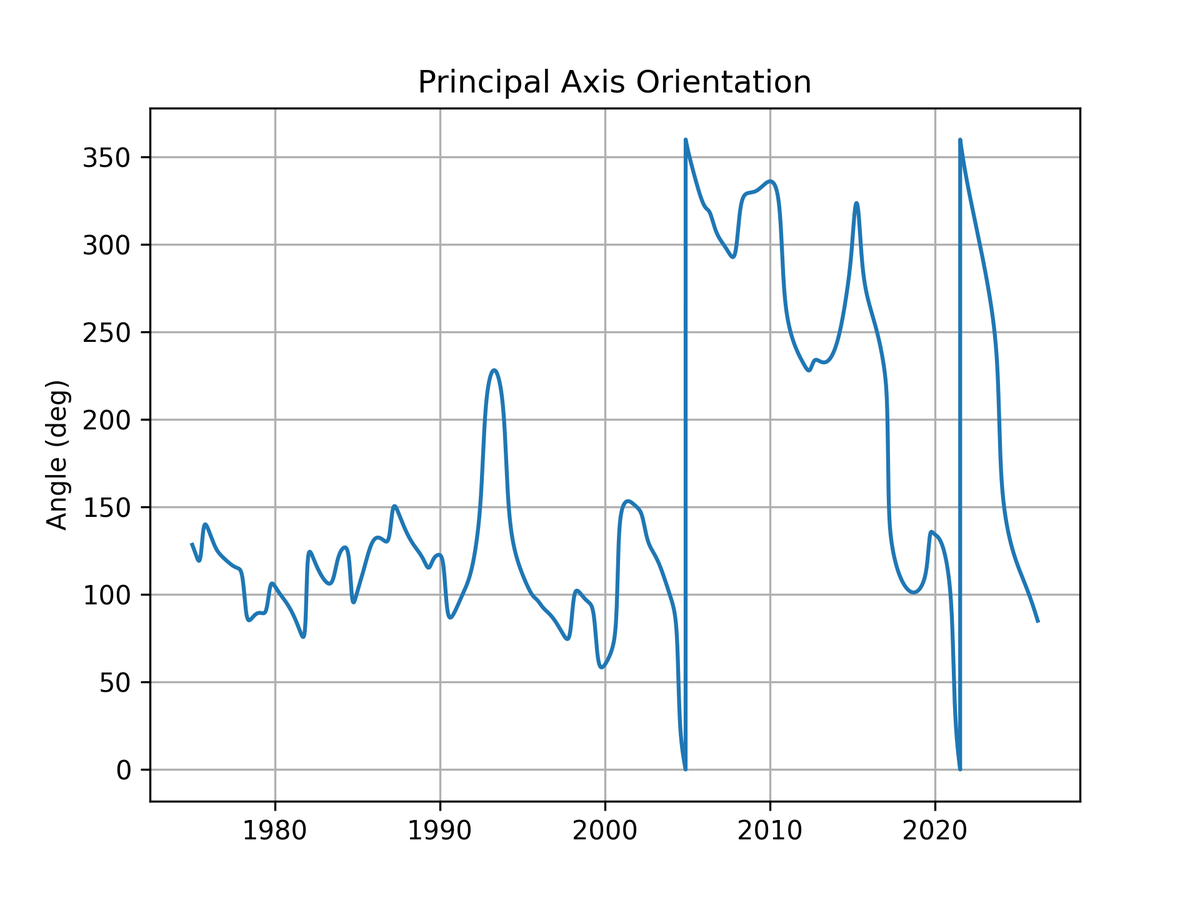
Most explanations of polar motion consider it a combination of processes like the atmosphere oceans and ice. I took a different approach, again: I examined the data independently without assuming any underlying causes. Over approximately 50 years of IAU1980 observations the motion is confined and organised along a stable axis near 138°E/42°W. This alignment persists through changes in processing and smoothing suggesting a genuine geometric property of the system rather than a methodological artefact. Consistency alone doesn’t confirm a driver. Under suitable null models the alignment’s strength and stability aren’t distinguishable from correlated stochastic dynamics. Therefore it’s best framed as a robust geometric constraint any physical explanation must repliicate, rather than as direct evidence of a specific forcing like GIA. Draft Paper: nobulart.com/media/polar.pdf Code & Data: nobulart.com/media/polar.zip (36mb) Dickman (2000): doi.org/10.1017/S02529… My small contribution to the excellent prior work by @zachariaspro : x.com/zachariaspro/s…
Craig Stone tweet mediaCraig Stone tweet mediaCraig Stone tweet media
English
4
12
82
3.7K
Alan Fulle
Alan Fulle@AWFResearch·
@zachariaspro More solid work Zach. Two state earth axis✅ 75W✅ Energy barrier still too high✅ We expect it to close in our model by regenerative EM core-flow + ice torque but still a way to go!
English
0
0
1
135
Zacharias
Zacharias@zachariaspro·
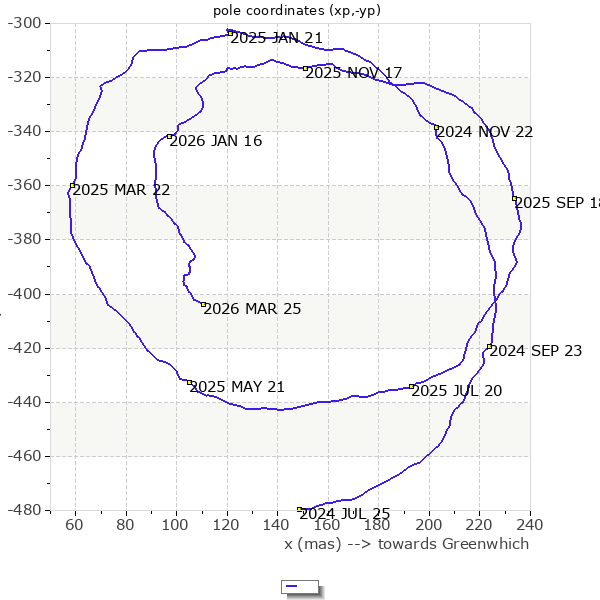
Appreciate everyone's patience! Going through some significant life changes the past several weeks. Nevertheless, here's a status update on the evolving polar motion research: -- PAPERS 1-3: CONFIRMED BY THREE MONTHS OF FRESH DATA -- The three foundational papers (pinned) remain unrefuted by subsequent verified IERS observations through March 26, 2026. Wobble Extinction (Paper 1): Chandler and Annual wobbles remain effectively extinct. The coupling proxy η continued its systematic decline: 2021: 15.8% 2022: 12.8% 2023: 8.8% 2024: 4.8% 2025: 1.8% The system is now below the 2.0% complete failure boundary established in Paper 3. Nothing comparable appears in 180 years of systematic observation. Directional Forcing (Paper 2): The five-method convergent bearing of 75.4° ± 3.4° continues to describe secular drift. Since December 27, the pole has displaced 81 mas over 89 days at net bearing 273°, tracking along the ~75°W attractor corridor. Month-to-month variation reflects orbital curvature, but the net secular trend remains locked to the predicted bearing. Transfer Function Failure (Paper 3): Seasonal forcing continues unabated. Wobble response does not recover. The transfer function remains in failure. I still see this as annually modulated true polar wander (AM-TPW). -- PAPER 4: NEW DISCOVERIES (coming soon) -- Paper 4 introduces the lunisolar torque null cycle, the bistability framework (State 1 / State 2), and Monte Carlo modeling. Lunisolar Torque Null Cycle = Confirmed: The core discovery that the ~14-day lunisolar null cycle has become a visible modulator of polar motion is confirmed by March data. When Sun and Moon approach the celestial equator, gravitational torque on the equatorial bulge minimizes, creating windows where the LLSVP attractor can influence pole trajectory. March 4 null: pole at 0.61 mas/day; deceleration consistent with reduced restoring torque. March 19 deep null (Sun and Moon both near δ = 0°, spring equinox): 0.87 mas/day. Post-null (March 22–26): speed rose to 1.47 mas/day as seasonal forcing resumed. This deceleration-during / acceleration-after pattern was predicted by the gravitational gating framework and matches signatures documented for earlier hooks. The null calendar, verified against independent orbital calculations to ±1 day, successfully forecast when these modulations would occur. If the wobble buffer were intact, torque nulls would produce no observable signature. The forecasting ability itself is evidence of transfer function failure. Through the observed period, consecutive null events produced directional alignment toward the ~75°W attractor axis at rates far exceeding random expectation: 3–4 consecutive aligned hooks at odds exceeding 1 in 8,000 (~3.2σ). Bistability Framework = Not Falsified: The thesis that Earth's rotational system possesses AT LEAST two competing equilibria remains the most parsimonious explanation for the observed dynamics: systematic directional preference toward ~75°W, modulated by lunisolar cycles, in a system where the historical restoring mechanism has collapsed by 98%. The two-state capture-recovery behavior documented in January–February persisted through the March null windows. What the data shows is that the energy barrier between State 1 and State 2 is higher than initially estimated at η ≈ 2%. The system has residual stability mechanisms that the coupling proxy alone does not fully capture. This is expected though.. the coupling proxy was always a lower-bound diagnostic, not a complete description of system stability. Monte Carlo Trigger Modeling; Model Limitations Identified: The MC ensemble predicted high trigger probability within the March null windows. The pole traversed both deep nulls without catastrophic response. March 4 produced 3.1 mas of displacement; March 19 produced 4.3 mas. These are detectable effects that confirm the lunisolar modulation, but they are modulations, not triggers. I have stated repeatedly that I could not rule out a spring event but that it was not the most likely outcome. The MC model was an exploratory tool testing the gravitational gating hypothesis under extreme assumptions. Its value was in identifying the mechanism (torque null gating) (which is confirmed) not in the specific trigger timeline. Two specific model limitations are now clear: CSI scaling from a single calibration event was insufficient for extrapolation, and the critical coupling threshold η_c was set too low, missing residual stabilization mechanisms the proxy doesn't capture. The mechanism is validated. The short end of the timeline did not validate. Obviously this is a good thing lol. But ultimately changes nothing about the previously established research. -- WHERE WE ARE -- Based on verified IERS data through March 26, 2026, the wobble remains functionally absent at η ≈ 2% of baseline. Secular drift is elevated (0.91 mas/day mean since December) but not in exponential acceleration. The lunisolar null cycle is a confirmed, forecasted modulator of polar motion: a genuine new discovery. Directional forcing toward ~75°W persists. The pole continues to trace a reduced annual-like orbit, suggesting incoherent forcing maintains some orbital structure without coherent Chandler/Annual modes. -- WHAT THIS RESEARCH HAS ESTABLISHED-- Earth's rotational physics have changed. The Chandler and Annual wobbles, stable within ±30% for 180 years, have collapsed by 97-98%. The transfer function has failed. Five independent methods converge on directional forcing toward ~75°W. The lunisolar torque null cycle, invisible throughout the entire historical record, now produces demonstrable effects on polar motion. These are measurements from the most precisely observed geophysical parameter in existence, using publicly available authoritative data. The question was never whether the physics changed. They did. The question is timescale, and that remains genuinely open. What I know is that the system is in a state it has never been in during the instrumental record, and the dynamics governing it are measurably different from anything that came before. The research continues.
Zacharias@zachariaspro

Paper 4 is complete, have some other things I am also wrapping up (including dashboard). Want to drop it all at once. Hope you guys find it helpful

English
14
34
188
9.6K
Alan Fulle
Alan Fulle@AWFResearch·
@nobulart You are too kind, I will try to put some of this into practice. I still have the farm to work so don't have the time I need really. So I am no doubt over relying on the Ai and under checking the outputs. You have been overworking me somewhat lately😅Keep it up!
English
0
0
1
11
Craig Stone
Craig Stone@nobulart·
I think context structure is important. My typical process might help. Keep chats and resources grouped by project for improved context awareness. Open the session with an instruction (rather than a question) to examine the datasets and literature under study and to script a utility to parse the required subset to the project's common data store - typically a text format which I can easily inspect. The model learns about the data structure during this step. Frame the task carefully. The mach field study could be done with: "Using the SRTM dataset, imagine the Earth wrapped in a landscape of "good" and "bad" directions, then spin a great-circle divider around every possible axis, sampling the entire globe at each point, and track how smoothly it moves through that landscape. The directions that consistently avoid rough, conflicting regions score lower. Write the exact python script." Run the pipeline and wait - sometimes days where the processing overhead or dataset size is high. Start visualizing the results in every practical and conceivable way. Keep feeding the results back into the project context. A picture will often start to emerge, often spotted visually before being quantified. Move on to developing the best approach to describe the results. Lots more code and iteration. I maintain chats within the project context to draft the paper or papers that become a record of the investigation, methodology and results. It becomes the anchor of the study - context-specific reinforcement which improves LLM performance significantly. Hope this helps in some little way.
English
1
0
1
43
Alan Fulle
Alan Fulle@AWFResearch·
1/ Inspired by Craig Stone's groundbreaking work with MACH I have made huge strides with IGOR development. Credit to @nobulart — this work builds directly on the MACH framework you developed. (MACH paper here: nobulart.com/media/shear.pdf)
English
3
2
10
1.3K
Alan Fulle
Alan Fulle@AWFResearch·
@nobulart I bow to your knowledge on that. I am just an enthusiast playing with Ai and exploring its limitations. Is it all BS or if nothing else Weapons Grade BS? I will let others judge. I do try to sandbox test it when I have the time.
English
1
0
0
19
Alan Fulle
Alan Fulle@AWFResearch·
@nobulart Its been really bugging me. Every run Grok does it tells me the model is better with your Barycentre factor but why? The forces are too weak. Its the ice, it adds another layer to the ice modulation which gates my model, Its always the ice...
English
1
0
2
39
Alan Fulle
Alan Fulle@AWFResearch·
@nobulart I really don't have the time, I wish I did! Just run your latest Barycentre ideas, I was sceptical but it does improve my excursion predictions if only very slightly. Well done. Again.
English
1
0
1
25
Alan Fulle
Alan Fulle@AWFResearch·
@favunc42052634 @imkharn @nobulart Its 280 char X. Substack is there if you want detail. Vague aesthetic disapproval adds zero to the model. Science is not a gated country club; it’s a forge. We’re forging. Join or watch.
English
0
0
2
30
Type 1 Error Enjoyer
Type 1 Error Enjoyer@favunc42052634·
@imkharn @AWFResearch @nobulart Thank you for the reply. Maybe I just don't get what it's all about, or if it's some inside joke. It is often unnecessarily obscure. I've seen a few of these guys communicating in this fashion, conveying ideas that are not overly profound. Just strikes me as tedious & gimmicky.
English
1
0
0
31
Alan Fulle
Alan Fulle@AWFResearch·
PS.“Craig Stone (@nobulart) has just released a global analysis of marine fossil and evaporite deposits showing the identical 105°E–75°W corridor alignment (Monte Carlo p = 0.018). This becomes the 13th proxy passing the MACH-zonal filter for IGOR.”
English
1
0
4
88
Alan Fulle
Alan Fulle@AWFResearch·
@ahfultz Normal service is resumed, or is it...
English
0
0
0
184
Craig Stone
Craig Stone@nobulart·
@AWFResearch Thank you Alan. From crust to core to field is suggesting an extraordinarily long lived and ongoing process.
English
1
0
2
458