Nobody nowhere

3.1K posts

Nobody nowhere

Nobody nowhere

@ahfultz

"Cleverly masking willful ignorance is still net stupid." -- Nobody nowhere Daily chart source: https://t.co/m6qeDdbXqR

nowhere Katılım Ocak 2023
1 Takip Edilen779 Takipçiler
Sabitlenmiş Tweet
Nobody nowhere
Nobody nowhere@ahfultz·
@nobulart Yeah, facts like the bottom of mantle is shedding chunks of itself causing instant changes to the dominant MoI, paving the way ultimately for a sudden rotation axis swap, axis swap which we have evidence has occurred at least 2x in the last 12ka. Biblical implications!
English
6
4
43
35.2K
Nobody nowhere
Nobody nowhere@ahfultz·
@welchkristina @nobulart Ty. I also recall that work of his. Was hoping to hear ideas about the whys which in turn might enlighten us as to the mechanics of both S1 to S2 and back, and thus timing, so I can finish getting all muh chit up the hills 😈
English
0
0
1
47
Kristina Geidt (Welch)
Kristina Geidt (Welch)@welchkristina·
@ahfultz @nobulart Craig has previously hypothesized that the S2> S1 rotation happens in increments, rather than all at once like the S1>S2. So this checks out.
English
1
0
1
54
Nobody nowhere
Nobody nowhere@ahfultz·
@EthicalSkeptic But oddly, the imprint Craig found for S1 > S2 was not found for S2 > S1. Maybe let's call S2 > S1 the "docile" IITPW.
English
1
0
3
446
Ethical Skeptic ☀
Ethical Skeptic ☀@EthicalSkeptic·
"On a planet that has not undergone rapid true polar wander, [anisotropic variance] would be expected to appear heterogeneous and unstructured. It does not. The field exhibits a clear structure. The symmetry suggests the most likely Euler configurations are roughly halfway between the high-variance bands – a pattern consistent with the ECDO Euler." x.com/nobulart/statu…
English
4
21
148
10.5K
Nobody nowhere
Nobody nowhere@ahfultz·
@Shtaras1 Minor effect. You can see it in the wiggling on the outward hook. Matches dates.
English
0
0
1
227
Shtaras
Shtaras@Shtaras1·
@ahfultz so what's your take on polar action for these nulls
English
1
0
0
311
Nobody nowhere
Nobody nowhere@ahfultz·
@cognitivecarbon @zachariaspro No, you're wrong. To ferret out whether there is wobble or not you need to perform harmonic analysis on the motion. A histogram of decreasing mas yoy is not that. Not even close. And you claim the why of what you show while denying you claim why. You're just a grifter. Shoo
English
0
0
0
104
Eric Tilton
Eric Tilton@cognitivecarbon·
@ahfultz @zachariaspro I think you are conflating "that" the wobble has sharply reduced (it has, by multiple measures, my charts simply show it in a different way) with "why" it has sharply reduced. I don't claim to know the "why", but I can see the "fact of" clearly, in the data.
English
1
0
0
140
Eric Tilton
Eric Tilton@cognitivecarbon·
Here's an independent way to visualize what @zachariasPro has said regarding the near cessation of polar wobble. Below is an interesting update I just published for one of my new pole position charts. Each day, the physical north pole's position moves slightly, relative to the day before (the movement is obviously continuous, but is sampled only once per day.) Over the course of a year, the pole "wanders" in more or less a circular path (see the polhody chart type for that), spanning maybe 30-50ft in diameter. Important note: this is NOT the magnetic north pole, but the physical north pole. Magnetic north has wandered more than 600 miles since the year 2000. Each day the pole may move more, or less, relative to previous days. What I wanted to see, using this chart, is how the magnitude of each day's move in March of 2026 compares to its movement on that same day in prior years. Here, I chose 1996 as the start date, so each red bar below for a given day of March is compared to 30 prior years (which are shown in faded out colors.) The new markers above the red bars (which again, are March 2026 data) show the 'percentile rank' of that red bar compared to the same day of march on the previous 30 years. A "0%" would therefore mean that this year's bar is the smallest of the comparison set (whereas a 100% would mean that day's bar is the largest of all of the prior years.) 2026 is certainly and interesting year for polar motion. URL: pole.mjttech.com/?start=1996-01…
Eric Tilton tweet media
English
8
9
55
3.3K
Nobody nowhere
Nobody nowhere@ahfultz·
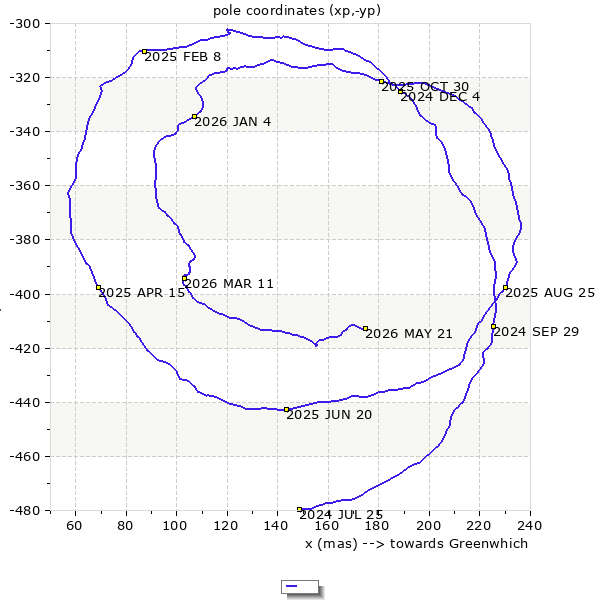
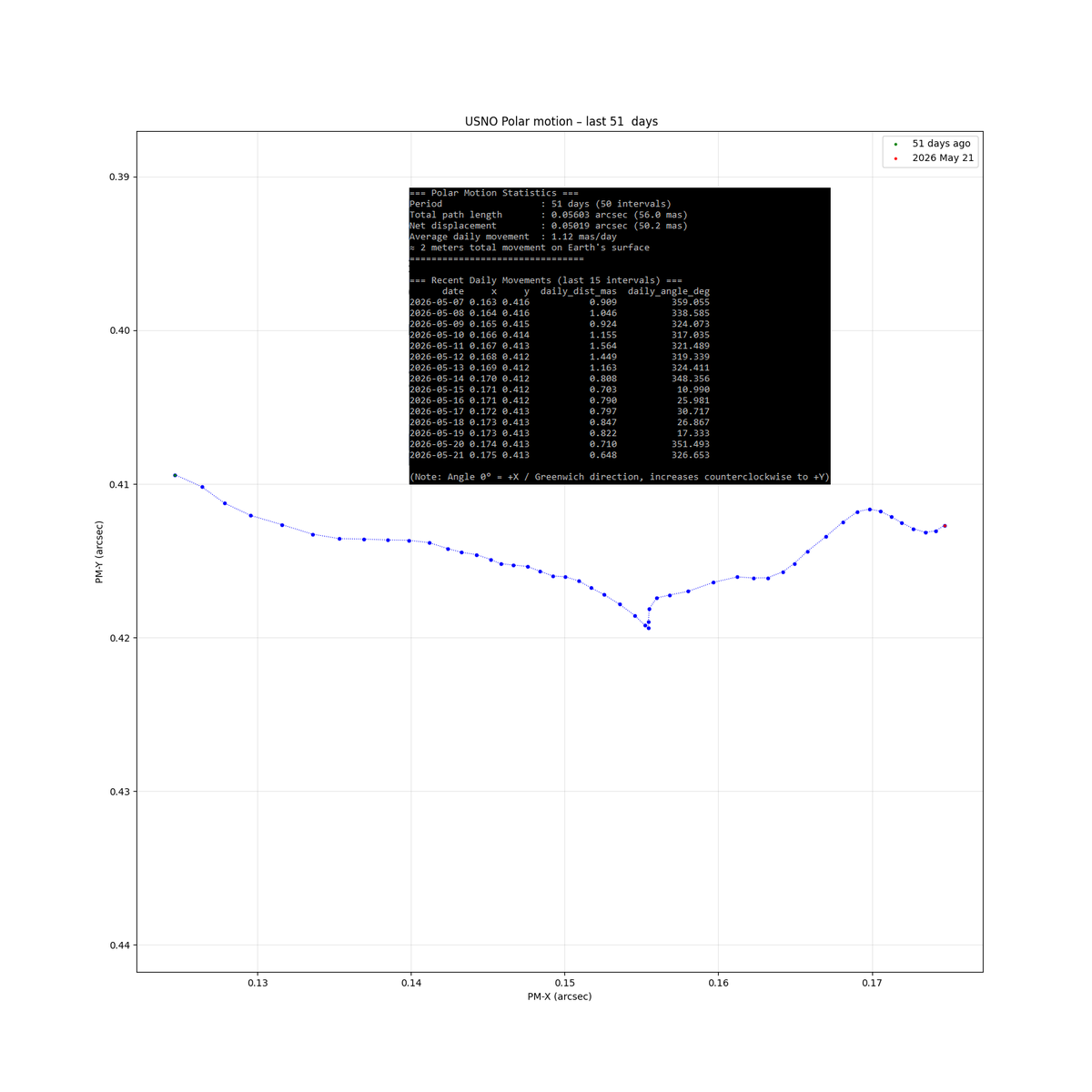
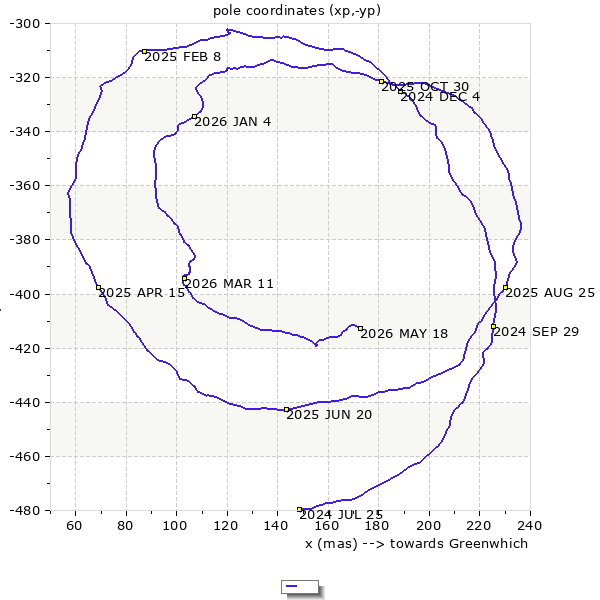
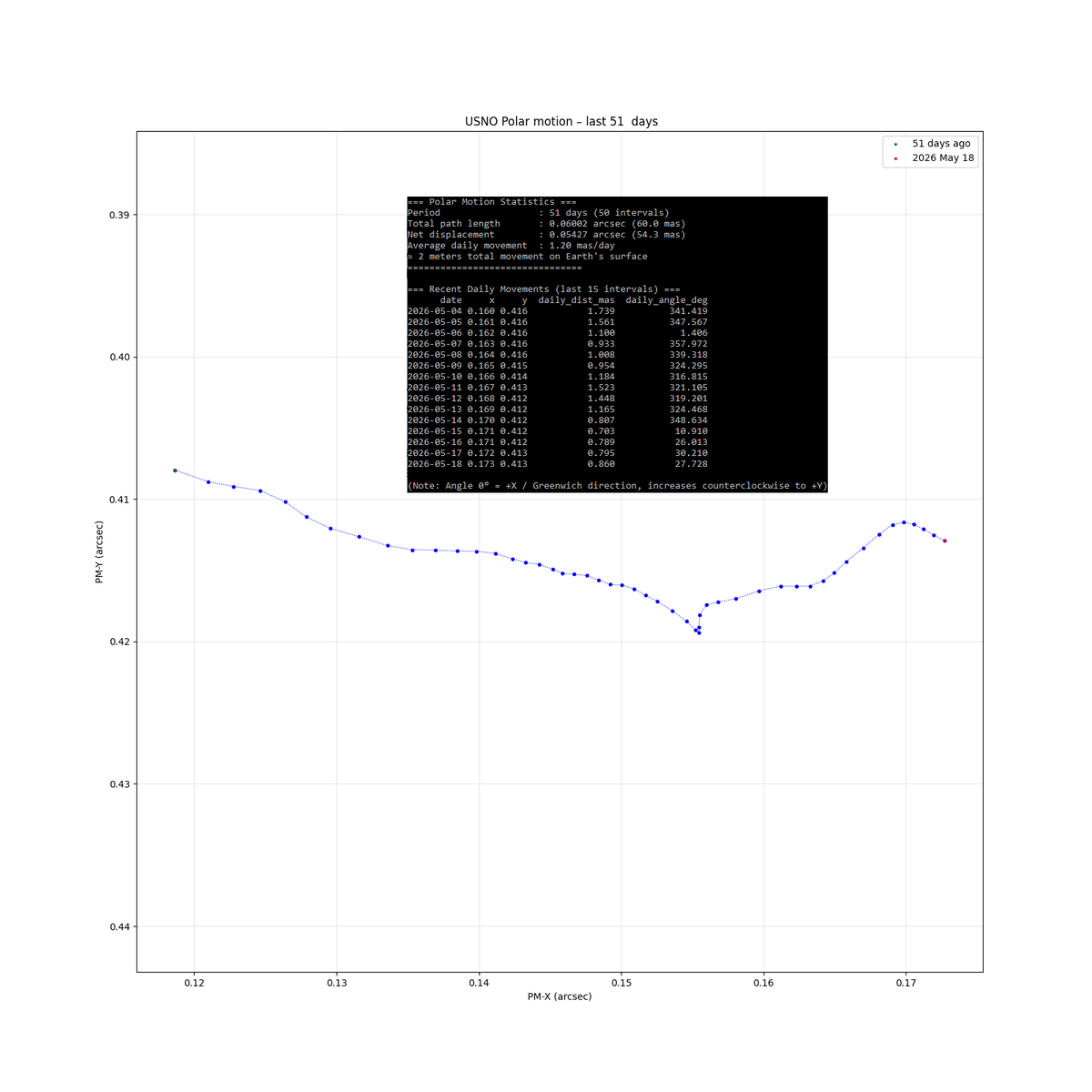
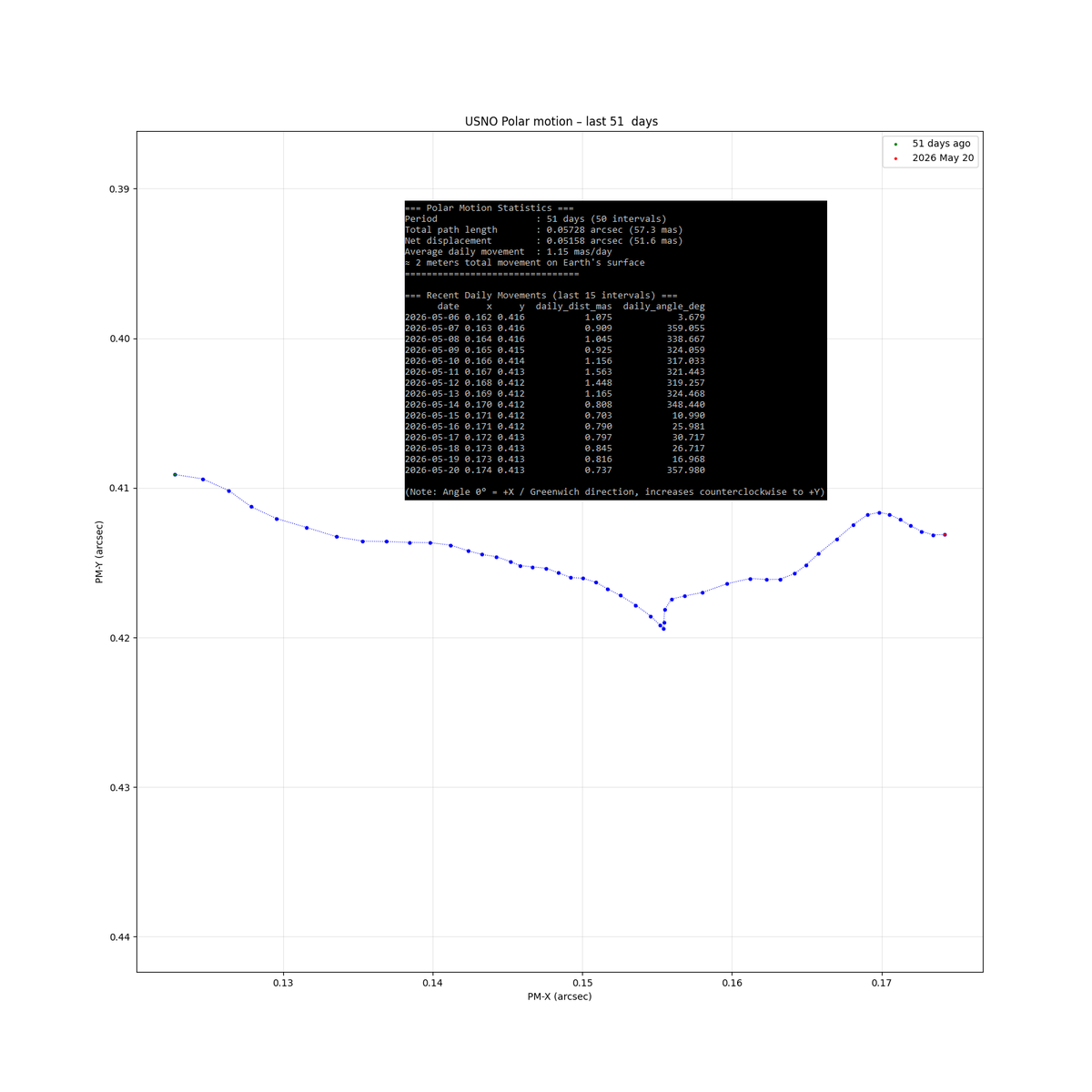
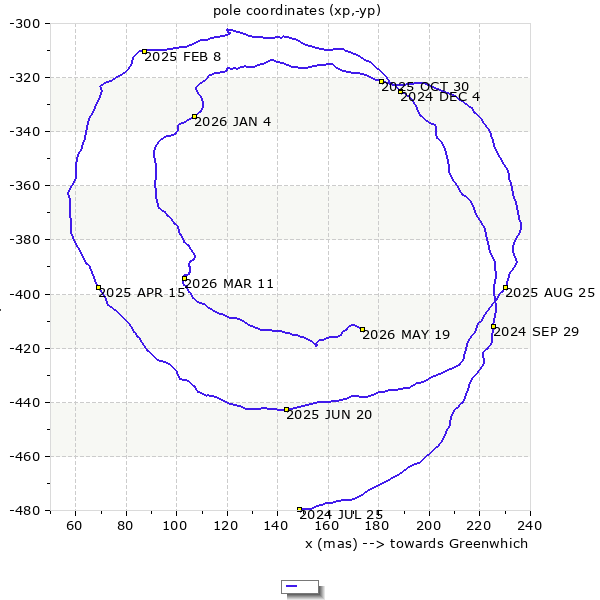
@VeritasSounds The image on the right is zoomed in depiction of the polar motion with daily statistics. The left shows motion for the last 600 days. The reason I post it is to show PM's current evolution - and possibly on the eve of a recurring IITPW - as a warning should the motion accelerate.
English
1
0
6
194
Britton Beckham
Britton Beckham@VeritasSounds·
I've be following space weather news, pole shift and sun stuff for ages. However, you have data on the pole movement I havent seen before. From what I can tell about it looks like the pole has a has a circular movement every year but it has a motion in some direction that is stable over time and I get that and there's been some posts about how that shift is happening at a greater growth factor right now what I'm not understanding is this stuff on the right
English
1
0
0
181
Britton Beckham
Britton Beckham@VeritasSounds·
@ahfultz Hey man for those that don't follow you every day or know exactly how to interpret this data it'd be great if you could do a little science-y update or paragraph on what we're seeing here. Especially with what's on the right.
English
1
0
0
206
Libertybella
Libertybella@TheLibertyBella·
@ahfultz @TruthBeTold424 So what should we do if it goes over 3 mas? Is that start packing your bags time or is that get in the Jeep and hightail it to higher ground ASAP ?
English
1
0
2
162
Jay Anderson
Jay Anderson@TheProjectUnity·
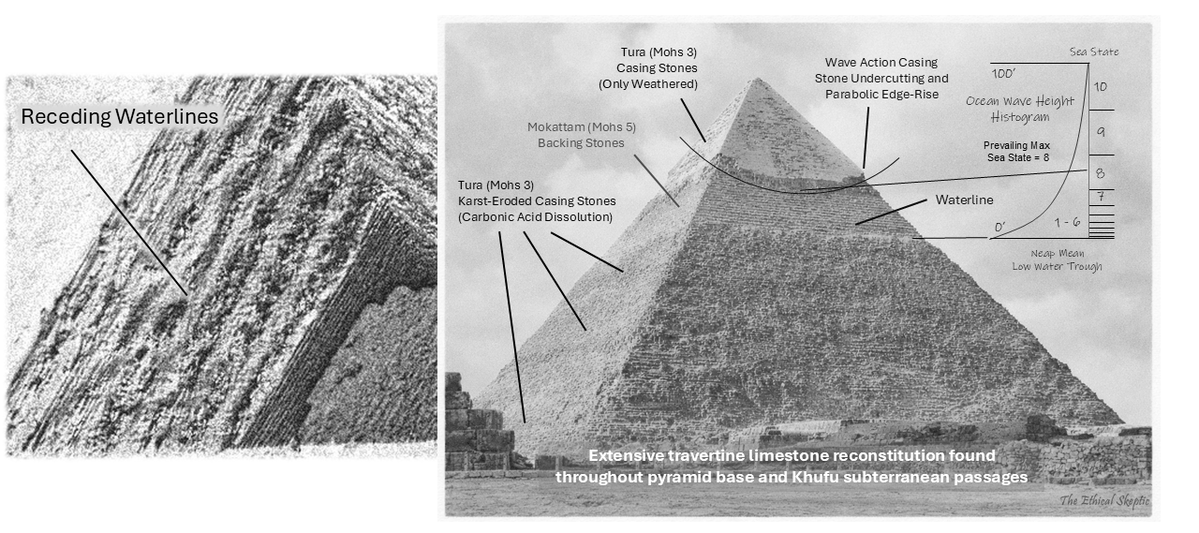
In 2006, the Journal of the American Ceramic Society published research by M. W. Barsoum and colleagues showing micro-structural evidence of reconstituted limestone blocks in the Great Pyramids. Scanning and transmission electron microscopy revealed micro-constituents with appreciable amounts of silicon in ratios that do not exist in any natural limestone sources near the pyramids. Submicron silica-based spheres in the samples strongly suggest the material was formed from a basic solution, consistent with Joseph Davidovits' Geopolymer Hypothesis that at least some pyramid blocks were cast in situ from a limestone aggregate concrete, rather than quarried and transported as monolithic blocks
Jay Anderson tweet media
English
29
80
730
50K