
Tweet Disematkan
Conexus
1K posts


Conexus
@ConexusAI
Rolling out your data fabric ONCE
San Francisco, CA Bergabung Nisan 2019
23 Mengikuti509 Pengikut

@semanticbeeng @jaredq_ we agree, gotta mix symbolic AI and stochastic AI to get safe AI
English


Today's AI landscape is reminiscent of the early automotive and aviation industries. Although we have seen remarkable demonstrations and early successes, the full transformative impact and proliferation of LLM systems are bottlenecked by robustness and reliability challenges.
Building on the analogy, massive leaps were needed to progress from the Wright Brothers' initial Kitty Hawk breakthrough to the contemporary aviation industry, where over 2M humans fly daily. Notably, the gap from Kitty Hawk to what is considered the dawn of commercial aviation with Jannus was ~10 years.
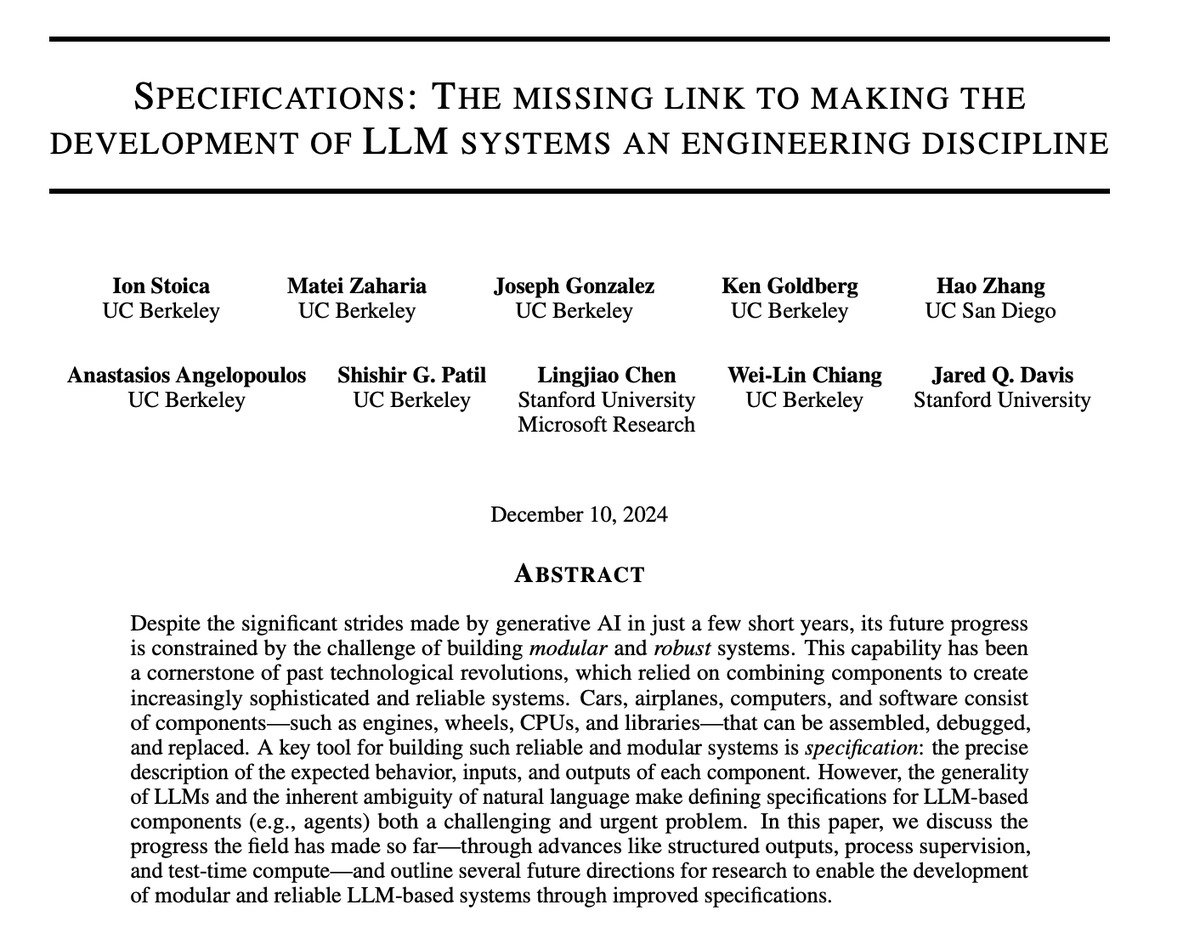
In this paper, Ion Stoica, along with collaborators @matei_zaharia, @joseph_gonzalez , @Ken_Goldberg, @haozhangml , @ml_angelopoulos, @shishirpatil_, @ChenLingjiao, @infwinston, and I, surveys the landscape and lays out a vision for advancing today’s LLM systems design into a mature engineering discipline with even broader deployed impact. This paper begins to address how we can reconcile the tensions arising from the value of these systems partially being their stochasticity and “creativity” (hallucination) and the engineering imperative to build robust, reliable 'compound AI' systems out of these noisy components.
SPECIFICATIONS: THE MISSING LINK TO MAKING THE DEVELOPMENT OF LLM SYSTEMS AN ENGINEERING DISCIPLINE
arxiv.org/pdf/2412.05299
English
Conexus me-retweet

Deep cuts to the National Science Foundation only make sense if you are an enemy of science or of the US. Most basic research in the US is funded by the NSF. The whole NSF budget is less than 0.2% of the federal budget, and most of it goes directly to scientists.
English
Conexus me-retweet
Conexus me-retweet

can't help but Stan everything Leinster writes, today it's this beautifully simple analysis of injections and their duals in Set


English
Conexus me-retweet


@TechNerdForLife @stephen_wolfram We are very much looking forward to the day when all of this is made practical on a computer and not just in theory!
English

@stephen_wolfram I saw this from the Institute for Advanced Study on where Miles Stoudenmire talks about reducing the complexity for solving very complex problems, typically thought to require Quantum Computers O(N^Y), to simpler problems O(N*X) using tensors via addition. Thought you would be very interested in this and it's application to deep neural networks, complex mathematical problems and LLM training. Interested in hearing your thoughts. Link: youtu.be/k1NuZDQ2Syk (or easily found in the Institute for Advanced Study YouTube channel). @coecke - Bob, @ConexusAI - Ryan, @johnbaez09 - John
YouTube
English

Live CEOing Ep 839: Language Design in Wolfram Language [Tabular] x.com/i/broadcasts/1…
English
nytimes.com/2024/09/23/tec… Harmonic is part of growing effort to build a new kind of A.I. that never hallucinates. Today, this technology is focused on mathematics.
English
Conexus me-retweet

In the age of AI, what skills will set our kids up for success? Programming is changing, liberal arts degrees seem limited, but physical dexterity remains irreplaceable. Cosmetology, carpentry, physical therapy - these hands-on fields might be the surprising answer to future-proofing our children's careers. hashtag#FutureOfWork hashtag#AIRevolution
English
Conexus me-retweet

category theory in the news. theguardian.com/science/articl… cc @HighPerplexity9
English
@jawwwn_ Pretty sure this is why e.g. arxiv.org/pdf/2311.07509 are putting knowledge graphs (a kind of ontology) into LLM prompts
English

I have seen about every $PLTR clip there is and this one…
There’s something special about it🔮
Karp: “We are differentiated because in order to actually make AI work, you need an ontology.” ✨
Shyam (summarized in my own words): Your LLM is useless without Palantir.
Jawwwn@jawwwn_
$PLTR CEO Alex Karp 🔮: “I don’t believe we have competitors. I don’t believe in the US commercial market with have competition. I don’t believe in the US government market with have competition. “In order to actually make AI work, you need an ontology.” “I think that’s the reason Israel 🇮🇱 and Ukraine 🇺🇦 bought our product.
English
@EarningsNugget who would have thought 'data modeling' would be so useful!
English

11/ So, in simple terms, Palantir's ontology is like creating a super-organized, interactive map of all your school's information. It makes it easy for everyone to see how things are connected, understand complex stuff, and work together better. It's turning a jumble of data into a powerful tool that helps get things done!
English
@ValkBarn @alc2022 Strange that more people haven't heard about ontology, what with RDF/OWL en.wikipedia.org/wiki/Web_Ontol… and other projects that have ontology right in the name
English


$PLTR is going to be bigger than $TSLA.
Here’s why:
1. We're rapidly approaching a future where anything a machine can produce or perform becomes a commodity.
2. The driving force behind this shift is data. Data is essential for training neural networks, enabling machines to think and operate independently.
3. As we advance, the ability to gather, manage, and leverage data will become the most crucial task for any business globally.
4. As a result, Ontology will emerge as the foundation of capitalism, while tasks within a machine's capabilities become commoditized.
5. Consequently, the pursuit of better data will drive capital toward superior Ontologies. The best Ontologies will be key to creating machines that excel at performing advanced tasks.
6. Even after infrastructure is in place to commoditize energy, transportation, and automation (areas where $TSLA excels), there will still be decades of development needed for better Ontologies.
7. With the same automation tools available to everyone, competitive advantage will depend on having a superior Ontology.
8. This is why I believe $PLTR will ultimately grow to be a larger company than $TSLA.
English
@DSeng20 Absolutely this is possible, here are various tools for doing so, in addition to those posted above. conexus.com/ontology/
English

If AWS can replicate Ontology using their own AWS tools (albeit at a much higher cost), I wonder if the other cloud providers can do so as well. One of Palantir’s key advantages is their first mover status where they’ve been working and refining their application for decades.
Arny Trezzi@arny_trezzi
What's $PLTR's competitive advantage? The Ontology. Building and maintaining an Ontology using AWS tools would cost $10mn/year. @PalantirTech customers pay on avg ~$5mn/y, and Ontology is only one of the innumerable available tools. Great job @serknight_!
English
@GoodeJobs @FilipSalling @baredavid_ Lots of people have ontologies, here's a list conexus.com/ontology/
English

@FilipSalling @baredavid_ 2/2
See @cmwahlqu explaining why the past decade’s secular trend of everyone “going to the cloud” still led to fragmented systems, and why the smart enterprises are starting the secular trend to Ontology-driven outcomes & Palantir is the only one with an Ontology. 🔮🔥🚀
English

Har du overvejer hvad din opsparingsevne kunne og burde være i forhold til dine langsigtede økonomiske mål?
Dansk
@jmartela @CuriousPejjy Lots of commercial ontology systems out there for example Cyc en.wikipedia.org/wiki/Cyc
English

@CuriousPejjy Palantir has the ontology and their customer base is growing rapidly.
English

$TSLA PE: 63
$AVGO PE: 72
$NVDA PE: 75
$INTC PE: 94
$LLY PE: 116
$AMD PE: 189
$PLTR PE: 190
Crazy to me that Tesla is the only one that has REAL WORLD AI data and other AI companies are trading much high than Tesla...
Tesla truly is the most undervalued AI company today.
English
@drmusician1 Surely the Cyc project would count as the first commercial ontology, and it is still up and running today en.wikipedia.org/wiki/Cyc
English

This is a lecture video by the head of Palantir Korea.
I’ve summarized only the key points.
1. The concept of ontology can be traced back to the graph database concept that emerged 30 years ago. While many have tried to emulate this idea in various ways, Palantir Ontology is the only successful case of productizing it.
2. At first glance, ontology may seem to be just about relationships between data, but there’s an additional layer that’s incredibly significant. This is what we call Ontology Action.
3. Once an ontology (data + logic + action) operational layer is established within an enterprise, "what-if" simulations become automatic.
4. One of the reasons ontology is so important is that this operational layer merges with LLM.
5. Most enterprises, including large corporations, are currently using LLMs to search for answers within documents through Retrieval-Augmented Generation (RAG). However, 99% of the data within enterprises is not in documents, but in databases.
6. In large corporations, when managing supply chains and dealing with variables like typhoons that require changing delivery routes, how long does it take to get an answer? It typically takes between 2 and 7 days.
Palantir challenges this by asking:
"With all the investment in IT infrastructure and the creation of data lakes for integration, why are you still unable to get immediate answers?"
If an ontology is in place, you can get the answer within seconds.
youtu.be/e7i71gf23Pc?fe…

YouTube
English
@simonseverino @ValueInvestJpn We got you covered, here are some open source ontology platforms conexus.com/ontology/
English

@ValueInvestJpn As a philosopher, I love Palantir. Ontology!
As an investor, I’d enter only if I had transparent data. Too secretive of a business for that.
English

@SKaraahmetovic If you like ontologies, you'd love "ologs", which are improvement thereof. en.wikipedia.org/wiki/Olog
English

“Palantir's #AI operating system, powered by their Ontology software, overcomes myriad roadblocks to adoption and is igniting AI use across the enterprise landscape. Palantir doesn't just automate insight creation, but also decisions, the next wave of AI.”
English
Palantir $PLTR rated new Market Perform at Northland; PT $35
English
@JsonBasedman @Sentdex If you like ontologies, you might want to check out this list of ontology platforms conexus.com/ontology/
English

The way I see the general workflow of Palantir Foundry in three steps:
1. Ingest raw data, and clean/format it. Many supported modalities from sql tables, to pdfs, to sensor streams. Very good data cleaning/structuring tooling.
2. Define the Ontology, connect it to processed data sources. The Ontology layer is the interface between the raw slop that's coming in, and the myriad of things you might want to build on top of it
3. Develop applications on top of the Ontology layer. Analysis tools, ERP dashboards/visualizations, and things like the graph that I showed above, which is an interactive application for looking at and modifying my underlying data sources
Overall very happy with the platform. I am surprised they didn't get back to you, my experiences with their engineers have been fantastic. Particularly @chadwahl
English


@PalantirMystery @hyperindexed Because ontologies are actually an old technology; consider the 'web ontology language' for example. en.wikipedia.org/wiki/Web_Ontol…
English

@hyperindexed It’s absolutely incredible that companies NEED an ontology to do enterprise Ai and there’s just no other way to do it right…
If that is true, then how does $PLTR not take the whole Ai market?
English

What is the Ontology, and why do you need it? blog.palantir.com/connecting-ai-…
Eliano A Younes@eliano
who’s ready to party?
English