Donovan Pyle

1.4K posts

Donovan Pyle banner
Donovan Pyle

Donovan Pyle

@DonovanPyle

Health Insurance Whistleblower & Author of “Fixing Healthcare: How Executives Can Save Their People, Their Business, and the Economy” — OUT TODAY

Orlando, FL Bergabung Ağustos 2009
427 Mengikuti272 Pengikut
Donovan Pyle
Donovan Pyle@DonovanPyle·
This is exactly why my team developed the Compensation Integrity Index™️ (CII), which audits broker and consultant 408 compensation disclosures so that employers understand conflicts of interest that produce fiduciary risk. This is akin to the service @TonyRobbins provided businesses when 408 compensation disclosures became required in the retirement industry 20 years ago.
Mark Cuban@mcuban

Don't you wish CEOs knew what was in their HC benefits, brokers and consultants contracts? I bet they can add more cash flow by paying attention to this than 90 pct of the things they want to do for their business today I'm still amazed that VCs and PE don't use reducing benefits costs as a source of cash. It's easy

English
0
0
0
20
Donovan Pyle
Donovan Pyle@DonovanPyle·
If you profit from system failures, you’re not financially incentivized to fix them. #healthcare #brokers
English
0
0
1
22
Donovan Pyle
Donovan Pyle@DonovanPyle·
Advanced tax strategies are never recommended by CPAs who get paid by the IRS. And advanced healthcare financing and procurement strategies are never actively recommended by legacy benefits brokers. That’s because legacy brokers would have do more work and make less money if those strategies were adopted by their clients. And this conflict of interest costs businesses millions each year. At Health Compass, we are like advanced tax strategists for your company’s health plan. Want better results? Message me.
English
0
0
1
26
Donovan Pyle
Donovan Pyle@DonovanPyle·
A little piece of me dies every time an executive tells me they’ve been googling something about health plans and benefits. They have in-house HR and/or benefits teams. And they work with a legacy broker. But still, no one is leading them to where they want to go. So they rely on google…good luck with that. Under federal law, fiduciaries (often execs) who are not experts in benefits are required to hire people who are. But here’s the rub: the benefits industry as done a terrible job educating fiduciaries about what credentials to look for… So here’s your cheat sheet: - State insurance license: this is essentially a “GED” (good enough degree) for the industry. It legally allows you to advise employers on how spend millions each year, with virtually no training at all. - CEBS: this is like a bachelors degree in benefits. It’s a solid program, but really broad in scope. It does not teach benefits professionals how to help businesses progress through the health plan maturity model (HPMM). - REBC (Registered employee benefits consultant): thanks to the work of David C. Smith JD, REBC and others at NABIP, this is like a masters degree in health plan management, financing, and procurement. There are ~500 benefits professionals in the US with this designation. Look for them. - CHVP (Certifed health value professional): this is PhD level training on health plan innovation. Developed by the Validation Institute, it contains 13 courses that created and taught by veteran industry professionals like Brian Klepper, Ron E. Peck, Emma Fox, CHVA, and others. There are about 100 CHVPs in the market. Note: I chair the advisory board for this designation. If you’re an executive who has ever had to google something about benefits, it’s time to consider upgrading your advisor. People who “dabble” in employee benefits are more likely to create risk, than manage it. Use the criteria above as a starting point in your search. Cheers and happy Friday.
English
0
0
2
31
Donovan Pyle
Donovan Pyle@DonovanPyle·
How much is it going to cost to have this meeting? It’s easy to disparage corporate best practices, but you can often tell when someone has never worked in that environment: The clues include… - no clear meeting agenda or understanding of what decisions need to be made - no introductions - no action items Result? No action…and negative ROI. That said, I’m trying to more actively consider how much it is going to cost to have every meeting and quickly weigh the cost/benefit analysis before sending an invite. And I certainly make mistakes too, so feel free to call me out when neglect these best practices. I’m not a fan or work about work, but what other best practices are you using to increase ROI?
English
0
0
0
8
Donovan Pyle
Donovan Pyle@DonovanPyle·
@chamath Congrats - does the medical industrial complex care? What’s the financial ROI for self-funded employers?
English
0
0
0
103
Chamath Palihapitiya
Chamath Palihapitiya@chamath·
Four years ago, I invested ~$40M and got involved helping build a small publicly listed company in Canada called Perimeter Medical. Why? They were trying to build an AI enabled device to help doctors do cancer surgeries better: take a tumor out from a patient, analyze it with AI while still in the surgical theater and tell with precision if all the cancer was taken out. If yes, close the patient up. If not, go back and get all the cancer. Well, we got FDA approval today!! Our product, Claire, became the FIRST FDA-approved AI-enabled imaging device for breast cancer surgery. We also got Breakthrough Designation. Currently, ~20% of women face repeat surgeries because surgeons "didn't get it all". What’s even worse is that they typically don’t find out for 10 days after the surgery until pathology has reviewed the resected tumor. That is 10 days of waiting and worrying for patients. Claire’s real-time AI + OCT tech delivers 10x the resolution of standard X-rays, identifying suspicious tissue during a surgery so surgeons can act immediately. Claire is now a regulated tool that sits in the workflow, in real time, while a surgeon is operating. It is just the start for what this platform can do for cancer care. We will first focus on ~300,000 breast cancer surgeries per year in the U.S., and then grow into other solid tumors over time. From a systems perspective, it’s also what “real AI” looks like: invisible to the patient, indispensable to the clinician, and measured in fewer surgeries  and better treatment experience .   Congratulations to @adrianvmendes and the @perimetermed team.
English
305
456
6.2K
397.9K
Donovan Pyle
Donovan Pyle@DonovanPyle·
Commercial friction is quietly bankrupting the American middle class. Every single year, U.S. businesses bleed over $300 billion in healthcare overspend. Let that number sink in. That is roughly $4,000 per employee, per year—completely wasted. Why is this happening? It isn’t a lack of medical innovation. We have incredible value-based healthcare solutions available right now: transparent pharmacy benefit managers, Direct Primary Care, and high-performance networks. Think of these value-based solutions as a fleet of Ferraris. The problem is that we are trying to drive these Ferraris down a commercial highway that is completely destroyed by potholes. Those potholes are misaligned legacy broker incentives. When the person advising your company on how to buy healthcare to is paid commissions and bonuses by the insurance carriers selling it, they make more money when your costs go up. They act as a tollbooth, actively blocking high-performance (lower-cost) solutions from reaching your business. That is commercial friction at its worst. In my work advising foreign governments on macro-healthcare frameworks, the contrast is staggering. When you remove the conflicted middlemen, the friction disappears. The math finally works. This isn't just a U.S. policy issue; it's a universal lesson in supply-chain governance. So, how do U.S. employers fix the road? You change the legal standard of your advice. You fire the conflicted broker and hire a fee-based Fiduciary Advisor. At Health Compass, we deploy our Fiduciary Governance Protocol™ (FGP) to bypass the potholes entirely. We audit the hidden fees, strip out the friction, and finally align the financial incentives with the employer and the employee. I wrote Fixing Healthcare to give CEOs and CFOs the exact blueprint to stop paying this $4,000 invisible tax and start demanding the truth. It’s time to pave the road. Message me for more info.
Donovan Pyle tweet media
English
0
0
3
46
Donovan Pyle
Donovan Pyle@DonovanPyle·
When you threaten the medical industrial complex, it’s immune system tries to kill you. Don’t let it. Employers and patients need you.
English
0
0
1
11
Donovan Pyle
Donovan Pyle@DonovanPyle·
Selling advice or selling products? These are two completely different value propositions, and trying to do both makes you a double-agent that does neither well. In healthcare, this dynamic costs US employers in over $300 billion in waste annually.
English
0
0
1
26
Donovan Pyle
Donovan Pyle@DonovanPyle·
CFOs: if you want to stop getting fleeced by the health insurance and medical industrial complex, you need someone to diagnose your problem. Since legacy brokers serve as retail distribution for the extraction machine, they are not in the business of diagnosing your illness. In fact, they financially benefit from the disease. That said, there’s a good chance no one has ever quantified how your organization is performing in the 7 categories of benefits value. Without this visibility, you probably don’t know what opportunities exist, what goals to pursue, or what road map you can use to achieve them. This lack of clarity often leaves executives frustrated, and disengaged. Net result? Avg business wastes over $4,000 per employee, per year, on healthcare. Want a different approach that yields better results? Send me a message.
English
0
0
1
15
Donovan Pyle
Donovan Pyle@DonovanPyle·
If your company wants to stop being fleeced by the medical industrial complex, you need to stop focusing on products and take a look at your process. There are millions of ways to buy healthcare for employees. Anyone who says they know what you should buy before diagnosing your challenges is committing malpractice. Legacy brokers are retailers that make more money when your costs go up. That’s why they almost always prescribe before diagnosing. This lack of alignment and process is costing you more than $4,000 per employee each year. Change your process. Change your outcomes. Questions? Send me a message.
English
0
0
0
25
Donovan Pyle
Donovan Pyle@DonovanPyle·
Your company shouldn’t have to suffer from uncontrollable healthcare costs… With Health Compass, you won’t.
English
0
0
1
20
Donovan Pyle
Donovan Pyle@DonovanPyle·
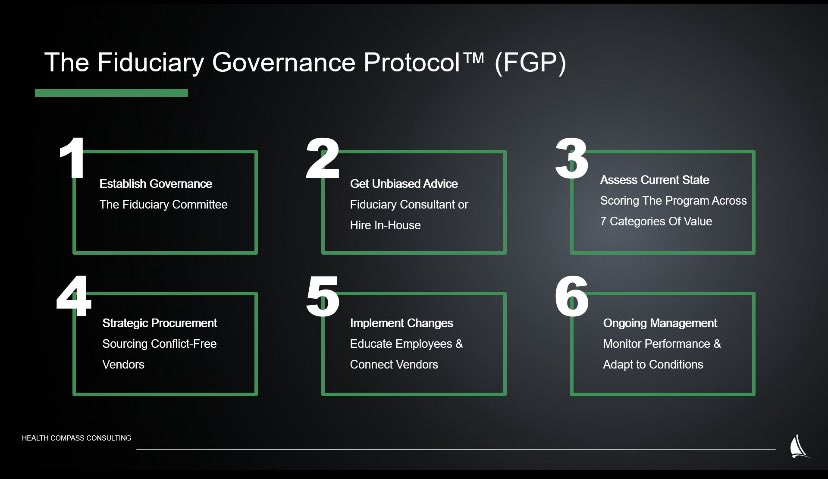
Products don't fix broken health plans...protocols do. Most employers treat their health plan like a commodity. They shop it once a year. They get a 10% increase. They blame the "market." But the market isn’t the problem. The process is. If you are only looking at your health plan 60 days before renewal, you aren’t managing a budget—you are subscribing to inflation. At Health Compass Consulting, we don't sell products (all the carriers already have sales people). Instead, we install a governance system that systematically drives more value to your bottom line and your people. As you can see in the graphic below, the Fiduciary Governance Protocol (FGP)™ moves your plan from "Reactive Shopping" to "Proactive Management." We cycle through 6 distinct phases of fiduciary oversight: ✅Governance: Establishing the rules and committees. ✅Strategy: Using data (TBA™) to find the waste. ✅Procurement: creating leverage, not just asking for quotes. ✅Implementation: Engaging employees (EBV™). ✅Management: Daily compliance and stewardship. ✅Optimization: Continuous improvement loops. The result? You stop buying products and start building an asset that gives you a strategic advantage in the market for talent. Did your 2025 renewal conversation look like a strategic business review, or just a spreadsheet from hell? Let’s stop shopping and start governing.
Donovan Pyle tweet media
English
0
0
0
25
Donovan Pyle
Donovan Pyle@DonovanPyle·
Lee Lewis revealing the tactics fortune 100 companies are use to maximize healthcare investments and keep inflation in line with — or below — CPI.
Donovan Pyle tweet media
English
0
0
0
15
Donovan Pyle
Donovan Pyle@DonovanPyle·
Businesses need to understand that health insurers are wholesalers of medical services and legacy brokers are retailers. In the commercial space, they all make more money when costs go up — not down. This is why relying on them to manage your company’s healthcare supply chain is financial suicide.
Brigham Buhler@ferrisbuhler81

Insurance companies profit from junk food. We’re sold the illusion of a “free market” while choices are quietly made for us. Without transparency, there is no real choice. @drmarkhyman

English
0
0
2
43
Donovan Pyle
Donovan Pyle@DonovanPyle·
We usually advise clients to avoid vendors with inflation-based revenue models, but you've got to give it up to @mcuban for raising awareness about so many challenges in the Rx space today. His passion and advocacy are literally shaping U.S. healthcare policy, and he doesn't have to spend his time doing any of this --- and yet he does. Looking forward to rallying the "Coalition of Defense" on behalf of employers and patients next week at the YOU Powered Symposium in Savannah. @GeBaiDC
Donovan Pyle tweet media
English
0
0
1
41
Donovan Pyle
Donovan Pyle@DonovanPyle·
Last week, I had the privilege of joining an expert panel alongside academic leaders and partners from a Tier-1 Global Strategy Firm to discuss health policy reform for a major international economy. We all agreed that we want to build the "Ferrari" of healthcare (Value-Based Care). But during the session, I shared a caution that applies just as much to U.S. employers as it does to foreign governments: You cannot run a high-performance engine on a broken commercial road. If your "road" (the commercial infrastructure) is built on: ❌Inflationary Broker Commissions ❌Hidden Spreads ❌Misaligned Incentives... ...then your "Ferrari" (Value-Based Care) will get destroyed before it leaves the garage. I presented my "Commercial Maturity Model" to the panel—a framework designed to transition markets from passive payers to active stewards. We have to repair the road before we can race the car. Whether you are a Ministry of Health or a mid-sized US company, the math is the same. Stop financing the system's inefficiency. Start defending your capital. Your people need you.
Donovan Pyle tweet media
English
0
0
0
29
Donovan Pyle me-retweet
Mark Cuban
Mark Cuban@mcuban·
How in the world are CMS and HHS paying a subsidiary of the large insurance company in the country to give them research Because The Lewin Group is a wholly-owned subsidiary of Optum (itself a subsidiary of UnitedHealth Group), it does not release a standalone public annual report or balance sheet. Its specific revenues and profits are "rolled up" into Optum’s financial reporting, effectively hiding its precise profit margins from the public eye. However, because they are a major federal contractor, their cash flow can be tracked through public government spending databases. 1. Financial Status & Revenue Estimates * Corporate Classification: Subsidiary (Private). * Parent Unit: They operate within Optum Serve, the federal health services division of Optum. , The Lewin Group is a boutique consulting outfit. Based on their federal contract history, their annual revenue is estimated to be in the $50 million – $100 million range. 2. Major Federal Contracts (The "Hard" Numbers) The bulk of The Lewin Group's identifiable revenue comes from the Centers for Medicare & Medicaid Services (CMS). Below are recent high-value contract awards that illustrate their financial scale: | Contract / Project Name | Agency | Total Value (Est.) | Description | |---|---|---|---| | AHEAD Model Implementation | CMS | ~$95 Million | A 10-year contract (awarded ~2024) to support the "States Advancing All-Payer Health Equity Approaches and Development" model. This is a massive policy implementation project. | | GUIDE Model | CMS | ~$75 Million | Implementation and monitoring for the "Guiding an Improved Dementia Experience" (GUIDE) Model. | | PERM Statistical Contractor | CMS | ~$43 Million | "Payment Error Rate Measurement." Lewin acts as the statistical auditor to estimate improper payment rates in Medicaid and CHIP. | | MIDS IDIQ | CMS | (Shared Pool) | Lewin is one of several awardees on a $1.6 Billion Indefinite Delivery/Indefinite Quantity (IDIQ) contract for "Measure and Instrument Development and Support." They compete for task orders within this massive pot. | Summary Analysis The Lewin Group acts as a high-revenue service provider to the very agency (CMS) that regulates its parent company (UnitedHealth). * Flow of Funds: Taxpayer money \rightarrow CMS \rightarrow The Lewin Group \rightarrow Optum \rightarrow UnitedHealth Group. * Financial Leverage: While their direct revenue is small, the value of the data they access (Medicare claims data, error rates, model designs) is incalculable for a parent company that insures 50+ million
English
87
193
760
158.4K