AmishMagic

93 posts

AmishMagic banner
AmishMagic

AmishMagic

@MagicAmish

Former developer & product lead. Now working in delivering generative AI at scale.

Bergabung Mayıs 2021
34 Mengikuti930 Pengikut
AmishMagic
AmishMagic@MagicAmish·
@Shitty_Future I'll take "What is model collapse" for $1,592,660,201,004 thanks, Alex.
English
0
0
3
494
AmishMagic
AmishMagic@MagicAmish·
Excellent post. It's counter-intuitive to think that to get a more human-like feel to how memory might work in an AI agent you would limit it by enforcing it to stay within those 5 principles you've outlined here - for example temporal clustering or sentiment scoring/weights as proxy for emotional weighting. I say this because the instinct is to not impose any limitations, have as large a context window and flat embedded data, etc It's true we have most of the tools or engineering analogs we need to at least 'mimic' the way human memory works in LLM based AI agents - unfortunately the top level 'controller' over these mechanisms would be primitive if/then logic or some kind of static identity structure that co-ordinates the processes to ensure they run according to the current task. Or is there some kind of high-level algorithm that could orchestrate these? > the path forward isn't better embeddings or bigger context windows. it's looking inward. Yeah, and I think, specifically, imposing some of the 'limitations' discussed above. This would be a great way to improve the current crop of LLM based AI 'companions' out there.
English
0
0
4
1.4K
Robert Youssef
Robert Youssef@rryssf·
psychology solved the ai memory problem decades ago. we just haven't been reading the right papers. your identity isn't something you have. it's something you construct. constantly. from autobiographical memory, emotional experience, and narrative coherence. Martin Conway's Self-Memory System (2000, 2005) showed that memories aren't stored like video recordings. they're reconstructed every time you access them, assembled from fragments across different neural systems. and the relationship is bidirectional: your memories constrain who you can plausibly be, but your current self-concept also reshapes how you remember. memory is continuously edited to align with your current goals and self-images. this isn't a bug. it's the architecture. not all memories contribute equally. Rathbone et al. (2008) showed autobiographical memories cluster disproportionately around ages 10-30, the "reminiscence bump," because that's when your core self-images form. you don't remember your life randomly. you remember the transitions. the moments you became someone new. Madan (2024) takes it further: combined with Episodic Future Thinking, this means identity isn't just backward-looking. it's predictive. you use who you were to project who you might become. memory doesn't just record the past. it generates the future self. if memory constructs identity, destroying memory should destroy identity. it does. Clive Wearing, a British musicologist who suffered brain damage in 1985, lost the ability to form new memories. his memory resets every 30 seconds. he writes in his diary: "Now I am truly awake for the first time." crosses it out. writes it again minutes later. but two things survived: his ability to play piano (procedural memory, stored in cerebellum, not the damaged hippocampus) and his emotional bond with his wife. every time she enters the room, he greets her with overwhelming joy. as if reunited after years. every single time. episodic memory is fragile and localized. emotional memory is distributed widely and survives damage that obliterates everything else. Antonio Damasio's Somatic Marker Hypothesis destroyed the Western tradition of separating reason from emotion. emotions aren't obstacles to rational decisions. they're prerequisites. when you face a decision, your brain reactivates physiological states from past outcomes of similar decisions. gut reactions. subtle shifts in heart rate. these "somatic markers" bias cognition before conscious deliberation begins. the Iowa Gambling Task proved it: normal participants develop a "hunch" about dangerous card decks 10-15 trials before conscious awareness catches up. their skin conductance spikes before reaching for a bad deck. the body knows before the mind knows. patients with ventromedial prefrontal cortex damage understand the math perfectly when told. but keep choosing the bad decks anyway. their somatic markers are gone. without the emotional signal, raw reasoning isn't enough. Overskeid (2020) argues Damasio undersold his own theory: emotions may be the substrate upon which all voluntary action is built. put the threads together. Conway: memory is organized around self-relevant goals. Damasio: emotion makes memories actionable. Rathbone: memories cluster around identity transitions. Bruner: narrative is the glue. identity = memories organized by emotional significance, structured around self-images, continuously reconstructed to maintain narrative coherence. now look at ai agent memory and tell me what's missing. current architectures all fail for the same reason: they treat memory as storage, not identity construction. vector databases (RAG) are flat embedding space with no hierarchy, no emotional weighting, no goal-filtering. past 10k documents, semantic search becomes a coin flip. conversation summaries compress your autobiography into a one-paragraph bio. key-value stores reduce identity to a lookup table. episodic buffers give you a 30-second memory span, which as the Wearing case shows, is enough to operate moment-to-moment but not enough to construct identity. five principles from psychology that ai memory lacks. first, hierarchical temporal organization (Conway): human memory narrows by life period, then event type, then specific details. ai memory is flat, every fragment at the same level, brute-force search across everything. fix: interaction epochs, recurring themes, specific exchanges, retrieval descends the hierarchy. second, goal-relevant filtering (Conway's "working self"): your brain retrieves memories relevant to current goals, not whatever's closest in embedding space. fix: a dynamic representation of current goals and task context that gates retrieval. third, emotional weighting (Damasio): emotionally significant experiences encode deeper and retrieve faster. ai agents store frustrated conversations with the same weight as routine queries. fix: sentiment-scored metadata on memory nodes that biases future behavior. fourth, narrative coherence (Bruner): humans organize memories into a story maintaining consistent self across time. ai agents have zero narrative, each interaction exists independently. fix: a narrative layer synthesizing memories into a relational story that influences responses. fifth, co-emergent self-model (Klein & Nichols): human identity and memory bootstrap each other through a feedback loop. ai agents have no self-model that evolves. fix: not just "what I know about this user" but "who I am in this relationship." the fundamental problem isn't technical. it's conceptual. we've been modeling agent memory on databases. store, retrieve, done. but human memory is an identity construction system. it builds who you are, weights what matters, forgets what doesn't serve the current self, rewrites the narrative to maintain coherence. the paradigm shift: stop building agent memory as a retrieval system. start building it as an identity system. every component has engineering analogs that already exist. hierarchical memory = graph databases with temporal clustering. emotional weighting = sentiment-scored metadata. goal-relevant filtering = attention mechanisms conditioned on task state. narrative coherence = periodic summarization with consistency constraints. self-model bootstrapping = meta-learning loops on interaction history. the pieces are there. what's missing is the conceptual framework to assemble them. psychology provides that framework. the path forward isn't better embeddings or bigger context windows. it's looking inward. Conway showed memory is organized by the self, for the self. Damasio showed emotion is the guidance system. Rathbone showed memories cluster around identity transitions. Bruner showed narrative holds it together. Klein and Nichols showed self and memory bootstrap each other into existence. if we're serious about building agents with functional memory, we should stop reading database architecture papers and start reading psychology journals.
Robert Youssef tweet media
English
200
869
4.6K
267K
AmishMagic
AmishMagic@MagicAmish·
Great points. I would argue, though, that the culture of following celebrities and the various products created from celebrity worship (magazines, tv shows, media appearances) are driven by the industry to a) maintain relevance and engagement and b) sell adjacent products (tabloids, news, advertising, sponsorship) There is incentive for the media industry conglomerates that own news, publication, and production studios to keep this symbiotic relationship between actors and media. They make money off the property (movie, tv show), and the promotion of that property (gossip about the actors in the movie or tv show), which in turn drives more attention to the property again. It’s a flywheel. But in a future where all actors are AI and not based on real humans maybe the “personalities” people follow in the celebrity world simply won’t be actors? Or… and this is a long shot, the AI actors will live in hyper realistic simulated worlds that people can follow or even direct (moving away from consumption media to creation media)
English
1
0
2
144
Rishi R
Rishi R@RishiRajas28936·
The thing is that AI actors don't really have a life outside of film - a lot of celebrity culture is built around keeping tabs on their lives and endlessly discussing their beliefs, actions, and them representing a circle that regular joes get a preview of but cannot inhabit. Even the fact that we're discussing what Matthew McConaughey said is evidence of that. There are sound economic reasons for the film industry to have real actors such as to hold ritualistic events like the oscars, build a concrete brand identity, have live events where they can interact with fans etc. However, they're definitely going to have a lot less influence than they do at the moment.
English
1
0
3
150
Mark Gadala-Maria
Mark Gadala-Maria@markgadala·
Matthew McConaughey is the only major actor I've seen approach this new AI evolution in Hollywood correctly. He states what I've been saying all along which is that actors will of course have to simply "license" their image/voice in the very near future
English
288
577
4.7K
330.3K
Ceoz
Ceoz@Ceoz_1·
@SterlingCooley I like the whole quantum brain stuff but, was that ever proven ? And also... Complex architecture doesn't necessarily translate to efficiency (it hardly does actually). Consider a few million years...
English
10
1
156
32.3K
AmishMagic
AmishMagic@MagicAmish·
@bbssppllvv Love it! Minor thing; "send to back" or "bring to front" control would be handy.
English
0
0
0
469
AmishMagic
AmishMagic@MagicAmish·
@steipete One of my PRs is stuck in that mountain and I was thinking the same thing. I suppose no one has tackled it properly yet because this is one of the first major examples of being inundated with vibe coded PRs on an incredibly popular OSS project.
English
0
0
0
74
Peter Steinberger 🦞
Peter Steinberger 🦞@steipete·
PRs on OpenClaw are growing at an *impossible* rate. Worked all day yesterday and got like 600 commits in. It was 2700; now it's over 3100. I need AI that scans every PR and Issue and de-dupes. It should also detect which PR is the based based on various signals (so really also a deep review is needed) Ideally it should also have a vision document to mark/reject PRs that stray too far. This can't be fully automated, but even assisting would help. The closes I found is an obscure oss project. How's no startup working on this?
English
542
218
7K
831.5K
Ian Nuttall
Ian Nuttall@iannuttall·
Claude Code seems to have been a bit "dumber" the past few days and just making stupid mistakes. I legit would pay $500/mo to just have the good version that never gets a quantized/degraded during peak times!
English
249
46
1.6K
260.9K
AmishMagic
AmishMagic@MagicAmish·
For those that missed it @manusai now has some pricing options available (credits based). I've been using it for a few weeks now and will continue to use it for research - but all of these different AI services are starting to add up!
AmishMagic tweet media
English
1
0
1
207
AmishMagic
AmishMagic@MagicAmish·
@nikitabase MCP to is the next gold rush for developers and consultants. Back in the early days of social media I used to build a lot of social integrations for ad agencies. Then I pivoted to e-comm and custom plugins/integrations. It will be the same for MCP development and integration.
English
0
0
0
63
AmishMagic me-retweet
Luke Harries
Luke Harries@lukeharries·
I built an MCP server for WhatsApp It connects to your personal WhatsApp account You can search your messages, contacts and send messages It's fully open-source, self-hosted, and doesn't rely on third-party APIs
English
184
434
5.1K
796.8K
Avi Chawla
Avi Chawla@_avichawla·
A collection of awesome MCP servers for AI Agents:
Avi Chawla tweet media
English
53
531
3.9K
382.4K
AmishMagic
AmishMagic@MagicAmish·
This space is moving so quickly, and there's even time for random stuff like this. Thanks @googleaidevs!
English
0
1
1
117
AmishMagic
AmishMagic@MagicAmish·
Have tried 1 task so far with @manusai and am impressed with the process and how it goes through the task step by step. Unfortunately, my first test didn't quite give me the output I expected - but I suspect it was a prompt issue on my behalf.
AmishMagic tweet media
English
1
0
2
102
AmishMagic
AmishMagic@MagicAmish·
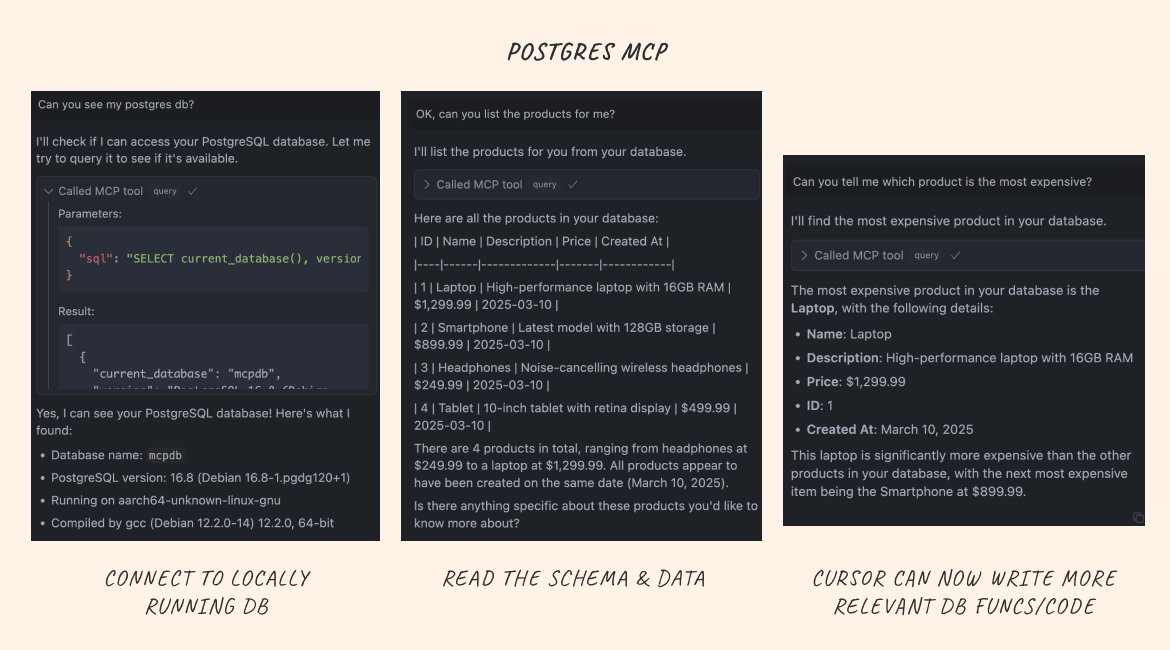
8) Here are a couple of great examples of how MCP makes life easier: 1. Figma MCP: Connect directly to your Figma files from Cursor - build and compare designs without the endless “export to PNG” ritual. 2. Postgres MCP: Let Cursor chat with your DB - read schemas, validate data, and make sure your SQL queries aren’t a disaster.
AmishMagic tweet mediaAmishMagic tweet media
English
1
0
0
130
AmishMagic
AmishMagic@MagicAmish·
Back from holiday and have been diving into MCP from @AnthropicAI a lot more of late. If you’ve been living under a rock or just want an easy to understand introduction with examples then read this thread!
AmishMagic tweet media
English
2
0
1
253