

Theo
275 posts
Theo
@SnsblModerate
Here is our kingdom, the best of monarchies, the best republic.
Bergabung Ocak 2026
98 Mengikuti77 Pengikut

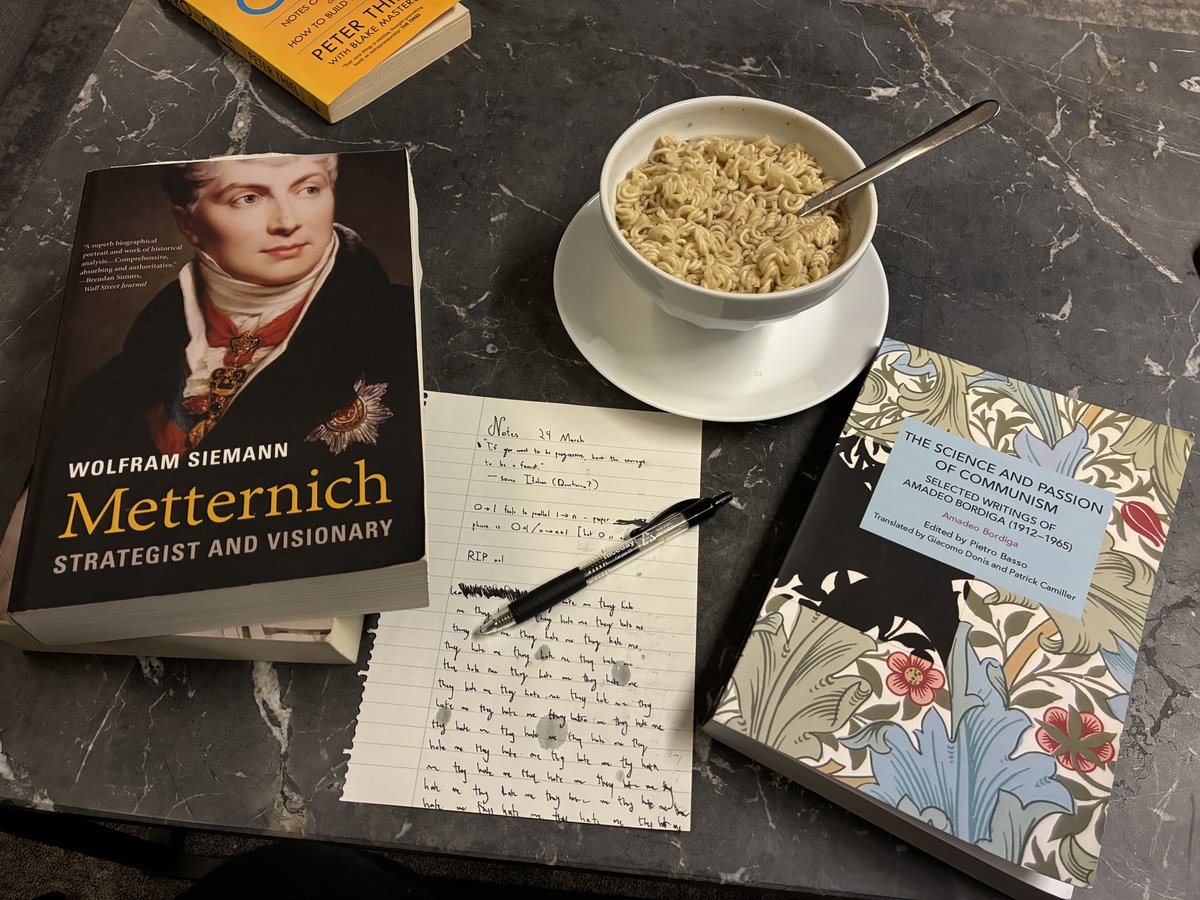

Likes and rts appreciated! This stuff doesn’t usually get a lot of engagement but it’s something I’ve been passionate about recently
English
Theo me-retweet
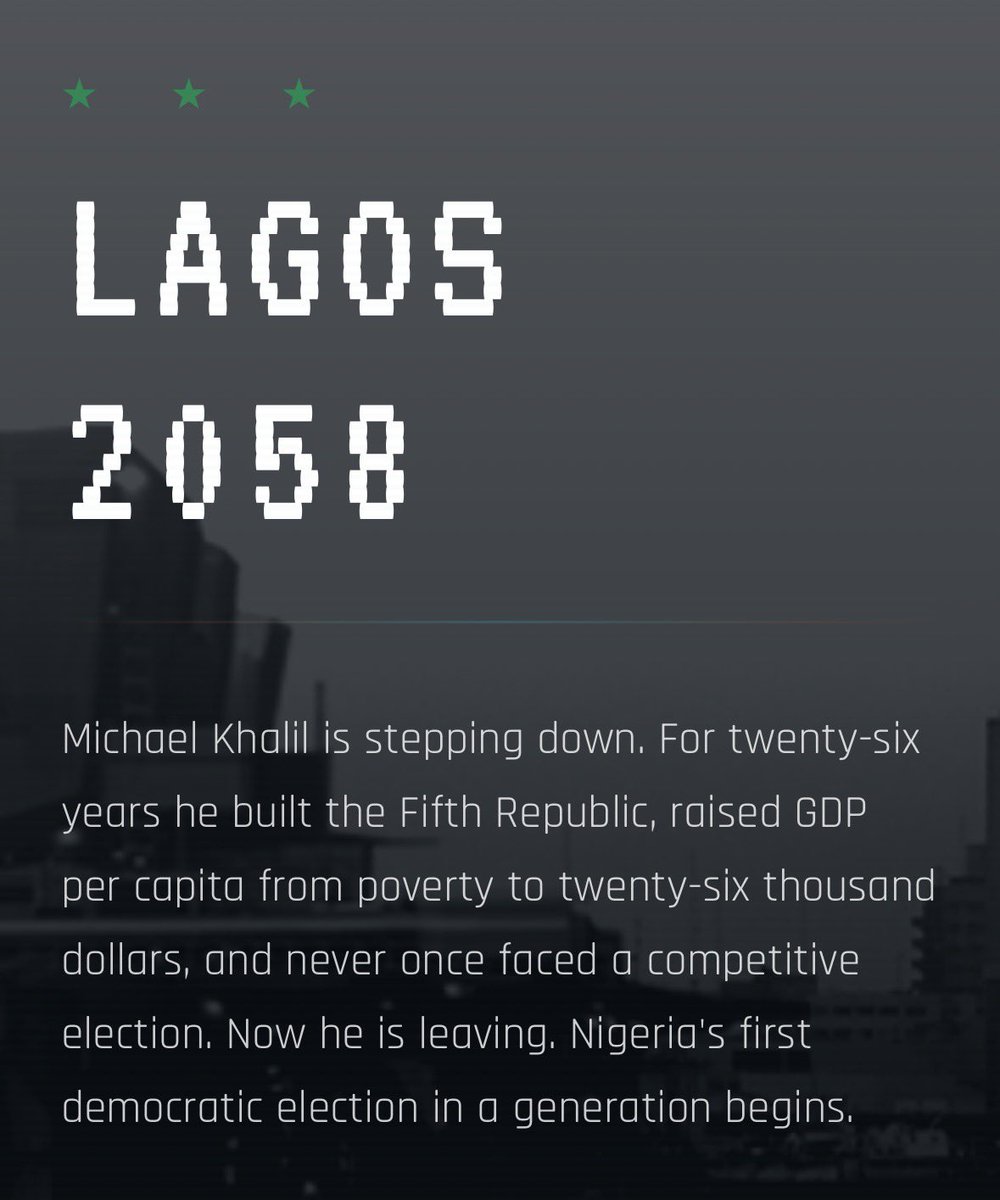
If you’re interested in joining with new polsim with a rich lore taking place in a futuristic post-dictatorship Nigeria join @LAGOS2058
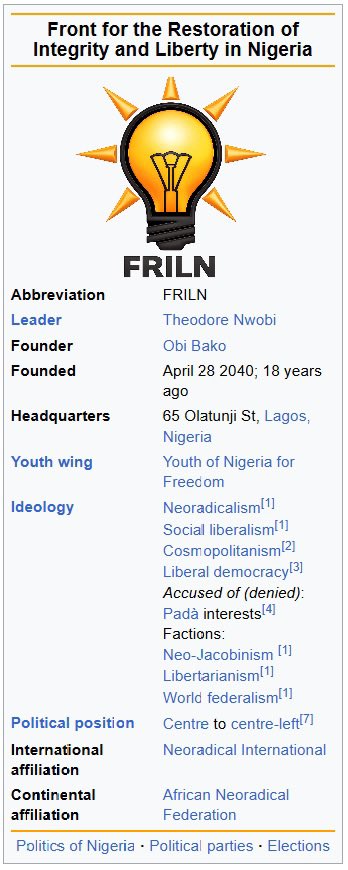
You could even join my party! We need people to help write the manifesto and do propaganda art
English
Is there a detention center near Pitt?
The writers are NOT FROM HERE and they HATE US
Lucky Teter@TheMagaHulk
The Pitt is the gayest show ever made
English

Tik Tok communism is actually in the stone age man, it's horrifying
English


"Minecraft PVP" is such an unbelievable retarded concept that I still haven't come to terms with its' existence and it's been like 10 years
@redaction@redaction
For years now, the #1 ranked Minecraft PVPer was a girl named Marlow This was touted as a huge win for diversity in esports Long standing cheating suspicions were universally condemned as sexism A few days ago, Marlow was revealed to not only be cheating, but also a catfish
English
Theo me-retweet

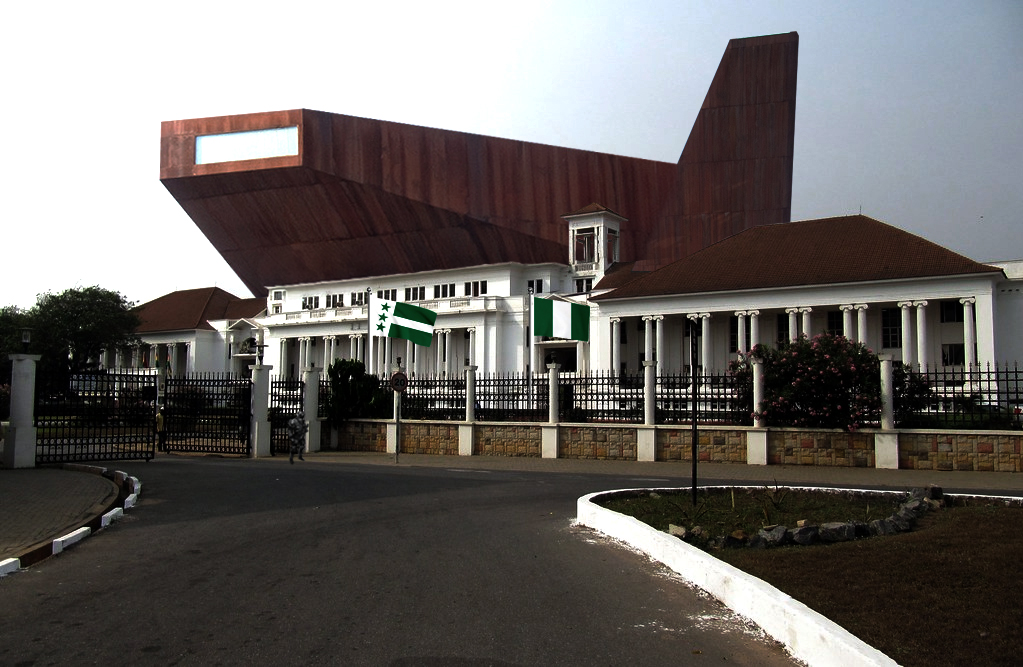
The first debate of the 2058 general election is almost here: Shaykhah Asma'u Balarabe and Ayodele Balogun will take the stage Saturday night in Lagos. This will be livestreamed on this platform.
While some of the rules and formatting elements are standard — for instance, the candidates will be allowed to take notes during the debate, but not to bring prepared notes — others will be less typical.
Here is an overview of the rules that the two campaigns have agreed to with the Nigerian Broadcasting Corporation, the evening’s host.
How long will the debate be?
Ninety minutes, starting at 9 p.m. Eastern time, with two commercial breaks. That is a normal length for a campaign debate, but the commercial breaks are noteworthy: General-election debates in past cycles, sponsored by the Commission on Presidential Debates rather than an individual news organization, did not have them.
The candidates will not be allowed to talk to their aides during the commercial breaks, but they will have time to take a breather and collect themselves in a way they would not have in past years.
Will there be an in-person audience?
No. The candidates will debate in a Lagos Forum studio with no live audience.
This was a demand from the NDF campaign, most likely based on a recognition that Balarabe tends to play to and feed off supportive crowds.
How will the candidates be positioned?
They will stand at lecterns. Balarabe won a coin toss to choose his spot, and he will be on the right side of viewers’ TV screens.
Will there be opening and closing statements?
Opening statements, no; closing statements, yes.
The order of the closing statements was determined by a coin toss. Balogun will make his first, and Balarabe will have the last word of the debate.
How long will the candidates have to answer questions?
NBC will allow two minutes for each answer and one minute for rebuttals. The moderators, the NBC hosts, will be able to grant extra time at their discretion.
English
Theo me-retweet
THE ODUDUWA PRESS, January 18th, 2058
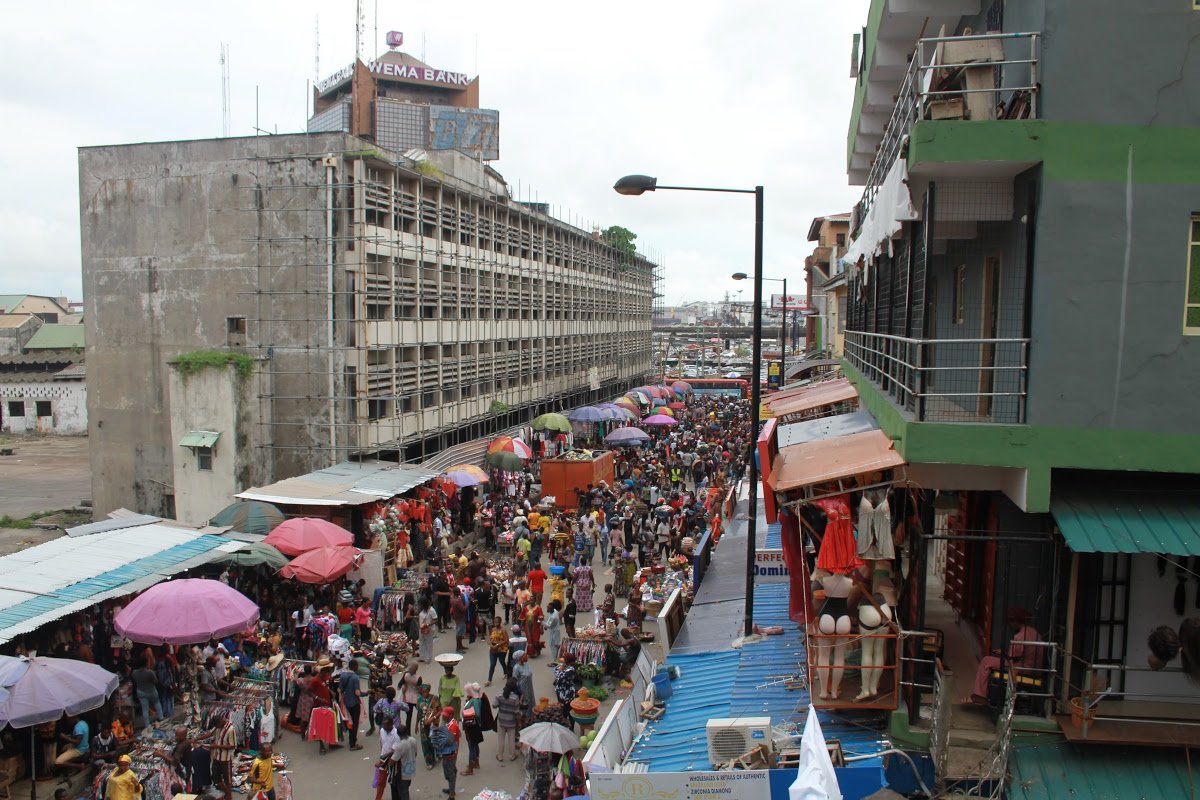
FULL TRANSCRIPT: Adegoke Fashola addresses crowd at Balogun Market, January 16th. Approx. 800 in attendance. Transcription by Oduduwa Press staff. Crowd responses noted where audible. Rendered as spoken.
Balogun!
[Crowd: Fashola!]
Balogun!
[FASHOLA! FASHOLA!]
E kaasan o!
[E kaasan!]
Make everybody hear. The ones for back, una dey hear so?
[We dey!]
Good. Sharp sharp, make we start, because wetin I get to talk today no fit wait and sun no go wait for us. I get things to say wey nobody for television go say. Things wey nobody for newspaper go print. Things wey the pada dem and their oyinbo English dey use fine fine word to hide from una every single day.
[Clapping, whistling]
Una know me. I be Fashola. I dey sell cloth for this Balogun twenty-one years. My papa dey here before me. Him papa before am. I no go Columbia. I no go Tsinghua. I no go nowhere. I stay. I stay when the bomb dey fall. I stay when ASS enter Abuja. I stay when dem dey rape woman for Ijegun and light no dey and water no dey and the pada dem still dey for Maryland dey wear winter jacket dey complain say snow too much.
[Laughter, cheering]
Dem no stay. But dem come back o! With their double-barrel name and their American accent and their Columbia certificate, and Khalil spread red carpet for dem, roll am out from the airport to the Ministry. Come! Come and govern us! We the people wey survive, we the people wey bury our dead with our own hand, we no sabi anything! Make the people wey dey eat hamburger for Silver Spring come and teach us how to run country!
[Angry laughter, shouting]
But that one na old gist. Pada na old gist. Today I get new gist. Today na Naijin day.
[Crowd surges forward, shouting]
Ehn! Naijin! Make we talk about the Naijin! Because the pada, bad as dem be, at least dem get Nigerian mama and Nigerian papa. At least dem sabi wetin egusi taste like even if dem cook am with American Maggi. At least if you look dem for face you see Nigerian person.
[Murmuring]
But the Naijin. Ah. The Naijin. Make I ask una something. Una don see Naijin person for street? Una don look dem? Dem dey look like una? Dem dey look like your brother? Dem dey look like your mama? Or dem dey look like something else? Something wey no quite belong for here?
[Crowd: Something else!]
I no be racist o! God forbid! I dey talk wetin everybody dey see with dem own eye! You walk for New Makoko, you no go know say you dey Nigeria! The face dem no be Nigerian face! The food no be Nigerian food! You think say you dey Lagos? No o! You dey Shanghai! Na Shanghai with better weather!
[Raucous laughter, cheering]
Last week I go that place. New Makoko. The planned city. Built for Lekki, for Yoruba land, for land wey my grandfather generation dey fish before anybody know say China exist for map. I walk Akin Adesola Street. You know wetin I do? I count sign. Because I be man wey dey count. I count forty-one business sign for one street. How many dey for Mandarin?
[How many?!]
Twenty-nine!
[Eruption]
TWENTY-NINE! For Lagos! For Yoruba land!
[Shouting, stamping]
How many for Yoruba?
[Dead silence]
ZERO!
[Sustained uproar, several minutes]
Zero! Akin Adesola! ADESOLA! Yoruba name! And for him street, the people wey kill our language put their own! Like say we be ant wey dem fit step on! Like say Yoruba na rubbish wey dem fit throw for dustbin! Not one word! NOT ONE!
[Chanting, someone throws a bottle, Fashola gestures for calm]
No no no! No bottle! We no be animal! Dem call us animal already, no give dem proof! Keep the bottle. Keep the anger. We go need am for election day. Save am.
[Laughter, more calm]
Now. The New Lagosian reporter dey here. I see am. The woman there with the glasses and the notepad. Yes, you, madam. Wetin be your name?
[Inaudible response]
Ah! Fine name. Na pada name abi?
[Laughter]
No vex o, madam. Make you write everything. Every word. And when you carry am go your editor for Victoria Island, the one wey dey drink expensive coffee for him office wey my rent no fit pay, tell am say Fashola send greeting. Tell am say Fashola dey come. Not for him office. For the ballot box.
[Cheering]
Write this one.
Hua Sharif.
[Immediate, violent booing]
HUA SHARIF! The name wey sweet for Forum people mouth like chin chin! "Hua Sharif na visionary!" "Hua Sharif na bridge between culture!" Which culture? Chinese culture and wetin? Because I no see Nigerian culture anywhere near that man!
Make I tell una the true story of Hua Sharif because the New Lagosian no go tell una.
Hua Sharif papa na Chinese man. Full Chinese. Come Nigeria 2034 to build rail. Na WAFTA contract. He suppose build, finish, go back China. Simple. But this Chinese man, he look around, he see opportunity. And he see Yoruba woman.
[Crowd murmurs]
I know. I know. The woman from Epe. Times hard. War just finish. Chinese man get money, get salary, get future. Yoruba man get wetin? Nothing. Bomb don scatter everything. So the woman follow the money. Na wetin woman do since beginning of time, I no blame am.
But make we be honest. Make we stop the pretending. That marriage, that kind marriage, Chinese man come take our woman because our country don destroy and we no get nothing to offer, that no be love story. That na transaction. And the product of that transaction na Hua Sharif. Half Yoruba by blood, full Chinese by everything else. Grow up dey speak Mandarin for house. Chinese food for table. Chinese friend dem. Go Chinese university wey our own tax money pay for. Come back and use him papa Chinese connection to get contract wey NO YORUBA MAN GO EVER SEE!
[Sustained angry shouting]
And you know wetin funny? You know wetin make me laugh until I want cry? This same Hua Sharif, this half-and-half, this man wey if you put am for Beijing nobody go look am twice because HE LOOK LIKE DEM, this man dey sit for Lagos Forum. The Lagos Forum! Wey suppose be for NIGERIAN! And when one member say "wait, this no be right," the New Lagosian call am xenophobe!
[Uproar]
Xenophobe! Fine English word! You know who dey use that word? People wey no get answer to the question! You ask dem "why Naijin dey control our money?" and dem say "xenophobe!" You ask dem "why my nephew no fit get work because he no speak Mandarin?" and dem say "xenophobe!" You ask dem "why sign for our street dey for Chinese?" and dem say "xenophobe!" Na the only word dem know! Na their shield! Anytime you ask question wey dem no fit answer, dem bring out "xenophobe" the way juju man bring out charm!
[Cheering, laughter]
But charm no dey work for me o! I be Balogun man! The only juju wey work for Balogun na money, and the Naijin get ALL of am!
[Laughter, applause]
The Naijin Community Council. NCC. Make we discuss.
You know wetin the NCC be? Na country inside country. Na China inside Nigeria. Dem get their own council. Dem elect their own leaders. Not for Nigerian election o! Their own separate election! For Naijin only! You, Yoruba man, you no fit vote for NCC. You, Igbo woman, you no fit vote. You, Hausa trader, you no fit vote. Only Naijin. Only dem. Separate. Apart. Like say dem dey live for different planet even though dem dey chop our food and breathe our air and use our road wey our tax build!
[Angry shouting]
And last year! Last year o! This NCC, this country-inside-country, dem go before the federal government and say, make una hear this, make una hear am well, dem say make Mandarin replace English!
[Gasps, sustained shouting, some crowd members turn to each other in apparent disbelief]
MANDARIN! FOR NIGERIA! Dem stand there, for our government, for building wey our people build, and dem tell us say make we throw away our language, the language wey everybody speak, the language wey hold this country together, and put Chinese language for him place! The GALL! The àìnírẹ̀lẹ̀! I no even get word for English! Only Yoruba fit describe this kind madness! Àìnírẹ̀lẹ̀!
[Crowd chanting àìnírẹ̀lẹ̀]
E no enter. Thank God e no enter. But I ask una: today e no enter. Tomorrow nko? Next year nko? When Naijin money grow more and Naijin people grow more and Naijin power grow more, and our own people, our Yoruba youth dem, no fit get work unless dem speak Mandarin, you think say dem no go try again? You think say dem go stop? Dem no go stop! Because dem believe, for the bottom of their heart, say this na their country now. Say dem buy am. Say Lagos na for sale and dem sign the receipt!
[Sustained angry chanting]
If I go Beijing tell dem make Yoruba be the language of dey country !
[Crowd: Dem go kill you!]
Dem go DEPORT me! The same way America deport the pada! And dem go be RIGHT! Because Beijing na CHINESE city! And Lagos na YORUBA city! Or ... wait. Na Yoruba city? Still? Or we don lose am? Because right now, right now as I dey talk, the richest man for Lagos na Naijin. The biggest bank for Lagos get Naijin board. The tallest tower for Lagos na built by Chinese company. The fastest internet for Lagos na Naijin network. And the sign for the street dey for Mandarin.
So I ask una again. Na who city be this?
[WHO CITY?! / NA OUR CITY! / YORUBA!]
Na who city?!
[NA OUR OWN!]
Then why we no fit read the sign?!
[Eruption]
Okay. Okay. Make una hear. I get something personal to share. I no been plan to talk this one. But I dey here and my people dey here and I think say una need to know how this thing dey touch ordinary family. Not policy. Not economics. Family.
[Crowd quiets]
My nephew. Taiwo. Small boy. Just turn eighteen. Good head. Hardworking. Him mama na my sister, she dey sell provision for Mushin. No husband. The man die for the strikes, 2045, factory accident, dem no pay compensation because the factory don automate and the machine no get union, but that one na different gist.
Taiwo finish school. Good marks. Not best, but good enough. He want work. Him mama no fit send am university. So the boy, he iron him shirt, one shirt, one good shirt, the one wey him mama keep for special, and he go find work. Apply seven place.
[Crowd very quiet]
Four of those seven, when the boy sit down for interview. MANDARIN.
[Angry murmuring]
No be say dem advertise for Mandarin o! Dem write English for the advert! But the manager na Naijin and the secretary na Naijin and the other candidate dem na Naijin and the talk just dey change. Like water wey dey find him own level. Just dey go Mandarin. Small small. Until my nephew, this boy, this Yoruba boy from Mushin wey iron him one shirt that morning, he just dey sit there.
[Silence]
He just dey sit.
For him own city.
For him own country.
He no understand one word.
[Someone in crowd is audibly crying]
The boy come house. Him eye red. He tell him mama. Him mama tell me. And I look this boy, this fine Yoruba boy, eighteen years, sharp, ready for work, ready for life, and he look me for eye and he say-
[Fashola's voice breaks]
He say, "Uncle, maybe I suppose learn Mandarin."
[Gasps, then absolute silence]
...
[Long pause, approximately fifteen seconds.]
That night I no sleep. My people, I no sleep. I lie for bed and I hear that boy voice for my head. "Maybe I suppose learn Mandarin." And I see him face. And I see my papa face. My papa wey sell cloth for this market for forty years. My papa wey speak Yoruba like music. My papa wey tell me, small boy, "Adegoke, Yoruba na the language of your soul, no let anybody take am from you."
And now, one generation later, him grandson grandson nephew dey tell me say maybe he suppose learn the language of the people wey take him country.
[Silence]
I cry that night. I no shame to tell una. I be old man. I be tough man. Market life make you hard. But I cry that night because I understand something. I understand say if we no act now, if we no take this thing serious, if we let the pada and the Naijin and the Forum and the NCC and the whole rotten establishment continue the way dem dey go, then my papa language go die. Our language go die. And we go die with am. Not for body. For soul. For the thing wey make us Yoruba. For the thing wey make us who we be. That one go die. And our children go bury am and dem no go even know wetin dem don lose because nobody go remember the word to describe am.
[Many in crowd audibly weeping]
SO!
[Crowd startles]
Make I tell una wetin we go DO. Because Fashola no be man wey cry and go sleep. Fashola cry, then Fashola WORK.
[Cheering through tears]
NUMBER ONE!
Language protection! For the new constitution! English, Yoruba, Igbo. Na ONLY language wey fit dey for public sign, government paper, court, school. Mandarin no dey. Vietnamese no dey. Chinese no dey. If you want speak Mandarin, speak am for your house, speak am for your bed, speak am for your pillow. But for our street? Our language. OUR OWN.
[Sustained applause]
NUMBER TWO!
NCC don die! Today! Not review! Not committee! Not "stakeholder consultation" wey go take five years and produce five hundred page wey nobody read! TODAY! If you be Nigerian, join Nigerian government like Nigerian. If you need separate council because you dey too precious to mix with the rest of us, then my brother, maybe this no be your country. Maybe your country dey across the ocean. Maybe make you go there. And if you no go by yourself-
[Crowd: WE GO HELP YOU GO!]
[Extended cheering, stamping, chanting]
NUMBER THREE!
[THREE!]
Every company with foreign money connection must open book! I want see Hua Sharif account! I want see every naira wey enter from Shanghai! I want see every contract wey go to Naijin firm when Yoruba firm apply for the same work and no get am! OPEN THE BOOK! And if dem refuse, if dem say "na private business," then we go know. We go know say the money dirty. We go know say the connection dey. And we go REMEMBER for election day.
[Applause]
NUMBER FOUR!
[FOUR!]
No more sending our children to China to come back as stranger wey dey look us like animal for zoo. Twenty-five years don do! Nigerian children go NIGERIAN university. And if the university no good, we no go cry, we no go beg China, we go FIX AM. With our own hand. Like we fix everything else for this country since beginning.
[Sustained cheering]
NUMBER FIVE!
[FIVE!]
And this one, this one na the one wey go make headline. This one na the one wey the New Lagosian go use call me mad.
[Quiet laughter]
I want inquiry. Under oath. Into the relationship between the Naijin Community Council and the government of the People's Republic of China.
[Explosion of noise]
I DEY SERIOUS! Una think Beijing spend thirty years dey invest for this country, build railway, build factory, send engineer, send manager, send spy, YES, SPY, everybody know, everybody whisper, nobody SHOUT, well I DEY SHOUT, and then Beijing just forget about community of people with Chinese blood wey dey control the financial system of Lagos? Beijing no forget ANYTHING! Beijing no do CHARITY! Every yuan wey enter this country get string attach, and some of those string lead straight to the NCC building for New Makoko and EVERYBODY KNOW THIS!
[Shouting, clapping, chanting]
I no say every Naijin na spy. Some na just people wey dey try live. But I say this: the NCC na not ordinary community council. The NCC na operation. And the new parliament, the PEOPLE parliament, must investigate. Must subpoena. Must put dem under oath. Make Hua Sharif come explain him connection dem. Make NCC chairman come explain who dey fund dem. Make dem explain am for public, under camera, where the whole country fit see. And if the explanation good, fine. We go accept. But if the explanation no good, and my people, I no think say e go good, then we go know who the Naijin really serve. And e no be Nigeria.
[Sustained chanting: "INQUIRY! INQUIRY! INQUIRY!"]
My people!
[FASHOLA!]
I nearly done! Sun dey hot! I know! I don talk long! I know! But I beg una, hear the last thing.
[Quiet]
I tire. I tire for twenty-six years. I tire when Khalil put pada for every office and we no fit talk. I tire when the Chinese come build tower wey we no fit enter. I tire when my nephew sit for interview like ghost for him own city. I tire when I walk for Akin Adesola Street and no see one word of my father language. I tire. All of us tire.
But you know wetin? E don reach. The tiredness don finish. Because something dey happen wey never happen before for this country. Democracy dey come. Election dey come. For the FIRST TIME, you, market woman, and you, taxi driver, and you, mechanic, and you, provision seller, and you, mai guard wey dey stand for sun all day — for the first time, UNA voice go matter. Una go get VOTE. And vote na power. And power na the ONLY thing wey the pada and the Naijin understand. Money and power. Money we no get. But power? Power dey inside that ballot box. And for the first time for twenty-six years, the ballot box dey OPEN.
[Massive cheering]
My papa, God rest am, he be Yoruba man. Everything he know, he know am for Yoruba. And he tell me one thing when I small wey I no forget and I no GO forget and I go tell MY children and dem go tell their own:
Ilé la ti ń kọ ẹṣọ́ r'òde.
Before you go world, first sweep your own house. First clean your own floor. First know where you dey before you go where you dey go.
Our house dirty, my people. I no go lie to una. Our house DIRTY. Stranger dey for parlor dey sit for our chair. Dem dey chop our food. Dem dey spend our money. Dem dey speak language wey we no hear. And dem dey LAUGH. Dem dey laugh at us because we LET dem. Because for twenty-six years nobody ask dem to leave. Nobody ask dem to even TRANSLATE THE SIGN.
[Building roar]
But that don finish. Today. For this market. For Balogun. That don finish.
E don reach to sweep.
[Voice cracking]
E DON REACH!
[ERUPTION. Chanting of "SWEEP! SWEEP! SWEEP!" begins immediately and sustains for approximately four minutes. Multiple crowd members perform sweeping motions with their arms, a gesture that spreads rapidly through the crowd. Fashola remains on platform for approximately thirty seconds with his right fist raised, then descends. He is mobbed by supporters. Several vendors abandon their stalls to join the crowd. The chanting continues intermittently for over an hour after Fashola's departure. At least two confrontations between crowd members and Naijin-owned businesses on the market perimeter are reported by witnesses but could not be independently verified by Oduduwa Press staff. Lagos Metropolitan Police were not called.]
EDITOR'S NOTE: The Oduduwa Press publishes this transcript in the public interest. We note that at the time of publication, neither the Naijin Community Council nor the Lagos Forum has responded to Mr. Fashola's remarks. Persons wishing to submit responses may do so through the usual channels. The Oduduwa Press remains committed to giving voice to the people of Western Nigeria.
English

@NondescriptRed @crushed_bug Idealistslop that you are making up post hoc to rationalize your habits that are destroying the planet and causing unnecessary suffering
English

@elaifresh @JohnWakefieId I hate cyclists. One time I saw a cyclist riding down the highway and he almost got ran over and I would've laughed with glee. I hate cyclists.
English
@JohnWakefieId Sorry what is this thing about saving money on the spread of one tank of gas
Who fucking cares about this small potatoes shit
English

Theo me-retweet
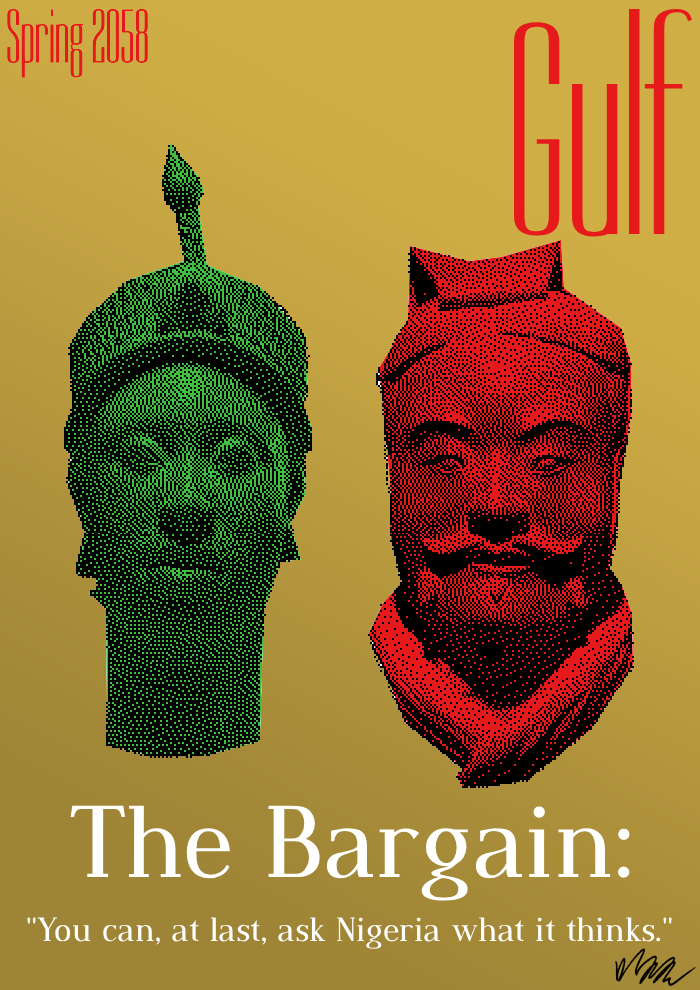
THE GULF, Spring 2058
The Bargain by Emeka Obi-Fernandez
In the lobby of the Ministry for Modernization's Lagos headquarters there is a photograph, blown up to mural size, of Michael Khalil and Ding Xuexiang shaking hands. The photograph was taken in 2032, shortly after the founding of the Fifth Republic, and it captures a moment that the official narrative treats as the beginning of modern Nigeria. Both men are smiling. Khalil is in military dress, still lean from the guerrilla years, his expression carrying the particular confidence of a man who has just won a war and is about to win a peace. Ding is in a dark suit, avuncular, extending the hand that held, behind it, the full weight of Chinese state capital. Between them, on the table, is a sheaf of papers that would become the West African Free Trade Agreement.
I have walked past this photograph dozens of times. It is impossible to work in Nigerian policy circles and avoid it, because it has been reproduced on the walls of government buildings, in the introductory pages of economics textbooks, and in the opening credits of at least three state-produced documentaries about the Nigerian miracle. It is, in the visual grammar of the Fifth Republic, the equivalent of a founding icon, the moment the handshake happened and the future began.
The last time I stood in front of it was in November, shortly after President Khalil announced his retirement and the coming democratic transition. A young official from the Ministry, a woman in her late twenties, noticed me staring and stopped to chat. She had been educated at Peking University on a WAFTA scholarship and had returned three years ago to take up a position in industrial planning. Her English was excellent, her Mandarin (she told me, smiling) was better. I asked her what she thought about the transition. She said she was optimistic. I asked her what she thought about WAFTA. She looked at me as if the question did not make sense, the way you might look at someone who asked you what you thought about the weather. "WAFTA is Nigeria," she said. "You cannot separate them."
She was not wrong. That is precisely the problem.
The numbers are, by now, familiar to anyone who reads this magazine. In 2032, the year WAFTA was signed, Nigeria's GDP per capita was somewhere south of $2,000, and large portions of the country were still recovering from the combined devastation of the ISWAP insurgency, the farmer-herder wars, and the Alliance of Sahel States invasion. By 2057, GDP per capita had surpassed $26,000, making Nigeria the wealthiest nation in Africa by a considerable margin and placing it in the upper range of what the World Bank used to call "upper-middle-income countries" before it revised its categories to account for exactly this sort of rapid ascent. Nigerian industry now produces refined petroleum, electronic components, drones, pharmaceuticals, and cognitive enhancement drugs that are exported across three continents. The Lagos skyline, with the Decade Tower and the Embankment Port Authority Building anchoring the waterfront, is unrecognizable from the city that existed thirty years ago.
WAFTA made this possible. Not entirely, not exclusively, but substantially. Chinese investment built the high-speed rail from Lagos to the northern mining regions. Chinese technology transfer agreements gave Nigerian industry the tools to move up the manufacturing chain. Chinese university scholarships created an entire class of technocrats who returned home and staffed the ministries that planned the industrialization. The story of Nigeria's rise is not a Chinese story, exactly, but it is a story in which China appears on nearly every page, and any honest accounting of the last quarter century has to begin by acknowledging that the alternative to WAFTA was probably not a different development path but no development path at all.
I want to begin here, with this concession, because the argument I am about to make is often made by people who do not begin here, and their arguments are weaker for it. Nigerian nationalists who rage against Chinese influence without acknowledging what that influence purchased are not serious. Western commentators who write about "debt-trap diplomacy" from the comfortable distance of London or Washington, where the consequences of Nigerian poverty were never felt, are not serious either. WAFTA was a deal struck by a desperate country with the only partner willing to offer terms, and the terms, considered in isolation, were not unreasonable. Joint ownership provisions. Technology transfer. Educational exchange. Khalil negotiated hard and he negotiated well, and the country is richer for it.
But a deal can be well-negotiated and still be ruinous in ways that do not appear in the contract.
Consider the WAFTA education provisions, which are perhaps the clearest case of a benefit that became a trap. The agreement, expanded in 2033, created a pipeline that sent Nigeria's highest-scoring secondary school graduates to Chinese universities on full government scholarships, with the stipulation that they would return and serve in the civil service for at least five years. The program was a success by every measurable standard. It produced a generation of superbly trained bureaucrats. The Ministry for Modernization, the BIC, the industrial planning apparatus that drove Nigerian growth through the 2030s and 2040s were all staffed disproportionately by WAFTA graduates.
What the program also produced, and what nobody involved in its design appears to have considered seriously, was a governing class whose formative intellectual experience was Chinese. These were Nigerians who spent their late teens and twenties in Beijing, Shanghai, and Shenzhen. They learned to think about economics in Chinese terms, to admire Chinese models of governance, to speak Mandarin with their colleagues and sometimes with their spouses (the rate of Chinese-Nigerian intermarriage among WAFTA graduates is estimated at somewhere between fifteen and twenty-five percent, depending on who is counting and how they define terms). They came home, as the local professors who warned against the program had predicted, with deep competence and shallow roots. They were brilliant administrators. They were also, in a meaningful sense, not entirely Nigerian, and the country they built reflected this.
A walk through New Makoko makes the point viscerally. The planned city in Ibeju-Lekki, completed in the late 2030s, was designed by a Chinese-Nigerian architectural consortium and it looks like it. The street grid follows Chinese urban planning principles. The signage is bilingual, English and Mandarin, with the Mandarin text consistently larger. The commercial district is anchored by branches of Chinese banks and Chinese-Nigerian joint ventures. The Naijin Community Council, founded here in 2047, operates as a parallel power structure to the Lagos Forum, representing the interests of the Sino-Nigerian population that has become, in the space of a single generation, one of the wealthiest and most influential demographics in the country. New Makoko is a handsome city. It is also, unmistakably, a Chinese city that happens to be located in Nigeria. The young Ministry official I met in the lobby would feel perfectly at home there. I am not sure that someone from Bauchi would recognize it as part of their country.
The defenders of WAFTA will respond that New Makoko is an outlier, that the Chinese cultural footprint is concentrated in a few planned cities and professional enclaves, that most Nigerians go about their lives without ever encountering Mandarin signage or Chinese-Nigerian corporate boards. This is true in the same sense that it was true, in the British colonial period, that most Nigerians never set foot in Government House. The question is not whether the average Nigerian encounters Chinese influence directly. The question is whether the institutions that govern the average Nigerian's life were shaped by it. The answer, unavoidably, is yes.
The financial architecture is the deepest layer of this shaping, and the hardest to see. WAFTA oriented Nigerian trade toward Beijing with the gravitational force of a large body acting on a small one. Nigerian oil went east. Chinese capital came west. The joint-ownership provisions, which Khalil's defenders rightly cite as evidence of his negotiating skill, ensured that Nigerian firms held equity in Chinese-funded ventures, but the equity was structured in ways that left operational control disproportionately in Chinese hands for the first two decades. By the time rising Nigerian labor costs drove Chinese firms to begin selling off their factories in the 2050s, the financial plumbing of the Nigerian economy, the correspondent banking relationships, the currency swap arrangements, the trade credit facilities, had been built to flow in one direction. The pipes point east. Reconnecting them to the west would require not just new trade agreements but a wholesale reconstruction of the financial infrastructure that undergirds Nigerian commerce.
This is not a problem that anyone in the political class is currently willing to name, in part because the people most qualified to diagnose it are the WAFTA graduates who built the system and see no reason to dismantle it. The Naijin Community Council has lobbied, so far unsuccessfully, for Mandarin to replace English as the primary language of business. The proposal was denied. But the fact that it was made at all, that a significant constituency within the Nigerian elite now regards English as a colonial inheritance and Mandarin as the language of progress, tells you something about where WAFTA has taken the country's center of gravity.
I want to pause here and acknowledge the argument that I find most difficult to answer, because intellectual honesty demands it and because the people who make this argument are not fools. The argument is simply this: So what? So what if the financial pipes point east? So what if a generation of technocrats thinks in Mandarin? So what if New Makoko looks like a Chinese city? Nigeria is rich. Nigeria is industrialized. Nigeria is, for the first time in its history, a serious country with serious institutions and a serious economy. The cultural and financial entanglements of WAFTA are the price of admission to modernity. Every developing country that has ever risen quickly has done so in the shadow of a larger power, and the shadow always leaves marks. Japan modernized under American tutelage. South Korea's economic miracle was underwritten by American military protection and American market access. Singapore built its prosperity on the back of British legal institutions and American-dominated global trade. In each case, the smaller country absorbed foreign influences, adapted them, and eventually outgrew the dependency. Why should Nigeria be different?
It is a strong argument. I am not sure it is wrong. But I think it misses something, and the something it misses is the thing that makes Nigeria's situation genuinely novel rather than merely another chapter in the familiar story of developmental catch-up.
Japan, South Korea, and Singapore all modernized under the umbrella of a liberal international order that, whatever its hypocrisies, operated on the principle that economic integration would eventually produce political liberalization. The theory was not always borne out, but the expectation shaped the relationship. American influence in postwar Japan came with a constitution. American influence in South Korea came, eventually, with pressure for democratization. The implicit bargain of the liberal order was that economic entanglement would, over time, create the conditions for political freedom.
WAFTA contains no such bargain. China's model of development assistance is explicitly agnostic about the political character of the recipient state. Beijing did not care whether Khalil was a democrat or a dictator. It cared whether he could maintain stability, protect Chinese investments, and ensure the flow of resources. The joint-ownership provisions were about equity, not governance. The technology transfers were about capacity, not institutions. The educational exchanges produced excellent technocrats, not citizens. Everything about WAFTA was designed to build an economy, and nothing about it was designed to build a polity.
This matters now, in 2058, in a way that it did not matter in 2032, because the question Nigeria faces is no longer "how do we get rich" but "how do we govern ourselves." The democratic transition that Khalil has announced will require Nigerians to build, essentially from scratch, the political institutions that WAFTA never provided for. A parliament. A constitution. An independent judiciary. A free press (we have the press, or the beginnings of one, though whether it is free is a question that several of my colleagues would answer differently than I would). A civic culture in which disagreement is resolved through deliberation rather than through the authority of a single man backed by the BIC.
None of these things can be imported from China. None of them were part of the WAFTA package. And the class of people best positioned to build them, the educated, cosmopolitan, institutionally fluent elite, is precisely the class whose intellectual formation was most thoroughly shaped by a political culture in which none of these things exist.
I am not suggesting that WAFTA graduates are secret authoritarians or that the Naijin community is a fifth column. That kind of paranoia is the province of populist demagogues, and Nigeria has enough of those already. What I am suggesting is something subtler and, in its way, more troubling. The people who will write the new constitution, staff the new ministries, and manage the new economy have been trained to think about governance as a technical problem rather than a political one. They are optimizers. They believe in efficiency, in planning, in the application of expertise to social problems. These are not bad instincts. They are the instincts that built the Bonny Island refinery and the Lagos-Gausa rail line and the data center that runs the Ministry's AI planning apparatus. But they are insufficient instincts for the task of building a democracy, which is not an optimization problem but a legitimacy problem, and legitimacy cannot be engineered.
The developmental states that WAFTA's defenders invoke as precedents all eventually confronted this gap between economic capacity and political legitimacy. South Korea's confrontation was the Gwangju uprising and the long, bloody, unfinished struggle for democratization that followed. Singapore's was the quieter, ongoing tension between material prosperity and political freedom that Lee Kuan Yew managed through a combination of competence and coercion and that his successors have managed with diminishing returns. Japan's was the lost decades, when an economy built on technocratic consensus discovered that consensus could become paralysis. In each case, the developmental model produced wealth and deferred the question of self-governance, and in each case, the deferred question eventually came due.
Nigeria's bill is coming due now. The democratic transition is not a reward for economic success. It is the moment when the country must confront everything that WAFTA built and everything it failed to build. An economy oriented to Beijing. A governing class trained in Chinese institutions. A population divided between those who benefited from the deal and those who were excluded from it. A north that was never fully integrated into the WAFTA economy and that views the entire arrangement, with some justification, as a southern project imposed on a national scale.
I think about the young woman in the Ministry lobby, the one who told me that WAFTA is Nigeria and that you cannot separate them. She was being descriptive, not prescriptive. She was telling me what she saw, which is that the agreement has so thoroughly penetrated the economic, educational, and cultural fabric of the country that dismantling it is not a realistic option. And she is right. WAFTA cannot be undone. The factories are built. The railways run. The graduates have returned. The Naijin are Nigerian citizens with Nigerian children and Nigerian stakes in the Nigerian future. Any politician who campaigns on "decoupling" is either lying or delusional, because there is nothing to decouple from that does not also involve decoupling from the prosperity that Nigerians have spent a generation building.
But there is a difference between acknowledging that WAFTA cannot be reversed and accepting that it should not be reformed. The first democratic government will inherit an economic relationship that was negotiated by a dictator, ratified by no legislature, and subjected to no public debate. The terms of WAFTA have never been voted on. The educational provisions that sent a generation to Chinese universities were never debated in a parliament, because there was no parliament to debate them in. The financial architecture that orients Nigerian trade toward Beijing was never subjected to the scrutiny of an independent press, a parliamentary committee, or a public referendum.
The democratic transition offers an opportunity, the first in the history of the Fifth Republic, to do what should have been done in 2032. To open the books. To subject the terms of the agreement to democratic scrutiny. To ask whether the joint-ownership provisions still serve Nigerian interests or whether they have become mechanisms for the extraction of Nigerian wealth. To ask whether the educational pipeline should continue in its current form or whether Nigerian universities, starved of talent for a generation, deserve the investment that was lavished on Tsinghua. To ask whether the financial infrastructure that points east should be supplemented by new connections to the west, not because the west is morally superior (it is not) but because a country that depends on a single trading partner is a country that has traded one form of vulnerability for another.
These are not radical questions. They are the questions that any democratic society would ask about an economic arrangement that was imposed without consent. The fact that the arrangement produced wealth does not exempt it from scrutiny. Wealth and justice are not the same thing, and a country can be rich and unfree simultaneously, as the last twenty-six years have amply demonstrated.
I was in New Makoko last month, walking through the commercial district where the bilingual signage glows in the equatorial evening and the branches of Chinese banks stand like embassies on foreign soil. It is a beautiful city. I say this without irony. The architecture is striking, the infrastructure is immaculate, the quality of life for its residents is among the highest in Africa. If you are measuring a country's success by the comfort of its most privileged citizens, New Makoko is proof that WAFTA worked.
But I kept thinking about the photograph in the Ministry lobby. Two men shaking hands, one of them desperate and the other patient, signing an agreement that would reshape a country for a generation. Neither of them asked the country's permission. In 2032, there was an argument for that. The country was broken and the man with the pen had just put it back together with his bare hands. He had earned the right to sign, if anyone had.
That argument is over now. Khalil is stepping down. The pen is being passed. And the question that faces the first generation of Nigerians who will actually get to vote on the terms of their own prosperity is not whether WAFTA was worth it, because it was, but whether a deal struck in desperation should be allowed to define a nation in perpetuity, or whether a free people have the right, and the obligation, to renegotiate the terms of their own future.
The young woman in the Ministry said you cannot separate WAFTA from Nigeria. Perhaps not. But you can, at last, ask Nigeria what it thinks.
English
Theo me-retweet
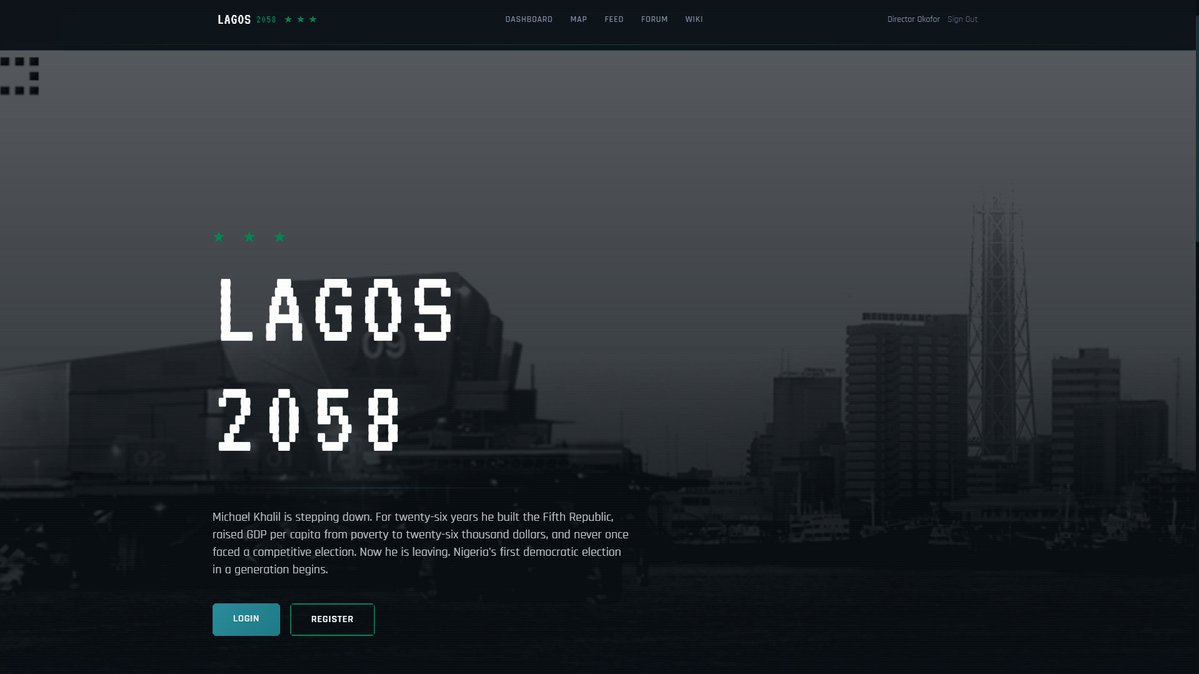
LAGOS 2058 is LIVE! Join below to take part in the governing of the Fifth Republic of Nigeria ⬇️
LAGOS 2058@LAGOS2058
PARTY REGISTRATION FOR LAGOS 2058 IS NOW LIVE ⬇️ John Wakefield's LAGOS is a cutting-edge, net-gen political simulation that uses a spatial voting model for 174,960 voter types set in Nigeria thirty-two years in the future. Join to play and access our website.
English
Theo me-retweet

Interactive timeline and map!


RAY@3xcalibaneur
The game begins. Party registration is up at LAGOS2058.com, the most complex online political simulator ever created. Check out the timeline, the map, and then create your character! Join the Discord (in thread) to scheme with other players over the future of Nigeria.
English
Theo me-retweet
Theo me-retweet
PARTY REGISTRATION FOR LAGOS 2058 IS NOW LIVE ⬇️
John Wakefield's LAGOS is a cutting-edge, net-gen political simulation that uses a spatial voting model for 174,960 voter types set in Nigeria thirty-two years in the future. Join to play and access our website.
English
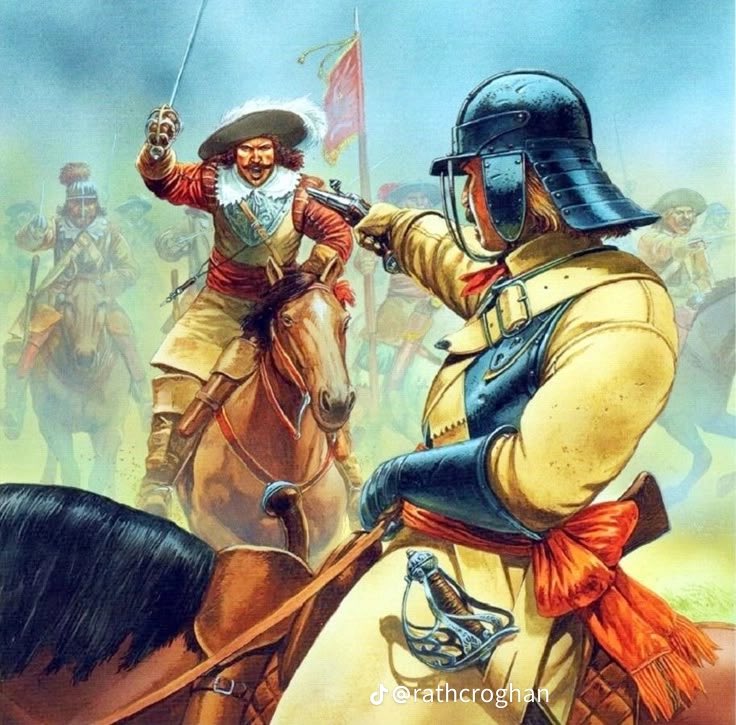
@AndromedaPip @asubparusername Ermmmm actually that guy is almost certainly not a leveller considering he's a cavalryman and the levellers usually couldn't afford to furnish the horse or equipment for that and came overwhelmingly from the infantry 🤓
English

It’s too late, I have already portrayed you as the emotional, brash, archaic Cavalier and myself as the stoic, level-headed, modern Leveller.
English
Theo me-retweet
