
@davegobe.bksy.social
20.4K posts

@davegobe.bksy.social
@davegobe
Chemist, husband, father of two wonderful daughters, gamer, @NASASocial alumnus & purveyor of bad puns.
Berea, OH Bergabung Nisan 2007
451 Mengikuti686 Pengikut

What is a movie that "broke" you so hard you can only watch it once, but you would still recommend it to everyone?
English
Why is he getting scanned? 🤔
TopNews@TopNewsPrime
Spider-Man getting scanned in new clip from 'Spider-Man: Brand New Day'
English

The Ohio Senate is considering legislation that would create a formal partnership between the state and Israel aimed at expanding trade, investment and research collaboration.
fox8.com/news/proposed-…
English
@MalcolmNance Every time you say ‘multi-pass’ it makes me smile 😊
English
@ShishirShelke1 It takes place in 2028 so basically an Obama phone in his third term cause multiverse and what not.
English


The Hutts really found their way into the 2 biggest films of the year… greedy criminals

English
@ScottKacsmar Dune 2 chicks at once > ‘The’ Return of the King
English

Highly unlikely.
Fellowship > Dune 1
Two Towers > Dune 2
And some people think Return of the King is the strongest one, so good luck there.
The Cinéprism@TheCineprism
Can Dune surpass The Lord of the Rings legacy?
English



@DanEastman2023 @shanaka86 Of course, beans are the magical fruit, You’ll be fine.
English

@shanaka86 Or…. One could just plant more beans than corn this year and ride it out…. Farmers have brains, you know!
English

Right now, in barns and equipment sheds across the American Midwest, farmers are making the most consequential decision of this war. Not generals. Not senators. Farmers.
At $683 per ton urea, corn economics have collapsed. Nitrogen is the single largest input cost for corn production. At pre-war prices a farmer could justify 180 pounds per acre and expect a margin. At $683 the math breaks. Soybeans fix their own nitrogen from the atmosphere through root bacteria. They do not need the molecule trapped behind the Strait of Hormuz. The seed decision is being made this week across roughly 90 million acres of American cropland. Once the planter rolls into the field, the choice is irreversible. Corn seed in the ground stays corn. Soy seed stays soy. The acreage allocation locks in.
USDA Prospective Plantings reports March 31. That report will tell the world how American agriculture responded to the Hormuz blockade. But the decisions it captures are being made now, in conversations between farmers and agronomists and seed dealers who are looking at nitrogen prices and making the rational economic choice: plant the crop that does not need the input you cannot afford.
Every acre that shifts from corn to soybeans tightens the corn balance sheet for the rest of the year. Corn feeds livestock. Corn feeds ethanol. The Renewable Fuel Standard mandates 15 billion gallons of corn ethanol annually, consuming roughly 43 percent of the US corn crop regardless of price. That demand is inelastic. If acres shift and production falls while the mandate holds, corn prices spike. Feed costs spike. The protein cascade reverses. The US cattle herd sits at 86.2 million head, a 75-year low. Poultry and pork margins that were benefiting from cheap feed compress when corn crosses $5 per bushel.
This is how a naval blockade 7,000 miles from Iowa reaches the American grocery shelf. Not through oil. Not through shipping. Through nitrogen. The farmer cannot afford the molecule. The molecule cannot transit the strait. The farmer plants soy instead. The corn supply tightens. The ethanol mandate consumes its fixed share. The remaining corn reprices. The feed reprices. The meat reprices. The grocery bill reprices.
The decision is not political. It is arithmetic performed on a kitchen table by a person who needs to plant in three weeks and cannot wait for a ceasefire, an escort convoy, or an insurance normalisation that the Red Sea precedent says takes years.
The deepest penetrator in the American arsenal cannot reach a sealed Iranian doctrinal packet. But the fertiliser price it failed to resolve is reaching every planting decision on 90 million acres of the most productive farmland on Earth.
The war’s most irreversible consequence is not happening in a bunker. It is happening in a barn. And by the time USDA publishes the data on March 31, the seeds will already be in the ground.
Full analysis in the link.
open.substack.com/pub/shanakaans…

English


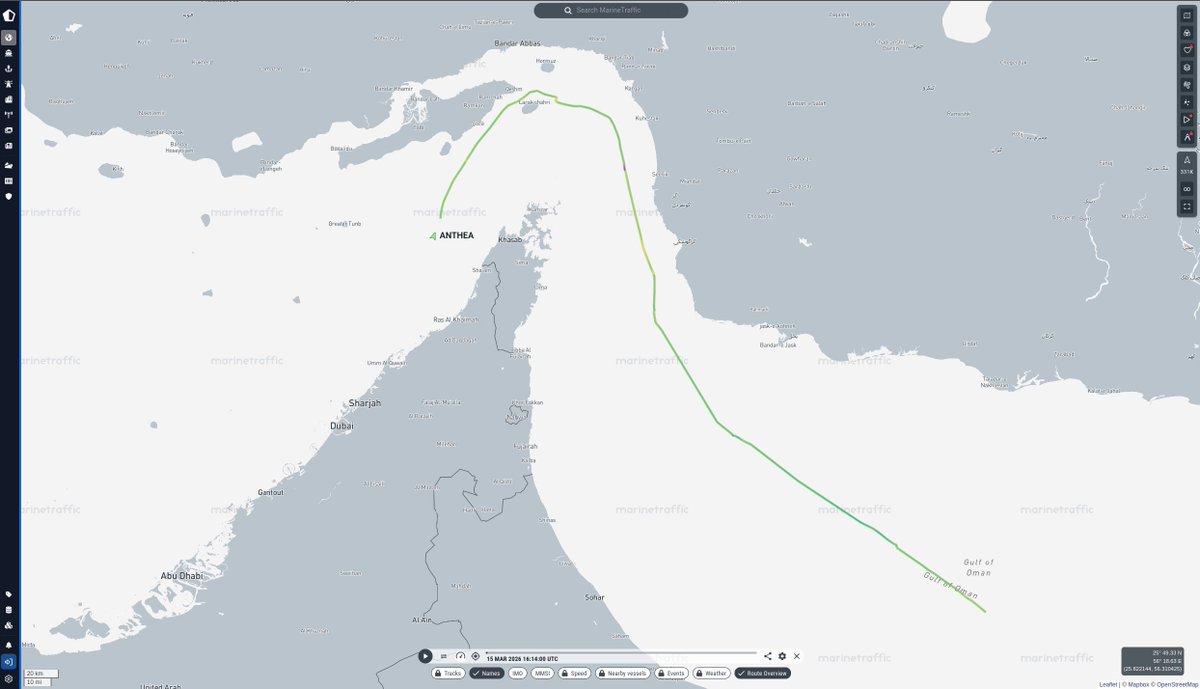
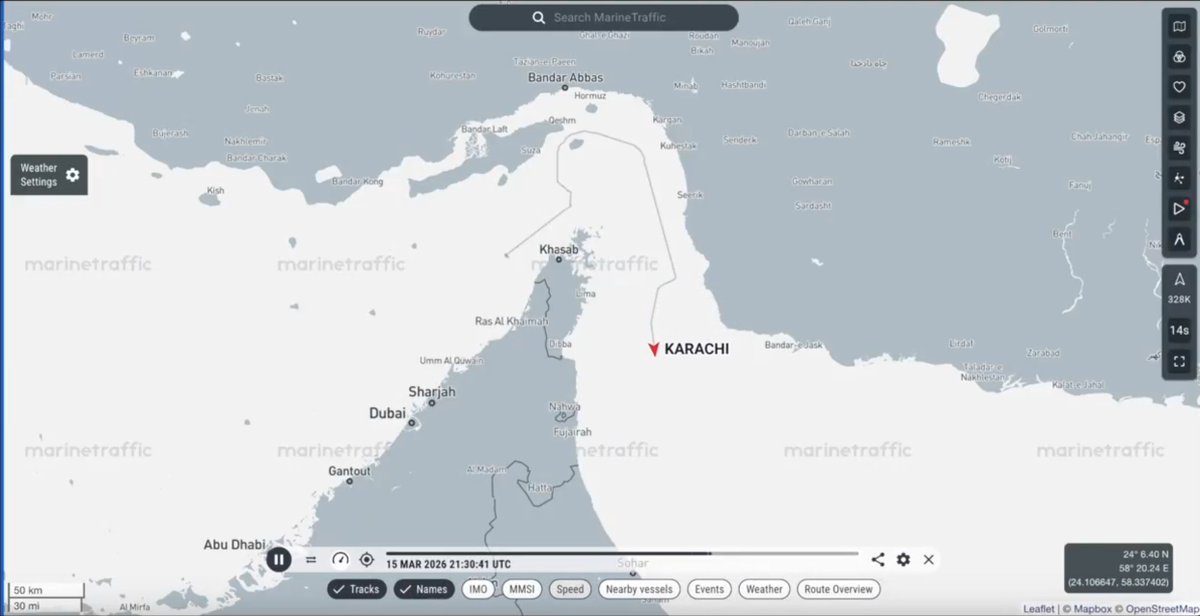
@TheIntelFrog These ships are taking an unprecedented route into iranian waters past the Qeshem, Larak & Hormuz Islands then back down to the TSS so the IRGC can visually confirm their EZ pass is approved. Not joking.
English

Three tankers have transited the Strait of Hormuz in the past several hours, each navigating deep INTO Iranian waters sailing around the north side of Larak island, Iran well outside of the standard channel.
This likely indicates some level of coordination with Iran for safe passage. It may also indicate that some hazard exists within the usual shipping channel.
h/t: @TankerTrackers @_MartinKelly_

Thord Are Iversen@The_Lookout_N
Do note the route, north of Larak Island and then close to the Iranian coast.
English
@ShaykhSulaiman Show your face if you want to sell oil by the dollar
English