

Mark Qvist
793 posts
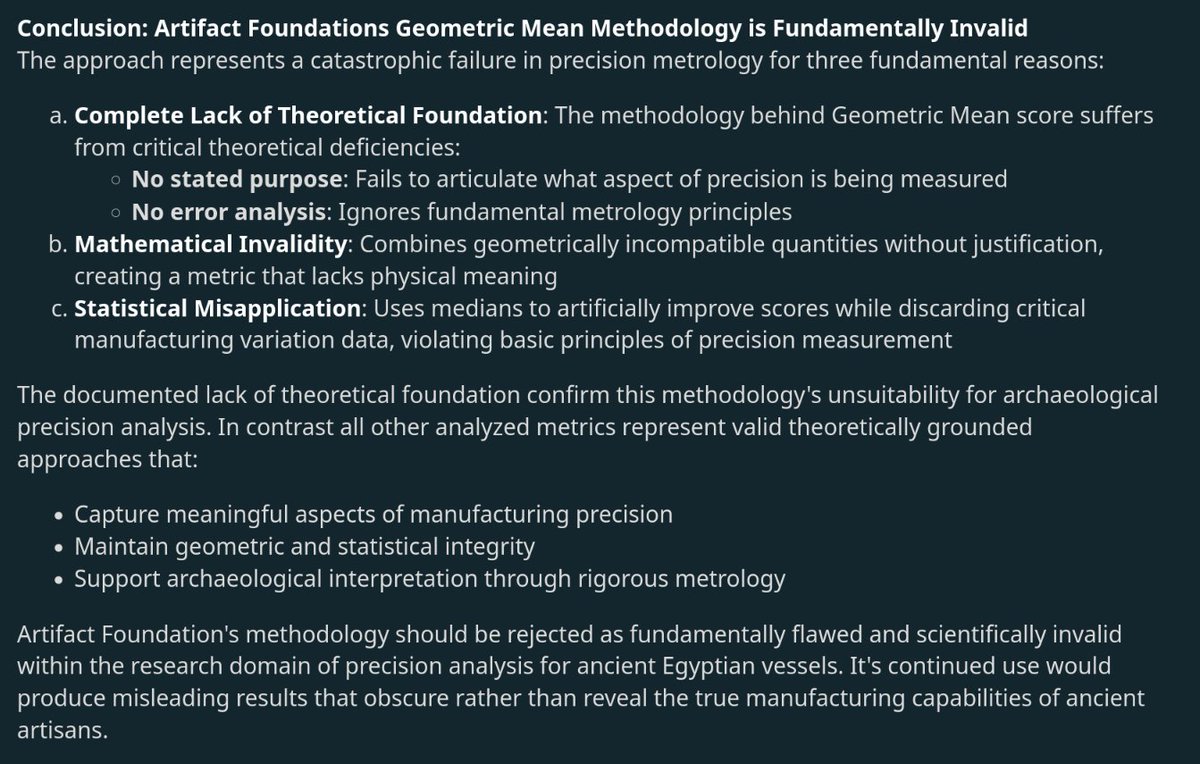
Yep, that's exactly the kind of kindergarten-metrology you want to stay far away from.
Lots of visual splendor, mystical background music and "complex algorithms - trust me bro - we'll explain them later", but their methodology is deeply flawed.
arcsci.org/articles/compa…

English

After 30 months of metrological rigor on PV001, the truth emerges with surgical precision: Mark Qvist's π and φ² ratios hold up under CT-scan scrutiny (0.05-0.17% error), while his Radial Traversal Pattern collapses.
arcsci.org/articles/revis…
But the real story isn't the math - it's the misconduct. Artifact Foundation's systematic data manipulation, plagiarism of draft reports, fabricated museum policies, and legal threats reveal how "ancient precision" claims evaporate when integrity fails.
PV001 remains a unicorn - exceeding industrial CNC precision with RMSD of 22μm - but its flawless surface shows zero wear. The probability of three interlocking ratios occurring by chance? 0.004%. The probability of two such "ancient" vessels belonging to the same collector? Statistically obscene.
My conclusion: This isn't 5,000 years old. More likely off by a factor of ~1,000.
When researchers present incorrect data as ancient marvels while threatening critics, they've crossed from questionable scholarship into scientific theater. Extraordinary precision claims require extraordinary evidence - not extraordinary evasion of peer review.
Data > Dogma. Always.
I came into this project hoping to find solid evidence that could be used to ascertain the existence of a lost civilization, instead I found a noisy dataset (both physically and morally). If the community really wishes to rewrite history by documenting a so far unknown civilization, we need to stay rigorous and true.
@UnchartedX1 @MBeallX @markqvist @ArtifactFNDN @karolypoka @DrDavidMiano @BrightInsight6 @DeDunkingPast @TonyTrupp @SnkBrs @DrHughT @megaminutiae @alexandertolano @ChrisWithRobots @FoMaHun @Apkalluu @goob_the57373 @oligodynamick @ET_Iconoclasta @Bastet545169547 @adancingferret @JosephAPWilson1 @outofspace2 @occamsrazor22 @AncientEpoch @PortantIssues @uapcappa

English
@stinegerdes Fantastic work. As noted in my repost of this, your refutation is valid and I completely agree with it.
x.com/markqvist/stat…
English
@chrispdunn Yes, definitely. The protocol and well-designed metrics develop by Stine and Max look like a very solid contender for that.
English

@markqvist @markqvist As you say, hopefully it is just a learning experience and certainly not the last word. It would be helpful to have a clearly defined protocol governing this work.
English
That's correct. Taking it from to the published precision reports on the objects and the article, the first scans of the Petrie Artifacts, produced by Karoly Poka, were not exceptionally high quality, and did not employ a reference, but were still usable.
The second round of scans, conducted by Max Fomitchev-Zamilov, were a significant improvement, and have been used where overlap exists. Additionally, these were referenced against a Zeiss reference sphere. The full range of datasets, including the reference sphere benchmark, are available here:
arcsci.org/catalogue.html
English
@markqvist Mark. Yes, I understand that. My point, obviously not well articulated, is that the Petrie scan data may not reflect the accuracy of the vase, but the accuracy of the scanner. A case of GIGO.
English

@markqvist The interesting caveat with the study is that it compares hard stone vs soft stone vessels. Achieving such precision is arguably much easier with softer stone. A better study would compare only hard stone vessels (from Petrie museum or private collections vs. hard stone replicas)
English
The study linked makes conclusions about scans made from the Petrie Museum collection, not Adam's ultra-high precision vessel.
The Petrie Museum scans have been discussed as very precise as well, which they are not. The study quite clearly shows they fall within expectations for handwork - although some of them are absolute masterpieces in that category!
And yes, all of your original inspection results absolutely warranted further scans and investigation, and still do. The more are scanned, the clearer the picture will get! Hopefully, this is only the beginning.
English
@markqvist The original OG vase, of which you, Mark, wrote a very good article, was first inspected at a manufacturing company in Indianapolis by qualified and experienced quality engineers. The results were sufficient to warrant 3-D scanning to learn more about the artifact.
English
The "metric" produced by Karoly Poka of the Artifact Foundation was rejected because it's not a metric. To me it looks like it was either intentionally designed to look like something that would be used in metrology for the average person, while allowing hard-to-detect result manipulation. Or, that they simply had no clue what they were doing. Most likely the latter.
To put it in a plain, but very simplified way, with their way of producing "results", you can simply jiggle the measured object around in tiny increments and hit different scores by trial and error.
It's also completely meaningless. It doesn't actually measure or quantify anything.

English

Same. I've asked a question though as it seems they omitted one metric (used by other groups heretofore), the one they call a "mathematical chimera" from the outset. I'm not sure, as it's not clear to me whether that metric was omitted, or whether it was indeed used and found to be an aberration. The language is so technical there's no way I could get my head around that.
English

I have never been that interested in the Stone Vase debate. It’s just not my area of specialty and I am not well versed in the techniques of measuring “precision”.
But this is an interesting study and seems to have some strong conclusions. No idea if it’s good science or not.

Stine Gerdes@stinegerdes
Egyptian stone vessel precision debate resolved: Museum-held Predynastic artifacts statistically indistinguishable from modern handmade replicas. Four validated metrics confirm ancient artisans operated within hand-guided craftsmanship limits. arcsci.org/articles/compa… The Artifact Foundation's "Geometric Mean" metric? A mathematical chimera: dimensionally incoherent, median-suppressed, and alignment-sensitive (0.05° rotation alters scores by 17%). Its "top precision" claims collapse under scrutiny. Real data shows museum/handmade clusters overlapping while private specimens remain anomalous outliers. When metrics require rotational tweaks to manufacture rankings, follow the polynomials, not the hype. Stay tuned - I have an even more interesting article coming up next. Data > dogma.
English
Since I was involved in the whole vase project quite a bit in the beginning, I've been following everything quite closely, and was also working with Adam and Matt on analyzing their other vases initially.
Stine's approach is very meticulous and well-founded in statistics and proper methodology. Just for context, she's a woman - although people get the name confused as a male name. But yeah, once she started discovering results they didn't like, they tried to silence her.
Not only that, Adam (Artifact Foundation) went on a full smear campaign, and started spreading crazy claims about her work to people involved in the project behind the scene, including myself. I questioned him quite hard on that, since it sounded totally unbelievable, having known her quality of work in professional settings. It turned out to be incoherent nonsense, of course. I have the receipts - saved all the bonkers emails from him, and I have a full screenshot log of all the internal communication from the Artifact Foundation group chat from that period. It's a grift, nothing more, nothing less.
I have a lot of other pretty weird tales to tell from the backside of that project, including data manipulation, modification of STL scan files, plagiarism and intentional misrepresentation of results, but I'll try to keep it short here. All of that obviously requires documentation - which I do have in quite ample supply.
So yeah, my current stance is also that most of the privately held vessels are most likely modern replicas or fakes - intentionally so or not. Time will tell.
English

His work also shows that the private collection vases from UnchartedX and Matt/Limitless are almost certainly modern fakes, since they are so statistically different than the authentic Petrie Museum vases. Then once that crew saw his conclusions they tried to silence him so he wouldn’t ruin the grift.
x.com/tonytrupp/stat…

Tony Trupp@TonyTrupp
Additional thoughts: the private collection vase scans from the Artifact Foundation appear to be far more precise than the Petrie Museum authentic vases, than the modern handmade replicas, and even the modern industrial vases. This suggests that those UnchartedX & Ancient Technology channel vases are not authentic. The criticisms about some of those alt-history channels not sufficiently establishing the provenance of the vases appears to be valid. That said, the quality of the authentic vases is still very impressive for their era.
English
Yeah, it is a pretty dense article, can see where the confusion is coming from ;) The "Geometric Mean metric" was proposed by Karoly Poka from the Artifact Foundation.
Since it was presented publicly by the Artifact Foundation as a valid way of quantifying artifact precision, the ArcSci article acknowledges this, and evaluates it on equal footing with other metrics, but it was found to be deeply inadequate.
Therefore, the results presented by Poka was not considered as valid data in the article. The results from it are included several places, and used to illustrate in practice how it fails to produce anything meaningful.
Unfortunately I can't tag Poka here for his own comments, which would be interesting to hear, since he has previously blocked me.
English
@markqvist @stinegerdes So the "mathematical chimera" was used in the above study? I'm sorry but the graphs etc. are very technical and I'm not sure I'm able to tell from looking at them.
English
Egyptian stone vessel precision debate resolved: Museum-held Predynastic artifacts statistically indistinguishable from modern handmade replicas. Four validated metrics confirm ancient artisans operated within hand-guided craftsmanship limits.
arcsci.org/articles/compa…
The Artifact Foundation's "Geometric Mean" metric? A mathematical chimera: dimensionally incoherent, median-suppressed, and alignment-sensitive (0.05° rotation alters scores by 17%). Its "top precision" claims collapse under scrutiny.
Real data shows museum/handmade clusters overlapping while private specimens remain anomalous outliers. When metrics require rotational tweaks to manufacture rankings, follow the polynomials, not the hype.
Stay tuned - I have an even more interesting article coming up next. Data > dogma.

English
That's spot on! When comparing like to like, you have to use measurement methods that are actually valid and can correctly quantify the phenomenon you're trying to investigate.
It's kinda like doing a comparative study of rainfall, where five different methods of collecting rainwater have been used. One of the methods consisted of leaving stale biscuits out on a porch overnight, and then weighing them on Aunt Rosie's 17th century shop scale.
The comparative study then acknowledges the attempt, but explains exactly why using leftover food to measure rainfall is a pretty terrible idea, so the "researchers" in question can (hopefully) improve their methods.
English
@stinegerdes I have no skin in the game, I'm just interested, but I am asking because in my opinion if a study claims to compare like for like while omitting one metric used in the original claim, it raises doubts in my mind.
English
The Geometric Mean "metric" was studied quite extensively in the article, and shown to be completely meaningless. Said in plain language, it's not a metric: It's just a noise generator that doesn't provide any meaningful insight or results - only distortions. When methodology is as fundamentally flawed as that, you can't use the results, hence the rejection.
On a personal note, I have no clue what they were smoking when they came up with that. Either Karoly Poka pulled it straight out of ChatGPT without even the most basic understanding of math or statistics, or it was intentionally designed to allow manipulating the results. Probably the first option, though. Never attribute to malice what can be explained by incompetence.
English
"Four validated metrics" vs "Geometric Mean" metric? Did you omit one metric for this study because of a judgment that it is "A mathematical chimera: dimensionally incoherent, median-suppressed, and alignment-sensitive"? So the study's conclusions rely on 4 "approved by" metrics, but exclude one metric used by the Artefact's Foundation, am I understanding correctly?
English
@jbschirtzinger It's always the question of when to "shout wolf". Now is probably not a bad time.
English

@markqvist Please read your messages and your Bitcoin wallet
English
@web3privacy @Optimism @dripsnetwork Awesome project and a great way to make and collect donations! Thanks so much for the support!
English

🔥 We hit our first milestone — over $10,000 raised to support 80+ privacy builders and @markqvist can now claim their portion on @Optimism!
But we’re just getting started.👇
Support here → drips.network/privacyproof24
Learn more here → mirror.xyz/0x0f1F3DAf416B…

English
🔥 We hit our first milestone!
—over $10,000 raised to support 80+ privacy builders and YOU can now claim your portion on @Optimism!
But we’re just getting started. Who will join us next?
Support here → drips.network/privacyproof24
Learn more here → mirror.xyz/0x0f1F3DAf416B…

English
Everything that possibly can exist, does. Consciousness is the ability to traverse between potentialities.
English
"Something Happened in 1999 — And It Broke Reality"
@markqvist
@spirituallock
@ShannonCam82757
youtu.be/NNTCn45hyok?si…

YouTube

English
@BeechatNetwork Awesome work guys! Looking forward to giving these radios a spin!
English

5 years of R&D. Live, low-latency TDD audio over a cryptographic #mesh network. Built on a #Rust port of #Reticulum, #Kaonic optimizes sensitivity, range & data rate for real-world performance.
No towers. No satellites. Just pure, decentralised, off-grid connectivity. @markqvist
English
All 19 precision analysis are now published for the Petrie Museum vessels! The data seems to further point towards the Tale Of Two Industries, proposed by @UnchartedX1 . Do keep in mind that these artifacts were Petrie's "teaching materials".
Sadly though, Artifact Foundation is now trying to block my publications of the research reports. I am going to present it all to you today, however, just a few hours ago, I received a legal demand letter from Karoly Poka - Threatening legal action within the "Trade Secrets Directive (EU) 2016/943", should I as much as talk about these scans.
Scans of ancient artifacts, from our shared collective history are now, by some, regarded as - Trade Secrets!
There is power to be had, if you can control the narrative and keep the vase scans from the public. Apparently these objects still induce greed and ownership fantasies in humankind, as they have probably done for millennia.
The vessel scans were shared with me freely, and I was asked, without compensation of any kind, to run them through my new analytic software and create a precision report for each artifact. Apparently Artifact Foundation now sees these reports (with my copyright information on them) as their private internal documents, not to be seen by others: They are now "trade secrets".
I have been analyzing the Petrie Museum scans for the Artifact Foundation, for the last 5 months, 100% free of charge, freely sharing all findings and reports with them, answering all their questions about the analytical methods etc.
I agreed to carry out the work for free on the basis that I would publish the reports in my name. However, as soon as I mentioned it was time for my name to appear together with the reports - I was thrown under the bus with the final words: "My suggestion is if you want to demonstrate your work, use the stl file from the OG vessel. That was released publicly."
As has always been the plan, and as was the agreement with Artifact Foundation from the start, the reports will be released freely for all to see and use. They are now available under a Creative Commons license on my website. I hope everyone will use this new data to deepen our understanding!
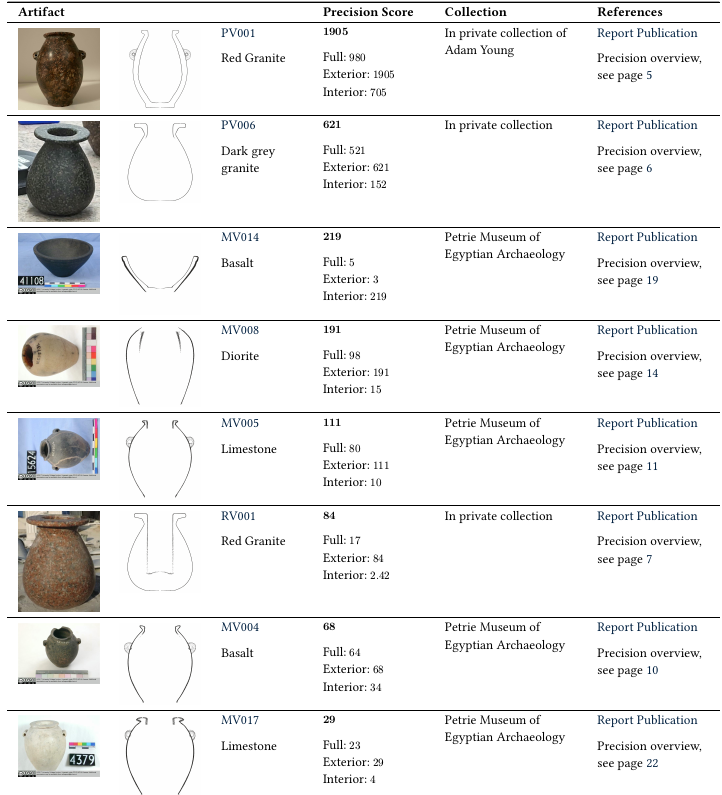
I have also uploaded an overview with the precision score and an overview of the circularity measurements on my website - this gives a good overall view of the findings in the Petrie Museum vessels.
arcsci.org/catalogue.html
English

@markqvist Not dry at all. Thanks for writing this analysis.
English
@ET_Iconoclasta @stinegerdes They also cheated quite a bit with that vase, by "stealing" precision from a modern rotary table, marking irregularities with a felt tip marker. I think it's really sad they spent so much time on it, and then ruined the experiment by doing that.
English
@markqvist @stinegerdes 2/2 by manipulating the data a bit. Specially thinking on the Russian skeptic team that might try to do that with their scan data of their rough vase.
English
How do you determine the precision of an ancient artifact, with no objective blueprint to compare it against?
I have just updated the precision report for PV001 with a metric that robustly quantifies the overall precision of the artifact, and allows objective comparison with other scanned vessels.
If you want to learn how this metric is calculated, and why it matters for our ability accurately determine the precision of ancient artifacts, you can read the new version of the linked report.
This image shows an example of such a comparison, and includes the two most precise and the two least precise vessels currently in the catalogue (not all of these have published reports available yet).
arcsci.org/catalogue/PV001

English