

Marcell Fóti 🪨
16K posts
Marcell Fóti 🪨
@FoMaHun
Ancient Mysteries’ Researcher🗿Inventor of The Natron Theory🧂Solved the artificial granite problem 🪨 with caveman materials only. Author: The Natron Theory 📔
Budapest, Hungary Katılım Mart 2009
316 Takip Edilen29.1K Takipçiler


This means I can get 23 views instead of 20?
Nikita Bier@nikitabier
We're rolling out a small tweak to boost visibility of your posts to your mutuals (people who you follow back). We noticed this data was missing from the algo and it made your friends appear less in your replies. This resulted in the reply section feeling more like a battleground with people you don't recognize. This should also help clusters form around interests more easily, which many people have asked for.
English


North American and European nations that are packed with russian spies – with the weakest, most susceptible governments to fascist russia’s malign influence – are outside the Coalition of the Willing: the United States, Austria, Malta, Switzerland, Hungary, Slovakia and Bulgaria.
English
Marcell Fóti 🪨 retweetledi

Megalithic concrete🗿Smoking gun😎
The global lost ancient high technology is chemistry! Not machinery.
#geopolymer #natrontheory #cusco #peru
English
Probably. But I’m one of the biggest Elon fans in secret and an all-in $TSLA investor. Still, russian propaganda is what it is, and believing it and spreading it is DUMB.
To be more precise: EXTREMELY DUMB.
No matter what.
I’m a Russian propaganda “expert” btw, living under disgusting Russian propaganda virtually all my life. Until very recently, when we ousted Viktor Orban, a disgusting Russian oligarch disguised as a Hungarian PM.
Just saying.
English


The world’s richest man is also a massive racist who loves to push disinformation online
Elon Musk@elonmusk
Literally true
English

We used to build train stations like they were cathedrals


English
Marcell Fóti 🪨 retweetledi
Here is an update on my Qorikancha megalithic concrete recipe!
Genuine pillowed masonry, with authentic syneresis “nubs” that glow under UV🎯
This mix pours like honey, and becomes workable clay in 25 minutes🗿
Exploring casting ideas as well😎
#geopolymer #natrontheory
English
@bixlereid Like this? It’s crushed granite in red metakaolin geopolymer.
Need polishing though if a mold was used.
But you can clearly push harder stones into the goo if there’s a surface area to do that. Like pebbles into concrete as decoration.


English

@FoMaHun Marcell, are you ready for a test?
Can you form an item with chunks of semi precious amethyst bits or jade bits points outwards?
Embed the harder stone inside formed stone for making a cutter/grinder?
Is it possible?
Quartz bits are fine as a test....

English
How to carve a hieroglyph into very hard stone in one easy step.
CAST!
English


The buildings look melted?
Solar micronova.
Waken Minds 𓂀@wakenminds
The more I see, the more I believe we’re living in a post-apocalyptic world.
English
Wow!
I have no info waterglass -> amorphous silica turning into quartz. I mean it can, with the usual restrictions: ultra high pressure and blah-blah.
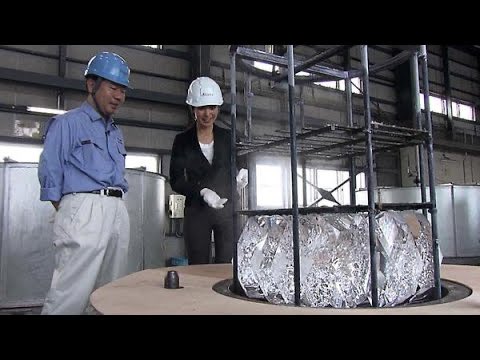
Meanwhile we can grow arbitrary sized quartz crystals in liquid in the 21st century for the chip industry. Like these gigantic ones.
So… what if it was grown instead of carved using a knowledge already lost?
English

@ancientcontent/note/c-291538254?r=2wxv0" target="_blank" rel="nofollow noopener">substack.com/@ancientconten… @FoMaHun I just wondered if waterglass could do anything like this without the crushed stone?
English

@FoMaHun wow, glad I found your account. came across geopolymer stuff on tiktok which I thought was super cool. one gal shared a ton of various "recipes" based on their country

English
Cooking waterglass The Ancient Way, round 3, gigantic bubbles.
What you can see here, is the way how ancient people were able to create waterglass using basically nothing.
Nothing but readily available, common, household materials.
What materials?
The first ingredient is sand. The second is water. You boil these together, and you will end up with nothing but mud. Pointless.
BUT!
If you add a third and a fourth ingredient, the tide will turn into your favor! What should we add?
Let’s add some wood ash lye, and some natron mixed with slaked lime! Or to put it in other words: KOH and NaOH.
Or if you are lucky, and your burnt vegetables are salt tolerant, like quinoa in Peru or mangrove in Sulawesi or seaweed in Western Europe, you can just add one simple thing, wood ash lye.
And TADAAAM!
Yes, it is waterglass bubbling in that pot! I tested it by creating stone with it! It works!
For naysayers: yes you are right, ancient people did not have stainless steel pots! What they used instead, is the top of rocks. This is how scoop marks were created. You’re welcome.
English


Hungary doesn't have any arms or troops.
The only reason Hungary is not currently occupied by the Russian army is Ukraine's heroism.
MAKS 26 🇺🇦👀@Maks_NAFO_FELLA
🇭🇺🇺🇦 Hungary's PM Péter Magyar: We maintain our humanitarian assistance to Ukraine. But, as I have said many times before, Hungary will not provide arms or troops to Ukraine.
English
Marcell Fóti 🪨 retweetledi
Some recent artificial stones I made in my kitchen😎 #geopolymer
The brown colored block got this color when I started adding Peruvian plant extracts🤔
Grateful to Chef @FoMaHun for sharing his caveman cooking recipe🗿#NatronTheory
English
@SeBAISSEstian @TheProjectUnity Everything in one place: bedrock, plastered bedrock, casting and individual stones. Nice chaos! 🤣
English

@TheProjectUnity @FoMaHun what do you think happened here?
English

Ancient Peru took 'WTF Architecture' to a different level.

English
@JablonskyVik Ah I see. Good question is why and how? It’s the same sodium waterglass chemically as mine. In theory.
English


@blurbot2 @JablonskyVik Good question! And a short answer is that I am an alien 👽
Next question?
🤣
English

@FoMaHun @JablonskyVik How do you move your "obelisk" around ? Do you use a levitation stick ? or maybe sound waves ? or some sort of alien technology ? Because we all know its impossible for humans to move a stone block without magic.
English

@alliao @FoMaHun @JablonskyVik Really confuse whoever finds it in 2,000 years. We will be known as the civilization who worshipped Spongebob🤣🤣
English