Jukan@jukan05
[EXCLUSIVE] Samsung Electronics Extends 'Emergency Management' to Mobile Division — DX Business as a Whole Now on Crisis Footing
Samsung Electronics has officially declared an emergency management regime for its mobile phone division, following similar moves in its TV and home appliance businesses. This effectively puts the entire Device Experience (DX) division — excluding the semiconductor (DS) segment — on crisis footing.
Despite the Galaxy S26 series setting pre-order records and signaling a blockbuster launch, sources within the Mobile Experience (MX) division say that soaring semiconductor procurement costs driven by "chipflation" — the explosive surge in memory chip prices — have raised internal concerns about the possibility of the division posting its first-ever operating loss in the company's history.
According to multiple Samsung Electronics insiders on the 15th, the company declared an emergency management regime for the MX division at the end of February — following similar declarations last year for the VD division (TVs) and DA division (home appliances). The MX division had been the last pillar of DX profitability. The primary driver cited is a severe deterioration in margins due to the explosion in memory semiconductor prices.
Memory semiconductor prices have surged more than 850% over the past year, marking a historically unprecedented rally in the industry.
The fact that Samsung quietly activated emergency management at the very moment it was holding the global Unpacked event for the Galaxy S26 — its flagship product of the year — signals that the "chipflation" shock has far exceeded what the market had anticipated. Compounding the pressure, the outbreak of war in the Middle East has triggered a spike in oil prices, adding further logistics cost burdens. A Samsung Electronics spokesperson stated: "With raw material costs under extreme pressure from rising semiconductor prices, and logistics costs increasing on top of that, we ultimately had no choice but to put the MX division under emergency management as well."
According to Samsung Electronics' 2025 annual business report, the company's raw material procurement costs (excluding Samsung Display) reached KRW 99.9475 trillion last year, up 8.8% (KRW 8.0177 trillion) from KRW 91.8398 trillion the prior year. The bulk of this increase was driven by rising cost burdens within the DX division.
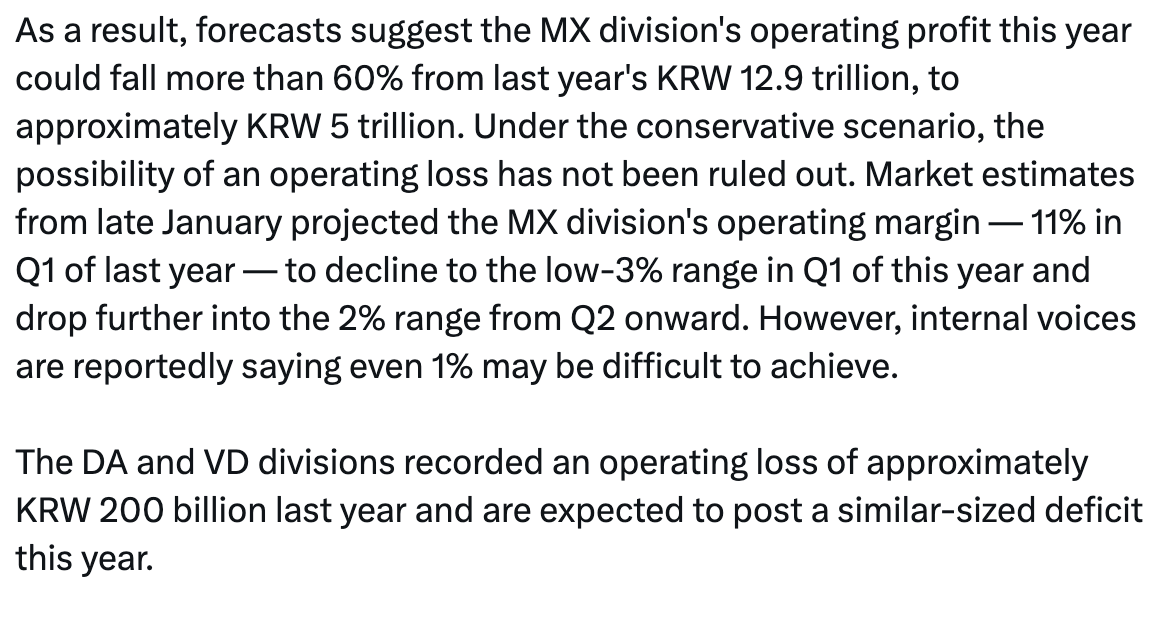
As a result, forecasts suggest the MX division's operating profit this year could fall more than 60% from last year's KRW 12.9 trillion, to approximately KRW 5 trillion. Under the conservative scenario, the possibility of an operating loss has not been ruled out. Market estimates from late January projected the MX division's operating margin — 11% in Q1 of last year — to decline to the low-3% range in Q1 of this year and drop further into the 2% range from Q2 onward. However, internal voices are reportedly saying even 1% may be difficult to achieve.
The DA and VD divisions recorded an operating loss of approximately KRW 200 billion last year and are expected to post a similar-sized deficit this year.
As part of its emergency management response, the DX division has instructed all business units to cut costs by 30%. Business travel policies have also been revised. Executives at the vice president level and below within the DX division will now be assigned economy class on flights of less than 10 hours — previously, business class had been provided — effective immediately, citing cost reduction. Following the TV division's lead, the home appliance and MX divisions are widely expected to face workforce restructuring measures, including internal redeployment under the label of "job redesign" and voluntary separation programs, depending on how the earnings deterioration unfolds.