Dominic Endicott
293 posts


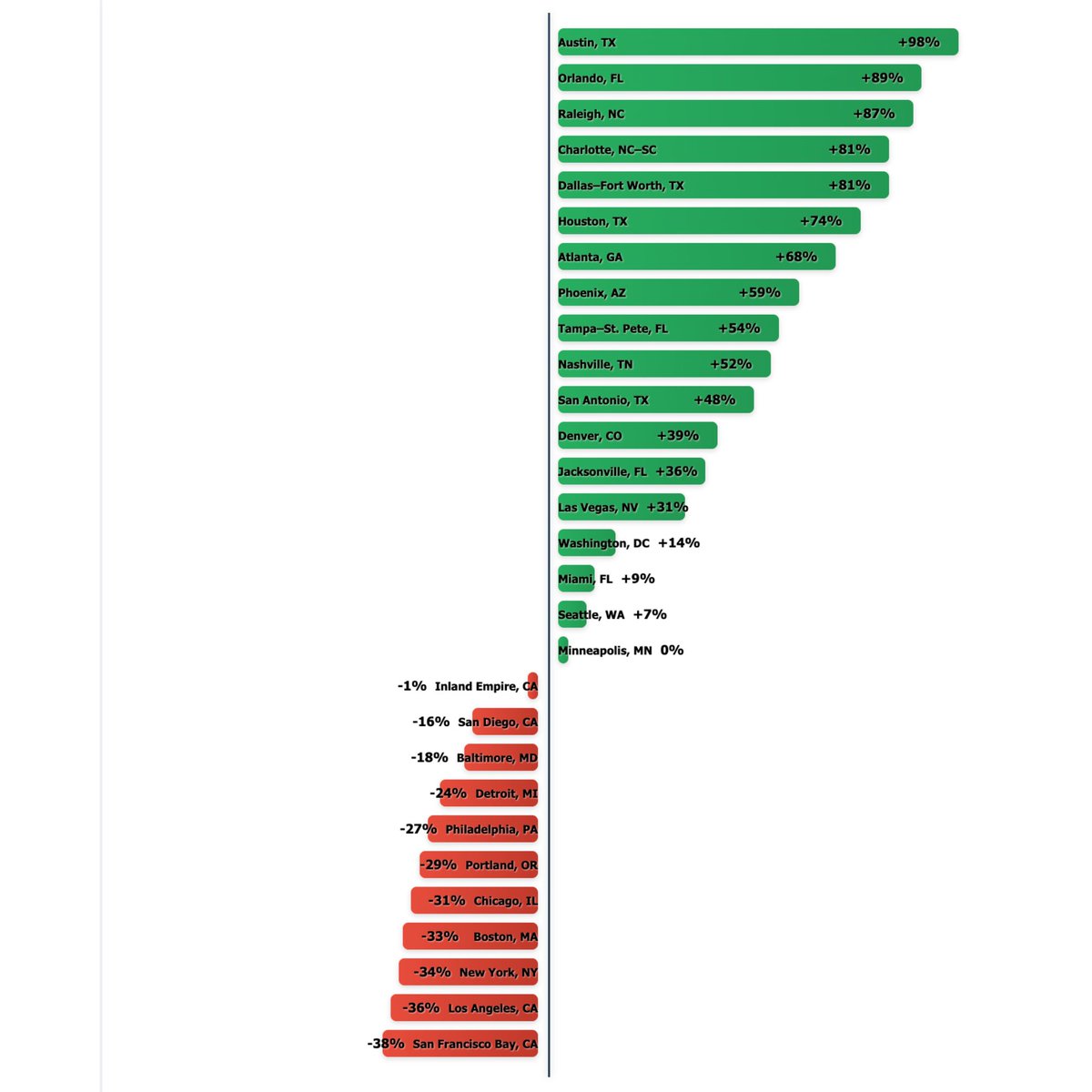
I’m starting to worry about Massachusetts 1. Biotech is way off from a few years ago 2. Only 1 of the top 50 ai companies are in MA 3. The Fed research funding cuts hitting MIT, Harvard, Whoi are brutal. 4. The millionaires tax is working in the short run, but I know a lot of wealthy folks preparing for a FL move. 5. A glut of empty condos 6. It’s not “cool” for young folks 7. It’s expensive as sh-t. I honestly don’t think the MA/Boston govt can do that much about it as they are kind of macro issues. I give them big credit for working on building more housing and fixing the T, which will help. I’m trying to help w HubSpot, partnering w WHOI, teaching at MIT. I’d like to help more. Specifically I’d like to encourage and help more ai and climate companies in the state. I think ai and climate should be our dual growth engines.


They left off Austin 🤔 2005 the metro was 1.2M & by end of 2024 it’s 2.5M. The +1.3M jump puts us 6th in absolute growth, & the 104% increase would rank 1st in percentage growth by 10+ points. Stop sleeping on the frontier city.


When Shohei Ohtani was a high school freshman, he created a detailed "dream sheet" with one central goal: to be the #1 draft pick for 8 NPB (Nippon Professional Baseball) teams. It was a 64-cell roadmap based on a framework called the Harada Method. Here's exactly what Shohei did 👇 1. First, some history.... The Harada Method was created by Takashi Harada, a Japanese junior high track coach. He took a team ranked last out of 380 schools and, using his system, turned them into the #1 team in the region within 3 years. They held that top spot for the next 6 years. 2. You start by placing your main goal in the center of an 8x8 grid. For Ohtani, this was "be the #1 draft pick." 3. Next, you identify 8 critical supporting pillars needed to achieve that goal. These surround the main goal. Ohtani's 8 pillars were: • Body • Control • Sharpness • Speed • Pitch Variance • Personality • Karma/Luck • Mental Toughness 4. You then break down each of those 8 pillars into 8 smaller, actionable tasks or daily routines. This fills out the entire 64-cell grid, turning a massive dream into a concrete, daily action plan. To improve his karma, he listed tangible actions like: • Showing Respect to Umpires • Picking up trash • Being positive • Being someone people want to support 5. The method goes far deeper than just technical skills. It forces you to analyze your weaknesses and build confidence. It also has a highlight on service to others, emphasizing that humility and contributing to your community are essential for personal success. 6. The key to the system is daily execution and accountability. Once the 64-cell chart is complete, you turn the tasks and habits into a daily diary and a "Routine Check Sheet." It’s designed to transform abstract intentions into a measurable, daily practice.






in 20 years, as a hobby, Rockefeller moved a medieval cloister from France to Manhattan and restored 400 buildings 1:1 at our nations first capitol in Williamsburg, VA. it is impossible to imagine our current elites turning this much ambition towards history today.


1/I'm very excited about the JMP of my PhD student Chris Kontz (Stanford GSB) who's on the academic job market this year. Chris’ job market paper analyzes the impact of the rise in passive investing on the real economy. More passive investing in a stock results in increased co-movement with other stocks, leading CFOs of these companies to set higher discount rates, as they were taught to do in business school, even when the fundamental riskiness of their business is unchanged. As a result, these companies cut back on investment. Chris provides compelling evidence that these investment distortions may help to account for part of the @ThomasPHI2 & Gutierrez missing investment puzzle in the US. christiankontz.com