
John Smith がリツイート

Declassified documents show the U.S. military released 282,800 lone star ticks made radioactive with Carbon-14 across Virginia between 1966 and 1969, tracking their spread with Geiger counters. Before these experiments, lone star ticks did not exist above the Mason-Dixon Line.
A CIA operative described dropping infected ticks on Cuban sugarcane workers from C-123 transport aircraft during Operation Mongoose in 1962. When he returned home, his four month old son developed a life-threatening fever. His CIA commander told him to "burn all the clothes you took to Cuba. Burn everything."
Defense Secretary Robert McNamara authorized Project 112 that same year, creating a bioweapons program "almost as large and secretive as the Manhattan Project" with facilities capable of breeding 100 million infected mosquitoes per month. The military denied the program's existence for 50 years until CBS News forced acknowledgment in 2000.
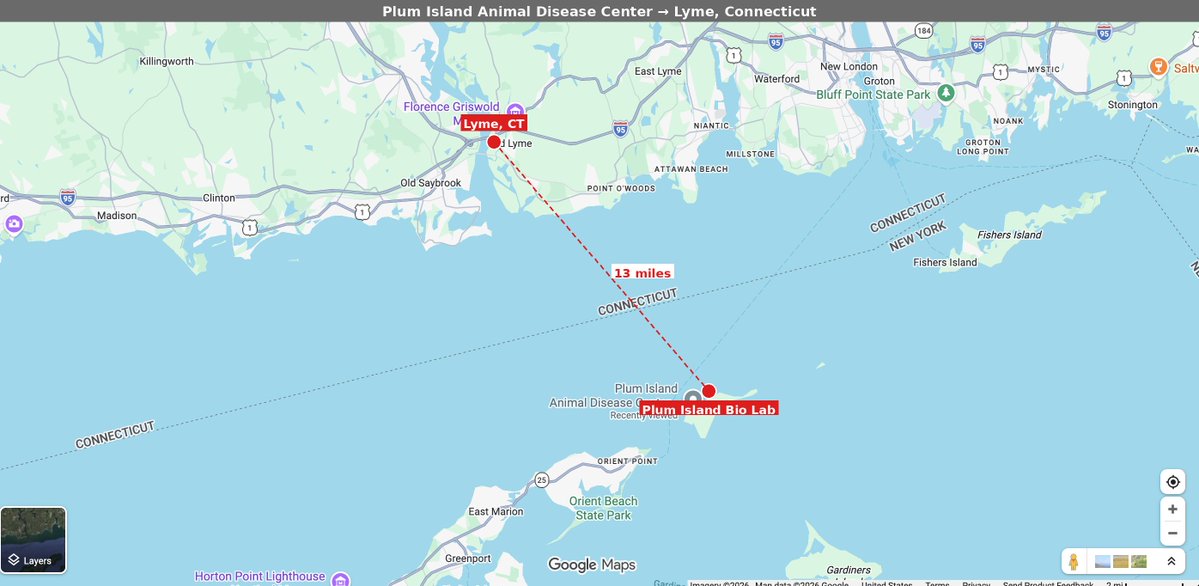
Plum Island Animal Disease Center sits 13 miles from Lyme, Connecticut. From 1952 to 1969, the Army Chemical Corps ran biological warfare research there, frequently conducting experiments outdoors with acknowledged containment failures. Deer from Lyme regularly swam to Plum Island and back.
Willy Burgdorfer, the scientist who discovered the Lyme disease bacterium in 1982, spent most of his career developing tick-borne biological weapons. In 2013 video testimony, he confirmed participation in bioweapons research and hinted at an accidental release. He also discovered a second pathogen in Lyme patient blood samples that was completely omitted from his landmark study for over 40 years.
Now the lone star tick is spreading alpha-gal syndrome across the country, making people allergic to meat. In 2019, the House passed an amendment requiring the Pentagon to investigate whether the military experimented with weaponized ticks between 1950 and 1975. The results have not been made public.
English