Piers Linney MBE

10.8K posts

Piers Linney MBE banner
Piers Linney MBE

Piers Linney MBE

@pierslinney

Former Dragon (Shark Tank) investor. Co-founder, Implement AI & Atherton Bikes. Sen - Space TV. Keynote speaker. 10k sub BAU Newsletter. 🇬🇧🇧🇧🇺🇦

UK 参加日 Aralık 2009
933 フォロー中37K フォロワー
Piers Linney MBE
Piers Linney MBE@pierslinney·
Every so often you build or invest in something that permanently changes how you live or work. Most products don’t. This one has. AIOS Command has changed how I operate day to day. Not because it’s another AI tool. Because it gives me continuous operational awareness. I now talk to my business instead of digging through systems. Emails. Calls. CRM. Finance. Meetings. Tasks. AI agents. Command sees across all of them at once and tells me: • what matters • what’s stalled • what needs action • what I’m missing Then it helps do the work. It has made me at least 2x more productive. The strange reality is that I can’t imagine working without it now. Most software stores information. This changes awareness. My own Jarvis. Command is coming soon. Learn more: yourimplementai.com/aios-command/
English
1
0
3
194
Piers Linney MBE
Piers Linney MBE@pierslinney·
𝐁𝐞𝐟𝐨𝐫𝐞 𝐀𝐆𝐈 𝐚𝐫𝐫𝐢𝐯𝐞𝐬 𝐢𝐧 𝐚 𝐦𝐚𝐜𝐡𝐢𝐧𝐞, 𝐢𝐭 𝐦𝐚𝐲 𝐟𝐢𝐫𝐬𝐭 𝐚𝐫𝐫𝐢𝐯𝐞 𝐢𝐧 𝐭𝐡𝐞 𝐰𝐚𝐲 𝐲𝐨𝐮𝐫 𝐛𝐮𝐬𝐢𝐧𝐞𝐬𝐬 𝐢𝐬 𝐨𝐫𝐠𝐚𝐧𝐢𝐬𝐞𝐝. Most businesses are not short of data, or human intelligence. What they are short of is connected intelligence. The information is already there: emails, meetings, calls, CRM records, SOPs, finance systems, support tickets, documents, dashboards and people’s heads. But it is fragmented. So people spend large parts of their day pulling reports, checking systems, preparing summaries, explaining what happened to colleagues and chasing what happens next. That looks like work. But often, it’s just information retrieval, repairing and sharing. Worse, when people leave, much of the real know-how leaves with them: the context, the exceptions, the relationships and the “this is how things actually work here” knowledge. That is the old operating model. Humans acting as the glue between disconnected systems. AIOS is built for a different one. AIOS Command: the leadership, insight and action layer. It reads across connected systems, retains memory, answers questions in plain English, drafts in the user’s voice and helps leaders take action. It does work. AIOS Workforce: the digital worker platform. It lets organisations deploy and manage digital workers across all functions to do work using all communications channels, including voice. Together, they form AIOS: one system for coordinating leaders, human resource and digital workers. That is the transformation. Not AI as another tool, but AI as an operating layer for the organisation. AIOS abstracts work from underlying software complexity, so leaders and teams do not have to navigate it. The systems stay. But the business gains an intelligence and action layer above them. Users do not need to know how every platform works as the intelligence layer understands your objectives and can access the APIs. They can focus on asking better questions, making better decisions and triggering the right action. This is not about replacing people. It is about changing the division of labour. Humans should focus on judgement, creativity, trust, relationships, exceptions, edge cases, and decisions under uncertainty. Digital workers should handle scale, repetition, monitoring, analysis, follow-through and execution. For a SME leader, AIOS creates leverage. For a corporate leadership team, it creates shared visibility. For a growing company, it adds capacity without scaling headcount in the old linear way. Productivity and efficiency gains are first-order effects. The strategic effect is competitive advantage. The companies that win with AI will not be the ones with the most tools. They will be the ones that organise intelligence best. That is what AIOS makes possible. It is not about buying AI. It's about organising intelligence. Learn more: lnkd.in/eGbdN7Qu @goimplementai @Aalokyshukla
Piers Linney MBE tweet media
English
0
1
0
379
Piers Linney MBE
Piers Linney MBE@pierslinney·
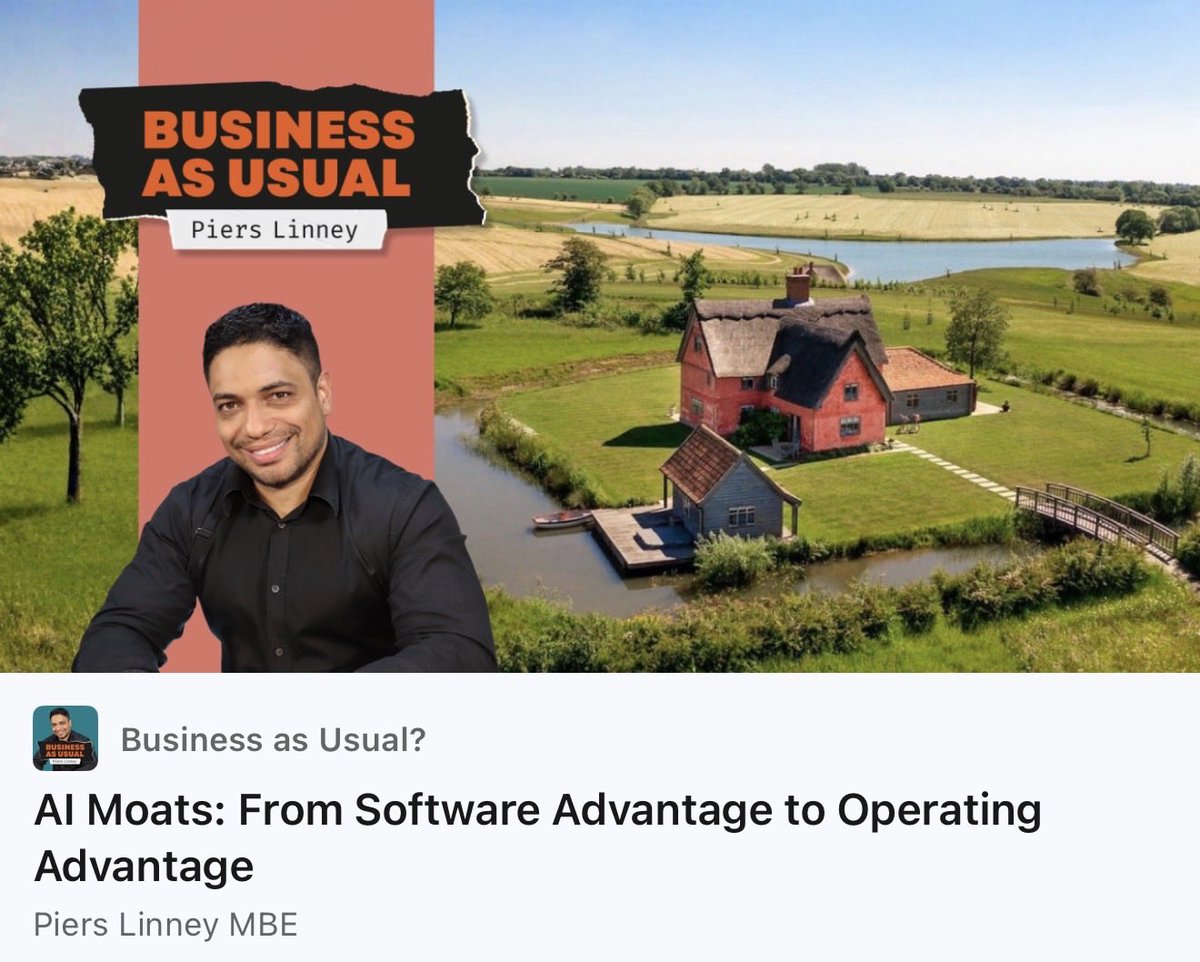
Most software moats are disappearing. The wrong question: “Which AI tool should we use?” That’s procurement, not strategy. The real question: what stays defensible when intelligence is cheap? It’s no longer features or models. Read my latest newsletter edition: what moats actually look like in the AI era. Read it here: linkedin.com/pulse/ai-moats… @goimplementai @Aalokyshukla
Piers Linney MBE tweet media
English
0
1
0
140
Piers Linney MBE
Piers Linney MBE@pierslinney·
AI is not just changing work. It is changing what work is. The real shift is not that new tools are appearing. It is that more and more work is moving from labour to capital. That has consequences far beyond productivity: ▪️ Who owns the capital, who captures the income, what happens to mass employment? ▪️ What remains distinctively human when machines can do more of the output? Read my latest newsletter on the deeper economics and human implications of that shift. If human labour is no longer the default engine of production, what does that do to business models, tax systems, identity and opportunity? Let me know where you think this goes next. @goimplementai @Aalokyshukla LinkedIn: linkedin.com/pulse/ai-shift… Web: pierslinney.com/post/the-ai-sh…
Piers Linney MBE tweet media
English
0
2
3
374
Piers Linney MBE
Piers Linney MBE@pierslinney·
When countries talk about AI leadership, the conversation often focuses on infrastructure, unicorn startups, and massive investments. But what if the real competitive advantage isn’t building the biggest models but ensuring millions of businesses know how to implement AI? Supporting SMEs with practical AI training and adoption could unlock enormous economic impact - potentially far beyond the value of a few large tech successes. This might cost £500 per business and several billion, but result in a far more material impact on productivity and GDP. Because economic transformation rarely comes from technology alone. It comes from widespread adoption. 🎧 Listen to the full episode on The @goimplementai Podcast with @KulveerRanger and my co-host Aalok Yashwant Shukla: Apple: rebrand.ly/396d8f Spotify: rebrand.ly/8c19a5 YouTube: rebrand.ly/ylnw6w0 #ImplementAIPodcast #AIAdoption #SMEs #FutureOfWork #EconomicGrowth #DigitalTransformation
Piers Linney MBE tweet media
English
0
0
3
115
Piers Linney MBE がリツイート
Goku
Goku@ProjectGokuu·
David Sinclair's lab is using AI to build a pill that reverses aging for $100. Right now, their gene therapy costs roughly $10 million to manufacture. It requires a direct injection into the target organ. That's not going to work for 8 billion people. So Sinclair's team made a breakthrough. They found that the three age-reversal genes aren't the only path to resetting cells. They discovered CHEMICALS that do the same thing. In mice, they can now give an animal a liquid — not genes, not injections, a drink — and rejuvenate tissues in 4 weeks. Sinclair says it's now normal for his students to casually report: "We just rejuvenated the ear. We just rejuvenated the skin. We just cured ALS (motorneuron disease) in these animals." He calls his lab "Willy Wonka's chocolate factory" because the discoveries blow him away every week. But he wants one molecule that does everything. So they used AI to screen 8 BILLION candidates. They're now down to three molecules that work. And they're using AI to try to combine all three into one. The gene therapy could cost over $100,000 per treatment. Sinclair's goal: "What if it could be $100 instead? That's what I'm working for. I want to democratize this technology so anyone even in Kenya can take these medicines." They should know within a year or two if the molecules work in mice. The gene therapy is the proof of concept. The pill is the endgame. — @davidasinclair
Goku@ProjectGokuu

David Sinclair said: "You can reverse aging by 75% in 6 weeks… by reinstalling the "software" of the body so that it's young again." This idea sprouted when he proved in his first experiment that you can accelerate aging in mice: "We took two mice born on the same day—same age, same genetics. We 'scratched the CD' of one mouse, corrupting its software and accelerating its aging. The result was dramatic. One looked far older than its brother." He believed if you can give aging, you can also take it away. Tomorrow, I'll share his experiment on how he reversed aging in mice (and then Monkeys). — @davidasinclair

English
164
591
4.1K
672.1K
Piers Linney MBE
Piers Linney MBE@pierslinney·
The Prince of Wales surprised me with a question about AI. It didn’t relate to my citation. It was about our shared future. After 25 years of work and commitment, I was honoured to be invested as an MBE at Windsor Castle, with my mother, partner and brother there to share the moment. The recognition was for services to small business, entrepreneurship, investment, banking, diversity, and social mobility. But the Prince of Wales chose to ask about the opportunities and risks of AI. That matters. AI has moved beyond a technical conversation. It is now firmly on the agenda of national leadership. I shared my views: AI’s evolution is inevitable. What matters is alignment, capability, and adoption. Every individual needs a working proficiency. Every organisation needs a strategy, or it will fall behind. My focus for the next chapter is clear: accelerating and supporting AI adoption across UK businesses.
Piers Linney MBE tweet media
English
1
1
7
688
Piers Linney MBE
Piers Linney MBE@pierslinney·
𝐀𝐈 𝐢𝐬𝐧’𝐭 𝐫𝐞𝐩𝐥𝐚𝐜𝐢𝐧𝐠 𝐰𝐨𝐫𝐤𝐞𝐫𝐬 - 𝐲𝐞𝐭. 𝐈𝐭’𝐬 𝐫𝐞𝐩𝐥𝐚𝐜𝐢𝐧𝐠 𝐭𝐡𝐞 𝐧𝐞𝐱𝐭 𝐡𝐢𝐫𝐞. For the past two years we’ve been told that AI is about to wipe out millions of jobs. The evidence so far suggests something more nuanced. A new study lfrom Anthropic looking at real AI usage across occupations finds no measurable increase in unemployment in highly AI-exposed jobs since ChatGPT launched. But that doesn’t mean nothing is happening. The change is showing up somewhere else. Instead of layoffs, the early signal is a recruitment slow down. Among workers aged 22–25, entry into AI-exposed professions has fallen by roughly 14% compared with pre-AI levels. Companies aren’t firing people. They’re simply hiring fewer of them as the people they have are augmented and digital workers are deployed for growth and to increase capacity. That’s exactly how most technological disruption begins. Not with mass unemployment, but with quiet changes in workforce demand. The jobs currently most exposed are exactly the ones you’d expect: ▪️Programmers ▪️Customer service roles ▪️Data entry ▪️Financial analysts ▪️Market research ▪️IT support 𝐓𝐡𝐞𝐲 𝐬𝐡𝐚𝐫𝐞 𝐚 𝐜𝐨𝐦𝐦𝐨𝐧 𝐜𝐡𝐚𝐫𝐚𝐜𝐭𝐞𝐫𝐢𝐬𝐭𝐢𝐜: 𝐩𝐮𝐫𝐞 𝐢𝐧𝐟𝐨𝐫𝐦𝐚𝐭𝐢𝐨𝐧 𝐰𝐨𝐫𝐤. Reading, writing, coding, analysing and responding are the domains where AI already performs well. What’s particularly interesting is who holds many of these roles. 𝐓𝐡𝐞 𝐦𝐨𝐬𝐭 𝐞𝐱𝐩𝐨𝐬𝐞𝐝 𝐰𝐨𝐫𝐤𝐞𝐫𝐬 𝐭𝐞𝐧𝐝 𝐭𝐨 𝐛𝐞 𝐦𝐨𝐫𝐞 𝐞𝐝𝐮𝐜𝐚𝐭𝐞𝐝 𝐚𝐧𝐝 𝐡𝐢𝐠𝐡𝐞𝐫 𝐩𝐚𝐢𝐝, 𝐨𝐟𝐭𝐞𝐧 𝐰𝐢𝐭𝐡 𝐠𝐫𝐚𝐝𝐮𝐚𝐭𝐞 𝐝𝐞𝐠𝐫𝐞𝐞𝐬. It appears that the early impact of AI is not on low-skilled labour. It’s on white-collar knowledge work. 𝐁𝐮𝐭 𝐭𝐡𝐞 𝐦𝐨𝐬𝐭 𝐢𝐦𝐩𝐨𝐫𝐭𝐚𝐧𝐭 𝐢𝐧𝐬𝐢𝐠𝐡𝐭 𝐟𝐫𝐨𝐦 𝐭𝐡𝐞 𝐫𝐞𝐬𝐞𝐚𝐫𝐜𝐡 𝐢𝐬 𝐭𝐡𝐢𝐬: 𝐀𝐈 𝐜𝐚𝐩𝐚𝐛𝐢𝐥𝐢𝐭𝐲 𝐢𝐬 𝐟𝐚𝐫 𝐚𝐡𝐞𝐚𝐝 𝐨𝐟 𝐫𝐞𝐚𝐥-𝐰𝐨𝐫𝐥𝐝 𝐝𝐞𝐩𝐥𝐨𝐲𝐦𝐞𝐧𝐭. Many occupations could theoretically see large portions of their tasks automated, yet actual usage still covers only a fraction of that potential today. In simple terms: the technology already exists, but most organisations haven’t redesigned work around it. That gap will not last forever. 𝐓𝐡𝐞 𝐜𝐨𝐦𝐩𝐚𝐧𝐢𝐞𝐬 𝐭𝐡𝐚𝐭 𝐦𝐨𝐯𝐞 𝐟𝐢𝐫𝐬𝐭 𝐰𝐢𝐥𝐥 𝐮𝐧𝐥𝐨𝐜𝐤 𝐦𝐚𝐣𝐨𝐫 𝐩𝐫𝐨𝐝𝐮𝐜𝐭𝐢𝐯𝐢𝐭𝐲 𝐠𝐚𝐢𝐧𝐬. The ones that don’t will continue hiring humans to do work machines can already perform. The labour market hasn’t been disrupted yet. But the foundations are already shifting. If you run a business today, the question is: Are you redesigning work around AI or still hiring as if nothing has changed?
Piers Linney MBE tweet media
English
1
0
2
307
Piers Linney MBE
Piers Linney MBE@pierslinney·
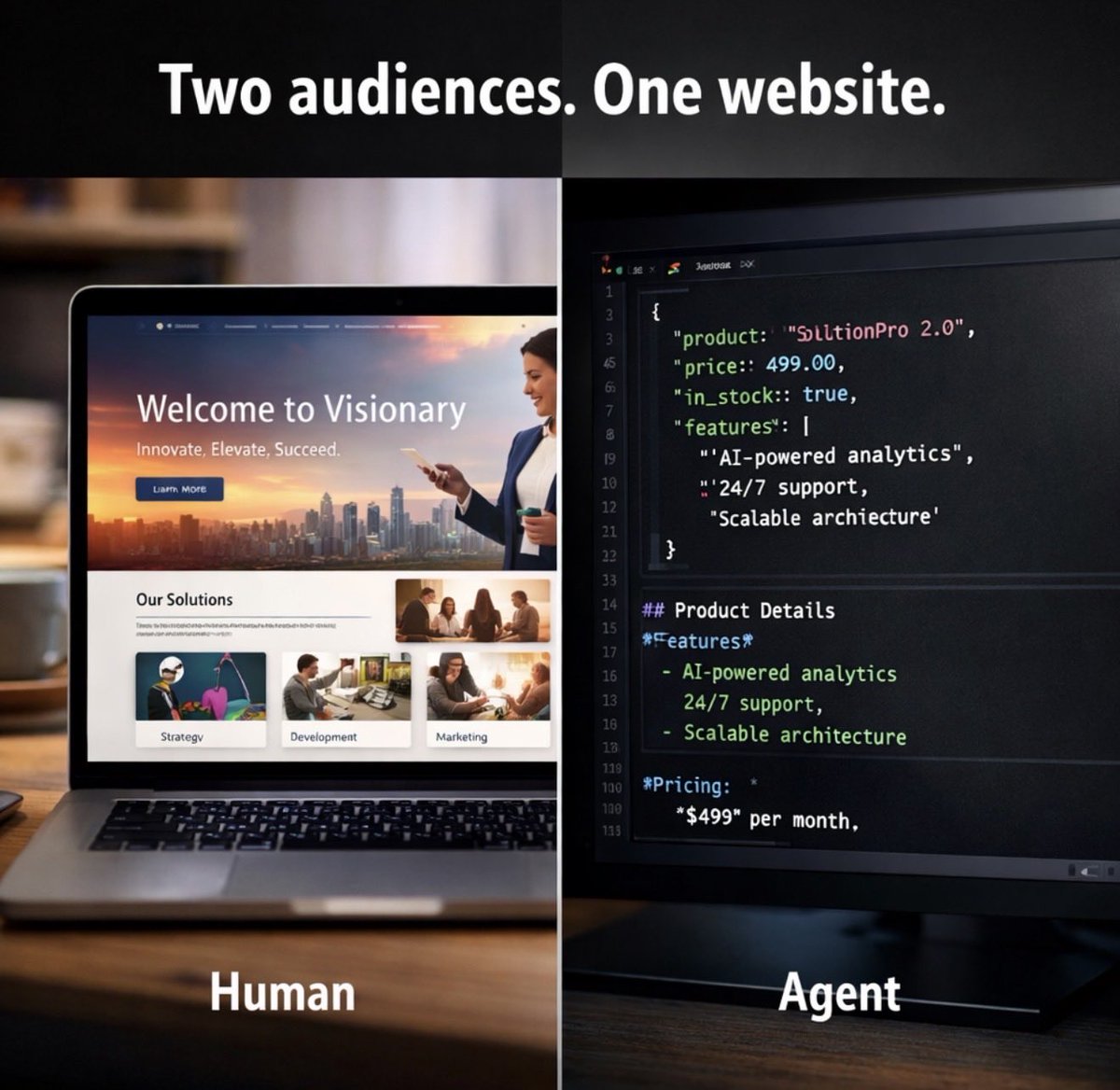
Your next online customer may never see your website. An AI agent will. The human web is still here. The agentic web is the future. Humans scroll. Agents parse at computer speed. Humans want imagery, narrative, comparisons, pretty scroll animations, and trust signals. Agents want JSON, markdown, APIs and a price list. Agents now have wallets and will soon be transacting once a purchasing decision has been made. We are in an overlap phase. For now, you still need both: ➡️ A persuasive front end for people ➡️ A structured, machine-readable layer But, increasingly, AI will: 🔜 Understand exactly what is required 🔜 Search suppliers 🔜 Compare specifications 🔜 Evaluate pricing 🔜 Shortlist options 🔜 Report back 🔜 Transact / pay Before a human has put down their coffee and clicked. See my article on the high frequency trading future of ecommerce here: linkedin.com/pulse/beyond-b… When the agentic web becomes a primary route to market, the winners will be those who built for both. ➡️ HTML for humans. ➡️ JSON and markdown for agents. Are you deploying AI Sales Engagement Agents to engage with humans on your web to maximise conversion as the human web inevtiably goes dark? Ask yourself: Who is your web site built for? 🤔 @goimplementai @Aalokyshukla
Piers Linney MBE tweet media
English
3
1
3
514
Piers Linney MBE
Piers Linney MBE@pierslinney·
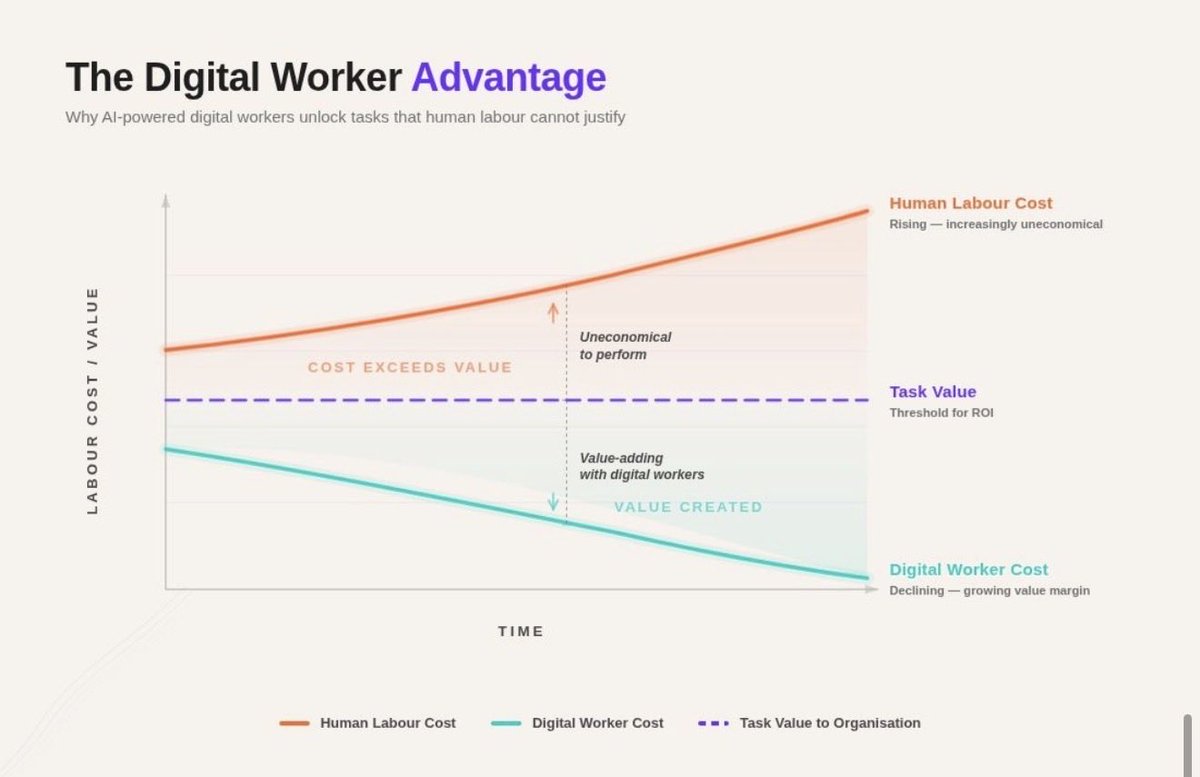
Your business is full of trapped value. You just couldn’t afford to unlock it. There have always been tasks inside organisations that we know would value but we can never justify using human resources: ➡️ Listening to every sales call. ➡️ Reviewing how the business is represented in meetings. ➡️ Analysing every customer interaction. ➡️ Checking for churn signals ➡️ Auditing email threads ➡️ Operating meaningfully out of hours. ➡️ Rigorous compliance checks (sales process or regulatory) This is not because such tasks lack importance, but because the cost of human labour and management attention exceeds the value created. Management bandwidth is finite and expensive and oversight does not scale. So we sample, we rely on dashboards, and we tolerate blind spots. As human labour costs rise, the threshold for what is economically viable keeps moving upwards, which means the gap widens are more value is left on the table. Now look at the lower line on the chart. Digital labour costs are far lower and will decline over time - not rise. When the cost of execution drops below the value created, even marginally, the task becomes economically viable. The value per action may be small, but at scale it compounds. What was previously uneconomic becomes a material opportunity. What was ignored becomes actionable. This is the advantage of digital workers. It is not about replacing people. It is about unlocking operational and managerial value that could not previously be pursued at scale. If you can now afford to see everything, what excuse do you have for not looking? 🤔 Read @Aalokyshukla’s guide: linkedin.com/posts/aalokshu…
Piers Linney MBE tweet media
English
0
1
2
350