The Protestant Philosopher

2.7K posts

The Protestant Philosopher banner
The Protestant Philosopher

The Protestant Philosopher

@ProtPhilosopher

Building a Philosophical Defense of Protestantism | Dr. Christopher Cloos

参加日 Ocak 2022
571 フォロー中1.9K フォロワー
固定されたツイート
The Protestant Philosopher
The Protestant Philosopher@ProtPhilosopher·
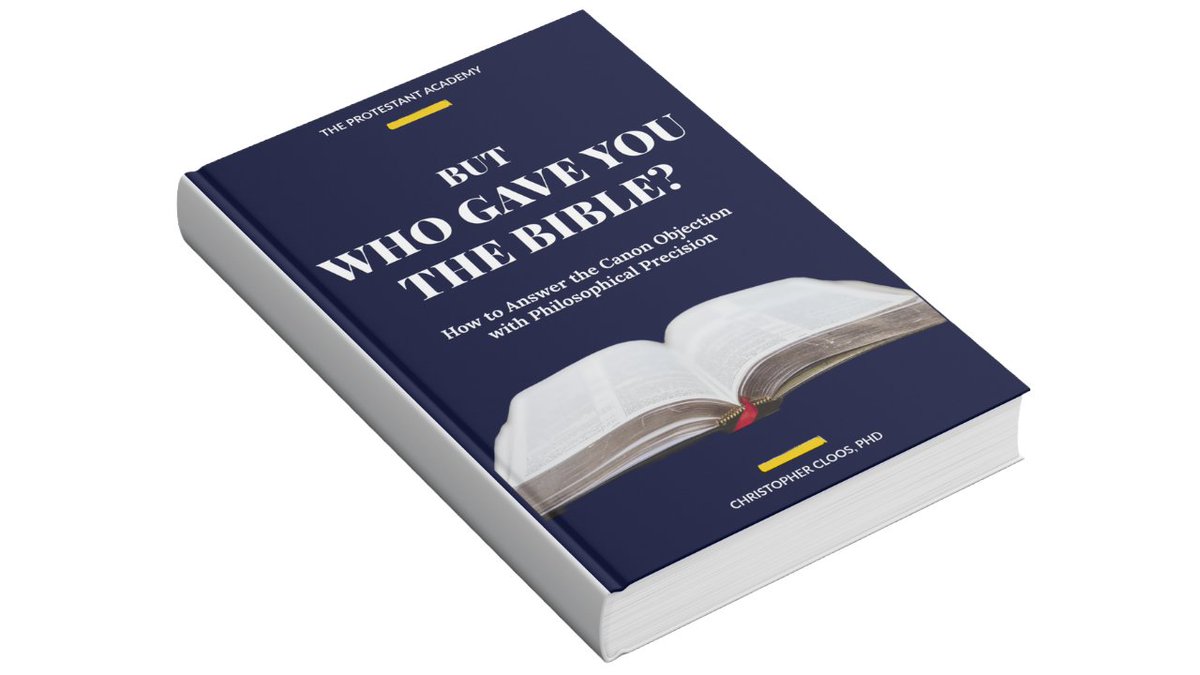
"But who gave you the Bible?" Most Protestants freeze when they hear this. I wrote a free guide that shows you how to answer the Canon Objection to Sola Scriptura with philosophical precision. Get your free guide now: protestantacademy.com
The Protestant Philosopher tweet media
English
10
5
46
2.9K
The Protestant Philosopher
The Protestant Philosopher@ProtPhilosopher·
Thanks for your replies. I'll work through them in reverse order. You ask how I can account for "Jerome citing Sirach as Scripture in AD 404." Easily. He did this throughout his career. He used 'Scripture', as was common amongst the Fathers, in a more broad sense to mean "a sacred writing." He didn't mean it in the narrow sense we do, which is "an inspired text within a closed canon with the authority to determine doctrine." When it came to judging their canonicity, he consistently excluded them from the canon proper. His formal judgments are in his prefaces. Further, as Gallagher (2012) says about Jerome's use of 'Scripture': "Jerome's scriptural citations are not a reliable guide for determining the books he would list as belonging to the canon." So, that's how I account for "Jerome citing Sirach as Scripture in AD 404." He wasn't making a canonical judgment about Sirach by calling it Scripture. [Ref: Edmon L. Gallagher, "The Old Testament 'Apocrypha' in Jerome's Canonical Theory," Journal of Early Christian Studies 20, no. 2 (2012): 221] (7) You say, "You are not with the Councils" and that somehow means "it's ideological, not historical." But, this is false. I accept the councils as a witness to what the early Church believed. They are ministerial in this regard. But, what I don't do is submit to them as infallible authorities over Scripture. I don't elevate them to having magisterial authority. Further, if the councils are so binding, why did Jerome contradict them without censure. Gregory the Great did the same thing. And The Glossa, which endorsed Jerome's distinction, contradicted the councils for a thousand years without censure. So, either the councils you cite don't bind the way you think or the whole tradition of the West was in a state of heresy for a thousand years. Which is it? (6) You say, "Before Trent there was disagreement, so what? Before Chalcedon there was disagreement on Christology." But, I actually think your analogy works in my favor. Chalcedon had a ton of support on both sides of the issue. Both traditions had heavyweight scriptural and philosophical arguments regarding how Christ's two natures relate to his person. Trent didn't do this. There weren't two heavyweight traditions that Trent overruled. Trent overruled the dominant tradition in the West for a thousand years. Trent reversed the majority position. And it did so by a narrow margin. The preliminary vote on the deutero question was, as I mentioned, 24-15-16. By contrast, Chalcedon's vote wasn't close. Over 500 bishops attended. Could you imagine if over one third of the bishops at Chalcedon opposed or abstained. Or, if Chalcedon has passed with a mere 24-15-16 vote, no one would treat it as having settled dogmatically the question of Christ's natures as they relate to his person. (5) You ask me to name drop, "Name a witness in the first thousand years who holds a 66-book canon," and you repeat that "Jerome is an outlier." He's not an outlier. He's a representative of a major tradition drawing a canonical distinction that was the basis for the Protestant 66-book canon. The following major figures endorsed the same distinction or listed the Hebrew canon: Rufinus, Athanasius, Melito of Sardis, Origen, Gregory the Great, and the Glossa Ordinaria upheld the canonical distinction for a thousand years in the West. And your "66-book canon" challenge is misguided. The question isn't whether someone placed 66 books in one document. The question is whether the Hebrew canon, which is equivalent to the Protestant 39 OT books, was identified as the OT canon distinct from the deuteros. And it was by the witnesses I just named. (4) You say, "Jerome didn't hold the deuterocanonicals contained errors, he prayed for the dead, and he cited Sirach as 'Scripture' in Letter 108 (404 AD)." I already addressed the claim about Jerome citing Sirach as 'Scripture'. And on the errors point, the Protestant position doesn't require Jerome to have thought they contained errors. He excluded it because it lacked the marks of canonical status, not because he found factual mistakes. (3) You say, "Jerome taught the deuterocanonicals should be read in liturgy, which contradicts Protestant practice." I addressed this in my last reply. Jerome's position is to read them but don't build doctrine on them. And confessional Protestant positions, like Lutherans and Anglicans, do read them liturgically. The fact that many evangelical denominations dropped the practice doesn't mean the Reformation disagreed with Jerome. It means evangelicals went away from the Reformation. (2) You say, "Jerome did outwardly comply." I also addressed this in my last reply. Yes, he outwardly complied by translating them. He also added disclaimers on them denying their canonical status. Compliance with a translation assignment is not the same as canonical submission. You're conflating the two. (1) You say, "Cajetan was censured and a cardinal's opinion means nothing." I think you're misunderstanding the point I was making. The argument was never "Cajetan proves the Protestant canon." The argument is that the dominant Western tradition for a thousand years followed Jerome's distinction. And Cajetan is the last person in that line before Trent. Cajetan was writing a commentary on the text and indicating the tradition he inherited. It's to show that the dominant tradition was in effect until the eve of Trent. That's why I included him. You also say "I could cite a dozen Cardinals from the 1500s who affirmed the 73-book canon." Sure, and I can cite the Catholic Encyclopedia admitting that "few are found to unequivocally acknowledge their canonicity" throughout the Middle Ages. That's not just one cardinal's opinion. That's the dominant tradition. One side has a thousand year paper trail. The other side has Trent. And Trent erased that paper trail by attaching an anathema. It said that anyone who "does not receive as sacred and canonical the aforesaid books entire with all their parts... let him be anathema." So it overruled the dominant tradition not by answering Jerome but by anathematizing his legacy.
English
0
1
1
26
Dr Taylor Marshall™️
Dr Taylor Marshall™️@TaylorRMarshall·
The responses to your objections on St Jerome and the 73 Bible are simple: 1) First, you cite Cardinal Cajetan as dissenting from the prior councils and the Council of Florence on the 73 books. Notably, Cajetan was censured by the Pope for other things he said. Also, it was common at that time for Catholic Apologists debating protestants to come their way. For example, many Catholic scholars at the time invented ideas like “double justification” to try to win over Lutherans. I could cite a Cardinal in 2026 arguing for the ordination of women. That doesn't mean that the Catholic Church in 2026 favors ordaining women, or ever has. A cardinal’s opinion means nothing. I could cite a dozen Cardinals from the 1500s who affirmed the 73-book canon. 2) Second, Jerome did outwardly comply. It's a fact. 3) Jerome explicitly taught that the Deuterocanonical books should be read and sung in liturgy in the public worship of the Church. This contradicts Protestant practice. The point stands. Protestants (except perhaps Anglicans) do not actually hold the same position of Jerome. 4) Jerome did not hold that the Deuteros contained errors. For example, Jerome prayed for the dead. Yet Protestants assert that the Deuteros contain error. Again the Protestants don't agree with Jerome’s position on the Deuteros. Jerome later (AD 404) cited Sitach as “Scripture.” Protestants don't do that. in Letter 108 (to Eustochium, A.D. 404), Jerome writes: “Does not the Scripture say: ‘Burden not thyself above thy power’?” (Sirach 13:2) Is that Protestant? 5) Jerome is monumental in the Catholic tradition, but he is an outlier on this matter. This why Protestants focus solely on (early) Jerome and not the hundreds of other Church Fathers who regularly cite the Deuteros as Scripture and within doctrinal discussions. I challenge you to bring forth a witness in the first thousand years who holds a 66 book canon. 6) You say before Trent there was disagreement. So what? That's like saying “before Chalcedon there was disagreement on defining the union of the two natures of Christ.” You're like a Neo-Arian slicing quotes from St Justin Marty to prove “the early church was actually proto-Arian.” 7) At the end of the day, you are not with the Councils. Luther eventually rejected all councils and pivoted to “sola scriptura” because he knew he was condemned by prior councils going back to the fourth century. It's ideological, not historical. I'd be curious as to how you account for Jerome citing Sirach as Scripture in AD 404.
English
2
3
60
2.2K
The Protestant Philosopher
The Protestant Philosopher@ProtPhilosopher·
I noticed several errors in Dr. Taylor Marshall's letter to Protestants. So I offer a corrected version below, addressed to Catholics. Dear Catholics, Your Bible contains 7 non-canonical books, added by the Council of Trent in 1546 over the objections of your own best bible scholar. Marshall says Jerome "changed his mind" about the deuterocanonical books around 402 AD in obedience to Pope Damasus. I've read Jerome's prefaces. This doesn't hold up. Damasus died in 384. Jerome wrote his famous Prologus Galeatus in 391. It excluded the deuterocanonicals as part of the canon. He labels these books as apocrypha. That's 7 years after Damasus was gone. That's not obedience to a living pope. The quote Marshall uses from Against Rufinus, which reads "What sin have I committed if I followed the judgment of the churches?", isn't about the canon. It's about Jerome's decision to translate from the Hebrew instead of the Septuagint. Rufinus attacked him for it. Jerome defended himself. In context, he's talking about translation method, not about which books belong in the Bible. And Jerome didn't stop his take. I've quoted these before, but here he is for the next 24 years of his life: 391: "Whatever is outside of these is set aside among the apocrypha." 398: The Church reads Tobit and the Maccabees "not for the authoritative confirmation of ecclesiastical doctrines." 405: Tobit is excluded from "the catalogue of Divine Scriptures." Judith is "considered among the apocrypha." 406: Cites the Book of Wisdom with "if one wishes to accept this book." 415: Still distinguishing Wisdom ("lest you gainsay this volume") from Ecclesiastes ("about which there can be no doubt"). This is one of his last works. Gallagher, a top scholar on Jerome on the canon, explains, "All of our evidence indicates that he always considered them outside the canon." Jerome never retracted. He never published a revised list. Never wrote "I was wrong." He translated Tobit and Judith under pressure, finished each in a single day, and attached prefaces denying them canonical status. That's not submission. That's a scholar doing what he's told while making sure everyone knows what he thinks. Dear Catholics, please drop the fan fiction that Jerome submitted to Rome on the canon. He held the same position from 391 until he died in 420. And Trent overruled him 15 centuries later by a vote of 24(Y)-15(N)-16(A). It passed by 44%. Not exactly a passing grade. Surely not one I'd write letters to Protestants about.
Dr Taylor Marshall™️@TaylorRMarshall

Dear Protestants, Your Bible lacks 7 canonical books, removed by Martin Luther and John Calvin as “Apocrypha”. Protestants often quote Saint Jerome to justify this removal. Saint Jerome later changed his mind about the 7 deuterocanonical books in obedience to Pope Damasus. His famous quote from the Helemeted Preface (quoted daily by Protestants) doubting the 7 deuteros dates from 391. Nine years later he wrote that he had submitted to the Catholic position and rejected his private opinion. Can Protestants please drop their fan fiction that Jerome was a Proto-Protestant? Later in life (in Against Rufinus around 402 AD), he defended the Church's judgment on the 73-book canon saying, "What sin have I committed if I followed the judgment of the churches?"

English
94
100
708
70.7K
The Protestant Philosopher
The Protestant Philosopher@ProtPhilosopher·
Thanks for your reply. Let me address each point. 1. Yes, "multiple councils and synods before Trent listed the 73-book canon, including the Ecumenical Council of Florence," but the question is what the status of those councils imply about the status of the canon. Though all three lists were materially identical, they weren't normatively identical, and none of the lists were binding or dogmatic. Cajetan was writing 90 years after Florence, which is arguably the strongest case for the 73-book canon pre-Trent, and said this about the deuterocanonicals at the end of his commentary on Esther: "And in this place we conclude the commentaries on the historical books of the Old Testament. For the rest (i.e., Judith, Tobit, and the books of the Maccabees) are reckoned by divine Jerome as outside the canonical books and he places them among the apocrypha, with the book of Wisdom and Ecclesiasticus, as is clear in the Prologus Galeatus. Nor ought you be disturbed if you find somewhere those books reckoned among the canonical, whether in the sacred councils or among the sacred teachers. For the words of both councils and teachers ought to be brought back to the revision of Jerome, and according to his opinion expressed to bishops Chromatius and Heliodorus, those books (and if there are any other similar in the canon of the Bible), are not canonical, i.e., are not normative (regulares) to confirm those things which are of the faith. But they can be called canonical (that is, normative) for the edification of the faithful, as received and authorized in the canon of the Bible. For with this distinction you can discern the things said by Augustine in book 2 of De doctrina christiana, and written in the Council of Florence under Eugene IV, and written in the provincial councils of Carthage and Laodicea, and by Popes Innocent and Gelasius. To the praise and glory of Almighty God, at Rome in the year of salvation 1532, but in the 64th year of my life, on the 19th day of July, Amen." [Ref: Thomas de Vio, In omnes authenticos Veteris Testamenti historiales libros, commentarii (Paris: Soleil d’Or, 1546), 481v–82r.; as quoted in Gallagher, E. L. (2025). The Apocrypha through History. Oxford University Press] So, the Cardinal very high up in the Church, who was tasked with putting Luther in check, argued that the council of Florence ought to be read in light of Jerome's distinction between the canon proper, which has books that can confirm doctrines, and the apocryphal books that should be read only for edification. This shows that right until the eve of Trent the canon was not settled at the highest levels of the Church. So that the lists appeared in councils that didn't dogmatically define the canon doesn't cut much ice. 2. You say, "No one contests that Jerome struggled with this,... But he did outwardly comply with Rome." I'm not sure what you mean by "outward compliance." If by this you mean he did his job of translating the apocrypha, then that's doing what the Church tasked him with doing. But he "outwardly" and "visibly" relegated those 7 texts to a secondary status, a non-canonical status. And that matters the most when it comes to discerning his impact on the Medieval manuscript tradition that upheld his smaller canon, and it matters how others like Cajetan thought those books should be judged in light of Jerome's canonical distinction, which traces back to way before Jerome. 3. This point is confused. You say that because Jerome allowed the apocrypha to be read in Church and most Protestants don't read them in Church that I can't use Jerome, who was your own Church's greatest translator of the Bible, in making a point about the status of those books regarding the canon. I can agree that the 66-book Bible is canonical because it contains the very books Jerome himself would endorse as canonical. That he allowed other books to be read for edification, and that modern Protestants don't by and large do that, doesn't mean I can't reference Jerome on the status of those books as lesser on the very issue of their canonical status. The point you're making is a red herring at best and completely confused at worst. 4. You again make a mistake regarding history. You say, "Jerome is an outlier and is not the Pope or magisterium." Jerome is not an outlier, tough he's obviously not the Pope or magisterium. He represents a tradition, a robust tradition, of Catholics endorsing a smaller canon. Jerome is no minor figure or mere outlier in this regard. Through his translation work and its impact on Medieval manuscript tradition, he exerted a huge impact on the Church. Further, I can set Jerome aside and simply note that one of today's best scholars on the history of the deutrocanonicals had this to say at the end of his detailed historical exposition of their histories. This is right before he discusses Trent, "As the mid-sixteenth century approached, the Catholic opponents of Luther and his movement did not maintain a uniform position on the status of the deuterocanonical books." [Ref: Gallagher, E. L. (2025). The Apocrypha through History. Oxford University Press, p. 172]. Again, until the eve of Trent there wasn't a "uniform position on the status of the deuterocanonical books." It took making denying them anathema for those books to be officially, dogmatically made "canonical" according to the Catholic Church. But, even then there was decent and the matters passed with a mere 44% yes vote. So I wrote a letter to clarify the factual errors in your original letter to Protestants and you've replied to me with red herrings and more errors. Again, you're telling a just-so story that doesn't reflect the actual historical details and its nuance.
English
6
8
97
2.5K
Dr Taylor Marshall™️
Dr Taylor Marshall™️@TaylorRMarshall·
Good post, but you need a couple of corrections: 1) Multiple councils and synods before Trent listed the 73-book canon, including the Ecumenical Council of Florence. 2) No one contests that Jerome struggled with this, and disagreed with Augustine and most 4-5the century saints on the matter. But he did outwardly comply with Rome. 3) Jerome still explicitly teaches that the deuteros should be read in church for the edification of the people. 99% of Protestants would burn down the church if Pastor Jim started reading from 2 Maccabees on Sunday morning. This proves they still disagree with Jerome’s position. You can't claim Jerome because you disagree with his acceptance of their being read for edification in the liturgy of the church. 4) Jerome is an outlier and is not the Pope or magisterium.
English
25
29
574
9.2K
ZZZZZZIFFSTER
ZZZZZZIFFSTER@IFFFMEISTER·
@ProtPhilosopher neither of you (respectfully) are really right about this. It's more nuanced than the way either is presenting this
English
3
0
6
2.1K
The Protestant Philosopher
The Protestant Philosopher@ProtPhilosopher·
An officially endorsed Catholic Encyclopedia says the opposite of what you suggest. The deuteros weren't made standard because they appeared on a list at regional councils. Rather their status was in dispute through the whole period you're referring to, as the encyclopedia indicates, "Few are found to unequivocally acknowledge their canonicity. The prevailing attitude of Western medieval authors is substantially that of the Greek Fathers." The Greek Fathers excluded them. If the 73 book canon had the kind of widespread acceptance you're describing, the Catholic Encyclopedia wouldn't describe the medieval period as ongoing hesitation.
English
0
0
1
5
Bible Study Faithful to the Magisterium
@ProtPhilosopher was made the standard in the West because of those canonical judgements. While some codices may have had local variants like those found in the Orthodox canon, they were exceptions to the rule and never gained widespread acceptance in the West the way the 73 book canon did.
English
2
0
0
29
The Protestant Philosopher
The Protestant Philosopher@ProtPhilosopher·
"But who gave you the Bible?" Most Protestants freeze when they hear this. I wrote a free guide that shows you how to answer the Canon Objection to Sola Scriptura with philosophical precision. Get your free guide now: protestantacademy.com
The Protestant Philosopher tweet media
English
10
5
46
2.9K
The Protestant Philosopher
The Protestant Philosopher@ProtPhilosopher·
@KennethGriswold Liturgical judgments are not equivalent to canonical judgments. A text can be part of liturgy without that equating to an endorsement of that text as canonical.
English
0
0
1
8
Bible Study Faithful to the Magisterium
@ProtPhilosopher Whole Catholic rites in the West used the Deuterocanonical books in the same way as they treated any other Scripture in the Liturgy, for example. The use of the Deuterocanonical part of Daniel is so ancient in the Divine Office (in a part that is Scripture on other days)...
English
2
0
0
31
The Protestant Philosopher
The Protestant Philosopher@ProtPhilosopher·
The Vulgate is an interpretation. And Jerome did his job faithfully because he was told to do so, but he also attached a disclaimer in the preface, "This preface to the Scriptures may serve as a helmeted introduction to all the books which we now turn from Hebrew into Latin, so that we may be able to know that whatever is outside of these is set aside among the apocrypha. Therefore, Wisdom, which is commonly ascribed to Solomon, and the book of Jesus son of Sirach, and Judith and Tobit, and The Shepherd are not in the canon." Attaching a disclaimer saying that those books aren't canonical isn't making a judgment that they are canonical. And the regional councils of Rome, Carthage, and Hippo weren't universally binding on the Church.
English
0
0
1
10
Bible Study Faithful to the Magisterium
@ProtPhilosopher I don't know how you can say that the Vulgate is not a canonical judgement. Just because Jerome didn't like the canonical judgement made, doesn't mean that Rome, Carthage, and Hippo weren't trying to make definitive lists of Scripture, nor does it negate that the Vulgate...
English
2
0
0
27
The Protestant Philosopher
The Protestant Philosopher@ProtPhilosopher·
There's a lot I could say here, but let me be brief. Convergence occurs when independent opinions across time universally and naturally come to agree on the canonical status of a set of texts. The 27 book NT is a perfect case in point. Though there were a couple of centuries of dispute of the edge cases, or the so-called antilegomina like Hebrews and Revelation, that disagreement converged into those books being canonical. Contrast that with the deuterocanonicals. There's a long, well-attested tradition dating back to Jerome showing that the deuterocanonicals were regarded as edifying but not possessing canonical status. That tradition continued for a thousand years until a 44% vote at Trent made not including them in the canon anathema. That they were included in the Vulgate or referred to as Scripture doesn't equate to them being regarded as canonical for the years 400 - 1500 as you suggest. Ancient Churches used them as edifying for faith and practice, but that's not the same thing as judging them canonical. Further, the deutrocanonicals haven't achieved that natural, independent, universal assent that's the hallmark of convergence. Protestants continue to make Jerome's distinction that they are non-canonical.
English
0
0
1
6
Bible Study Faithful to the Magisterium
@ProtPhilosopher How can you say "convergence on the Deuteros never arrived." Please define what "convergence on" something means, because the overwhelming majority of Christians from 400 - 1500, and every faithful Catholic, Orthodox, and other Christian if the ancient Apostolic churches use them
English
1
0
0
13
The Protestant Philosopher
The Protestant Philosopher@ProtPhilosopher·
@KennethGriswold On begging the question, I'm not assuming nothing else has divine causality. I'm arguing it. In my complete work I have an exclusionary argument showing nothing else could occupy the position of being the sole infallible norm of faith and practice.
English
0
0
1
9
The Protestant Philosopher
The Protestant Philosopher@ProtPhilosopher·
I'm not arguing "Aquinas was right about everything, so his metaphysics proves my canon." I'm using Aquinas's metaphysics of exemplar causality because the argument is good and because they are Catholic-friendly metaphysical commitments. I'm trying to start from shared assumptions and show what they entail. You're free to reject the Thomistic distinctions regarding causality, but that puts you at odds with your own tradition. Further, a Protestant like Turretin applies a very similar model of causality to Scripture. And it's a genetic fallacy if you're simply crying foul because I'm using a part of Thomas's view of causality.
English
0
0
1
11
Bible Study Faithful to the Magisterium
@ProtPhilosopher Is the intellect of St. Thomas not a "properly functioning intellect"? If not, why are you using him to come to conclusions about God? I also HIGHLY question your judgement about how the metaphysical qualities of God translate to that which He inspires. Lots of assumptions.
English
1
0
0
16
The Protestant Philosopher
The Protestant Philosopher@ProtPhilosopher·
On the Thomas point, I'm not claiming that every individual person will arrive at the correct canon on their own. The self-authentication is a corporate promise, not a guarantee each individual with arrive at the correct canon. That's why I emphasize convergence across time. Aquinas's intellect was properly function. He also lived in a tradition inherited from the Vulgate. The fact that someone like Aquinas could be impacted by his Church context is what I'd expect. The key is what the community across time arrived at and converged on. Convergence on the deuteros never arrived.
English
1
0
0
6
Bible Study Faithful to the Magisterium
@ProtPhilosopher Okay, I found the self-authentication one after some more careful reading. I find it ironic that you claim that God's truth is "self-evidencing to a properly functioning intellect" while using the St. Thomas to make your metaphysical claims while ignoring the canon he recognized.
English
2
0
0
15
The Protestant Philosopher
The Protestant Philosopher@ProtPhilosopher·
Regarding the mapping between the tiers and how you go from the divine attributes to the textual attributes, I'm working on an article that explicitly draws all the connections. They're many-to-many mappings, so while I can't rehearse them all here, I can just mention that I'm not hand wavy about that. I actually make all the connections in detail.
English
0
0
1
9
Bible Study Faithful to the Magisterium
@ProtPhilosopher I also don't understand how you got from the 5 metaphysical qualities (shouldn't omniscience be in this category too,so 6?) and that in the "1st tier" to either form of sufficiency, perspicuity, or self-authentication.
English
4
0
0
122
The Protestant Philosopher
The Protestant Philosopher@ProtPhilosopher·
You're asking good questions. Omniscience is in the communicative tier because it directly governs the content of a communicative act. That is, God as omniscient knows everything that needs to be communicated. That's a communicative perfect, not just a metaphysical one. The other ones are in the second tier because they don't directly govern communicative content. Rather, they govern normative standing of what the author creates. So, omniscience tells you what goes in the communication. And something like soverignty tells you where it stands in relation to other sources. Those are different roles.
English
0
0
1
68
The Protestant Philosopher
The Protestant Philosopher@ProtPhilosopher·
Yes, I'd be glad to expand on that. The responses get things going in the direct direction, but they're not the full explanation. The vulgate is a physical codex. It's not a canonical judgment. And those manuscripts came with Jerome's preferences, which said the deuteros are not for the authoritative confirmation of Church doctrines. And other codices have different amount of books and variations on books. So, if being included in a codex is equal to canonicity, then there's other books in other codices that need to be added to your 73 books, which is bigger than the canon Rome endorses. Whatever the criterion you use to exclude the extra 4+ books in other codices and canons, that judgment wasn't in a codex. Which means that being included in a codex wasn't the criterion all along. A codex is like a table of contents, while a canon is a theological judgment. And, as the reply in the guide you quoted says, "show me a 73-book Bible before Trent," as the judgment wasn't made until Trent.
English
2
0
0
76
Bible Study Faithful to the Magisterium
@ProtPhilosopher I just glanced at this. Your answer to the "show me a 66-book Bible before Luther" is "show me a 73-book Bible before Trent"? Am I misunderstanding ? Every standard version of the Vulgate for 1000 years would have been a 73 book Bible. I imagine there are still 100s existing.
English
1
0
0
119
Tim Williamson
Tim Williamson@timwmson·
Hoping that @gavinortlund hosts @ProtPhilosopher for a discussion along the lines of the Attribute Inscripturation Thesis soon. This is incredibly helpful and edifying thinking!
The Protestant Philosopher@ProtPhilosopher

I feel like we've discussed this already, but let me explain it again. Let me first clarify that the whole thing isn't riding on Jerome, as you suggested. He's a key proponent of a tradition throughout your Church's history. It's one that views the deuterocanonicals as being non-canonical but edifying. This tradition pre-dates the councils in the late 300's. So, the whole thing isn't riding on Jerome. That said, let me mention the big picture. The big picture is that what you have are citations by Jerome. What I have are canonical judgments. These are different categories, as I explained in another reply. Top Jerome scholar Edmon Gallagher has concluded that you can't infer from Jerome citing them as Scripture to that being equal to, or a reliable guide to, how he views their canonical status. Why? Mainly because at the same time Jerome is citing them as Scripture he's declaring them non-canonical. For instance, Jerome cited Wisdom as "Divine Scripture" and then wrote "if one is pleased to receive this book" when citing the same book in his Commentary on Zechariah (406). He cited Sirach authoritatively and then wrote that the Church reads these books "not for the authoritative confirmation of ecclesiastical doctrines" (398). He "defended" the additions to Daniel as read in the Church and then wrote in the same commentary that they "exhibit no authority as Holy Scripture" (407). He quoted Baruch and then called it "totally unworthy of treatment" in his Commentary on Jeremiah (414-420). So, you're confusing citation practice with canonical judgment. The Fathers themselves distinguished these categories. Athanasius cited Wisdom as "Scripture" and the Shepherd of Hermas with "it is written" while excluding both from the canon. Jerome did the same thing. Your list shows he valued the books. His own formal statements, often in the same books you're citing, say the opposite.

English
2
1
4
357