

Alex Yeh
1.6K posts

Alex Yeh
@alex_yehya
Founder & CEO of @GMI_Cloud I Nvidia Reference Platform Cloud Board Director @Robostrategy
Bay Area 参加日 Mart 2013
443 フォロー中516 フォロワー

Great progress for the AI community
Sheel Mohnot@pitdesi
Anthropic exp $10.9B Q2 revenue, up from $4.8B in Q1, and $559M of operating profit for the Q. Compute is 56 cents per dollar of revenue, lower than I expected. Q2 projection: $10.9B revenue -$6.1B compute -$2.7B sales & marketing -$1.5B other costs =$559M operating income
English
@WarcMeinstein @RoboStrategy Congrats bro. Look forward to work more closely together
English

Proud to announce my position as COO of @RoboStrategy
After two years of building, I'm proud to share that I'm Co-Founder and Chief Operating Officer of RoboStrategy, a NASDAQ-listed (Ticker: $BOT ) investment company built around a single conviction: robotics and physical AI will be THE defining industrial platform shift of the next two decades, and the existing capital structures are inadequate to fund it.
Private markets are too small. Traditional venture funds are too short-dated. Public market investors, who will ultimately own most of this value, have been largely locked out of the private-stage opportunity set.
RoboStrategy is built to close that gap.
What's different about our model?
Permanent capital. As a closed-end fund, we can underwrite founders on 10 to 20 year horizons rather than 7-year cycles.
Public market access. Ordinary investors get exposure to leading private robotics and physical AI companies, including Figure AI, Apptronik, Dyna, and Path Robotics.
Industry depth. We've built the investment platform around long-tenured robotics operators, researchers, and founders. The bar for technical sophistication is high.
Distribution as a competency. Most investment firms underinvest in storytelling. We treat it as a flywheel, both for the fund and for the founders we back.
As COO, I lead the operating side of that thesis: the team, the financial and control infrastructure, the capital markets engine, and the platform our portfolio companies rely on as they scale. I also sit on the Investment Committee and will continue to source opportunities for the fund.
The mechanization of the physical world is going to require hundreds of billions of dollars of patient capital. We intend to be the leading vehicle for it.
Follow @RoboStrategy to track the build. More to come
][
RoboStrategy@RoboStrategy
BOT: Public Market Access to Private Robotics Companies Introducing RoboStrategy: RoboStrategy, Inc. (Nasdaq: BOT) is a closed-end management investment company providing concentrated exposure to robotics and physical AI. The fund is designed to give public market investors exposure to a portfolio that aims to include the most promising private, pre-IPO, and public robotics and physical AI companies. It bridges a structural gap between where robotics innovation is occurring (largely in private markets) and where most investors can access exposure (public markets). The fund seeks to provide investors with access to a sector that has traditionally been limited to venture capital, and aims to provide exposure to companies that may stay private for longer. -- The Core Insight We believe the robotics industry is at an inflection point, with physical AI and robotics increasingly being applied to labor-constrained global industries such as manufacturing, logistics, and services. According to the International Labor Association, labor accounts for approximately 52% of global GDP.¹ According to Statista, global GDP in 2025 was $118T.² This represents an implied global labor market size of roughly $60T. At the same time, this labor base is increasingly constrained: Korn Ferry projects a global shortage of 85.2 million skilled workers by 2030, including a 7.9 million worker deficit in manufacturing alone.³ Deloitte and The Manufacturing Institute estimate the US could need 3.8 million new manufacturing workers by 2033, with 1.9 million of those roles at risk of going unfilled.⁴ Physical AI and robotics are emerging as a primary means of closing that gap. While public markets currently offer indirect exposure to robotics through diversified technology companies, much of the value creation is occurring in private companies that remain inaccessible to most investors. -- Portfolio Focus The portfolio focuses on what the fund believes are category-defining robotics and physical artificial intelligence innovators, including Figure AI, Apptronik, Dyna Robotics, Standard Bots, Dexmate, and other pioneers advancing autonomous systems, machine perception, and human-machine collaboration. The managers of the fund seek to optimize returns by actively managing the portfolio and continuing to make new investments in leading private robotics companies. -- The Ambition The fund's long-term goal is to grow into a significant public-market vehicle for robotics investing, providing public-market access to private innovation in the sector. -- Footnotes & Disclosure: ¹ International Labour Organization, World Employment and Social Outlook: May 2025 Update. ilo.org/sites/default/… ² Statista, Gross domestic product (GDP) in current prices worldwide. statista.com/statistics/268… ³ Korn Ferry, Future of Work: The Global Talent Crunch. kornferry.com/about-us/press… ⁴ Deloitte & The Manufacturing Institute, Taking charge: Manufacturers support growth with active workforce strategies, April 2024. www2.deloitte.com/us/en/pages/ab… RoboStrategy, Inc. (Nasdaq: BOT) is a closed-end fund registered under the Investment Company Act of 1940. This content is for informational purposes only and does not constitute investment advice or an offer to buy or sell securities. Investing involves substantial risks, including possible loss of principal. The fund invests in robotics, physical AI, emerging technologies, and private companies, which may involve heightened volatility, limited liquidity, valuation uncertainty, and concentration risk. References to portfolio companies are illustrative only, do not represent all investments made by the fund, and are not investment recommendations. Portfolio holdings are subject to change. Forward-looking statements are inherently uncertain. See the prospectus and SEC filings for additional information.
English

Thanks to
@adcock_brett from @Figure_robot
@jeffcardn from @Apptronik
@Lindon_Gao from @DynaRobotics
@evanbeard from @standardbots
@taochenshh from @DexmateAI
andylonsberry from @PathRobotics
@cixliv from @REK
@benedektasi from @AllonicRobotics
For having us as investors!
English
Proud to announce my position as CEO of @RoboStrategy.
When I initially started looking into investing in robotics 2 years ago most VCs I consulted with recommended not to invest in the space. Robotics companies at this time did not have an easy time raising capital. The industry didn’t have a track record of big venture winners, was perceived to be challenging for a variety of reasons, and was not well understood. But it was clear to me that the rate of acceleration of physical AI development would dramatically change the industry. I invested $19m into FigureAI as my first investment.
I believed it was a question of when, not if we could imbue machines around the world with physical intelligence. To accomplish this, the industry would need a tremendous amount of capital to grow, and also an investment firm that deeply understood the needs of robotics/physical AI companies so that it could build a platform to better support them. It will take hundreds of billions to capitalize the mechanized future meaning there is a big gap in the market. We decided we wanted to fill it.
Previously, Mechanism Capital had never taken outside capital, but to do this at the scale I envision, I would need to do so. However, the private markets don’t have that scale. The public markets do, and it was clear that there is and likely will be tremendous appetite for public market investors to participate in the immense value creation happening in AI & robotics that only private market investors currently have the privilege of accessing. The explosive growth of AI companies is a precursor of what will happen in physical AI. So in 2025, we founded RoboStrategy and a year later, we took it public on Nasdaq. Throughout this year, we’ve assembled a great portfolio, started leading rounds of some amazing companies, and have built the foundation to be ready to scale to the next level after going public.
We look different from a traditional VC firm in ways that founders appreciate. Our structure as a closed end fund means our capital is permanent - no fund life meaning we can invest with extremely long time horizons. Our investment firm also of course needs to have deep industry and research experience so that it can make the best risk reward optimized investment decisions. In the last year, we’ve brought on some truly exceptional robotics industry veterans who have previously served for decades as founders/operators. Many founders we talk to consider us as the most sophisticated venture capital firm they’ve talked to and we only intend to grow our expertise in the industry. RoboStrategy’s success depends on our ability to distribute the fund and capture maximal mindshare. This plays to our team’s strength in digital marketing and social media. We’re building a special marketing engine that serves as an attention amplifier for both us and our founders so that our products and stories can reach more people.
A source of inspiration for our fund structure, Strategy (MSTR) raised tens of billions from public capital markets to invest in Bitcoin. I believe robotics will be a much larger industry than Bitcoin and the asset class is orders of magnitude less accessible. We are aiming to raise more and not only become the largest robotics investor globally, but also one of the largest venture capital funds in the world. Venture capital has traditionally been restricted to a limited group of investors. We are changing the paradigm and bringing it to the rest of the world.
Be sure to follow @RoboStrategy.
Job’s not finished.
RoboStrategy@RoboStrategy
BOT: Public Market Access to Private Robotics Companies Introducing RoboStrategy: RoboStrategy, Inc. (Nasdaq: BOT) is a closed-end management investment company providing concentrated exposure to robotics and physical AI. The fund is designed to give public market investors exposure to a portfolio that aims to include the most promising private, pre-IPO, and public robotics and physical AI companies. It bridges a structural gap between where robotics innovation is occurring (largely in private markets) and where most investors can access exposure (public markets). The fund seeks to provide investors with access to a sector that has traditionally been limited to venture capital, and aims to provide exposure to companies that may stay private for longer. -- The Core Insight We believe the robotics industry is at an inflection point, with physical AI and robotics increasingly being applied to labor-constrained global industries such as manufacturing, logistics, and services. According to the International Labor Association, labor accounts for approximately 52% of global GDP.¹ According to Statista, global GDP in 2025 was $118T.² This represents an implied global labor market size of roughly $60T. At the same time, this labor base is increasingly constrained: Korn Ferry projects a global shortage of 85.2 million skilled workers by 2030, including a 7.9 million worker deficit in manufacturing alone.³ Deloitte and The Manufacturing Institute estimate the US could need 3.8 million new manufacturing workers by 2033, with 1.9 million of those roles at risk of going unfilled.⁴ Physical AI and robotics are emerging as a primary means of closing that gap. While public markets currently offer indirect exposure to robotics through diversified technology companies, much of the value creation is occurring in private companies that remain inaccessible to most investors. -- Portfolio Focus The portfolio focuses on what the fund believes are category-defining robotics and physical artificial intelligence innovators, including Figure AI, Apptronik, Dyna Robotics, Standard Bots, Dexmate, and other pioneers advancing autonomous systems, machine perception, and human-machine collaboration. The managers of the fund seek to optimize returns by actively managing the portfolio and continuing to make new investments in leading private robotics companies. -- The Ambition The fund's long-term goal is to grow into a significant public-market vehicle for robotics investing, providing public-market access to private innovation in the sector. -- Footnotes & Disclosure: ¹ International Labour Organization, World Employment and Social Outlook: May 2025 Update. ilo.org/sites/default/… ² Statista, Gross domestic product (GDP) in current prices worldwide. statista.com/statistics/268… ³ Korn Ferry, Future of Work: The Global Talent Crunch. kornferry.com/about-us/press… ⁴ Deloitte & The Manufacturing Institute, Taking charge: Manufacturers support growth with active workforce strategies, April 2024. www2.deloitte.com/us/en/pages/ab… RoboStrategy, Inc. (Nasdaq: BOT) is a closed-end fund registered under the Investment Company Act of 1940. This content is for informational purposes only and does not constitute investment advice or an offer to buy or sell securities. Investing involves substantial risks, including possible loss of principal. The fund invests in robotics, physical AI, emerging technologies, and private companies, which may involve heightened volatility, limited liquidity, valuation uncertainty, and concentration risk. References to portfolio companies are illustrative only, do not represent all investments made by the fund, and are not investment recommendations. Portfolio holdings are subject to change. Forward-looking statements are inherently uncertain. See the prospectus and SEC filings for additional information.
English
Alex Yeh がリツイート

The vibes in SF feel pretty frenetic right now. The divide in outcomes is the worst I've ever seen.
Over the last 5yrs, a group of ~10k people - employees at Anthropic, OpenAI, xAI, Nvidia, Meta TBD, founders - have hit retirement wealth of well above $20M (back of the envelope AI estimation).
Everyone outside that group feels like they can work their well-paying (but <$500k) job for their whole life and never get there.
Worse yet, layoffs are in full swing. Many software engineers feel like their life's skill is no longer useful. The day to day role of most jobs has changed overnight with AI.
As a result,
1. The corporate ladder looks like the wrong building to climb.
Everyone's trying to align with a new set of career "paths": should I be a founder? Is it too late to join Anthropic / OpenAI? should I get into AI? what company stock will 10x next? People are demanding higher salaries and switching jobs more and more.
2. There’s a deep malaise about work (and its future).
Why even work at all for “peanuts”? Will my job even exist in a few years? Many feel helpless. You hear the “permanent underclass” conversation a lot, esp from young people. It's hard to focus on doing good work when you think "man, if I joined Anthropic 2yrs ago, I could retire"
3. The mid to late middle managers feel paralyzed.
Many have families and don't feel like they have the energy or network to just "start a company". They don't particularly have any AI skills. They see the writing on the wall: middle management is being hollowed out in many companies.
4. The rich aren’t particularly happy either.
No one is shedding tears for them (and rightfully so). But those who have "made it" experience a profound lack of purpose too. Some have gone from <$150k to >$50M in a few years with no ramp. It flips your life plans upside down. For some, comparison is the thief of joy. For some, they escape to NYC to "live life". For others still, they start companies "just cuz", often to win status points. They never imagined that by age 30, they'd be set. I once asked a post-economic founder friend why they didn't just sell the co and they said "and do what? right now, everyone wants to talk to me. if i sell, I will only have money."
I understand that many reading this scoff at the champagne problems of the valley. Society is warped in this tech bubble. What is often well-off anywhere else in the world is bang average here.
Unlike many other places, tenure, intelligence and hard work can be loosely correlated with outcomes in the Bay. Living through a societally transformative gold rush in that environment can be paralyzing. "Am I in the right place? Should I move? Is there time still left? Am I gonna make it?" It psychologically torments many who have moved here in search of "success".
Ironically, a frequent side effect of this torment is to spin up the very products making everyone rich in hopes that you too can vibecode your path to economic enlightenment.
English
Alex Yeh がリツイート

前两天我发了篇推文说Meta是AI界最遗憾的公司,今天就刷大前Meta LLaMA团队的Peter Pang发的这篇3500字长文,是我今年看到的最有实战价值的AI-first落地报告。
它把所有喊了半年的AI-first空话,变成了可复制的步骤和可验证的数据。
现在所有人都在说AI辅助开发,说Copilot能提效20%,Pang认为这根本不是AI的正确用法。
在旧流程上叠AI工具,最多只能带来10-20%的效率提升,结构一点没变,
真正的AI-first,是先假设AI才是主要的代码构建者,然后把整个工程架构、CI/CD、测试流程、甚至组织分工,全部推倒重来。
最反直觉的一点来了:
当大多数人都以为AI-first的瓶颈是模型不够强,是工程师不会用工具,
他用真实数据告诉我们 AI写代码的速度从来不是瓶颈。
上下游的人工流程,才是卡死所有效率的死穴:
• PM写一份详细需求要两周,AI写完代码只要两小时
• QA测一轮要三天,AI部署只要两小时
• 再怎么招人,也永远追不上大厂的headcount增速
也就是说AI再快,只要有一个环节是人在拖,整体效率就还是人的效率。
所以他们根本没给工程师配更多Copilot,他们花了全部精力,建了一整套让AI能独立、安全、可靠干活的harness(驾驭系统):
统一monorepo让AI能看到整个系统的所有代码,
全链路结构化可观测让AI能自己定位错误,Claude 3-pass AI评审代替人工code review,
六阶段确定性CI/CD加Statsig feature flags和一键kill switch,
甚至做了一个自愈引擎,每天自动聚类生产错误,自动建工单,能修复的问题自己就解决了。
结果有多夸张呢?只用了14天,这个25人的团队,就做到了每天3到8次生产部署,出了坏功能,当天就能发现并回滚。
更反常识的是,部署频率翻了十几倍,用户指标和转化率反而上升了不少。
整个公司的分工被彻底重构,没有了天天写CRUD的工程师,人类只剩下两种角色:
架构师,负责设计规则和SOP,批判AI的输出,
验证者,负责判断风险和质量。
而且这不是只在工程部门,营销、产品发布、客户支持,全公司所有职能都在往AI-native转。
CTO花在日常管理上的时间,直接从60%降到了不到10%。
最扎心的是,这一切没有任何黑科技,所有工具都是开源的,所有流程都写在了文章里,任何人都能抄。
所以,真正的门槛从来都不是技术,是你愿不愿意承担转型的真实成本:比如员工的焦虑,资深工程师的抵触,连续几个月每天18小时的试错。
大多数公司宁愿守着10%的提效舒适区,也不愿意打碎自己运行了十几年的旧系统。
最让我震撼的是,这套工程逻辑,1:1平移到个人身上也完全成立。
你的笔记库就是你的个人monorepo,
你的AI助手就是你的专属agent,
你需要的也许更多的AI工具,而是一套属于你自己的认知harness和自愈循环。
让AI每天帮你扫描思考的漏洞,聚类你的认知gap,自动生成迭代计划。
当然,这只是他们一家的早期经验,不是所有公司都能直接复制。
但也给我们指明了一个清晰的方向:
未来的竞争,不仅看谁会用更多的AI工具,还要看谁先愿意把自己从一个执行者,彻底变成一个架构师和批判者。
Peter Pang@intuitiveml
中文
Congrats!! Hope it will be open-sourced soon 👀
Alexandr Wang@alexandr_wang
1/ today we're releasing muse spark, the first model from MSL. nine months ago we rebuilt our ai stack from scratch. new infrastructure, new architecture, new data pipelines. muse spark is the result of that work, and now it powers meta ai. 🧵
English
Alex Yeh がリツイート

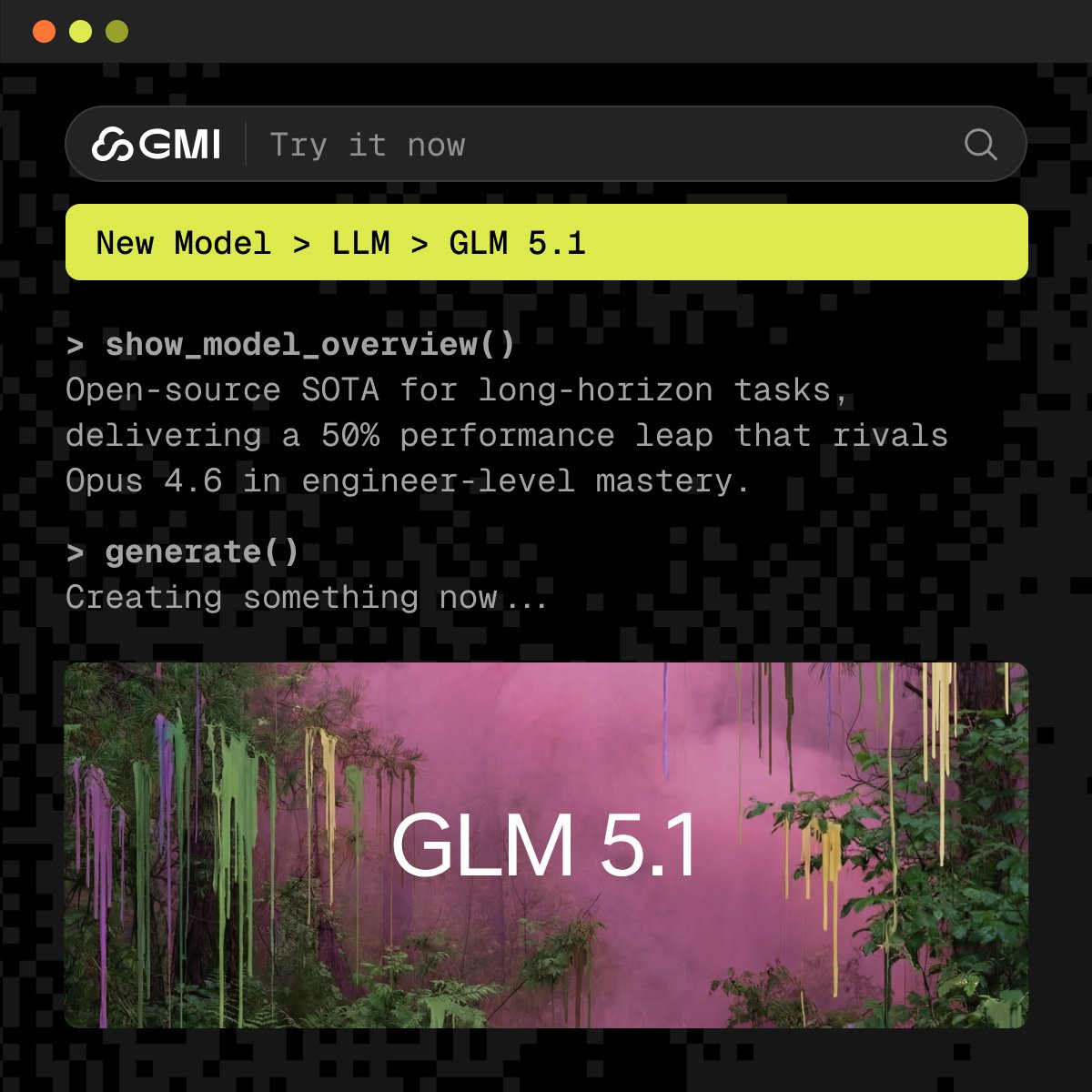
Day 0 support for GLM-5.1 is LIVE on GMI!
This new upgrade means
✅ No Plateaus: It stays productive over 100s of rounds.
✅ Agentic Engineering: SOTA on SWE-Bench Pro (58.4).
✅ Persistence: Handles 1000s of tool calls without losing context.
The era of "vibe coding" is over. The longer it runs, the better the result.
Congrats to the @Zai_org team!
English
here is their technical report for anyone who is interested: arxiv.org/abs/2602.15763
English
Been reading Z.ai’s technical report on GLM-5 and their latest blog on GLM-5.1, and one thing stands out:
In just over a month since launching GLM-5, @Zai_org reports a 28% gain in coding capability with the 5.1 update.
Beyond the 58.4 SWE-Bench Pro result, what caught my attention more is its endurance on long-horizon agentic tasks.
It doesn’t seem to stall after 50 turns. It keeps going through 600+ iterations and 6,000+ tool calls.
That kind of persistence matters.
Good job Z.ai team!

Z.ai@Zai_org
Introducing GLM-5.1: The Next Level of Open Source - Top-Tier Performance: #1 in open source and #3 globally across SWE-Bench Pro, Terminal-Bench, and NL2Repo. - Built for Long-Horizon Tasks: Runs autonomously for 8 hours, refining strategies through thousands of iterations. Blog: z.ai/blog/glm-5.1 Weights: huggingface.co/zai-org/GLM-5.1 API: docs.z.ai/guides/llm/glm… Coding Plan: z.ai/subscribe Coming to chat.z.ai in the next few days.
English
the benchmark here is quite stunning, tbh
sad that they are not releasing it to public
Alex Albert@alexalbert__
We released Claude Opus 4.6 just two months ago. Today we're sharing some info on our new model, Claude Mythos Preview.
English
As someone in semi, I can validate this
Dwarkesh Patel@dwarkesh_sp
If Huawei hadn't been banned from TSMC in 2019, @dylan522p thinks it would have already eclipsed Apple as TSMC's biggest customer. And that it would have better AI chips than Nvidia. Before it was banned, Huawei was actually the first to ship a 7nm AI chip — two months before Google's TPU and four months before Nvidia's A100.
English
Alex Yeh がリツイート

Can’t find us? Want the full picture of our programming for Scale?
We’re here: gmicloud.ai/company/scale
Our mission is always:
• Help founders build faster
• Share real startup insights
• Support builders worldwide
Building an AI startup? Follow us. Big things coming.
English
Applications are closed. Selection is done. Now the real work begins.
4 weeks of pure infra intensity starting now with @scale_at_gmi. Let’s go. 🛠️
Scale at GMI@scale_at_gmi
Yo, we are SCALE. Ready for our first 4-week intensive? Ask us anything in the replies!
English

BREAKING: Inside $VCX — The Public Venture Capital Fund
(aka on 𝕏: "mini Anthropic IPO")
Portfolio:
• Anthropic - 21%
• Databricks - 18%
• OpenAI - 10%
• Anduril - 7%
• SpaceX - 5%
Fundrise CEO Ben Miller (@BenMillerise) breaks down the launch of their publicly listed closed-end fund, Fundrise Growth Tech Fund (NYSE: $VCX)
..and why it has gotten so much insatiable demand.
VCX debuted at roughly $700M valuation & surged +18x, with shares spiking to $575, way above the estimated net asset value (NAV) per share of $18.97.
VCX debuted on the NYSE March 19, 2026 giving over 100,000 investors access to a portfolio of top private companies including Anthropic (~20%), Databricks (~18%), OpenAI (~10%), Anduril, & SpaceX
How we got here?
Private markets are now where most value is created. VCX portfolio companies grew ~193% vs ~25% for public tech benchmarks, highlighting the gap between private and public market growth.
Meanwhile, IPO timelines have stretched from ~3–5 years to 10–15+ years, meaning public investors are increasingly missing the highest-growth phase.
We discuss how VCX works as a closed-end fund, why it has traded at a premium (despite most closed-end funds trading at discounts), & how @fundrise accessed top-tier companies during the 2022–2023 venture downturn — including buying from distressed sellers and stepping into competitive rounds.
We cover:
• VCX launch & @NYSE debut
• Portfolio (Anthropic, OpenAI, Databricks, SpaceX)
• Risks: volatility, cycles, and downside scenarios
• Will megafunds like a16z or General Catalyst go public?
• Private vs public market growth gap (193% vs 25%)
• Macro shift: value creation moving to private markets
• IPO window + why companies stay private longer
• How Fundrise sources and wins allocation
• Closed-end fund structure, NAV, premiums/discounts
𝐓𝐈𝐌𝐄𝐒𝐓𝐀𝐌𝐏𝐒
(00:00) Benjamin Miller, Co-Founder & CEO at Fundrise
(01:12) The idea that almost got rejected
(04:27) How the 2023 crash created big opportunities
(05:54) From $700M to $6.5B in days
(07:38) How a closed-end fund works
(11:09) Inside the VCX portfolio (OpenAI, SpaceX, Databricks)
(14:50) What Robinhood & Destiny are doing
(17:02) Why private markets are pulling ahead
(21:38) IPO environment right now
(22:17) The SaaSpocalypse & market volatility
(25:55) What happens if VCX trades down
(27:39) How VCX moves through cycles
(31:25) How they decide where to invest
(35:45) Investment size and scale
(36:59) Most underrated portfolio company
(40:37) Biggest lesson: pain = success
(43:30) Origin story: why Fundrise exists
(47:12) Will big VC firms go public?
(50:52) Future of venture capital
(54:05) Biggest risks ahead
(57:18) Democratizing venture capital
(01:00:56) What’s next for VCX
(01:03:05) Dealing with skeptics
English