Andrea | Code to People

265 posts

Andrea | Code to People banner
Andrea | Code to People

Andrea | Code to People

@codetopeople

Technical expertise ≠ leadership ability. Frameworks for analytical minds making the jump to management ⬇️Free assessment: which IC habits are holding you back?

参加日 Şubat 2026
111 フォロー中46 フォロワー
固定されたツイート
Andrea | Code to People
Andrea | Code to People@codetopeople·
1/ AI is changing technical careers faster than most people are prepared for. Here's what I think actually matters if you're a technical professional worried about where this is heading.
English
1
0
0
9
Andrea | Code to People
Andrea | Code to People@codetopeople·
5/ Nobody knows exactly what tech careers look like in ten years. But the people learning to lead (not just execute) are building something AI can't touch.
English
0
0
0
2
Andrea | Code to People
Andrea | Code to People@codetopeople·
4/ The pure IC path is getting narrower. The leadership path isn't. The people who get squeezed first are the ones who stayed heads-down technical and never built the muscle to work across people, teams, and ambiguity.
English
1
0
0
5
Andrea | Code to People
Andrea | Code to People@codetopeople·
1/ AI is changing technical careers faster than most people are prepared for. Here's what I think actually matters if you're a technical professional worried about where this is heading.
English
1
0
0
9
Andrea | Code to People
Andrea | Code to People@codetopeople·
@LeadClearly1 This is one of the things I find the hardest doing as a manager. Shielding my team from the corporate politics and and pushing back on unrealistic timelines.
English
0
0
0
1
Clear Leadership
Clear Leadership@LeadClearly1·
@codetopeople Exactly. Leadership isn't about relaying pressure, it's about translating it into something your team can actually execute.
English
1
0
0
10
Andrea | Code to People
Andrea | Code to People@codetopeople·
Your team doesn’t push back on leadership. You do that for them. If you’re silently passing down unrealistic deadlines, you’re not managing. You’re just forwarding emails.
English
1
0
1
63
S.🎧
S.🎧@1ssve·
Have you ever been to a job interview and while you are being interviewed you decide you no longer want the job?
English
644
150
3.9K
142K
Ryan Deiss
Ryan Deiss@ryandeiss·
I'm seeing this pattern with CEO dashboards now. CEO A: - Spends $50K on fancy BI tools - Has dashboards nobody trusts - Argues with teammates about feelings instead of facts - Systems break every few months - Still firefighting in Slack and email CEO B: - Uses a Google Sheet - Tracks metrics weekly - Makes their team enter metrics manually - Uses green/yellow/red stoplights - Reviews the whole business in 15 - 30 minutes In 2026, guess who scales to $20M?
English
23
16
289
45.2K
Andrea | Code to People
Andrea | Code to People@codetopeople·
Fair point on the discipline angle - but that breaks down fast when you scale. I built reporting from scratch for a CTO at a media company. Started in Excel, totally fine at first. Six months later the team and investment tripled, 20+ people trying to edit the same sheet, manual errors everywhere, no way to QC anything. The discipline was still there, but the tool just couldn’t keep up. Once we set up the infrastructure and built a simple reporting layer on top, efficiency followed.
English
0
0
0
31
Apurva Shukla
Apurva Shukla@shukla_apurva·
@codetopeople @ryandeiss Would still argue that CEO B will win. It was never about data infrastructure or automations. There is an inherent closeness to execution that happens when you have to manually source and enter a number. That discipline is what creates progress.
English
1
0
0
84
sine.
sine.@sneminaj·
You ever work somewhere and realize the job ain’t even hard, it’s the people who make it exhausting?
English
8
50
258
7.7K
Andrea | Code to People
Andrea | Code to People@codetopeople·
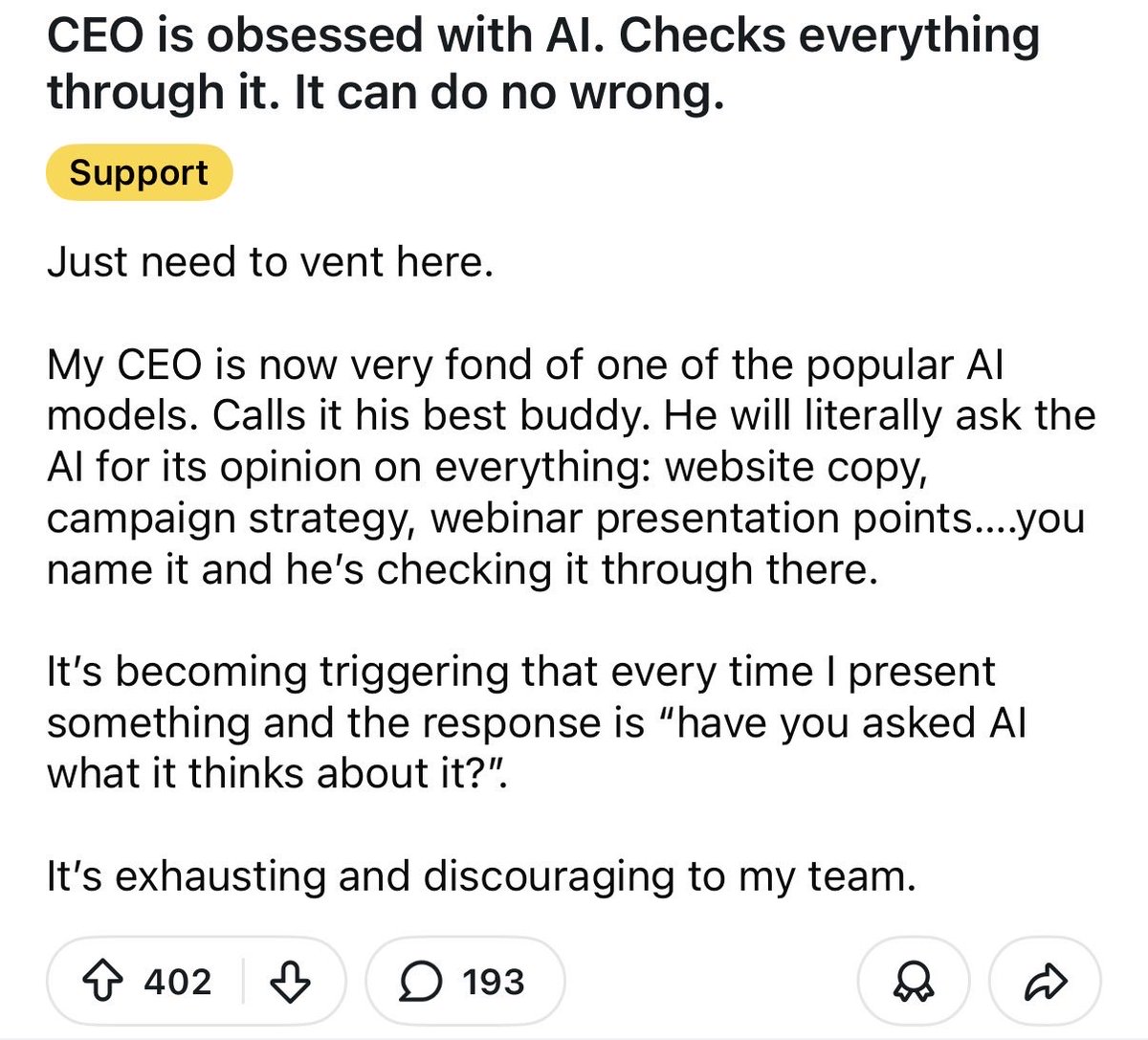
@milkkarten Nope, just my real take. I’m all for AI in the workplace. But when leadership trusts a tool’s judgment over its own team’s, that’s not an AI strategy.
English
0
0
0
3
Andrea | Code to People
Andrea | Code to People@codetopeople·
@milkkarten When leadership outsources judgment to a tool, it doesn’t just slow things down - it tells your team that their expertise and experience don’t count for much. That’s a trust problem, not an AI problem.
English
3
0
0
204
Rachel Karten
Rachel Karten@milkkarten·
it’s important to understand the impact workplace ai obsession has on team morale and boss perception
Rachel Karten tweet media
English
113
413
5.1K
127.8K
Andrea | Code to People
Andrea | Code to People@codetopeople·
@Stopworkplacebu Most gatekeepers weren’t born that way. They were never properly developed by their own managers, so knowledge felt like the only leverage they had. It’s a culture problem that gets passed down until someone breaks the cycle.
English
0
0
0
9
Workplace Mental Health Resources
You’re not leadership material if you gatekeep wisdom like it’s job security. Mentorship isn’t about protecting your throne—it’s about building successors. Hoarding wisdom will get you nowhere. Great leaders don’t fear being replaced over time; They pave the way for it. 🖐
English
9
39
150
3.3K
Andrea | Code to People
Andrea | Code to People@codetopeople·
Hot take: being promoted into management should require as much vetting as hiring externally. We don't ask ICs 'do you actually want to manage people?' We just assume the best performers do and promote them. Then we're surprised when great engineers, analysts, and data scientists struggle in management roles they didn't choose. The skills that make you exceptional at the work don't automatically transfer. Agree or disagree?
English
0
0
2
70
The Random Recruiter
The Random Recruiter@randomrecruiter·
When your boss sends "hey, got a sec?" with no context
The Random Recruiter tweet media
English
12
144
1.7K
33.8K
Andrea | Code to People
Andrea | Code to People@codetopeople·
This is exactly why the analyst role isn’t going away - it’s evolving. The institutional context, the judgment about which metrics to trust, knowing what changed in the business last quarter - that lives with people, not models. The best analysts I’ve managed are the ones who can hold all of that and translate it into a decision. That’s still very human work.
English
0
0
0
24
Julie Zhuo
Julie Zhuo@joulee·
Everyone is trying AI analysis with agents. No one has gotten it to be trustworthy enough to open widely to all business users. Dozens of companies I've spoken to in the past few weeks have told me this. Why is that? It turns out, the last 15-30% of quality and trust in analysis is really really hard to get right. This is what your best analysts know that AI doesn't yet: 1. Which metrics to trust, out of the mess of metrics and contradicting dashboards 2. What's changed in the business behind the numbers, including strategy, roadmaps, or just one-off edge cases. 3. How to actually think about the problem, including what its downstream implications and decisions are and how it should be scoped 4. What happened last time, and what feedback signals should alter our future judgements AI can sound smart while being wrong in exactly the ways that waste the most time. Wrote an article explaining this, and what we can do about it, in the latest in Opinionated Intelligence.
Julie Zhuo tweet media
English
5
1
4
1.7K
Andrea | Code to People
Andrea | Code to People@codetopeople·
@Gavel_on_X Learning to communicate up. Most people optimize for doing great work. Far fewer learn how to make that work visible to the people who make decisions about their career. It’s not politics - it’s just how organizations actually function.
English
0
0
0
3
Gavel
Gavel@Gavel_on_X·
In your opinion, what’s one business skill everyone should learn first?
English
103
1
75
3.5K