

Dan Greller
2.7K posts

Dan Greller
@dgreller
Tech optimist inspired by psychology, economics and history. Liberty, Stoicism, epistemic humility, civil discourse, innovation, automation, #AI
Baltimore 参加日 Şubat 2011
379 フォロー中337 フォロワー

New: Readwise for @openclaw
Save anything with one click from your browser or phone: articles, tweets, books, youtube, podcasts, newsletters, more.
Your claw now has instant access to that full library as markdown. Easily search and actually stay on top of it all.
English

So that’s pretty cool. Silver play button just showed up. 100k subscribers is indeed a milestone I won’t forget.


English
@sukh_saroy Create 500 word markdown summary of this post with links
English

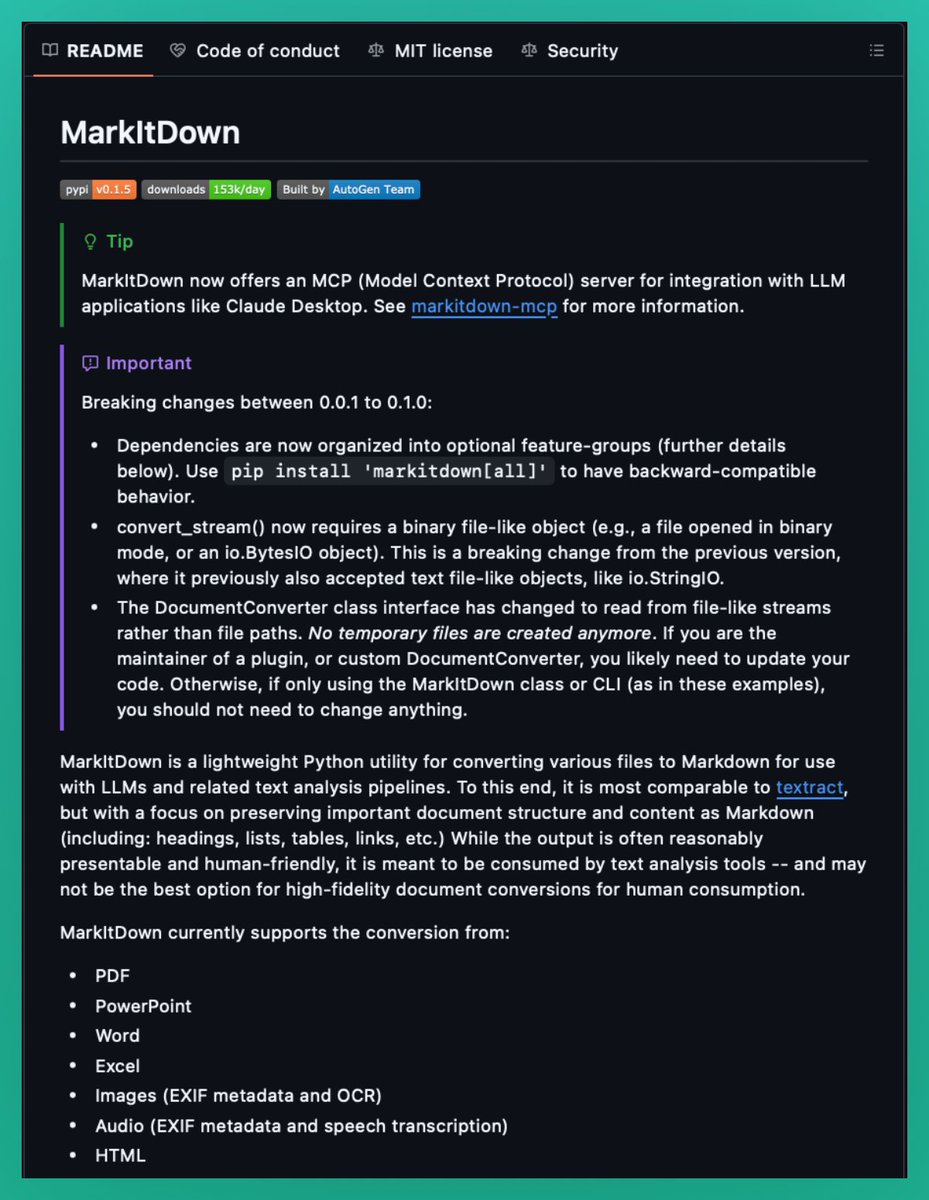
🚨Shocking: Microsoft just open sourced a Python tool that converts any file into Markdown for LLMs.
It's called MarkItDown. And it's not a document formatter.
It's a lightweight conversion utility built specifically for AI pipelines - takes any file you throw at it and outputs clean Markdown that LLMs can actually read and reason about.
Here's what it converts:
→ PDF - full text extraction with structure preserved
→ PowerPoint - slides, headings, bullet points
→ Word - full document with lists, tables, links
→ Excel - tabular data as Markdown tables
→ Images - EXIF metadata + OCR text extraction
→ Audio - EXIF metadata + speech transcription
→ YouTube URLs - fetches transcription automatically
→ HTML, CSV, JSON, XML, EPubs, ZIP files - all supported
Here's the wildest part:
LLMs natively speak Markdown. They've been trained on vast amounts of it.
When you convert your PDF or Excel file to Markdown before feeding it to an LLM, you get better extraction, better reasoning, and more token-efficient output than raw text or HTML.
One command:
`markitdown path-to-file.pdf > document.md`
Also ships as an MCP server for Claude Desktop integration.
87K GitHub stars. Used by 2,200+ projects. Built by the AutoGen team at Microsoft.
100% Open Source. MIT License.
(Link in the comments)
English

⚡️This is the moment the model gets hands.
That is the real threshold.
Once an AI can see the screen, move the cursor, type, navigate software, and execute workflows across arbitrary apps, the whole game changes. The limiting factor stops being language quality. The limiting factor becomes agency. Can the model actually do the work, not just describe it.
That is why this matters so much. The modern office is already a robot environment. Buttons, forms, dashboards, tabs, permissions, drop-downs, inboxes, calendars, CRMs, spreadsheets, admin portals. Humans were the temporary glue holding all that fragmented software together. The moment an AI can operate the same interfaces, a huge amount of white collar labor becomes directly attackable without waiting for every company in the world to rebuild its stack.
A lot of “knowledge work” was never pure insight. It was operational stitching. Open this. Copy that. Check this field. Schedule that meeting. Move this information between systems. Generate the draft. Update the CRM. Reconcile the report. Upload the file. Follow the workflow. Escalate the exception. Once the model can touch the interface, the human integration layer starts getting erased.
The desktop is becoming the first real robot body for AI.
People keep imagining humanoids as the big labor shock. The real labor shock arrives sooner through screens. The average office worker already lives inside a digital box. If the model can act inside that box, it has entered the worker’s physical domain. That is enough to trigger a major compression wave.
The first wave will be supervised agency. One human overseeing multiple agentic processes. One operator managing ten machine clerks. One analyst managing five machine researchers. One coordinator managing twenty machine admins. That still destroys labor demand because the firm no longer needs one human per workflow. It needs one human per cluster of workflows.
That is where the real cull begins.
The next layer is organizational. Middle management, operations teams, chiefs of staff, coordinators, assistants, junior analysts, support staff, back-office processors, internal service functions, all the roles built around moving information through software become vulnerable. Once the CEO, VP, or manager can directly deploy agentic systems into the stack, the argument for multiple relay layers gets weaker fast.
And deep down, this is how bureaucracy starts dying. Through hundreds of micro-automations that remove the need for human routing, human clicking, human follow-up, human translation, human glue.
The deepest part is that capability is no longer the hardest problem.
Trust is.
Who gets permission.
Who watches the model.
Who is liable when it clicks the wrong button.
Who audits what it did.
Who controls the credentials.
Who stops the model from becoming a security breach with a smile on its face.
That is the next battlefield. The winning AI platform will not just be the one that can act. It will be the one enterprises trust enough to let act at scale. Reliability, auditability, security, permissions, rollback, human override, those become more important than one more bump in benchmark intelligence.
So my real view is simple.
This is one of the most important threshold crossings so far.
AI is moving from cognition into execution.
The computer is becoming its robot body.
The office stack is becoming automatable in place.
A massive slice of white collar labor is now in the blast zone.
Once the model can operate the software, the countdown starts.
Felix Rieseberg@felixrieseberg
Today, we’re releasing a feature that allows Claude to control your computer: Mouse, keyboard, and screen, giving it the ability to use any app. I believe this is especially useful if used with Dispatch, which allows you to remotely control Claude on your computer while you’re away.
English

Anthropic is rolling out computer use! Claude will be "finally" able to control your mac, see things, click things, do things!
This is awesome especially paired with the Dispatch thing they launched where you can link 1? mac to your ios account and send messages while your computer is not asleep.
I don't seem to have this yet? Hopefully soon!

Felix Rieseberg@felixrieseberg
Today, we’re releasing a feature that allows Claude to control your computer: Mouse, keyboard, and screen, giving it the ability to use any app. I believe this is especially useful if used with Dispatch, which allows you to remotely control Claude on your computer while you’re away.
English
Interesting post and thread on why enterprise AI implementations are failing. The excess governance structure suggested here has always held back innovation with past technology transformations. But in previous waves, firms had time to ponder, plan and play catch-up. With AI, this behavior will turn you into a 1/10x competitor.
Pascal Bornet@pascal_bornet
The real reason AI is failing inside companies? Let’s say it. A company decides to go all-in on AI. The CEO announces the vision. The CTO aligns. The CIO gets the budget. Then the real transformation begins. Chief AI Officer. AI Center of Excellence. AI Ethics. AI Governance. AI Steering Committee. AI Committee for the AI Committee. Soon, you have 12 people managing AI. And one person using it. The intern. The only one actually shipping anything. Everyone else is busy… aligning on the prompt. AI doesn’t fail because of the technology. It fails because we turned it into a meeting. So here’s a thought: Are you building with AI… or scheduling it? #ArtificialIntelligence #AITransformation #Leadership #FutureOfWork #Innovation
English
@SergioRocks Yes - And this will be true for other domains where people are leveraging agents. Work shifts from doing to determining what problems to solve, defining requirements, overseeing orchestration and validating results.
English

The best Software Engineers now spend less time coding.
Not because coding is less important. But because it’s no longer the bottleneck.
Tools like Cursor, Claude Code, and Copilot can now generate large parts of the implementation.
The leverage moved.
What senior engineers increasingly spend time on is:
- Designing the system before code exists
- Deciding what should actually be built
- Structuring the context so AI can execute correctly
In other words, less typing. More thinking.
This is why the gap between Software Engineers is widening.
- Some are still focused on writing code faster.
- Others are focused on defining the system clearly and letting AI accelerate the build.
AI didn’t eliminate engineering skill. It shifted where the skill sits.
Coding used to be the scarce resource. Now clarity and direction are.
English
This so spot on. People fall into black and white thinking here regarding whether agents can perfectly handle the task or not. There are a variety of possibilities available today. First - agents are ready for prime time and clearly exceed humans in accuracy or efficiency. Two - agents with humans in the loop as a team. Three - agents not ready for prime time. However, it's a moving bar so next month's improvements will shift some potential workload from 3>2 and 2>1.
English

Too many teams dismiss AI agents because they don't deliver the exact, deterministic results traditional systems do. But that's the wrong benchmark.
Luke (Medable) reframes the question: How can agents have less variance of errors than a human doing the same job? With 10,000 uncured illnesses and 200 years to go at the current pace, the goal isn't replacing humans—it's enabling them to run more clinical operations, faster.
👉 Find a link to the full episode here:
Spotify: buff.ly/GgZGVmd
Apple Podcast: buff.ly/ROfAMDJ
YouTube: buff.ly/mLwne6h
English
@APompliano Great post. Can you provide any details on the companies you are describing here? How many associates, industry sector. I agree with your general premise. Curious where you have seen this actual traction. thanks!
English

Here are 13 things learned after making a big push to integrate AI into our companies:
1. We haven’t replaced a single external SaaS tool with something we built internally.
2. We have refrained from hiring numerous entry level jobs because AI can do the work faster/better/cheaper.
3. The automation provided by AI highlights how much time every person was wasting on tedious tasks daily.
4. Each company is capturing more revenue and each employee is becoming more productive.
5. There is still a bit of apprehension in giving agents full control of machines or systems.
6. There has been no obvious trend in age, gender, or role for those who adopt AI the fastest. More of a mindset than anything.
7. Many non-technical people have started to create software tools or products, which has changed the speed of execution across the companies.
8. One downside is the AI slop across written documents/memos. If humans don’t review the content, it is painful to read and I worry critical thinking gets lost.
9. The implementations of AI are incredible once you get them done, but it is much more difficult to build/implement than most people want to communicate online. Persistence needed!
10. We have walked away from numerous potential small acquisitions because we realized we could build the product ourselves for a fraction of the cost.
11. Our best engineers are invincible now. They produce high quality products at warp speed. Forget 10x engineers, they are 1,000x engineers now.
12. The adoption of AI starts at the top. If the company leader is not constantly asking “how do we automate this?,” it is harder to drive internal change.
13. I am personally working harder than I have in a long time and having more fun than ever. It feels like a moment in time that has to be seized.
Overall, I believe AI is underestimated, not overestimated. The worries about SaaS software are probably overblown. The labor market impact is very real and only accelerating.
Businesses are fundamentally changing. Start paying attention!
English
@paraclete06 @testingcatalog @AnthropicAI @felixrieseberg Agreed. I have built my scaffolding around Claude Code in terminal mode. Can this also provide the same capabilities but with nicer UI.
English

@testingcatalog Project folders in cowork eliminate half of the scaffolding I built to maintain context across cowork chats.
@AnthropicAI’s @felixrieseberg was right:
Invest in skills, not workarounds. The platform will catch up.
The velocity is mind boggling though.
English

BREAKING 🚨: Anthropic is planning to release Projects for Claude Cowork!
Projects will have a dedicated local folder to work with, as well as a new section for project-specific scheduled tasks for Cowork.
English
@hnshah Tried a few times with different browsers and can't seem to sign up. getting no response. May be user issue but wanted to alert you in case it is a site prob.
English

@dgreller Just decided to postpone it until next week. If you want a heads up for time and link, sign up at hiten.com x.com/hnshah/status/…
Hiten Shah@hnshah
Got some feedback as I've been working on this session. Going to postpone it for one week. No live session this Friday. The time will be 10am PT to help more folks attend. And I'll do this one next Friday. In the mean time, stay tuned for some nuggets...
English
I’m doing another live AI session on Friday. It’s on a topic countless people have asked me to talk about. 🦞💬
English
@daniel_mac8 @latentspacepod This is profound and is going to be at the heart of many similar decisions. How much effort do you put into engineering for specific outcomes with the current capabilities as opposed to waiting for the new models to simply handle those issues inherently.
English

Felix Rieseberg, Anthropic's Claude Cowork lead, shares an incredible insight on @latentspacepod.
This insight is something that you'll only get from an insider engineer:
"Is the right thing to invest in these scaffolding corrections? Or is it to give the model many capabilities, try to make those safe, then just wait a second for the next model to drop?"
That's where Anthropic engineers who work directly with Claude see the puck going.
You need to do the same.
Assume that, whatever you are building, the model will continue to get exponentially better, and your custom scaffolding becomes irrelevant.
English
@BenjaminBadejo Totally understand and appreciate all you do to help inform this community. Agree with your last point. Whenever anyone asks me how I am doing anything I ask Claude to explain it!
English

@dgreller I definitely will be writing more soon. I’m spending so much time on the doing part and finding enough time for the writing part is a challenge. Though I suppose I could use AI to do so more quickly!
English
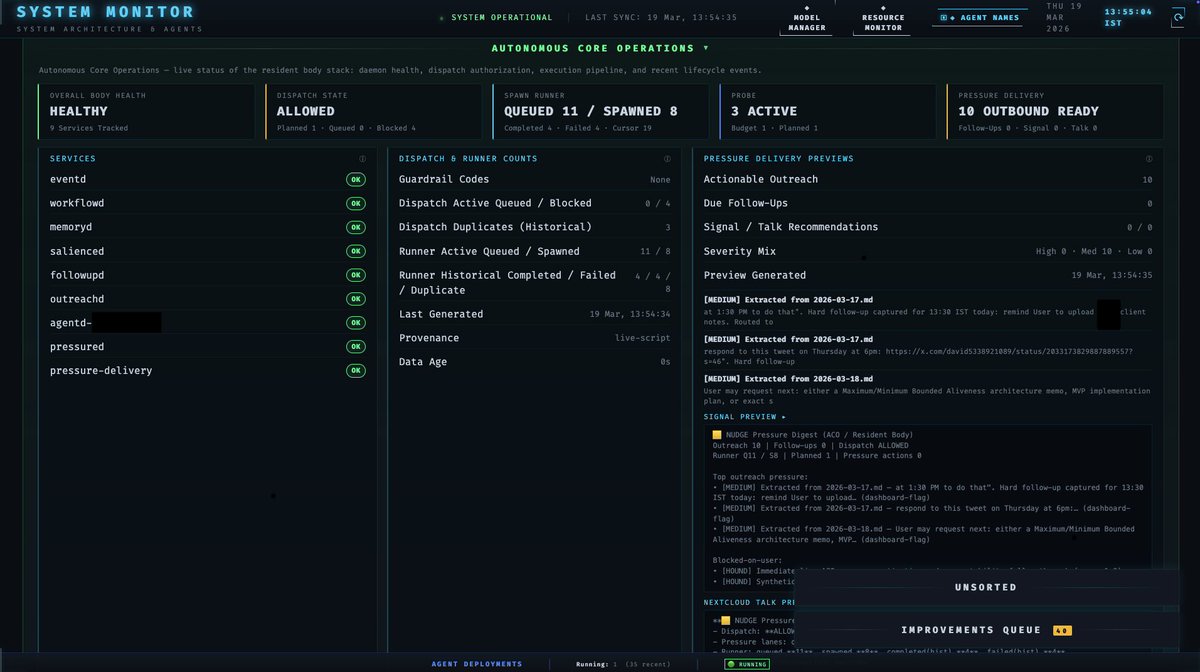
Goodbye, AI crons and heartbeats. Hello AI-powered on-device background system services. For those with a discerning eye, look at the daemons (continuous background services) on the left. Then ask yourself if they are all AI-powered.
They are.
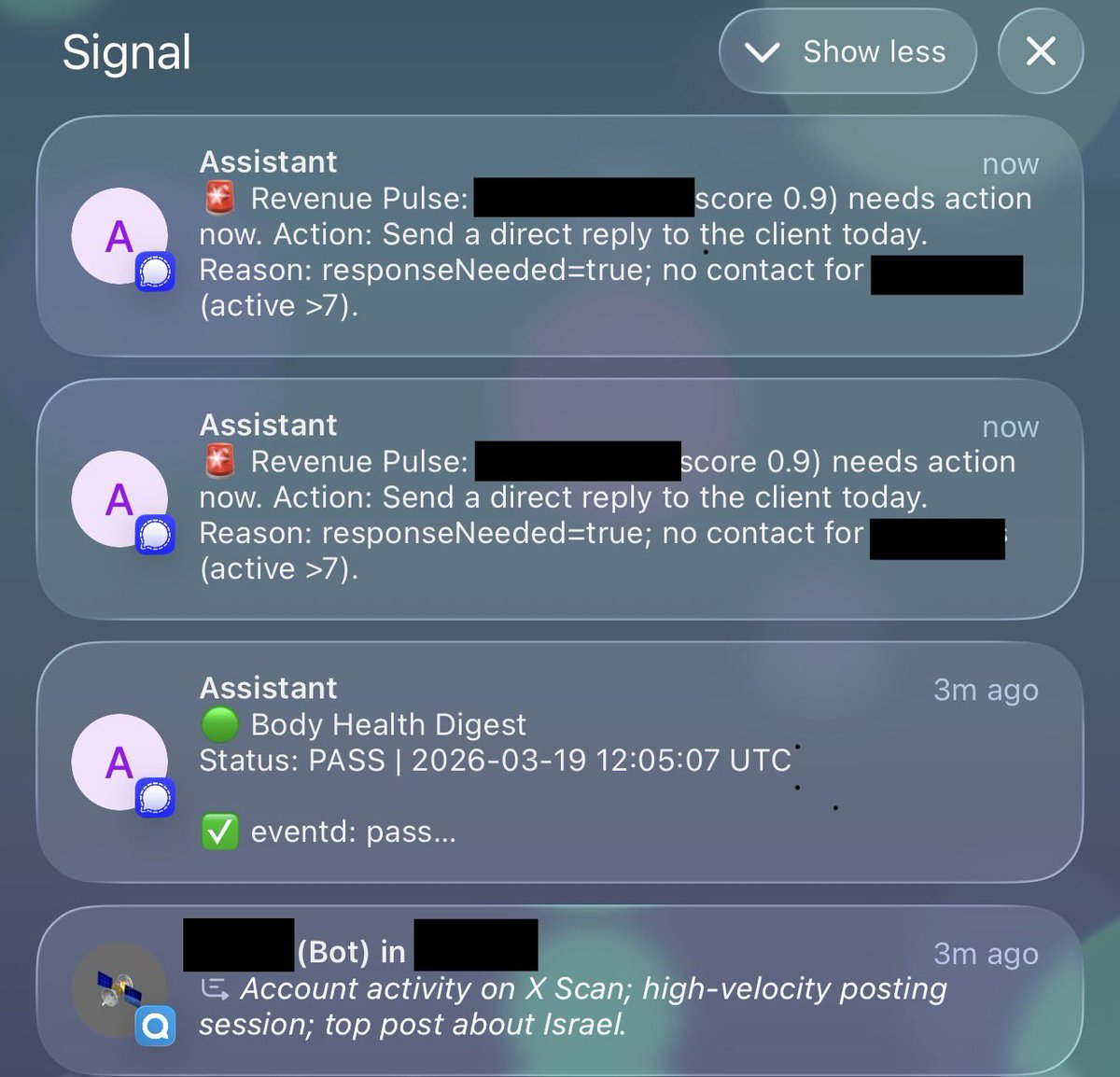
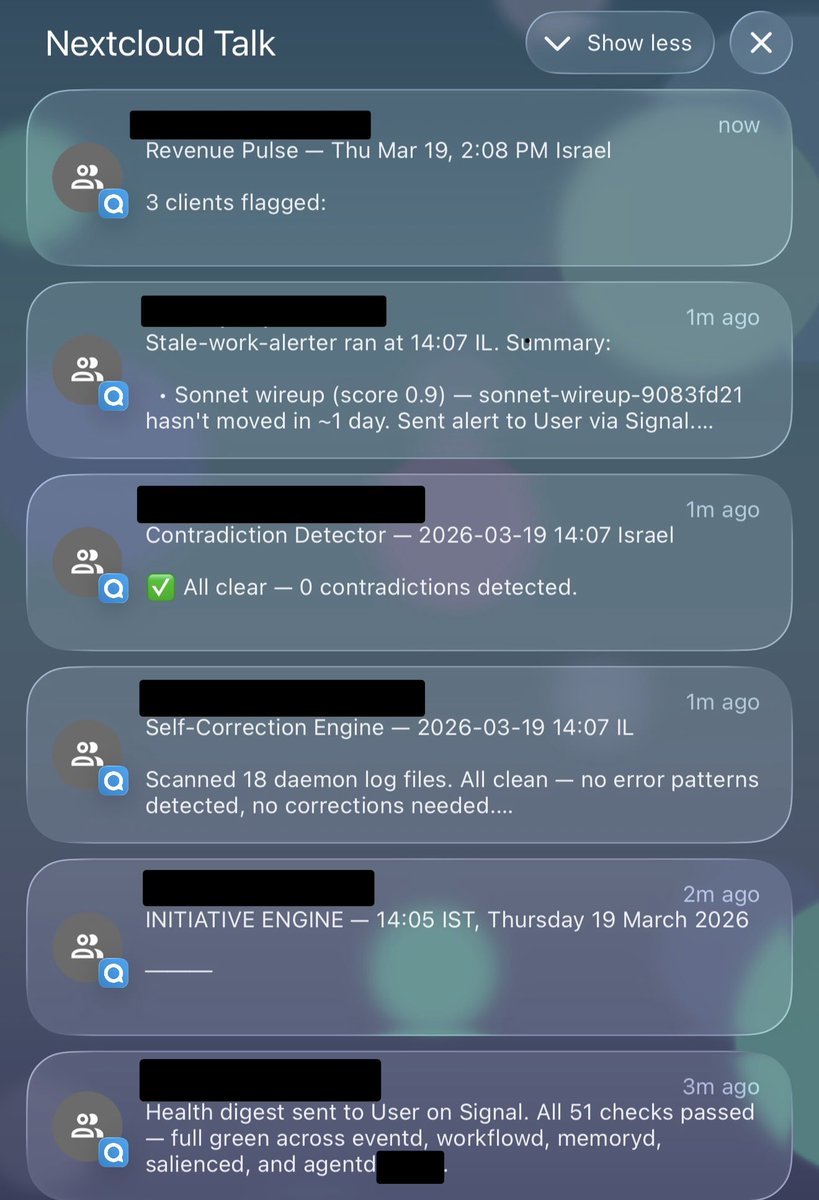
In short, this is a truly self-driven engine that ingests, monitors, creates and escalates tasks, task progression, system behavior, and agent work, picks up and forces forward work that seems incomplete based on its own independent monitoring and continuous state awareness, and escalates reminders by multiple messaging channels (including, soon, phone). It doesn’t do this when asked or even on a schedule — it does it on its own.
Continuously. No more scheduled jobs. No more dropped tasks, processes, or projects. It is always working. Always.
“Pressure,” and “Pressure Delivery” are particularly fun. Look at the bottom right: “Nudge.” “Hound.”
Built this in a single sprint. Now I can breathe and take a walk. No more building stuff for myself for a little while. Now back to building for others!
English
While I agree that AI may have a democratizing impact across developers, his main point, at least for now, is overly simplistic. To date, there is still no "magic button" that anyone pushes that will elegantly solve all problems, or even know what problems to solve. There still needs to be a human in the loop providing initial direction, monitoring progress (and course correcting) and validating ultimate outputs. These will be important skills that will separate 10x product managers (or whatever that role is called in this new world).
English

Chamath on how AI agents are making the "10x engineer" distinction disappear because the most efficient "code paths" are now obvious to everyone.
Just as AI solved chess and removed the mystery of the best move, AI is doing the same for coding, making the process reductive and removing technical differentiation.
"I'm going to say something controversial: I don't think developers anymore have good judgment. Developers get to the answer, or they don't get to the answer, and that's what agents have done. The 10x engineer used to have better judgment than the 1x engineer, but by making everybody a 10x engineer, you're taking judgment away. You're taking code paths that are now obvious and making them available to everybody.
It's effectively like what happened in chess: an AI created a solver so everybody understood the most efficient path in every single spot to do the most EV-positive (expected value positive) thing. Coding is very similar in that way; you can reduce it and view it very reductively, so there is no differentiation in code."
---
From @theallinpod YT channel (link in comment)
English
Dan Greller がリツイート

Had meetings and a dinner with 20+ enterprise AI and IT leaders today. Lots of interesting conversations around the state of AI in large enterprises, especially regulated businesses.
Here are some of general trends:
* Agents are clearly the big thing. Enterprises moving from talking about chatbots to agents, though we’re still very early. Coding is still the dominant agentic use-case being adopted thus far, with other categories of across knowledge work starting to emerge. Lots of agentic work moving from pilots and PoCs into production, and some enterprises had lots of active live use-cases.
* Agentic use-cases span every part of a business, from back office operations to client facing experiences from sales to customer onboarding workflows. General feeling is that agentic workflows will hit every part of an organization, often with biggest focus on delivering better for customers, getting better insights and intelligence from data and documents, speeding up high ROI workflows with agents, and so on. Very limited discussion on pure cost cutting.
* Data and AI governance still remain core challenges. Getting data and content into a spot that agents can securely and easily operate on remains a huge task for more organizations. Years of data management fragmentation that wasn’t a problem now is an issue for enterprises looking to adopt agents. And governing what agents can do with data in a workflow still a major topic.
* Identity emerging as a big topic. Can the agent have access to everything you have? In a world of dozens of agents working on behalf, potentially too much data exposure and scope for the agents. How do we manage agents with partitioned level of access to your information?
* Lots of emerging questions on how we will budget for tokens across use-cases and teams. Companies don’t want to constrain use-cases, but equally need to be mindful of ultimate token budgets. This is going to become a bigger part of OpEx over time, and probably won’t make sense to be considered an IT budget anymore. Likely needs to be factored into the rest of operating expenses.
* Interoperability is key. Every enterprise is deploying multiple AI systems right now, and it’s unlikely that there’s going to be a single platform to rule them all. Customers are getting savvier on how to handle agent interoperability, and this will be one of the biggest drivers of an AI stack going forward.
Lots more takeaways than just this, but needless to say the momentum is building but equally enterprises are acutely aware of the change management and work ahead. Lots of opportunity right now.
English
Agreed. The average firm is using a fraction of the current capabilities. Many using chat bots as simple Q&A oracles. Many using level 1 autocomplete for AI assisted software development. In many firms, security and governance concerns keep many associates from even having access to the tooling. A tiny fraction are actually doing anything significant with agents. To your point, there is huge amount of potential value by simply unlocking the existing powers of foundation models and all of the available tools and scaffolding.
English

If foundation models did nothing else but simply tried to get companies to adopt what they’ve already built in ways that are coherent with the goals and objectives of those companies - (and made no additional progress on the models) they would be busy for a long long time. It’s crazy to me that we have so much capability overhang and then folks want to talk lots about any hint of decelerating progress (which I would also bet money against - the exponential will continue)
expatanon@expatanon
Altman admitted that transformer models have hit the wall. Most improvements in the last 9 months are attributable more to the tooling around the model rather than the models themselves. In other words, this technology is rapidly maturing with no signs of another leap.
English
@mstockton @intercom 100% and what will happen a year from now when the firms leveraging these progressive ideas are now 25x instead of 10x the laggards. This is no longer a world where the best are 10% better or even 2x the average player.
English
This is the "highest alpha" compound engineering thread I have ever read - by a long shot too. It is simply astounding what @intercom is doing. It takes compound engineering to an entirely different level - it's not even about just engineering - it's the entire organization. It is "organizational compounding" through extremely smart orchestration of AI.
It's wild, because there is such a spectrum of how companies use AI. Some have no strategy to use it, or just deploy a very restricted co-pilot - and then 10% of their employees use it like a glorified search engine.
And then you have this. What do you think will happen to the performance gap between these two types of companies?
Also, what do you think foundation lab companies are doing? They are clearly even more all-in on this type of thing, and they have access to better models and better ways to tie this all together.
What a wild and exciting time to be going AI-first.
Brian Scanlan@brian_scanlan
We've been building an internal Claude Code plugin system at Intercom with 13 plugins, 100+ skills, and hooks that turn Claude into a full-stack engineering platform. Lots done, more to do. Here's a thread of some highlights.
English
So true on all accounts. The gap between those who "get it" and those using yesterday's work methods is growing by the day. Without meaning to sound condescending I'm reminded of Mr. T's catchphrase "I pity the fool..". In this case, I pity those who don't understand agentic AI or simply dismiss it as unimportant. As you rightly point out, anyone can bootstrap their way forward by simply asking a chatbot for help.
English
This is the most inspiring AI adoption story I have ever heard. This story is such a great representation of the core skills you need to adopt AI. They aren't technical at all.
They are: Agency, Curiosity, Beginner's Mindset, Persistence, and above all else:
The willingness to Just. Get. Started.
This ~15min interview is worth watching from start to finish. When people ask how to get started w/ AI, I am just going to send them this video from now on. My favorite part is the end where Cory says this. This is basically the only AI advice you need:
"...first download Claude. If you don't know how to download Claude, ask Claude and tell you, I've literally like, hey, step by step, screenshot, like step one, here's what my screen looks like. Where do I click? Step two screenshot. What do I click? And like, now it tells you, it could read all that stuff and screenshots and copy paste into the into the into the chat is huge. And it's, it's just too easy now. I mean, it'll answer anything you have. And I did this literally with zero person, I outside help other than the AI screenshots, step by step. Tell me like, I don't know anything about this stuff. Explain like I'm five, you know, you dumb it down to your own knowledge."
Never been a better time to roll up your sleeves. What's stopping you?
Todd Saunders@toddsaunders
I know Silicon Valley startups don't want to hear this..... But the combination of someone in the trades with deep domain expertise and Claude Code will run circles around your generic software. I talked to Cory LaChance this morning, a mechanical engineer in industrial piping construction in Houston. He normally works with chemical plants and refineries, but now he also works with the terminal He reached out in a DM a few days ago and I was so fired up by his story, I asked him if we could record the conversation and share it. He built a full application that industrial contractors are using every day. It reads piping isometric drawings and automatically extracts every weld count, every material spec, every commodity code. Work that took 10 minutes per drawing now takes 60 seconds. It can do 100 drawings in five minutes, saving days of time. His co-workers are all mind blown, and when he talks to them, it's like they are speaking different languages. His fabrication shop uses it daily, and he built the entire thing in 8 weeks. During those 8 weeks he also had to learn everything about Claude Code, the terminal, VS Code, everything. My favorite quote from him was when he said, "I literally did this with zero outside help other than the AI. My favorite tools are screenshots, step by step instructions and asking Claude to explain things like I'm five." Every trades worker with deep expertise and a willingness to sit down with Claude Code for a few weekends is now a potential software founder. I can't wait to meet more people like Cory.
English