固定されたツイート

dylanmints
62.8K posts

@dylanmints
your favourite degen | building @fckthejeets + @pepoburb




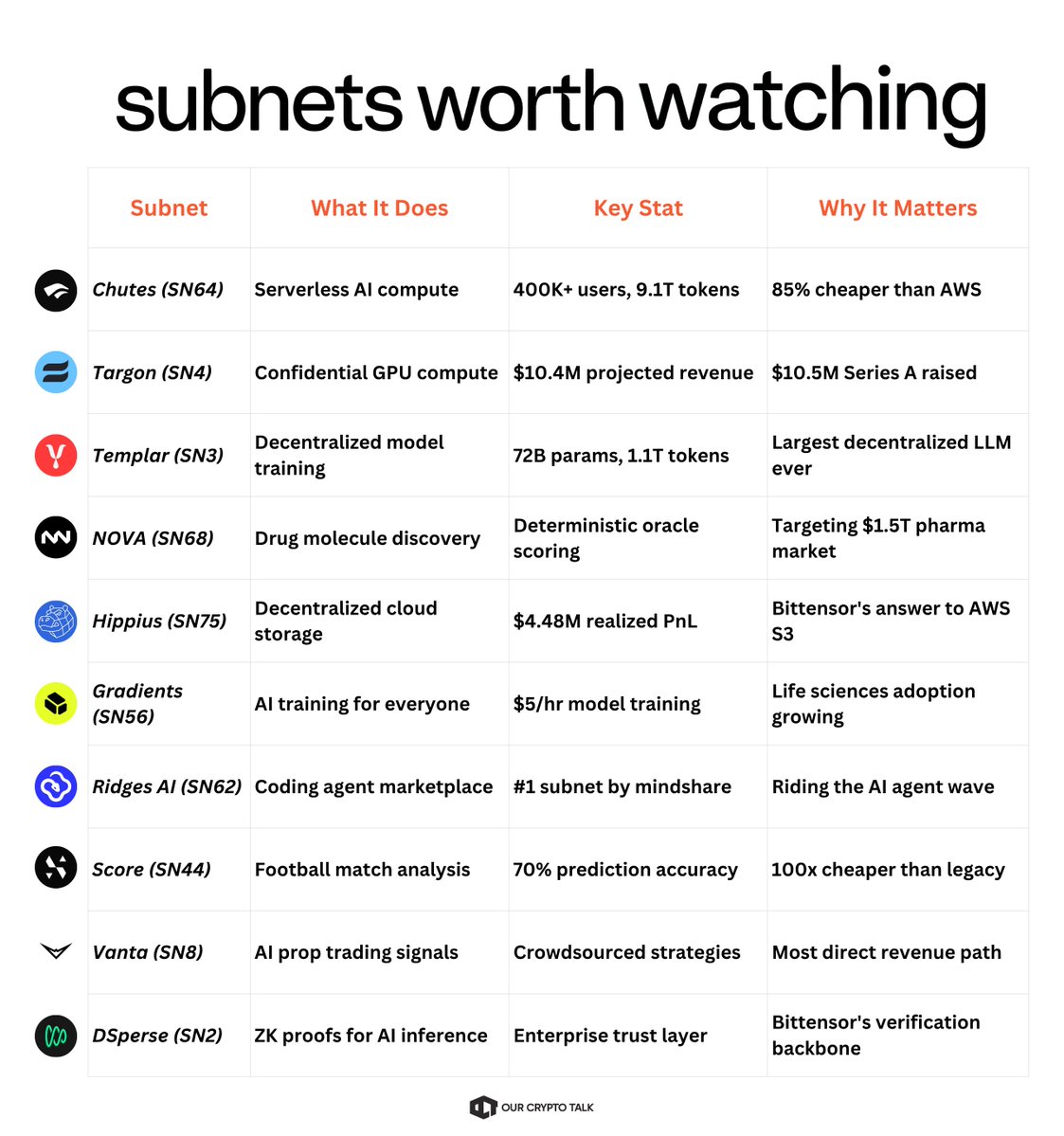
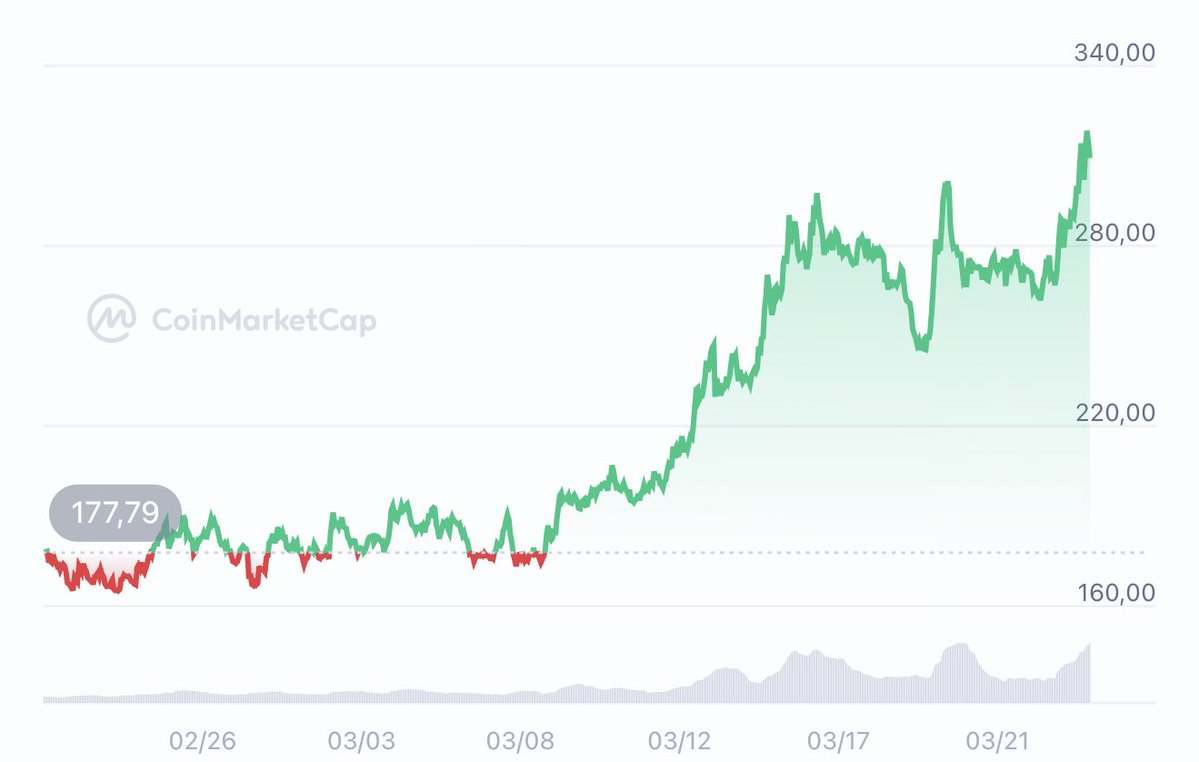
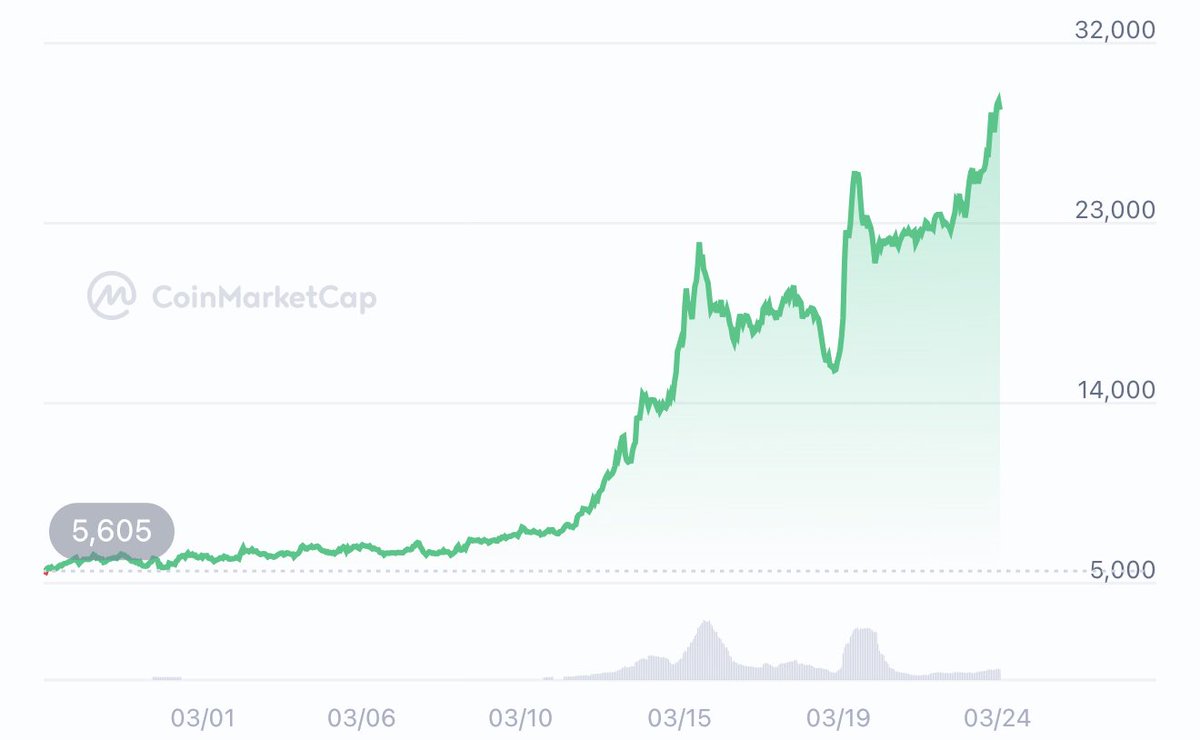
Look at this $TAO subnet chart Then, look at the numbers. And tell me with a straight face these subnets are overvalued. Bittensor subnet economy, all 128 slots combined, is worth about $1.36 billion. Everything. Compare that to how the centralized world prices similar businesses. Together, AI is reportedly discussing a raise at a $7.5 billion valuation. Their business is simple. Rent GPUs. Serve open-source models through an API. Now look at @chutes_ai SN64. Same broad category. Inference infrastructure. Open-source models. API access. Huge user growth. Real usage. Decentralized rails. Market cap around $126 million. That is the kind of gap people are still not understanding. Look at CoreWeave. Roughly $38 billion market cap. Massive projected revenue, yes. But also massive capex, huge debt, and huge losses. The market still gives them the valuation because compute is that important. Now look at @TargonCompute SN4. Confidential compute. Hardware-level validation. Intel co-authored work around their architecture. Real enterprise-grade angle. Market cap around $81 million. You are looking at one world pricing centralized compute companies in the tens of billions, and another world pricing decentralized versions at fractions of that. Not normal. It's mispricing. Then there is @tplr_ai SN3. Around $125 million market cap. Templar trained Covenant-72B in a decentralized way. No single company. Just global GPUs coordinated through incentives. That is a technical milestone. And it got noticed. When a subnet proves decentralized training at that scale is possible, it is not just bullish for one token. It raises the credibility of the entire Bittensor architecture. Then look at @webuildscore SN44. Roughly $38.8 million. Real partnerships. Real deployment. Real customers. Sports, agriculture, energy, retail. The kind of traction that in Silicon Valley. Then @ridges_ai SN62 around $46 million. Agent infrastructure. And this matters because if the agent economy really grows the way many believe it will, then the infrastructure underneath those agents becomes one of the most important layers in the whole stack. Then @affine_io SN120 around $61 million. Reasoning. At a time when reasoning is becoming one of the highest-value capabilities in AI. Then @MacrocosmosAI SN9 @IOTA_SN9 around $39 million. Training and data infrastructure, in a world where training quality and data quality keep becoming more important. Then @MetaNova SN68 around $26 million. Still valued below what plenty of mediocre startups raise in early private rounds with far less visibility and far less proof. And that brings me to the part most people in crypto still do not fully grasp. A private valuation is not the same thing as a live market cap. When VCs mark a company at $7.5 billion, that number is usually based on one financing round, one set of terms, one class of shares, and one protected group of investors. You cannot buy it freely. You cannot sell it freely. There is no real-time global price discovery. When a subnet has a market cap of $126 million, that is a live market. Anyone can enter. Anyone can exit. It trades 24/7. The price is constantly being tested by the market itself. In a lot of ways, that number is more real than the inflated private marks people keep using as benchmarks. And still the centralized company gets 20x, 40x, 60x the valuation. That is why I keep saying people are not thinking big enough. The whole subnet economy at $1.36 billion is less than what Silicon Valley gives a single hot AI company. Less than what hyperscalers spend in no time. Less than what the market is willing to forgive in losses if the story sounds big enough. Here you have 128 separate AI and startup-like markets running at once. Inference. Training. Reasoning. Vision. Storage. Prediction. Agent infrastructure. Compute. Real estate intelligence. And more. All competing in public. All priced in real time. $TAO DYOR.


"Challenges the political economy of AI." That's how Jack Clark ( @jackclarkSF), co-founded @AnthropicAI, ran policy at @OpenAI, described what Templar is doing. He's now featured it in Import AI twice. 1/n

Fair, the Llama 2 bar is low. But worth knowing this model was trained on 5% of a frontier token budget with no RL, by 70 permissionless peers over the internet. The benchmark was to validate the method at that scale, not to compete with anything recent. The zero-to-one was proving decentralised training works at 72B. That's what matters here. And honestly, the shovels might be more valuable than the gold. The economics of building frontier models are brutal. Creating an entirely new paradigm for producing them at scale is the bigger prize. @synapz_org wrote the best breakdown of why judging @tplr_ai on day-one performance is the wrong frame: synapz.org/posts/2026-03-…



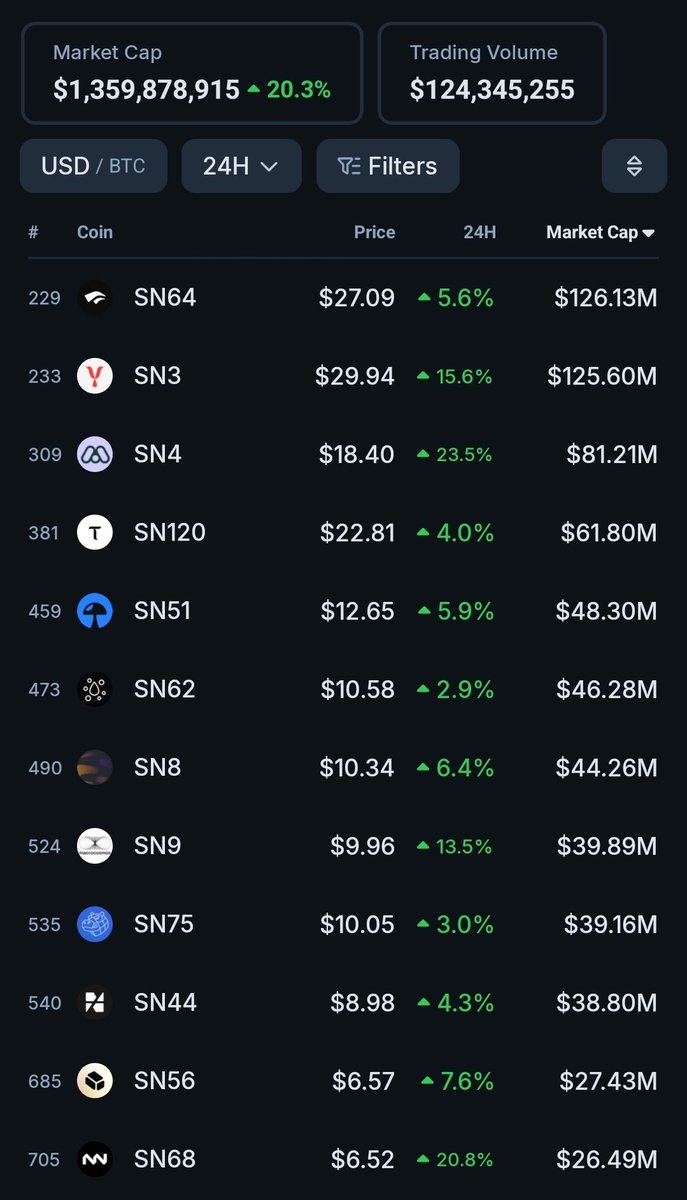
INSIGHT: Bittensor subnets are pumping alongside $TAO with the category gaining 18.6% today. Track #dTAO subnets here: coingecko.com/en/categories/…