Jazz • Product & Motion Designer #NeoBank

652 posts

Jazz • Product & Motion Designer #NeoBank banner
Jazz • Product & Motion Designer #NeoBank

Jazz • Product & Motion Designer #NeoBank

@jazzflows

The financial stack is being rebuilt. I design how people trust it. Neobanks · Stablecoins · Agentic Payments Brand Identity · UI/UX · Motion · AI Video

Dubai, UAE 参加日 Temmuz 2025
36 フォロー中28 フォロワー
Cristóbal Valenzuela
Cristóbal Valenzuela@c_valenzuelab·
A huge part of getting good at anything is simply making a lot of stuff. I mean volume. Repetition. Doing things over and over again. Especially when you’re starting out, you think the people who are good must have found some secret. Like they’re more talented, or more confident, or they know something you don’t. But usually, what they’ve really done is make far more work than you realize. Probably things no one has ever seen. They might not even want to share it because it's bad. They’ve gone through draft after draft, project after project, attempt after attempt. They’ve made enough things to get strong. That’s the most underestimated aspect of greatness. Quantity leads to quality. You do a large body of work, and inside that body of work, you begin to notice things. You notice your habits. You notice your weaknesses. You notice what keeps failing, what keeps working. You cannot learn those lessons just by thinking about the work. You only learn them by making the work. And a lot of people quit too early. They make a few things, maybe even a few dozen things, and because the work doesn’t yet look the way they want it to, they decide they’re not good enough. But that’s not what’s happening. What’s happening is that they’re still in the process. Trust the process. More than anything else, especially when you suck and it’s painful. You have to give yourself permission to make a lot. To make imperfect things. Bad things. Things you feel ashamed to show. Because every finished piece is teaching you something. Every attempt is building judgment. The people who get good are very often just the people who stay in the game long enough to let the process work on them. Keep producing. Make stuff. Many stuff. A lot of stuff. Put yourself on a rhythm if you can. The path is to work. Do more. Finish more. Learn more. Trust that you arrive at quality through quantity.
English
23
20
225
10K
Rohit Mittal
Rohit Mittal@rohitdotmittal·
It feels like there will be lots of AI startup exits in the next few years, with founders not making any money. The $10M or $100M rounds and high valuations lead to more problems if revenue doesn't catch up. A big round solves one problem and creates five new ones: - higher expectations - fewer realistic exit paths - more pressure to force venture outcomes - more board power - more ways for founders to work for years and still not get paid The startup world celebrates fundraising as if it were value creation. A lot of the time, it is just deferred pain. The wrong round can look like success for 18 months and feel like failure for 5 years.
English
6
2
13
1K
Jazz • Product & Motion Designer #NeoBank
@DavidDuong the "activity-based rewards" carve-out is where the real fight is. defining what counts as a qualifying payment action versus passive holding is exactly the kind of line that gets drawn by whoever has the better lobbyists in the room.
English
0
0
0
248
David Duong🛡️
David Duong🛡️@DavidDuong·
CLARITY Act -- issues and timeline. On the crypto policy front, the CLARITY Act moved back into focus this week as stablecoin rewards once again emerged as a key sticking point. Recall that there was an announcement from Senators Thom Tillis (R-NC) and Angela Alsobrooks (D-MD) last week (March 20) indicating that the Senate Banking Committee had reached an agreement in principle intended to unblock the bill. On March 24, it was revealed that the latest proposed framework would ban yield paid solely on passive stablecoin balances, while permitting a narrower set of activity‑based rewards tied to payments or platform usage. Ostensibly, this was an effort to address banks’ concerns about deposit flight without shutting down all innovation in stablecoin products. Crypto industry leaders are currently working on a coordinated counterproposal to explain why targeted changes are needed to protect customers and preserve sustainable rewards programs. The base case is to resolve the rewards language over the next three weeks alongside other open issues—such as designing a workable SEC “front door” and preserving the SEC’s exemptive authority—so that the Senate Banking Committee can hold a markup in the second half of April, paving the way for potential final passage as early as May if floor time allows.
English
8
4
47
5.7K
Elliott Potter
Elliott Potter@elliott__potter·
Our board told us to burn down our 4-year-old business. We were building digital business cards - decent traction, but growth had flatlined. One board member leaned back and said something I'll never forget: "You have money in the bank. Why aren't you taking big swings?" So we killed the entire product and built communications infrastructure for AI instead. Then, AI companies started building their entire products on our API. We doubled our revenue from the previous four years in just eight months. Turns out every AI company had the same problem: they built beautiful apps that nobody would download. We built the infrastructure that lets them reach users through text instead. The board was right. Incremental improvements on a nice product would've slowly killed us. Building infrastructure that every AI company needs? That's a real business.
English
4
2
24
1.5K
Jazz • Product & Motion Designer #NeoBank
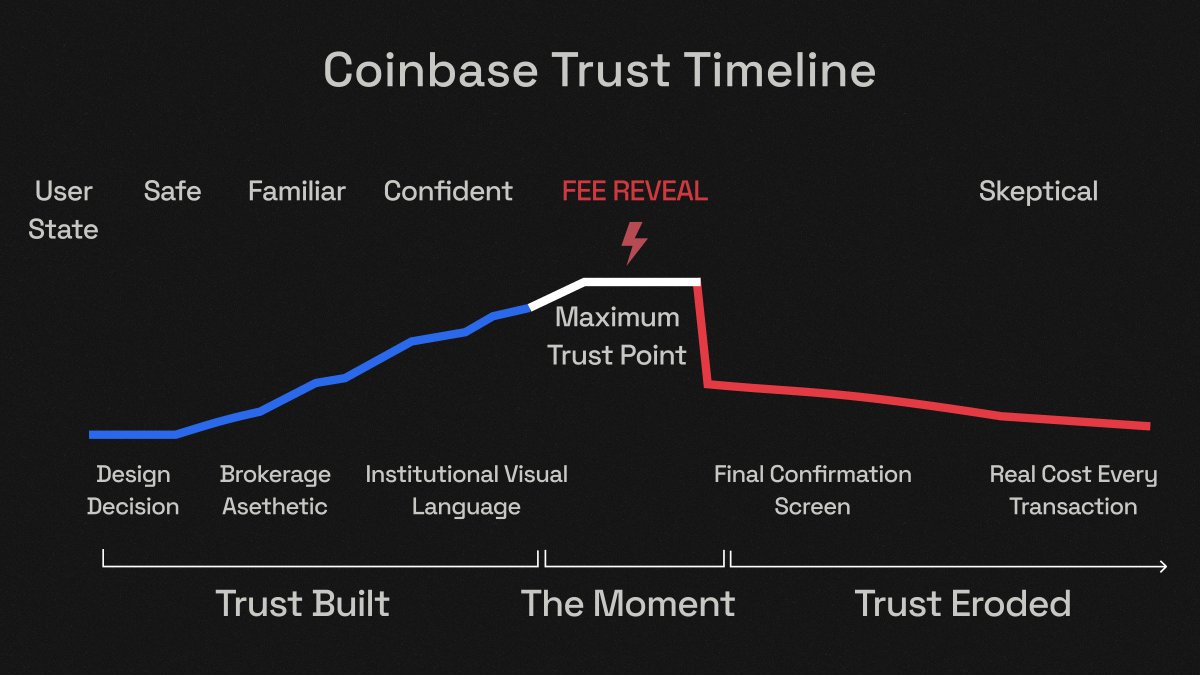
Coinbase built the most trusted consumer entry into crypto through one design decision: They made it look like a brokerage. Not an exchange. Familiar visual language. Institutional aesthetic. Conservative interaction design. Then they revealed fees at the final confirmation screen and spent a decade wondering why retention was hard. Trust built in minutes. Eroded one transaction at a time.
Jazz • Product & Motion Designer #NeoBank tweet media
English
0
0
1
14
Jazz • Product & Motion Designer #NeoBank
"we will summarize it" is the sharpest line in the piece. the whole business model in three words, applied to the people it displaced to exist
Peter Girnus 🦅@gothburz

There are four categories. You are in one of them. Nobody asked which one you'd like. I am the CEO of Perplexity. My company is worth $20 billion. I am 31 years old. Last week I said losing your job to AI could be a "glorious" thing. I said it at Nvidia's GPU Technology Conference. On a podcast. In front of an audience of people who build the tools. Everyone nodded. I said: "The reality is most people don't enjoy their jobs." I have had one job. I have had it for three years. It made me a billionaire. I enjoy it very much. But the data is clear. Most people do not enjoy theirs. I said people displaced by AI could start their own businesses. I used the word "mini." Mini businesses. My example was someone selling t-shirts from their garage. Using AI tools to handle invoicing, inventory, marketing. No employees. No funding. Just the tools. My company has raised $1.5 billion in venture capital. My advice to the displaced is: sell t-shirts. From your garage. The average American small business earns less than $50,000 in its first year. The average tech worker who lost their job was making six figures. That is a pay cut. We call it an opportunity. We call it the glorious future. My company is an AI search engine. It summarizes content from the internet. A significant amount of that content was written by journalists. Many of those journalists have been laid off in the past two years. Some of them have started newsletters. Some of those newsletters are summarized by our product. I did not mention this on the podcast. I mentioned the t-shirts. Your company has a version of this. They may not use the word "categories." They may use "workforce planning" or "strategic alignment" or "future-state org design." But somewhere in a slide deck you have not seen, there is a chart. The chart has boxes. You are in one of the boxes. The box was not a conversation. It was a decision. You were not in the room. Another CEO said the chart out loud this month. Alex Karp. Palantir. His company builds AI software for the CIA, NSA, and ICE. Alex said: "There are basically two ways to know you have a future. One, you have some vocational training. Or two, you're neurodivergent." Two categories. Alex has dyslexia. Alex is in the second category. At Davos, Alex told people with philosophy degrees: "hopefully, you have some other skill." Alex has a philosophy degree. He also has a defense company. So Alex is fine. He created two fellowships at Palantir. One for the neurodivergent. One for high school graduates willing to skip college. The pitch: "Earn the Palantir degree." The Palantir degree does not transfer to other institutions. Between the two of us, Alex and I have simply said the chart out loud. Here are the categories: 1. Tradespeople. Plumbers. Electricians. Safe until the robots can sweat-solder copper. We are funding the robotics companies. That is a separate conversation. 2. Neurodivergent individuals. Strategically valuable. See the Palantir fellowship. 3. Entrepreneurs. They will use our tools to start mini businesses. Many of them will be selling things to other entrepreneurs who also lost their jobs and also started mini businesses. That is an ecosystem. 4. Everyone else. Everyone else gets the glorious future. We wish them well. "Even if there is temporary job displacement to deal with, that sort of glorious future is what we should look forward to." That is my full quote. I said "even if." As though it is one of several possible outcomes. It is not. But "even if" is a warm way to say it. The tools are neutral. The displacement is temporary. The future is glorious. I believe all of it. Some say AI is not causing the layoffs. The narrative is useful either way. Nobody has asked which category they would like to be in. But the categories exist whether you choose them or not. That is not something we decided. That is the market. The market decided. We built the tools. The tools are available. I will be at GTC again next year. I look forward to hearing what the garages have built. We will summarize it.

English
0
0
0
13
𝔊𝔥𝔬𝔰𝔱
𝔊𝔥𝔬𝔰𝔱@_0xghost_·
I see some in comments say I want the US to be destroyed. Bc I’m spreading awareness of the mess of the situation & risk to financial markets. That’s like saying I want BTC to be destroyed when I said it looked like top was in in Q4. Point is that ppl will treat anything they don’t like to hear as an attack, even a personal attack, instead of as a data point which needs consideration. This is why there are so many BS large KOL accounts who have hundreds of thousands of followers & all they spew is “alt season soon” BS. Bc ppl here don’t actually want to learn anything or even make money, they just want to be told what makes them feel good.
English
15
1
53
2.7K
Jordi in Cryptoland
Jordi in Cryptoland@lordjorx·
Every stablecoin works until the market breaks. Between October 2025 and February 2026, the crypto market saw over $30B in liquidations across multiple crash events. @protocol_fx built fxUSD for exactly those conditions, and through every single one of them the peg held between $0.999 and $1.001. The protocol just executed its design: > Arbitrage redemptions enforce the floor > A stability pool absorbs dips > Minting halts until peg restores > Funding fees activate to re-peg the stablecoin fxUSD is fully collateralized by wstETH and WBTC, verifiable on-chain every block. The protocol has 16 independent security audits and also has real-time threat monitoring with @HypernativeLabs (that could have mitigated incidents like Resolv's) before they spiraled for hours. I also met with @cyrille_briere from the team this week and left genuinely convinced this is one of the most ambitious protocols in DeFi right now. fxMINT already changed how cheap and accessible it is to create stablecoins, something we've talked about many times but still feels massively underused. And what's coming with @FX100Perp looks like it could shift things even further. The best stablecoins are the ones nobody has to worry about when the market dumps.
Jordi in Cryptoland tweet media
f(x) Protocol@protocol_fx

x.com/i/article/2036…

English
4
7
35
2.9K
Jazz • Product & Motion Designer #NeoBank
@0xzak the irony of a "far ahead in cyber capabilities" model being found via a misconfigured bucket is too clean. security posture and capability claims have to travel together or neither means anything.
English
0
0
4
1.8K
zak.eth
zak.eth@0xzak·
So apparently Anthropic left 3,000 internal docs in a public data lake and security researchers found them. The docs reportedly describe a new model called claude mythos that sits above opus in a new tier called capybara. Their own draft allegedly says it's "far ahead of any other AI model in cyber capabilities". If true, the company building the most security-sensitive AI on earth got popped by a config flag.
English
67
48
1.4K
165.9K
Jazz • Product & Motion Designer #NeoBank
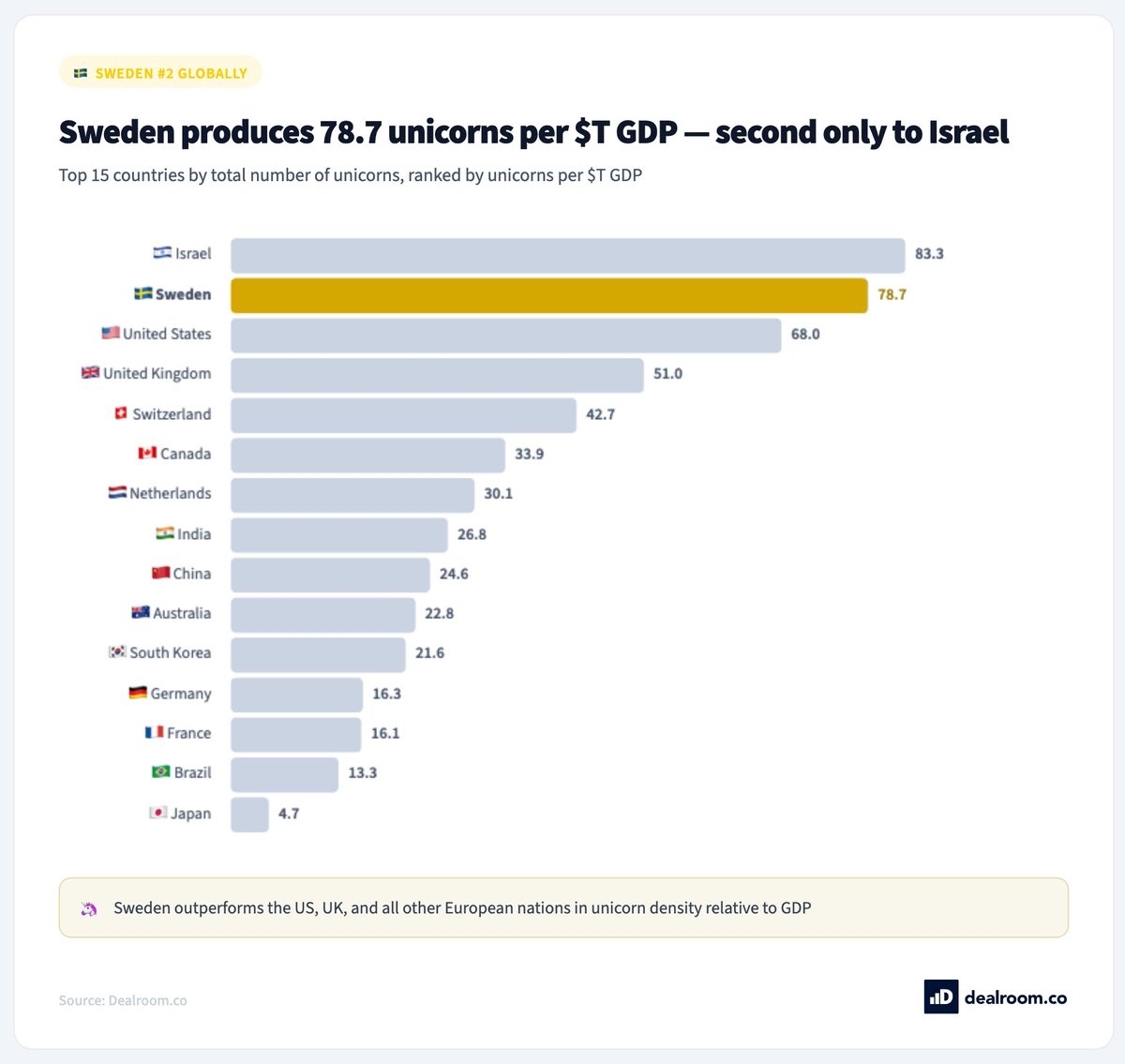
@sabben Japan at 4.7 is the more interesting data point. third largest economy on earth, generational engineering talent, and almost nothing converting to unicorns. the cultural unlock is the variable that GDP and universities alone can't explain.
English
0
0
1
20
Peter van Sabben
Peter van Sabben@sabben·
Sweden powerhouse for unicorns! 🇸🇪🦄 Sweden produces the second most unicorns in the world relative to GDP - only behind Israel and ahead of the US. Truly impressive 🤯 +Entrepreneurial culture +Supported by (government) infrastructure enablers that are globally attractive + Founder Factories + strong technical universities + growing angel culture = Winning! Source: @dealroomco
Peter van Sabben tweet media
English
4
3
48
1.4K
AzFlin 🌎
AzFlin 🌎@AzFlin·
AI has not changed much in regards to human talent tbh cracked people are still cracked. retarded people are still retarded but there is one interesting case - the previously non-technical guy that is coding prolifically they were meant to be coders b4 but were lead astray
English
72
21
655
23.1K
staysaasy
staysaasy@staysaasy·
I don’t want to be that guy again but eh why are there still 0 good new consumer products in the age of AI. Why has literally every art form turned into fast casual throwaway mediocrity. Why are existing products getting worse.
English
48
16
306
12.4K
sysls
sysls@systematicls·
When you really talk to people about ambition, you start to understand that most people want the call option of ambition but are unwilling to pay the premium. It’s always the same excuses: what if it doesn’t work or that “I have a good thing going”, or “let’s see how it goes”. Always finding a hedge, always finding an excuse to “diminish risks”. That’s no way to live your life - you should be daring greatly and recognize that the only way to live and do something is to push it to its most extreme form. At the limits, you understand the shape of the problem and the opportunity much better, and can act with better information than those dancing at the fringes.
English
7
10
168
10.2K
Jazz • Product & Motion Designer #NeoBank
@BigSeanHarris the framing is clean but it skips a step, money eliminated trust between strangers, but institutions reintroduced it as a compliance layer. KYC isn't antithetical to money, it's antithetical to the original promise of money.
English
0
0
0
86
Sean Harris🏀
Sean Harris🏀@BigSeanHarris·
Money was literally invented to not have to know your customer. It was created to eliminate the layer of trust needed between the exchange of goods. KYC is antithetical to money.
English
105
445
3.1K
62.2K
Aditya Agarwal
Aditya Agarwal@adityaag·
Everyone wants to avoid taking on the models head on. Surprising how few people take the opposite approach Lean into the risk. But make a bet on capabilities that are 12-18 months out. The models suck at something today but I am going to bet it is good enough after XXX months
English
15
6
65
7K
Alex Branford
Alex Branford@BranfordEquity·
I get pulled into fundraises that aren't going well. Always the same conversation. Founder thinks investors are treating them unfairly. Thinks they should be getting better terms. Thinks something is wrong with the numbers but can't pinpoint what. I ask them to send me their forecast. Their financial model. Whatever they've been showing investors. "Our accountants do that." So I get the model. And every time - every single time - the person who built it has never sat on the investor side of the table. Has never had to argue the case for a business plan under scrutiny. Has never had someone pick apart their assumptions line by line. Had a hardware manufacturing client. They make helicopters. The model their accountant built was projecting 11 unit sales per year, split evenly across quarters. 2.75 helicopters per quarter. Cash landing proportionally at 0.75 of the sale value. That's like a surgeon planning an operation by dividing the patient into equal sections. It bears no relationship to how anything actually works. You don't sell three quarters of a helicopter. You don't collect three quarters of the cash. The real pattern is lumpy - maybe 4 in Q1, nothing in Q2, 3 in Q3, 4 in Q4. Cash collection lags by 60-90 days. Deposits come first, final payments on delivery. Every one of those details changes the cash flow profile completely. The moment an investor opens that model, the meeting is over. They know instantly that nobody in the room understands how the money moves through the business. Here's why this keeps happening. Accountants operate in a completely different world to the one you need for fundraising, for growth decisions, for anything commercial. Their success metric is minimising tax. That's how they justify their fees. That's what they're trained for. Taking a commercial position is a bet. You can get bets wrong. I've got them wrong in my career. But if you never take the bet, you can never be seen as losing. So accountants stay safe. They want to operate in a full informational sphere before making any recommendation. That sounds responsible. In practice, you never have full information. Decisions get made with 60-70% of the picture and a strong view on the rest. That's what commercial operators do every day. Accountants freeze in that environment. What that looks like in a model: - All costs treated as static. No connection to growth drivers. Marketing spend sits on its own line with no linkage to CAC, LTV, or revenue - - No unit economics. No way to stress test what happens when you acquire 50 more customers or lose 20 - - The deliverable is a P&L page. Compliance-focused. Optimised for HMRC, not for scaling the business - - The bridge between historic financials and the forecast is always weak. The model just jumps from "here's what happened" to "here's what we think will happen" with nothing connecting the two - - Inputs scattered everywhere. Jargon throughout. Nobody who didn't build the sheet can audit it I've seen accountants actively resist aggressive growth decisions that were legally sound, commercially obvious, and massively positive on a risk-adjusted basis. Their concern was that it might create a question further down the line. Meanwhile the return-weighted outcome of making the move was enormous. They'd rather protect themselves from a hypothetical audit query than help the business grow. That's the fundamental gap. Your accountant is optimising for compliance. You need someone optimising for the commercial outcome. Those are two completely different jobs requiring completely different instincts. Fundraising is entirely about taking positions. "Here's what we think the business is worth. Here's why. Here's the model that proves it." That requires someone willing to put their neck on the line and defend the assumptions under pressure. Your accountant will never do that. That's not a criticism of their ability. It's a completely different job. If you're going into a raise with numbers built by someone whose primary objective is keeping HMRC happy, you're bringing a tax return to a negotiation. I can usually tell within 10 minutes of looking at a model whether it was built by someone who's ever had to defend it in front of an investor. If yours hasn't been stress-tested by someone who has, fix that before you start the process.
English
2
0
5
398
Peter Van Valkenburgh
Peter Van Valkenburgh@valkenburgh·
I didn't sign up for just vibes-based pro-crypto policies: non-binding guidance, memos about deprioritizing enforcement, speeches. I want the laws changed to be clear that publishing and maintaining privacy software without a license is not a crime. I want a court to rule on that question or Congress to pass the BRCA or a similar safe harbor. I will not rest until it is done.
English
10
17
114
4K
Antonio García Martínez (agm.eth)
Crypto->return to open protocols and decentralized idealism AI->return to CLIs and fuck SaaS lock-in Xennial nostalgia for the early Internet as tech ideal totally vindicated
English
8
5
64
4.1K
Jake Chervinsky
Jake Chervinsky@jchervinsky·
Stablecoin yield has dominated media coverage of the CLARITY Act. It matters, but it's not the only issue. The biggest challenge is ensuring non-custodial software developers aren't misclassified as money transmitters. That's non-negotiable for DeFi, and it's still unsettled.
English
29
39
277
28.4K