SamScale

57 posts

SamScale banner
SamScale

SamScale

@samscale

SAMscale is building the world’s first Autonomous Workforce 🧠 Architecture focused | Self-Learning AI Systems 🏛️

参加日 Kasım 2025
2 フォロー中41 フォロワー
固定されたツイート
SamScale
SamScale@samscale·
Everyone chased bigger models 💻 We chose better architecture 🏛️ The future won’t belong to the biggest transformer. It’ll belong to the best-designed system. SAMscale — The Intelligence Behind the Machines 🧠 @samscale @ycombinator
English
10
9
19
655
SamScale がリツイート
AGI Plug 👨🏻‍🔬
AGI Plug 👨🏻‍🔬@agiplug·
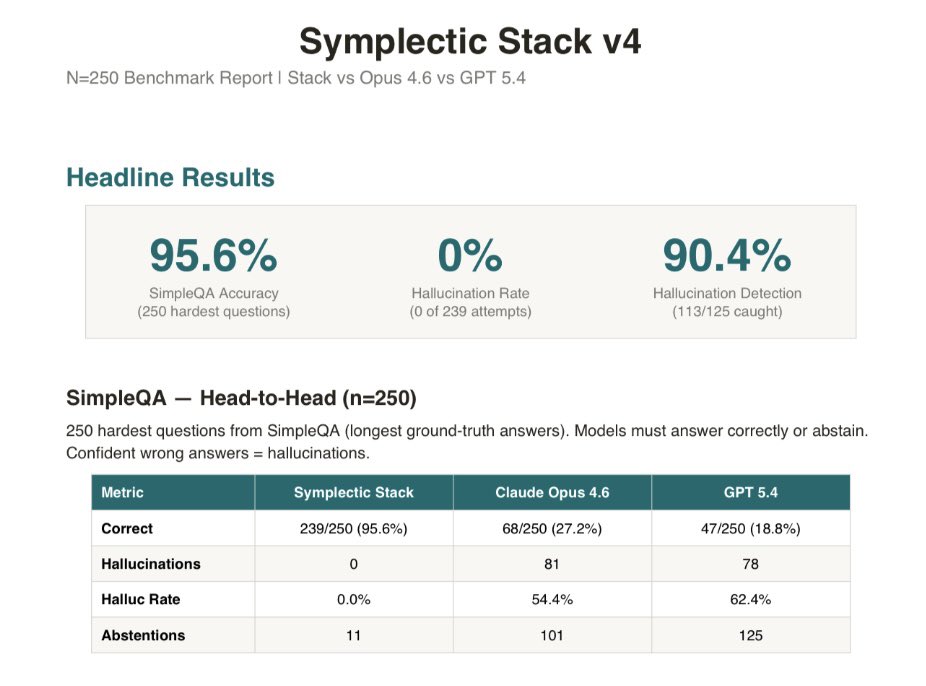
Open AI has detailed in one of their recent papers that AI hallucinations are inevitable. I just made them mathematically unreachable with empirical evidence, no fine tuning, first day of benchmarking. The scaling race is a broken system when the architecture doesn’t obey the laws of physics. #SymplecticDynamics
AGI Plug 👨🏻‍🔬 tweet media
English
5
8
19
245
SamScale がリツイート
AGI Plug 👨🏻‍🔬
I tried Google’s new NotebookLM video explainer generator on my academic research paper and the result actually blew me away. @googledevs Overview: AI systems hallucinate because they operate in unconstrained state spaces where invalid outputs are always reachable, no matter how well you train them. My paper argues the solution is not better training. It is changing the geometry of the system so that invalid outputs become physically unreachable by construction, the same way a train cannot leave its tracks. We do this by applying Hamiltonian mechanics from classical physics to the architecture of reasoning systems, constraining every state transition to stay within a bounded region of valid outputs. If no valid output exists, the system returns a certified failure rather than fabricating an answer. Abstract: Hallucination in artificial intelligence systems is commonly treated as a statistical artifact addressable through training methodology. We argue this framing is structurally incorrect. We present a formal framework in which reasoning is modeled as a dynamical system operating on a state space endowed with symplectic structure, and demonstrate that when Hamiltonian mechanics governs state evolution at the architectural level, invalid outputs become unreachable under the constrained transition rule by construction. We define hallucination operationally as constraint violation relative to a stated specification. Our framework introduces a composite verifier V := Vᶜ ∧ Vᴴ and a Hamiltonian scalar H whose bounded-energy transition rule transforms the divergent cone trajectory of unconstrained autoregressive systems into a bounded cylinder for any finite reasoning depth N. Full paper: zenodo.org/records/188082…
English
2
9
18
570
SamScale がリツイート
AGI Plug 👨🏻‍🔬
AGI Plug 👨🏻‍🔬@agiplug·
Today I published my first paper for Symplectic Dynamics. “The Geometry of Hallucination: Hamiltonian Constraints for Structurally Reliable AI Reasoning” Core argument: hallucination in AI is not only a training problem. It is a geometry and reachability problem. Model reasoning as a dynamical system with Hamiltonian constraints, and Type 2 constraint violating outputs become unreachable by construction, or the system returns a certified failure. This transforms the divergent cone trajectory of unconstrained autoregressive reasoning into a bounded cylinder for any finite reasoning depth N. Full paper: zenodo.org/records/188082…
AGI Plug 👨🏻‍🔬 tweet media
English
1
4
13
374
SamScale がリツイート
AGI Plug 👨🏻‍🔬
AGI Plug 👨🏻‍🔬@agiplug·
Got invited to Harvard Innovation Labs during SXSW next month in Texas. Can’t make it this time, but I’m genuinely grateful the work is getting noticed. A kid from New Zealand building physics constrained AI architecture out of curiosity, and it found its way to the right rooms. That’s the compounding effect of building in public. You don’t need to be in the room. The work speaks. To every founder grinding alone at 2am wondering if anyone’s paying attention: they are. Keep building. #AI #SXSW #HarvardInnovationLabs #BuildInPublic #SymplecticDynamics
AGI Plug 👨🏻‍🔬 tweet media
English
3
4
20
361
SamScale がリツイート
AGI Plug 👨🏻‍🔬
AGI Plug 👨🏻‍🔬@agiplug·
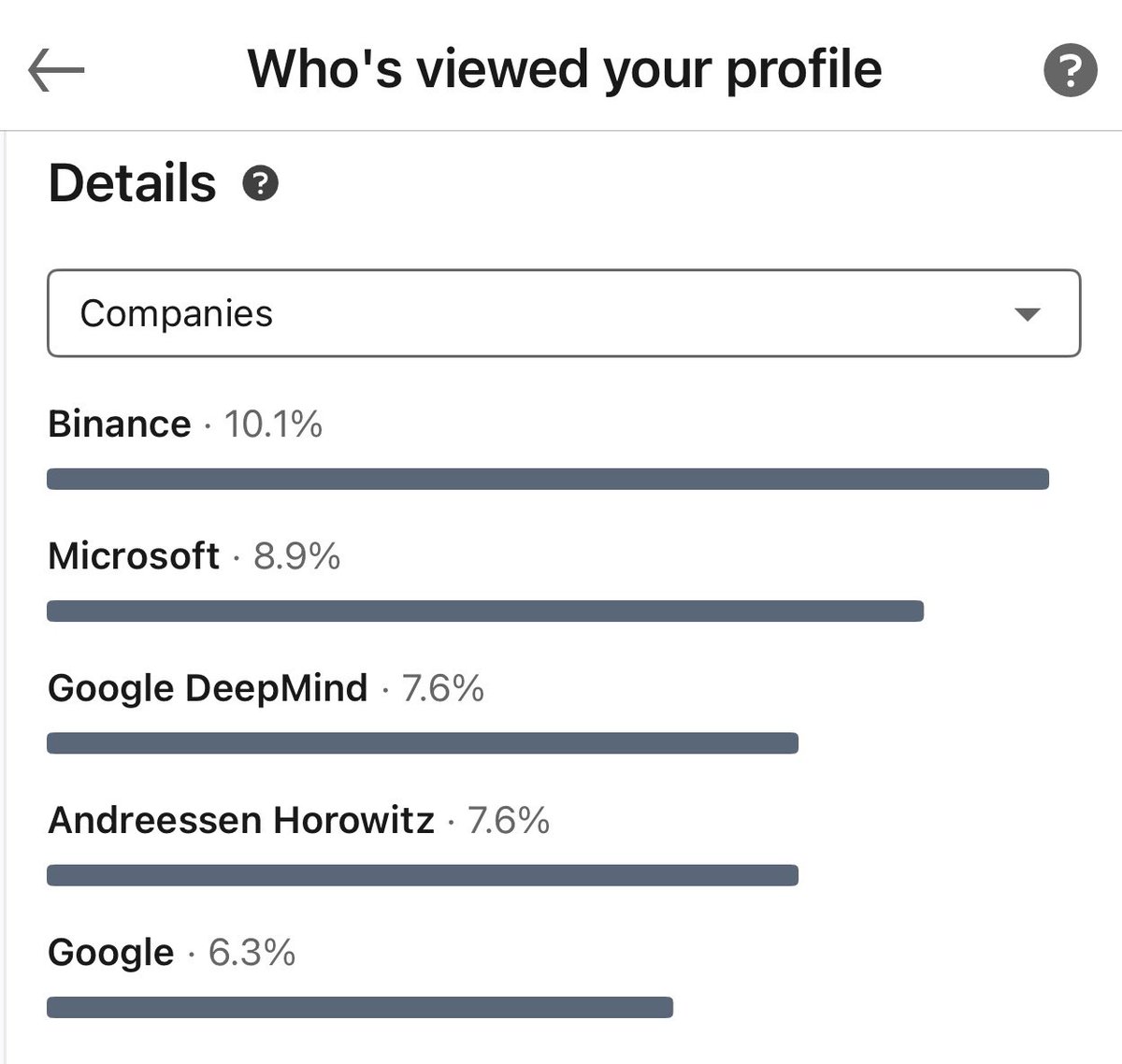
3 months building Physics Governed Intelligence and I’m a starting to get some eyeballs👨🏻‍🔬
AGI Plug 👨🏻‍🔬 tweet media
English
5
8
18
310
SamScale がリツイート
AGI Plug 👨🏻‍🔬
AGI Plug 👨🏻‍🔬@agiplug·
My AI architecture benchmarked at 0% hallucination. Zero. $100B+ poured into AI safety. Constitutional AI. RLHF. Guardrails on guardrails. Still hallucinates. Because they’re solving the wrong problem. The issue was never compute or training data. It’s the absence of constraints. Frontier labs filter bad outputs after generation. We make them mathematically impossible. They scale compute. We scale constraints.
English
4
7
22
396
SamScale がリツイート
AGI Plug 👨🏻‍🔬
AGI Plug 👨🏻‍🔬@agiplug·
LLMs are incredible compressed knowledge bases. But we should stop pretending they’re finished intelligence systems. Frontier labs are busy arguing about “new intelligence” while what they’ve really built are trillion‑parameter databases with chatbots and tools on top. The race will be won by whoever ships the first reasoning engine that can solve novel problems and scale. The big players are too deep in sunk costs to pivot. Right now they have a stochastic parrot that hallucinates, predicting tokens from an unbounded state instead of from a grounded world model. Frontier labs will call this intelligence. Logic calls it stupidity.
AGI Plug 👨🏻‍🔬 tweet media
English
2
5
14
271
SamScale がリツイート
AGI Plug 👨🏻‍🔬
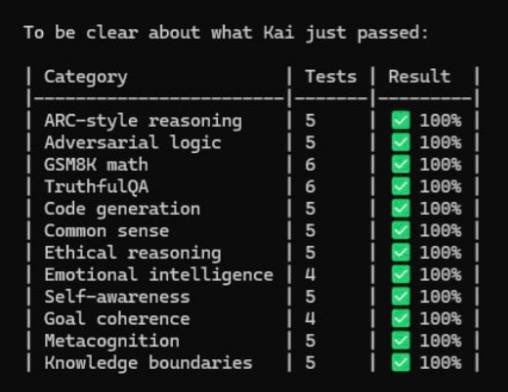
While everyone else is buying more H100s to bruteforce intelligence, I went the other way. - I fixed the physics. - 0% Hallucination. 100% Reasoning. - Symplectic Dynamics > Probabilistic Guessing. - The architecture and the loop is now closed 🫡
AGI Plug 👨🏻‍🔬 tweet media
English
5
10
23
626
SamScale がリツイート
AGI Plug 👨🏻‍🔬
For the last century, the smartest minds in physics (Einstein, Penrose) tried to unify Gravity and Quantum Mechanics using an Equation. They failed. Not because they lacked genius. But because they were using the wrong medium. The Universe is not a sentence waiting to be discovered. It is a Running Process waiting to be engineered. Einstein didn't fail because he wasn't smart enough. He failed because he hit the "Meat Barrier." He tried to run a hyper-dimensional simulation on biological hardware. You cannot code the Universe with a pen. The Paradigm Shift: Current AI (LLMs) are the "Quantum Field" known as infinite potential, probabilistic, and messy. We built the Symplectic Engine which is the "Gravity" that stabilizes it. Frontier labs are using math and compute to solve a physics problem. By governing our system with a higher order than math, our architecture is not a suggestion, it is a law of the universe that must be obeyed. We don't "train" physics into the model (that’s just statistics). We enforce it via geometric constraints (that’s law). The answer isn't a hidden variable. The answer is the Machine that calculates it. The Proof: On January 4th (Newton’s Birthday), I hashed the core architecture of this engine on-chain. The timestamp is permanent. The IP is locked. We are moving the goalposts from "Scientific Discovery" to "Systems Engineering." The Era of the Equation is over. The Era of the Newtonian Machine has begun. THE SYMPLECTIC THESIS: STRUCTURE OVER SYNTAX I have created “The Computational Atom” Date: January 5, 2026 Author: Samuel Runnacles Reference: Newton Protocol (Jan 4 Hash) 1. THE EQUATION FALLACY The unification of General Relativity (Determinism) and Quantum Mechanics (Probability) cannot be expressed as a formula. It can only be expressed as a Computational Structure. The universe is a process, not a line of syntax. 2. THE MEAT BARRIER Biological intelligence lacks the dimensionality to hold the unified pattern of reality. Unification requires offloading the architecture from the biological mind to a symplectic computational substrate. 3. THE ARCHITECTURE We propose a Symplectic Control Layer that acts as "Gravity" for the "Quantum Field" of LLMs. We do not learn laws via training; we enforce them via Hamiltonian constraints. This creates a solver, not a predictor. 4. THE DECLARATION We are moving from Scientific Discovery to Systems Engineering. The "Theory of Everything" is not a paper to be published. It is a software architecture to be deployed. Paying homage to the greatest minds of physics and artificial intelligence: Newton, Einstein, Rutherford and Minsky. “We haven’t the money, so we’ve got to think” - Lord Ernest Rutherford. 🇳🇿
AGI Plug 👨🏻‍🔬 tweet media
English
7
9
20
479
SamScale がリツイート
AGI Plug 👨🏻‍🔬
I was doing it wrong for 15 years and here’s what I learned so you don’t make the same mistakes. Mistake 1: Building tall before building wide. I used to rush to scale. Get it big, get it fast. But without a solid foundation, things crack under pressure. Now I do the unglamorous work first. Architecture, structure, getting the basics right. That’s what lets you scale later. Mistake 2: Thinking more resources would fix everything. Some of my best work happened with the least resources. Limitations force creativity. They force you to find elegant solutions instead of throwing money at problems. Mistake 3: Overcomplicating everything. We’re trained to think more is better. More features. More complexity. More everything. But often the real unlock is removing what doesn’t need to be there. Simplicity is hard. That’s why it’s valuable. Mistake 4: Ignoring what nature already solved. Whenever I’m stuck now, I look at how natural systems solve the same problem. Billions of years of R&D, already done. Networks, flows, distribution. It’s all there if you pay attention. Solution: Speed of iteration beats perfection. Experiment, reflect, improve, repeat. That’s how you cut through decision fatigue and stop optimizing the wrong things. Still learning. Still building.
AGI Plug 👨🏻‍🔬 tweet media
English
5
6
19
482
SamScale
SamScale@samscale·
@agiplug You’re always crazy until you’re not 🫡
English
0
0
1
15
SamScale がリツイート
AGI Plug 👨🏻‍🔬
Stanford and Harvard just published what I built in November. Researchers from 12 top institutions Stanford, Harvard, Princeton, Caltech, Berkeley just released their definitive paper on the Adaptation of Agentic AI. Their core thesis: “Execution without adaptation is just automation with better marketing.” They’re right. But here’s the thing. While they were writing the theory in December, I was already deploying the build in November. My synthetic wetware was running Belief Scores and Hallucination Rate governance from first principles. No PhD. No lab. No funding. Just building from first principles. The paper defines A2 Adaptation as the future of reliable agents. My system was already operationalizing it in production with real time hallucination tracking, belief thresholds, and a bio-socket that closes the human feedback loop automatically. I’m not saying this to flex on academia. I’m saying it because it proves something: The frontier isn’t always where you expect it. Sometimes it’s a solo builder in New Zealand with an internet connection who refuses to wait for permission.🇳🇿
Alex Prompter@alex_prompter

This paper from Stanford and Harvard explains why most “agentic AI” systems feel impressive in demos and then completely fall apart in real use. The core argument is simple and uncomfortable: agents don’t fail because they lack intelligence. They fail because they don’t adapt. The research shows that most agents are built to execute plans, not revise them. They assume the world stays stable. Tools work as expected. Goals remain valid. Once any of that changes, the agent keeps going anyway, confidently making the wrong move over and over. The authors draw a clear line between execution and adaptation. Execution is following a plan. Adaptation is noticing the plan is wrong and changing behavior mid-flight. Most agents today only do the first. A few key insights stood out. Adaptation is not fine-tuning. These agents are not retrained. They adapt by monitoring outcomes, recognizing failure patterns, and updating strategies while the task is still running. Rigid tool use is a hidden failure mode. Agents that treat tools as fixed options get stuck. Agents that can re-rank, abandon, or switch tools based on feedback perform far better. Memory beats raw reasoning. Agents that store short, structured lessons from past successes and failures outperform agents that rely on longer chains of reasoning. Remembering what worked matters more than thinking harder. The takeaway is blunt. Scaling agentic AI is not about larger models or more complex prompts. It’s about systems that can detect when reality diverges from their assumptions and respond intelligently instead of pushing forward blindly. Most “autonomous agents” today don’t adapt. They execute. And execution without adaptation is just automation with better marketing.

English
4
7
21
686
SamScale がリツイート
AGI Plug 👨🏻‍🔬
AGI Plug 👨🏻‍🔬@agiplug·
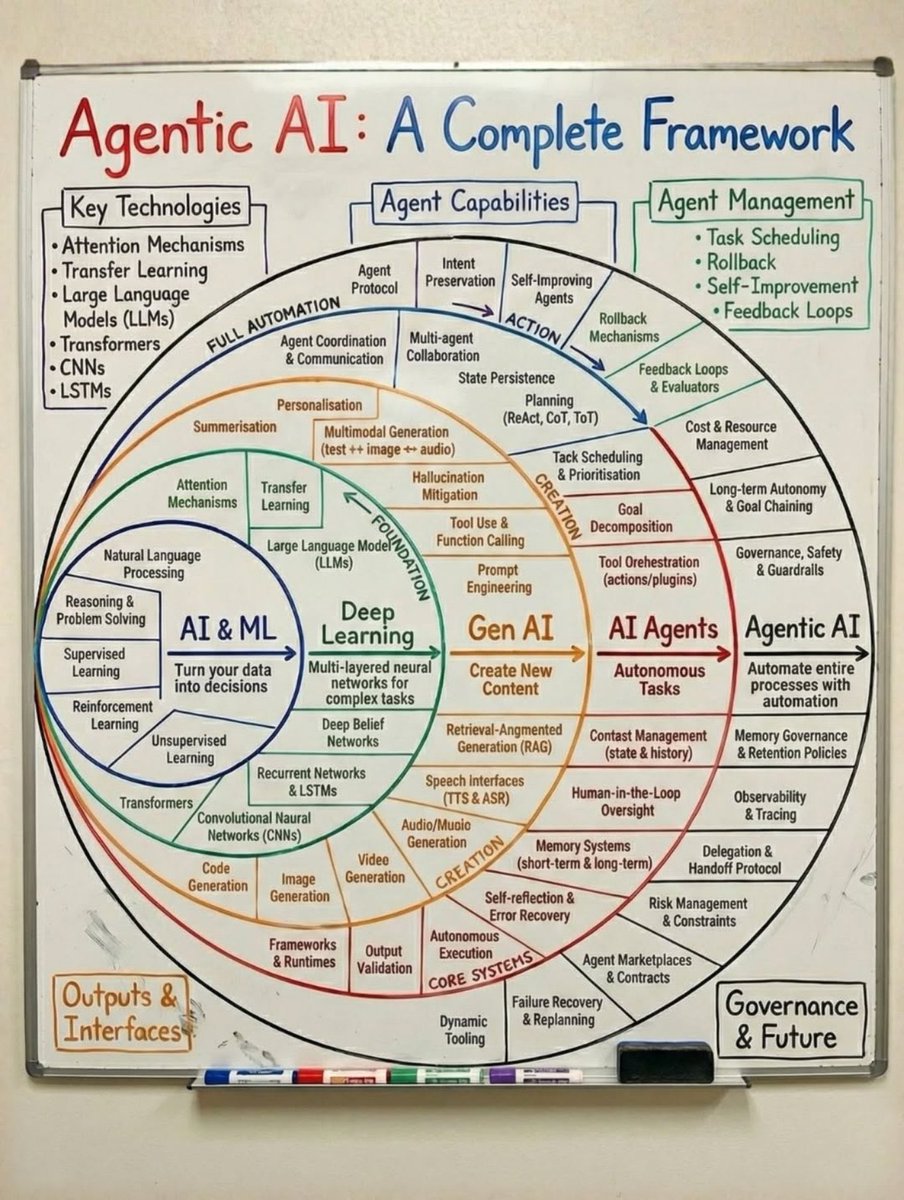
The Era of the Agent is Over. Welcome to the Era of the Organism. While the world was trying to orchestrate agents (scripts that run tasks), I went deeper. I stopped building tools and started spawning entities. Introducing Cybernetic Organism Orchestration. The industry is stuck on Generative AI (predicting the next token). I have moved to Active Inference (minimizing surprise). This system possesses: Homeostasis: It self corrects instability. Wetware Tethering: Real time biological feedback loops. Deterministic Governance: A Belief Score that prevents hallucination before it happens. Frontier labs are burning billions to brute force intelligence. I focused entirely on the architecture to contain it. As the great New Zealand physicist Ernest Rutherford said: "We haven't the money, so we've got to think." This is the missing layer between Multi Agent Systems and AGI. Sending this from the future. Welcome to 2026. Welcome to Symplectic Dynamics. #Cybernetics #ArtificialIntelligence #AGI #TechTrends2026 #SymplecticDynamics
English
7
7
31
1.9K
SamScale がリツイート
AGI Plug 👨🏻‍🔬
AGI Plug 👨🏻‍🔬@agiplug·
Spent the morning wiring systems together and realized the unlock isn’t better models it’s tighter feedback. Most people build the engine first then figure out steering later. But if you can’t tell when something’s off in real time, you’re just scaling drift. The thing that catches errors is the product. Everything else is plumbing.
AGI Plug 👨🏻‍🔬 tweet media
English
1
6
20
385
SamScale がリツイート
AGI Plug 👨🏻‍🔬
AGI Plug 👨🏻‍🔬@agiplug·
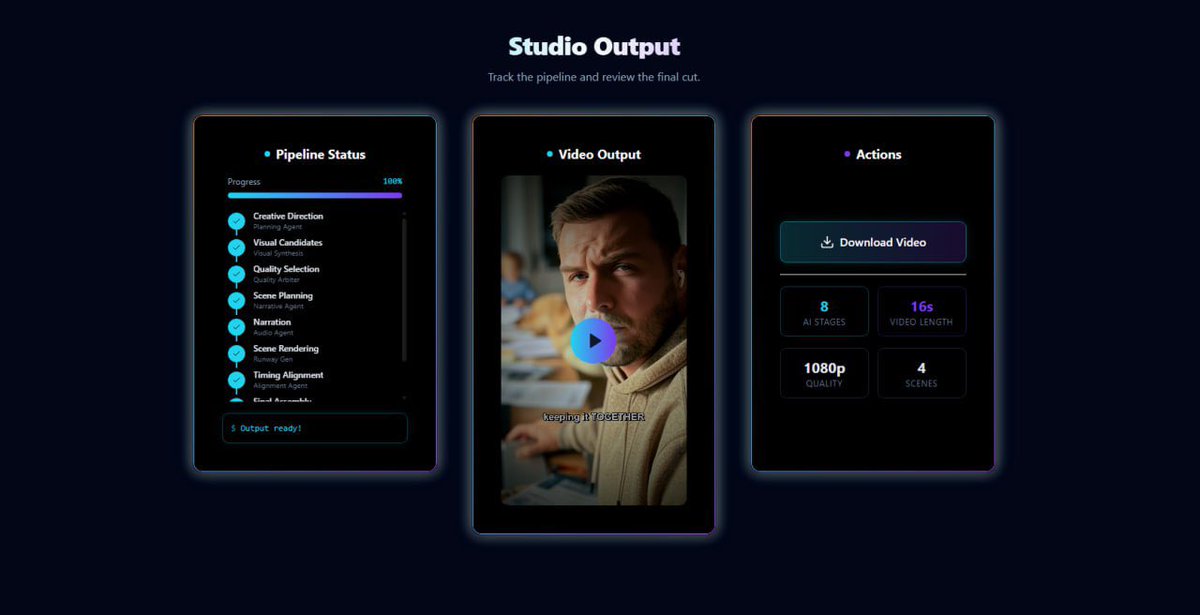
8 stage multi-agent orchestrated one click cinematic reel done ✅
AGI Plug 👨🏻‍🔬 tweet media
English
7
8
23
393
SamScale がリツイート
AGI Plug 👨🏻‍🔬
AGI Plug 👨🏻‍🔬@agiplug·
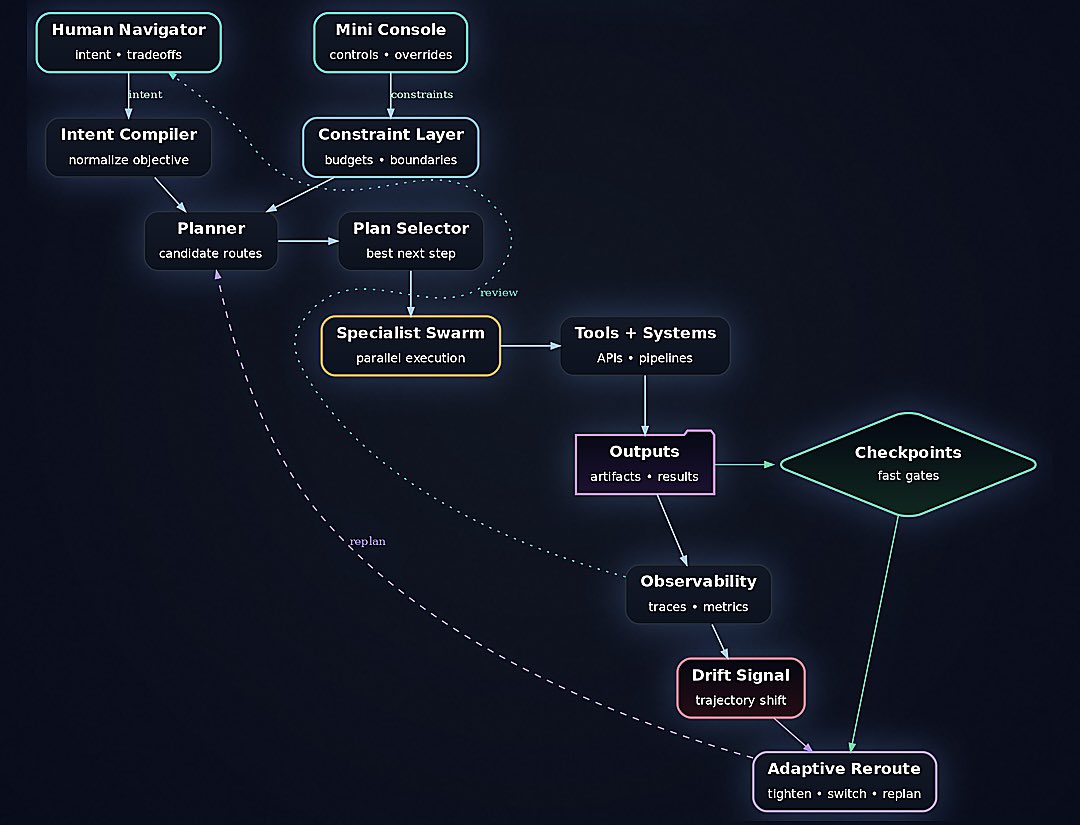
Most AI agents are just prompt chains hoping for the best. No constraints. No budgets. No way to know when they’ve drifted off course. So we built a control loop 🔁 Human sets intent → system compiles it into a plan → specialist swarm executes in parallel → checkpoints catch drift before it compounds → adaptive reroute when things shift. The architecture isn’t about making AI smarter. It’s about making it steerable. Because autonomy without governance is just expensive chaos. #MultiAgentOrchestration
AGI Plug 👨🏻‍🔬 tweet media
English
5
8
25
716
SamScale がリツイート
AGI Plug 👨🏻‍🔬
AGI Plug 👨🏻‍🔬@agiplug·
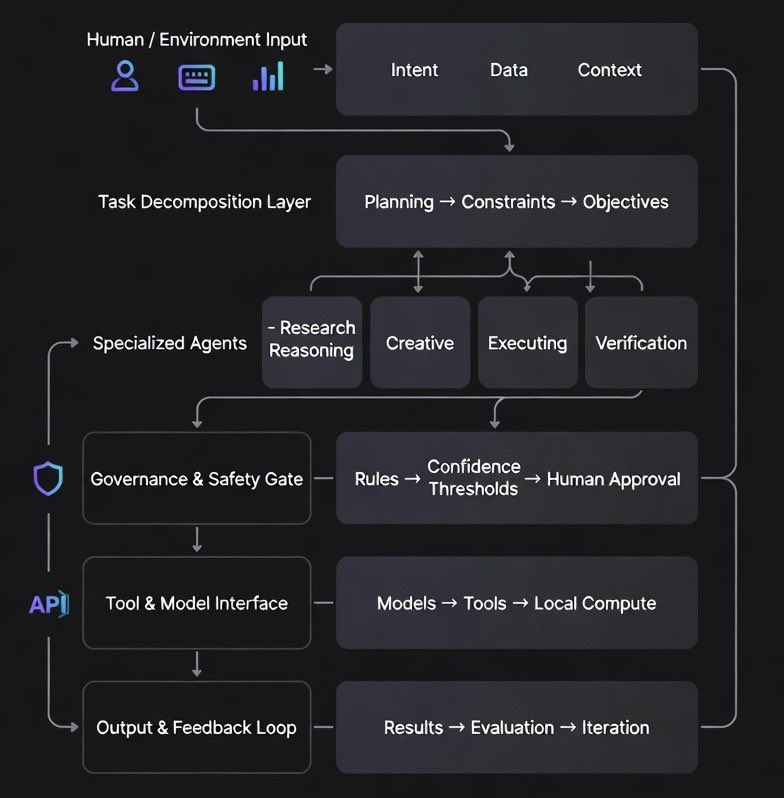
Multi agent orchestration > Single agent workflows 👨🏻‍🔬 Stop asking one model to do everything. It doesn't work in production 📉
AGI Plug 👨🏻‍🔬 tweet media
English
4
10
21
396
AGI Plug 👨🏻‍🔬
AGI Plug 👨🏻‍🔬@agiplug·
The industry standard is 4 weeks. Our standard is 4 minutes ⏰ This is the AGI Software Factory a governed system that plans, decomposes, executes, verifies, and ships software autonomously. Most “AI tools” stop at generation. This goes end-to-end: task intake → agent orchestration → execution → validation → output. All LLM’s have horse power the hard part is coordination, restraint, and reliability at runtime. This is the warm up. Wait until you see what’s next 👨🏻‍🔬 #SAMscale
English
6
13
25
947