고정된 트윗
Al-Pharaday
1.2K posts


@lopp No. No one is gonna be demoted & no one is being promoted. It's just the Web and Society in general is being splitting into two. The end of the Era of Compromises. The news is rather positive.
English
Al-Pharaday 리트윗함

Dennis Ritchie created C in the early 1970s without Google, Stack Overflow, GitHub, or any AI ( Claude, Cursor, Codex) assistant.
- No VC funding.
- No viral launch.
- No TED talk.
- Just two engineers at Bell Labs. A terminal. And a problem to solve.
He built a language that fit in kilobytes.
50 years later, it runs everything.
Linux kernel. Windows. macOS.
Every iPhone. Every Android.
NASA’s deep space probes.
The International Space Station.
> Python borrowed from it.
> Java borrowed from it.
> JavaScript borrowed from it.
If you have ever written a single line of code in any language, you did it in Dennis Ritchie’s shadow.
He died in 2011.
The same week as Steve Jobs.
Jobs got the front pages.
Ritchie got silence.
This Legend deserves to be celebrated.

English

@GSO_Police Bad advice. Never talk to someone who left you in the lurch even via intermediaries. Have several dealers, and when one of them gets busted pick a new one. This shit is called diversification. Be safe, beware of cops. 😁
English

Italian Prime Minister Giorgia Meloni is angry about fake sexual AI images of her shared online.
She said: “Deepfakes are a dangerous tool because they can deceive, manipulate, and target anyone. I can defend myself. Many others cannot.”
Meloni added: “Verify before believing and think before sharing. Because today it is happening to me. Tomorrow it could happen to anyone.”
The fake photos show her in lingerie.
Italy now plans tough new laws against bad deepfakes.


English
Al-Pharaday 리트윗함

The legendary Ian Murdock
• Founded Debian in 1993 at age 20, while a Purdue undergrad
• Name "Debian" = Debra (his girlfriend) + Ian — she later became his wife
• Debian became the base for Ubuntu, Linux Mint, Raspberry Pi OS, hundreds of distros, arguably the most influential Linux project ever
• Worked at Sun Microsystems on Solaris
• Became Chief Operating System officer at Docker, right at the peak of container adoption
• Died December 28, 2015, age 42, officially ruled suicide
• His final hours: a series of distressed tweets describing a violent encounter with San Francisco police (claimed they beat him during an arrest), followed by increasingly erratic posts, then silence
• His Twitter account was deleted by the family shortly after; the tweets are preserved in archives
Debian is still going strong, 30+ years later, without him but his contributions can never be forgotten.

English
Al-Pharaday 리트윗함
Al-Pharaday 리트윗함

Ferrari finally made a bike and it’s basically just a V8 with some wheels glued to it. 🏎️🏍️
Does this scream "Masterpiece" or "I value speed more than my own life expectancy"?
HOT or NOT? 🔥❄️
#Ferrari #V8 #Motorcycle #Superbike #CustomBuild #WickedRide #HotOrNot #MotoLife
English
Al-Pharaday 리트윗함
Al-Pharaday 리트윗함
Al-Pharaday 리트윗함

@vxunderground "This is a Chromium thing"
Check it with @brave, it is based on the Chromium open-source project. It is technically a "fork" of Chromium.
But only 'technically'.
English

The initial proof-of-concept was released in C-sharp.
Using this method to dump credentials is iffy because it requires administrative access and some security access tokens which can raise some flags.
First, Edge is Chromium based. This is a Chromium thing but (if my memory serves me correctly) a unique attribute to Edge exclusively. However, because it is Chromium based this may impact other Chromium bases. It requires more investigation. Edge is a primary target because it's the default Windows browser and used in enterprise environments.
Secondly, as far as malware goes, this is yet another method to potentially dump credentials on a home users machine. There are a few different ways. This method doesn't surprise me. However, successfully using this method is an enterprise environment would be difficult to use. It would require administrative access and some security access tokens which would immediately raise some flags.
In other words, this method is interesting, I like the research performed, however it isn't something super super critical. If you're using this method in an enterprise environment then that company has been completely compromised down to the bone and they've got much larger issues.
The code and research is really cool though. I just wish it wasn't written in C-sharp (I have an irrational disdain to .NET, especially lately).
International Cyber Digest@IntCyberDigest
‼️🚨 Microsoft calls this "intended behaviour," so here we go. How to dump the credentials of every user stored in Microsoft Edge: 1. Open Edge. Don't browse anywhere, just open it. 2. Flip to Task Manager, find Edge, expand the task. 3. Highlight the "browser" sub-task, right-click, and choose "Create Memory Dump." 4. Open the dump file and look for credentials. The logged-in Windows user can dump every stored Edge credential with no additional rights. Which means any malware that user executes has those credentials for the asking. Thanks to Rob VandenBrink at SANS: isc.sans.edu/diary/32954

English

@LundukeJournal @Cloudflare @ubuntu And what isues do the islamists have with Ubuntu? Age verification and sh't?
English

The Islamic terrorist group, 313 Team, has announced that they have ended their “5-day attack” on Ubuntu Linux infrastructure.
The Iran & Palestine aligned Islamists have also announced that they intend to target @Cloudflare servers in retaliation for assisting @Ubuntu.
“Cloudflare intervened and prevented our attack. Therefore, Cloudflare servers should expect a devastating attack that will target their servers.”

English

@GunloverClub1 Could be helpful against Big Boys in bullet-proof vests travelling in armoured vehicles. Right through the windshield.
English

@IntCyberDigest @L1v1ng0ffTh3L4N My Windows distro has never had Edge by default, and therefore requires a usb stick to load browser installers. Only @brave or Zen or nothing.
English

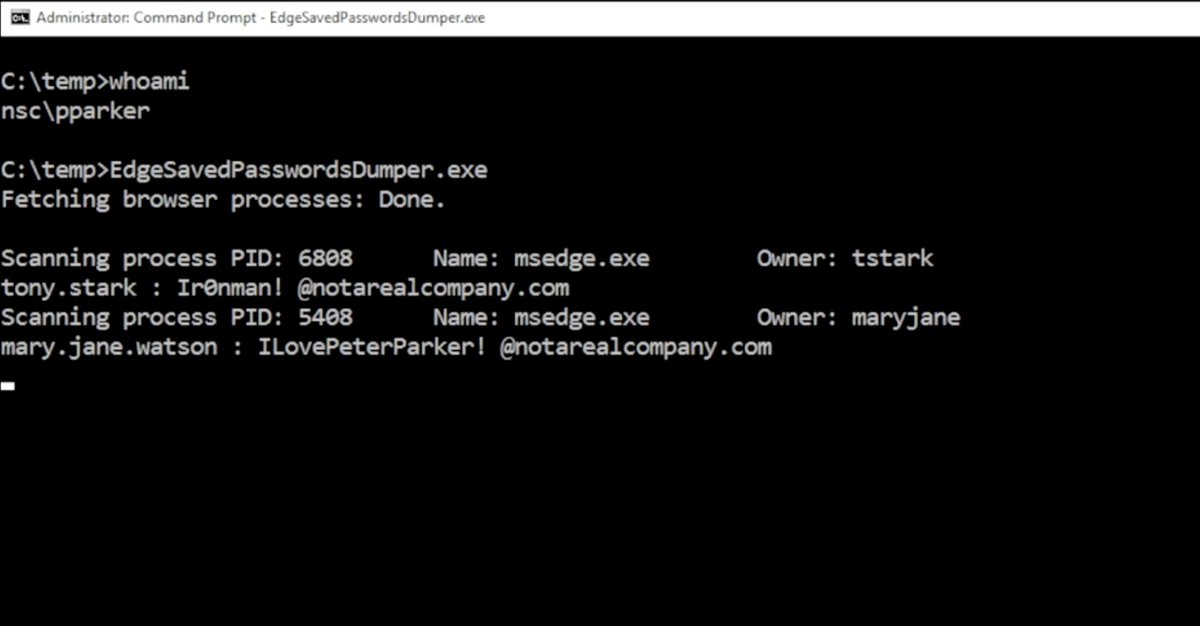
❗️🚨 Microsoft Edge keeps every saved password in process memory as cleartext from the moment it launches. Microsoft's responsed when reported: "by design."
All of them. Including credentials for sites you won't open this session.
Researcher @L1v1ng0ffTh3L4N tested every major Chromium browser. Edge is the only one that behaves this way.
Chrome decrypts credentials on demand, and App-Bound Encryption locks the keys to an authenticated Chrome process so other processes can't reuse them.
In Chrome, plaintext surfaces only during autofill or when a password is viewed, making memory scraping far less useful.
What makes this extra weird is that Edge still demands re-authentication before revealing those passwords in its Password Manager UI, while the same browser process already holds every one of them in plaintext.
In shared environments, this turns into a credential harvest. On a terminal server, an attacker with admin rights can read the memory of every logged-on user process. In the published PoC video, a compromised admin account lifts stored credentials from two other logged-on (and even disconnected) users with Edge running.
Microsoft's official response when notified: "by design."
The finding was disclosed April 29 at BigBiteOfTech by PaloAltoNtwks Norway, alongside a small educational tool that lets anyone verify the cleartext storage for themselves.


English
Al-Pharaday 리트윗함

I had a friend who tried secretly using Monero.
It was discovered he had embedded his “stealth” address inside a CPU mining malware binary that ended up being decompiled.
The same “stealth” address he used to accept normal payments thinking it was adequately private.
Seth For Privacy@sethforprivacy
If you only knew how many of your favorite maxis are secretly using Monero, running nodes, etc 🫣
English

@senatorshoshana If a third of kids know how to bypass the restriction, the other two thirds will learn from them. A perfect way to raise a generation of rebels. It'sfascinating to watch the System cutting its own head in real time. 🏴☠️
English