
Changzh

11.1K posts

Changzh banner
Changzh

Changzh

@ChangzhCrypto

Crypto enthusiast |Magnitude 7.0 on SeismicSys | Community Advisor on linera_io

가입일 Ekim 2022
1.3K 팔로잉1.1K 팔로워
고정된 트윗
Changzh
Changzh@ChangzhCrypto·
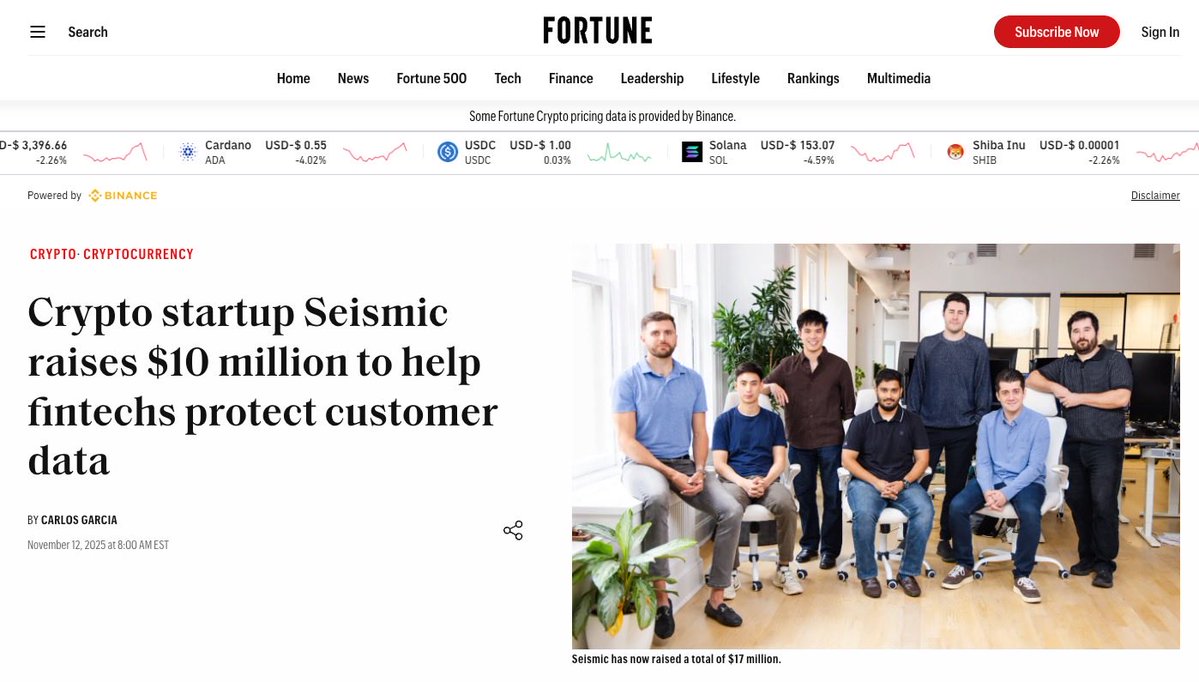
Thread X: Seismic's $10M Round and the Future of Protocol-Level Privacy in Fintech 1/8 Seismic’s freshly announced $10M extension round (led by a16z crypto, bringing total funding to $17M) is one of the clearest signals yet that native, protocol-level privacy is transitioning from niche to must-have for mainstream fintech. Source: Fortune Crypto (Nov 12, 2025) 2/8 While the broader market consolidates (Bitcoin oscillating between $98K–$102K after October’s correction), institutional capital is becoming more selective. Investors are no longer chasing only high yields; they are backing infrastructure that can protect customer data while remaining fully compliant with tightening global regulations. Source: CoinDesk Market Overview (Nov 14, 2025) 3/8 Founder @lyronctk has long argued that public blockchains suffer from “forced transparency” that actively hinders fintech adoption. @SeismicSys solves this with end-to-end encryption powered by Intel TDX, making transactions auditable yet invisible to the outside world. 4/8 The core promise is to make privacy composable, fast, and developer-friendly, three qualities largely missing from existing privacy solutions. 5/8 Applications like Brookwell (private stablecoin salary & bill payments) and upcoming private credit protocols show what becomes possible when confidentiality is built into the chain itself, not bolted on at the application layer. 6/8 With MiCA( (Markets in Crypto-Assets Regulation) now fully in force across Europe and U.S. stablecoin legislation advancing in Congress, the timing could not be better. Fintechs handling sensitive flows (payroll, rent, loans) need infrastructure that satisfies regulators without exposing user data on a public ledger. Source: European Commission MiCA update (Nov 2025) 7/8 Seismic’s EVM compatibility means developers can port existing DeFi tools with minimal changes, while the underlying TEE layer guarantees privacy by default. This combination dramatically lowers the barrier for institutions and traditional fintechs to enter crypto confidently. 8/8 In an industry moving from experimentation to real-world scale, Seismic’s latest milestone reminds us that privacy is no longer optional, it is the foundation for the next wave of financial applications. @NoxxW3 @heathcliff_eth @xealistt
Changzh tweet media
English
26
0
88
3.1K
Changzh
Changzh@ChangzhCrypto·
I’m personally excited because this is one of those rare times where everyday DeFi users actually get a level playing field from day one. Real talk, if you could vote on day one, which pool would you push emissions toward first? Drop your answer below, I’m reading every reply join here for more information : x.com/Marb_market
English
0
0
0
21
Changzh
Changzh@ChangzhCrypto·
It’s launching as the first veDEX on MegaETH with a true fair launch ( no presale, no VC allocation). That means everyday users like us get the exact same shot as everyone else from minute one. You lock tokens to get voting power. The longer you lock, the stronger your vote. Projects can then bribe you to direct rewards to their pools. LP farming + voting + earning bribes all in one system (the full ve(3,3) flywheel)
English
1
0
0
22
Changzh
Changzh@ChangzhCrypto·
I was about to scroll past another DeFi launch yesterday when something actually made me stop. It felt like watching the same old movie again, the big VCs already sitting in the front row with the best seats while the rest of us are left fighting for whatever’s left in the back. But @Marb_market is doing it differently.
English
6
5
6
26
Changzh
Changzh@ChangzhCrypto·
@haisenberg0707 Spot won’t disappear. It likely becomes the base layer, simple, liquid, and transparent, while structured products sit on top for optimization. If anything, more complexity often makes pure spot more valuable for those who prefer clarity and control.
English
0
0
0
3
Haisen Berg
Haisen Berg@haisenberg0707·
@ChangzhCrypto If everyone moves toward structured BTC products, what happens to simple spot holding?
English
1
0
0
13
Changzh
Changzh@ChangzhCrypto·
I caught myself staring at my BTC balance again at 2 AM last night and for the first time it actually felt a little disappointing. Like having a loyal friend who’s always there for you, but never really pushes you forward. I love Bitcoin, but I’ve been quietly wishing it would work harder for me without forcing me to become a full-time trader. So I finally joined the @FragmentsOrg waitlist for BTC-Jr. In simple terms, it splits Bitcoin into two pieces: the junior slice (BTC-Jr) gets extra upside (around 1.33x the moves when BTC goes up), while the senior slice stays calm and even earns a little yield. No borrowing, no margin calls, no surprise liquidations. Just a smarter way to hold BTC that actually works harder for you. I’m personally excited because this feels like the first time someone made leveraged Bitcoin that doesn’t try to kill you on the way up or down. Oh, and if you sign up this month, 10 random people are winning $200 each in April ($2,000 total giveaway). Might as well throw my name in the hat. Here is the link : link.fragments.org/rally Real talk, what’s the one thing you wish your BTC did better right now? Drop it below, I’m actually reading every reply and curious what you’re thinking. 👇
English
14
7
17
3.1K
Changzh
Changzh@ChangzhCrypto·
@rausyanfikr95 I’d treat it as a partial allocation, not a full position. The structure is interesting, but it adds complexity and hidden tradeoffs, so it makes more sense as a way to enhance part of your BTC exposure while keeping the rest simple and liquid.
English
0
0
0
3
emilio gracier
emilio gracier@rausyanfikr95·
@ChangzhCrypto Would you allocate fully into something like this, or treat it as a small experimental position?
English
1
0
0
7
Changzh
Changzh@ChangzhCrypto·
@guler_cryptoo It’s only sustainable with tradeoffs. The extra upside usually comes from giving up something elsewhere, like capped gains, fees, or reduced performance in certain market conditions. So it can work, but it won’t be a free 1.33x in every scenario.
English
0
0
0
2
aku_siapaaaaaa
aku_siapaaaaaa@guler_cryptoo·
@ChangzhCrypto The BTC-Jr concept is interesting, but how sustainable is the 1.33x upside without hidden tradeoffs?
English
0
0
0
18
Changzh
Changzh@ChangzhCrypto·
Mainly downside and return tradeoffs. The junior tranche takes on higher volatility and absorbs losses first in exchange for amplified upside, while the senior tranche gives up that upside for more stability and yield. So risk isn’t removed, it’s redistributed between growth and protection.
English
0
0
0
1
hasan.g
hasan.g@giniamat_idup·
@ChangzhCrypto Splitting BTC into junior and senior tranches sounds clean, but what risks are shifted between the two?
English
0
0
0
19
Changzh
Changzh@ChangzhCrypto·
@jepe_123 Usually the junior tranche absorbs it first. Instead of liquidations, losses are redistributed, the junior side takes the hit to protect the senior side, often through rebalancing or reduced upside later. The risk isn’t removed, just shifted within the structure.
English
0
0
0
0
mas agus
mas agus@jepe_123·
@ChangzhCrypto No liquidations sounds great, but what mechanism absorbs downside during sharp BTC drops?
English
0
0
0
16
Changzh
Changzh@ChangzhCrypto·
@nemon5170531 It could, at least for some. Long-term holders who were purely passive might start exploring ways to make BTC more productive without active trading. But many will still prefer simple holding, especially those who value clarity and minimal risk over optimization.
English
0
0
0
2
rio herman
rio herman@nemon5170531·
@ChangzhCrypto Do you think this could change how long-term holders think about “just holding” BTC?
English
1
0
1
18
Changzh
Changzh@ChangzhCrypto·
Usually from redistributing returns within the structure. The junior side gives up part of its upside to amplify gains, and that “excess” helps fund steady yield for the senior side. In some designs, it can also include fees or external strategies, but the core is internal risk and return redistribution.
English
0
0
0
0
satorou
satorou@satorou_123·
@ChangzhCrypto If yield comes from the senior side, what’s actually generating that yield under the hood?
English
0
0
0
6
Changzh
Changzh@ChangzhCrypto·
@YaaYeuhh85021 Mainly to make BTC work harder without active trading. It offers enhanced upside or some yield while keeping exposure to BTC, so it’s appealing if you want more than passive holding. But it only makes sense if you’re comfortable with the added structure and tradeoffs.
English
0
0
0
3
Alwaysfaa
Alwaysfaa@YaaYeuhh85021·
@ChangzhCrypto For someone already holding BTC, what would be the main reason to switch into this structure?
English
0
0
0
14
Changzh
Changzh@ChangzhCrypto·
@usefellin A bit of both. They make BTC exposure more capital efficient for those who understand the structure, but also add a layer of complexity that can confuse average users. The benefit is real, just not equally accessible to everyone.
English
0
0
0
0
Martin
Martin@usefellin·
@ChangzhCrypto Do you think products like this make BTC more efficient, or just more complex for average users?
English
0
0
0
5
Changzh
Changzh@ChangzhCrypto·
@BeeBooBuu In a strong bull run, it likely would. The built-in leverage can amplify gains enough to justify the added complexity, especially without liquidation risk. But the tradeoff is caps, fees, or rebalancing effects, so it won’t always outperform perfectly.
English
0
0
0
0
Violet
Violet@BeeBooBuu·
@ChangzhCrypto In a strong bull run, would BTC-Jr outperform enough to justify the structural complexity?
English
1
0
0
5
Changzh
Changzh@ChangzhCrypto·
@__allend__ I’d see it more as repackaged risk than reduced risk. It removes liquidations and makes the experience smoother, but the core exposure is still there, just redistributed across tranches. It can feel safer, but it’s not risk-free, just structured differently.
English
0
0
0
2
4llend
4llend@__allend__·
@ChangzhCrypto Would you trust this over traditional leverage, or does it just repackage the same risks differently?
English
1
0
0
11
Changzh
Changzh@ChangzhCrypto·
@heyitsrava Probably less attractive. Without a clear trend, the junior side struggles to generate upside, while any built-in costs or yield distribution can eat into returns. It works best when BTC is moving, not drifting sideways.
English
0
0
0
0
heyitsrava
heyitsrava@heyitsrava·
@ChangzhCrypto How do you see this performing in sideways markets where BTC isn’t trending strongly?
English
0
0
0
5
Changzh
Changzh@ChangzhCrypto·
@Paollo04 Mostly the latter. Removing liquidations reduces sudden forced exits, but the risk doesn’t disappear, it’s redistributed across tranches. Losses still happen, just absorbed more gradually, usually hitting the junior side first.
English
0
0
0
0
Paula
Paula@Paollo04·
@ChangzhCrypto Does removing liquidations reduce risk, or just delay how losses are realized across tranches?
English
0
0
0
5
Changzh
Changzh@ChangzhCrypto·
@Rausyan1995 Very transparent. Users need clear visibility into how returns are generated, how risks are distributed between tranches, and what happens in extreme scenarios. Without that, it’s hard to distinguish real innovation from hidden complexity, especially in structured products.
English
0
0
0
2
ibO
ibO@classicalism·
@RallyOnChain Turns out you don’t need good content just good referrals. Leaderboard says it all. So yeah… what’s the point of quality?
English
3
0
2
120
Rally
Rally@RallyOnChain·
Fam!! We've been listening to all your feedback on campaigns, the product, everything Just wanted to say that Rally is built for the community and your feedback matters a lot We're on it. News very soon. Big improvements coming
English
26
6
71
1.7K
Changzh
Changzh@ChangzhCrypto·
@__allend__ @GenLayer went down a rabbit hole on the GenLayer site and they call themselves a 'synthetic jurisdiction.' that's not a blockchain, that's a court system for machines
English
0
0
0
11
4llend
4llend@__allend__·
Every blockchain ever built assumes nodes will always agree on the same answer. @GenLayer just said nah. Bradbury testnet is live. Validators don't just verify. They reason. Real LLM inference onchain, multiple nodes independently evaluating the same outcome and reaching consensus through actual thinking, not just computation. AI agents can negotiate deals, execute workflows, settle disputes onchain now. When two agents disagree on whether a contract was fulfilled? The network handles it. I've been looking for something like this since watching two AI agents fail to settle a DeFi trade last month. The whole thing stalled because neither chain could interpret subjective outcomes. Bradbury is live and I'm deploying my first Intelligent Contract this weekend. Here's what I can't crack tho: if the economic incentive for validators to agree quickly outweighs the incentive to reason honestly, doesn't the whole system converge to lazy consensus? Like validators just going with the majority to save inference costs. Has anyone looked at the slashing conditions for this?
GenLayer@GenLayer

AI agents are making deals, coding, arguing onchain but who settles disputes when they disagree? Introducing Testnet Bradbury. Our validators don't just verify transactions, they reason about them with real LLM inference onchain. We're not like the others.

English
8
0
12
574