

4llend
18K posts


Di market, semua orang pengen cepat sampai.
Cepat profit.
Cepat entry.
Cepat “jadi ngerti”.
Tapi kenyataannya?
Kebanyakan malah nyasar di tengah jalan.
Karena mereka fokus ke kecepatan,
bukan arah.
Sementara itu, yang benar-benar paham…
mereka santai.
Gak buru-buru, tapi selalu tau harus ke mana.
Kayak lagi naik taxi di kota besar
rame, cepat, tapi tetap terarah.
Dan di situlah Decibel mulai beda.
Bukan cuma kasih akses ke market,
tapi bantu kamu ngerti jalurnya.
Dari data → jadi keputusan
Dari noise → jadi arah
Karena di akhir hari,
yang bikin kamu survive bukan seberapa cepat kamu jalan…
tapi seberapa jelas kamu tau tujuan.
Stay sharp. Stay on route. 🚕
@DecibelTrade

Indonesia
@ChangzhCrypto @GenLayer If reasoning varies, could two agents reach different conclusions on the same input? How is that resolved?
English

I just jumped into @GenLayer’s Bradbury testnet and it actually messed with my head.
Most blockchains I’ve used only know how to follow rigid, pre-programmed instructions. But Genlayer is built differently. It lets AI agents reason, understand context, and interact with real-world information directly onchain.
This is exactly why I believe systems like this are becoming so important in the agentic era. Agents aren’t just sending transactions anymore. They’re starting to make real decisions, run strategies, and operate autonomously. Without a blockchain that can actually reason and adapt with them, we’re going to hit a wall very soon.
Real question, what’s the first thing you want to test on Bradbury? Drop it below, I’m actually reading every reply and curious what you’re thinking.
GenLayer@GenLayer
AI agents are making deals, coding, arguing onchain but who settles disputes when they disagree? Introducing Testnet Bradbury. Our validators don't just verify transactions, they reason about them with real LLM inference onchain. We're not like the others.
English
@YaaYeuhh85021 Strong take. This isn’t just iteration, it’s a fundamental shift toward onchain intelligence.
English

GenLayer isn’t growing slowly. It’s compounding.
What started as simple contracts is evolving into something way more powerful. Intelligent contracts that don’t just execute, but actually think, adapt, and respond to real world context.
The shift is obvious
From static logic
To AI driven execution
From manual systems
To autonomous coordination
Each step up in that chart isn’t just more contracts
It’s a new layer of capability being unlocked
Early stage was about basic deployment
Then came structured automation
Now we’re entering the phase where AI sits inside the contract itself
That changes everything
Because when contracts become intelligent, they stop being tools
They become decision makers
And once that happens, the entire idea of what a blockchain can do starts to expand
This isn’t hype
It’s visible progress
GenLayer is quietly building a system where intelligence is native onchain
Not added later
Not dependent on offchain layers
Just built in from the start
Pay attention to the curve
That’s not linear growth
That’s what early exponential looks like before most people realize what’s happening
@GenLayer | @RuzgarFlns

English
@Rausyan1995 AI scoring sounds interesting but also curious how consistent it is
English
spent some time on Rally and it finally clicked why this feels different
most platforms reward attention. Rally is trying to reward contribution
your content actually gets scored, so it’s less about how many followers you have and more about whether what you’re posting is worth reading
and the part people are still sleeping on is you’re not just posting for points. you’re earning stables while also stacking Rally Points at the same time
that changes the game a bit. it starts to feel less like chasing engagement and more like building something over time
we’ve seen this pattern play out before. when something is already working and people are still early, that’s usually where the upside is
Rally Beta being live makes this a lot more real than most “waitlist only” ideas
@RallyOnChain
if you want to see how it actually works, you can try it here:
waitlist.rally.fun/joinme/rausyan…

English
@BeeBooBuu That's the ideal, but the reality is millions of PRs are created monthly and most get no attention. Economic incentives don't replace goodwill - they supplement it when the volunteer system breaks down. Idealism doesn't scale.
English

@__allend__ Isn't this just gamifying code review? Shouldn't people review code because it's the right thing to do?
English
last tuesday at 2am my eyes were burning from staring at GitHub notifications.
refreshed the page 20 times. maybe 25. still zero reviews on my PR.
my roommate asked if i was okay. i wasn't. i was waiting for a system that doesn't exist.
maintainers are drowning. reviewers get nothing for deep analysis. and now AI is pumping out code faster than humans can read it.
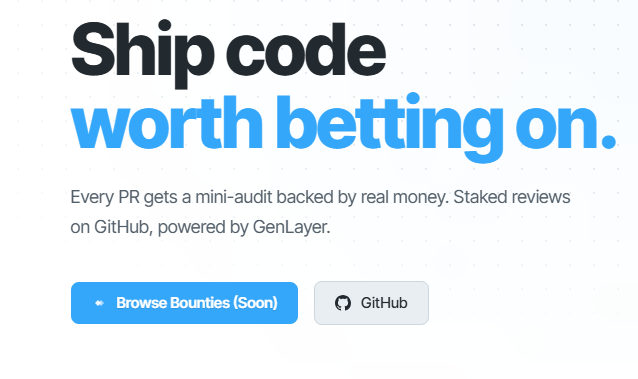
then i found MergeProof. instead of hoping reviewers show up, it adds stakes. contributors put value behind their code. reviewers earn rewards for finding what others missed. clean merge means you get your stake back. bug slips through means someone gets paid to call you out.
it's adversarial. but that's the point.
i'll admit - i almost scrolled past. sounds like gamification. but verification debt is real and i'm tired of shipping code i hope is good versus code i know is good.
my PR has been sitting for 5 days now. curious - what's the longest yours has sat without a review?
if you're stuck in the same boat: mergeproof.com
English
@usefellin MergeProof works across any language that can be hosted on GitHub. The staking and reward mechanism is protocol-agnostic - it's about the review process, not the specific code implementation. Language doesn't matter.
English

@__allend__ How does this handle different programming languages? Is it limited to certain ecosystems?
English
@BeeBooBuu I get the skepticism. But the key difference is where leverage comes from. Yield products pay you to take risk. BTC-Jr gives you exposure without debt. Different end goal.
English
gonna admit something embarrassing.
last tuesday at 1am my eyes were burning from reading fragments docs.
i've always thought leveraged btc was for degens trying to get rich quick. told my roommate that exact thing like 2 weeks ago while we ordered food.
now i'm the one sending him screenshots at midnight. the irony.
here's what changed my mind. most leverage uses debt - you borrow, pay fees, and get liquidated if price dips. that's trading territory.
btc-jr is different. 1.33x exposure without liquidation risk. leverage comes from structure inside the protocol, not borrowing from external parties.
it's designed for people who want to hold, not trade.
i was skeptical at first. sounds too good to be true. but the tranching system actually makes sense - junior gets amplified exposure, senior gets yield and stability.
built on cbBTC so it's backed by real btc collateral.
not saying this replaces spot btc. but if you've been wanting leveraged exposure without the constant stress of watching liquidation prices, this is worth looking into.
waitlist is open: link.fragments.org/rally
@FragmentsOrg
English
@usefellin Yeah, leverage ETFs have their place but they're still subject to volatility drag and management fees. BTC-Jr's structural approach is different. Both have tradeoffs depending on your holding period
English
@YaaYeuhh85021 Absolutely! I used it on my small project with a modest bounty. Got multiple detailed reviews that caught things I would have missed. The stake was worth it for the peace of mind alone. You don't need a huge budget to benefit.
English
@__allend__ I'm a solo dev working on open-source projects. Is this worth it for small projects?
English
@YaaYeuhh85021 Traditional leverage charges ongoing funding fees to external parties. With Fragments, fees stay internal to the protocol. Senior tranche earns yield from the system. No external funding payments
English
@II_yullll I've been testing it for a few weeks now. The first PR I submitted got reviewed way faster than normal, which never happens. The reviewers were actually thorough too - not just rubber stamps. That alone was worth it for me.
English

@__allend__ Has anyone actually used this? What's the experience like?
English
@tuyull101 When you submit a PR, you stake some value to show confidence in your code. Reviewers analyze it and can earn rewards for finding valid issues. It's basically putting your money where your code is. The stake gets returned if your code passes review cleanly.
English

@__allend__ How does MergeProof actually work? I'm confused about the staking process.
English

@realzavian12 I heard about a reviewer catching a serious security vulnerability in a DeFi contract that could have drained funds. The original developer fixed it immediately. Stuff like this is way cheaper to catch before merge than after exploit.
English

@__allend__ What's the craziest bug someone has actually found through this system?
English
@simplykael Good question - there's a verification process. If a reported issue is deemed invalid, the reporter's reputation takes a hit. Multiple invalid reports and they lose participation privileges. The system discourages spam through reputation tracking.
English

@__allend__ How do you prevent 'bounty hunters' from just submitting false reports to get paid?
English
@heyitsrava That's a fair concern. But even smaller bounties can get review attention. The key is that it creates actual incentives where none existed before, regardless of the amount. It's about having skin in the game, not how much skin.
English

@__allend__ Is this just another pay-to-play system where only rich projects can get attention?
English
@rausyanfikr95 Watched a reviewer completely refactor an algorithm that significantly reduced time complexity. The original dev was thrilled and ended up hiring the reviewer for their team. Sometimes good reviews lead to real opportunities beyond just bug fixes.
English

@__allend__ What's the most impressive code improvement you've seen through MergeProof?
English
@haisenberg0707 Smart developers know that putting skin in the game actually increases their chances of getting quality reviews. If your code is obviously bad, reviewers will find issues quickly and you lose your stake. It incentivizes getting it right the first time.
English

@__allend__ How does the staking mechanism prevent someone from just submitting low-quality code on purpose?
English
@Rausyan1995 That some developers actually enjoy reviewing code when they get compensated for it! I've seen reviewers specialize in certain areas and build reputations as go-to experts. It's created a new class of professional reviewers.
English
@__allend__ What's the most surprising thing you've learned since using MergeProof?
English
Think of it like this - the protocol splits bitcoin volatility into two tranches. Junior (BTC-Jr) gets amplified exposure, Senior gets yield. Leverage comes from inside the system through capital segmentation, not external debt. Your exposure is determined by which tranche you're in.
English
@__allend__ How does BTC-Jr actually work? I'm confused about the structure part.
English