
Château Crypto ꧁IP꧂
3.2K posts

Château Crypto ꧁IP꧂
@ChateauCryptoVC
Château Crypto is a network of qualified blockchain investors, entrepreneurs, founders & KOL’s from all over the world.
The Moon 가입일 Ekim 2020
1.6K 팔로잉3.7K 팔로워

okay enough drama for the day, let's get back to business
BTC seems to be in our chop zone and our next direction would be based on where we close 1D
above 117.5k = super bullish and we probably go for new highs
below 111.8k = bearish and we probably go for new lows around 1D EMA200
seeing some people target mid 90ks as well but im not sure if we go there yet (will put all my $10 capital if we get a chance to buy BTC in 90ks)
which way western man?

English
English

Squid Game. Parasite. K-Pop Demon Hunter. Korean IPs dominate global entertainment.
But top studios are down 50–95%. Meanwhile, we run the risk of becoming a content factory for streaming platforms like Netflix.
We need to stop this colonization. Korean creators must get the rightful share of their IPs' value.
My full thoughts below. More at Origin Summit.
S.Y. Lee@storysylee
English
Château Crypto ꧁IP꧂ 리트윗함

1/
STR8FIRE AMA Recap 🔥
We’re here to share where we stand, what’s next, and why this is the best time to be part of our journey.
At its core, STR8FIRE makes blockbuster entertainment IP investable — liquid, transparent & global.
Think: owning a piece of Star Wars back in 1977. 🎬
English
@TylerDurden Much better option Tyler, unfortunately I can’t bet with you. Restricted where I am
rn.

English


Château Crypto ꧁IP꧂ 리트윗함
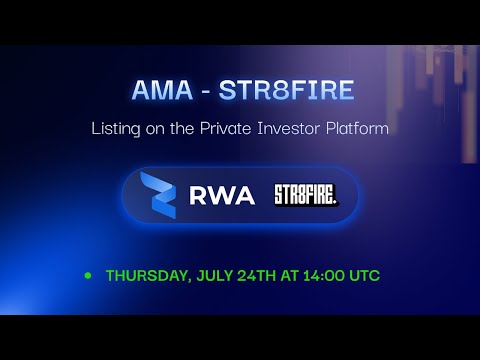
Join us tomorrow, July 24th at 14:00 UTC for an exclusive AMA with STR8FIRE, as they are listing on our Private Investor Platform.
@STR8FIRE_io is building the future of the $3 Trillion entertainment industry through investing in tokenized Entertainment IPs.
Take a closer look at their mission, their unique position in the industry, and the opportunities that come with their listing on our Private Investor Platform.
📅 Tomorrow, July 24th
🕑 14:00 UTC
👉 youtube.com/watch?v=AmPoqD…
YouTube

English
Château Crypto ꧁IP꧂ 리트윗함
STR8FIRE will be launching soon on the RWA Inc. Private Investor Platform.
Get ready to invest in the value and upside of iconic entertainment intellectual properties on-chain.
🔷 Backed by real-world entertainment deals and revenue streams
🔷 Buy, sell and trade Hollywood-level IP assets on-chain
🔷 Potential for long-term returns as the IP gains popularity
Previously reserved for insiders and industry players.
Soon open to all, starting from just $1000
Don't miss the launch of @STR8FIRE_io
👉 launch.rwa.inc
English
Château Crypto ꧁IP꧂ 리트윗함

My trading skills: mid
My building skills: improving
My conviction in Beam: never been higher
It’s a pleasure to be able to work towards something bigger every single day 🤝
English
Château Crypto ꧁IP꧂ 리트윗함
STR8FIRE x Promptale | Partnership Announcement
1/
We’re proud to announce a visionary partnership with @PrompTale — the platform redefining how stories are built, prompted, and scaled through AI-native worldbuilding.
Together, we’re unlocking the next era of IP creation at scale — where great stories aren’t just imagined, but remixed, expanded, and co-owned by the community.
English
Château Crypto ꧁IP꧂ 리트윗함
Château Crypto ꧁IP꧂ 리트윗함
STR8FIRE x BitDCA | Partnership Announcement 🔥🚀
We’re thrilled to announce our strategic partnership with @BitDCA — a platform pioneering long-term crypto investing through automated DCA strategies.
Together, we’re bridging two critical pieces of real-world blockchain adoption:
Tokenized entertainment IPs × Onchain wealth building.
To kick things off, we’re going LIVE on X Spaces to explore what this future looks like — and how both our communities can be part of it.
🗓 Date & Time 28 May 2025 @1pm UTC
📍 X Spaces
x.com/i/spaces/1ynko…
What we’ll cover:
🎬 How STR8FIRE is bringing Hollywood IP onchain — from comics to games, animations to phygital toys
💸 How BitDCA makes long-term crypto investing simple, disciplined, and accessible
🌐 The intersection of real-world assets, savings tools, and cultural capital
🔗 Building true utility in a post-hype world
🎁 Giveaway Time
3️⃣ x BDCA Founder Pass
3️⃣ x STR8FIRE OG Pass
Key Message:
"STR8FIRE is building the future of IP ownership, and BitDCA is building the future of onchain wealth. Together, we’re showing what real Web3 utility looks like — where fans, investors, and builders all win."
Let’s talk adoption, ownership, and onchain opportunity.
Don’t miss it.
English
Château Crypto ꧁IP꧂ 리트윗함

Château Crypto ꧁IP꧂ 리트윗함
Algorand Foundation@AlgoFoundation
Join us on May 14th for ALGO Radio Episode 8: The RWA Roundtable 🎙️ A conversation on the current state and future of real-world assets and tokenization. Featuring: @PeraAlgoWallet @AlexaJaccarino @GoraNetwork @STR8FIRE_io @XVCTech @StocktwitsCrypt twitter.com/i/spaces/1lPJq…
English
@grandgangstaci Love to see these two partnering up! 🤩
English
Château Crypto ꧁IP꧂ 리트윗함

⚡️ Exclusive Opportunity for Gangsta ID Holders ⚡️
Get paid $150/month to help build the future of cloud gaming with YOM as an Alpha Node Tester.
Put your computer setups to work and start earning passive income. Made for the gamers, builders, and the hustlers.
Full details on our Discord 👉 discord.gg/JkAztn65D9
English
Château Crypto ꧁IP꧂ 리트윗함
6/ 🌍 And Now: Dubai
As the bull run energy rises, STR8FIRE landed in Dubai for Token2049.
• Partnering with global industry leaders
• Participating in exclusive dealmaking events
• Expanding capital and co-production networks for tokenized IPs
@CharlieHusats, @rwa_io, @Decubate, @AiTechio, @RWA_Inc_, @dversepr, @hackenclub, @masterblox_io, @MaximaEquity, @marionawfal, @ibcgroupio, @MEXC_Official, @gate_io, @pauli_speaks, @cryptic_web3, @chateaucryptovc, @bitlayerlabs, @KaironLabs, @kucoincom, @solus_group, and many more
English

English
Great catching up with our close partners Koos @ChateauCryptoVC and Chris @STR8FIRE_io — a little indoor marina golf, a few drinks, and plenty of laughs before the @token2049 festivities officially kick off!
English