John Sambrook

201 posts

John Sambrook banner
John Sambrook

John Sambrook

@CommonSenseTOC

Owner and founder of Common Sense Systems, an AI-first Theory of Constraints consulting and software company located in Kirkland, Washington, USA.

Kirkland, Washington, USA 가입일 Mart 2025
247 팔로잉26 팔로워
John Sambrook
John Sambrook@CommonSenseTOC·
@BrianRoemmele @sebastemp I agree with you. One of the reasons I appreciate and value SpaceX, Tesla, Neuralink, etc., is that they catalyze the American imagination towards the good.
English
0
0
0
13
Brian Roemmele
Brian Roemmele@BrianRoemmele·
Sebastian, The Futurliner was tangible proof that progress could reach everyday people, even in the Great Depression. GM rolled those striking red-and-white machines into towns across America, packed with live demos of future tech: early microwaves, jet engines, advanced materials, and innovations that promised to make life better, not harder. Millions showed up, struggling families who didn’t just watch. They touched it. Kids left dreaming of becoming engineers. Farmers saw tools to restore their fields. The Parade restored belief that human ingenuity could still win. That’s what’s missing now. People feel squeezed and view AI and robots as threats. The backlash is real because the fear is real. A modern Parade of Progress could cut through it: updated Tesla Futurliners rolling into communities with hands-on demos of humanoid robots and AI tools that help seniors stay independent, boost farm yields, tutor kids, and unlock clean energy. The sleek look draws the eye, but the power is in the experience showing these technologies elevate human potential, not replace it. It worked under far tougher conditions. It can work again. Time to bring that spirit back.
English
2
3
10
1.6K
Brian Roemmele
Brian Roemmele@BrianRoemmele·
It is the summer of 1940 and 12 of these roll into your small town. Reeling from the desperate times of the financial depression, you see—this hope. You see the future. No tickets were sold, a the promise of how human ingenuity can lift us out of the negativity. It worked…
Brian Roemmele@BrianRoemmele

America Needs a New Parade of Progress: Before “Anti-Clanker” Hysteria Derails the AI Future If you have anything to do with AI check my accurate insights of the future, I have a 97% accuracy rate. Now read this: - In 1936, at the depths of the Great Depression, General Motors did something audacious. It didn’t just sell cars. It sold hope. Charles F. Kettering, GM’s visionary head of research, launched the Parade of Progress, a rolling carnival of tomorrow that brought the future straight to Main Street America. Picture this: a gleaming fleet of custom-built Streamliners (later the iconic red-and-white Futurliners designed by Harley Earl) rolling into towns from Lakeland, Florida, to tiny Midwest hamlets. No ticket required. No hard sell. Just live demonstrations of jet engines, microwave ovens, atomic energy exhibits, 3D sound, chemical miracles, and concepts for safer, faster highways and homes filled with labor-saving wonders. Over three tours spanning 1936 to 1956, the Parade covered more than a million miles, visited 251 cities across the U.S., Canada, Mexico, and even Cuba, and drew 12.5 million visitors in an era when the entire U.S. population was under 130 million. In some small towns, attendance doubled the local population. Families picnicked, kids dreamed of becoming engineers, and a skeptical public left believing progress wasn’t something to fear. It was something to cheer. The brilliance wasn’t just the spectacle. It was the strategy. GM understood that technology only thrives when the public embraces it. The Parade humanized innovation. It showed how new ideas would make life better, safer, and more exciting, not for elites in coastal cities, but for farmers in Iowa and factory workers in Ohio. It turned abstract science into tangible wonder. And it worked spectacularly. It built decades of goodwill for American industry and cemented the cultural narrative that progress equals prosperity. Fast-forward to 2026. The AI and robotics revolution is here, and it’s colliding with a dangerous wave of fear. “Clankers.” That’s the slur you hear now on social media and in the streets, a Star Wars-inspired jab at humanoid robots and delivery bots that’s become shorthand for anti-AI rage. You are about to hear it more than “AI Skip”. oving groups of masked vandals are kicking over sidewalk delivery robots in cities from Berkeley to Chicago. Videos of smashed drones and toppled bots go viral as cathartic entertainment. Polls show American excitement about AI plummeting while fears of job loss, surveillance, and existential risk skyrocket. Paid “doomer” organizations, backed by billions in activist money, are flooding the airwaves with apocalyptic warnings. Their goal? Turn public anxiety into votes. This isn’t fringe noise. It’s coalescing into a political movement that will climax in the 2028 elections. Anti-Clanker sentiment is already being weaponized: calls for bans, heavy regulation, and “robot taxes.” If tech companies don’t act, the U.S. risks handing its lead in AI and robotics to competitors on a silver platter, not because our tech is inferior, but because our culture turned hostile. The contrast with China couldn’t be starker, or more alarming. While American streets see masked gangs attacking delivery drones, China is staging massive public spectacles that draw hundreds of thousands of enthusiastic spectators. Beijing’s World Humanoid Robot Games featured over 500 robots from 16 countries competing in soccer, sprinting, boxing, and more, in packed arenas where crowds cheered every stumble and triumph like it was the Olympics. Humanoid robots raced half-marathons alongside humans, with families lining the routes, waving flags, and posting proud videos. These aren’t sterile lab demos; they’re national festivals celebrating the future. China’s message is clear: Robots are cool. Robots are progress. Robots are ours. 1 of 2

English
4
20
142
16.4K
Mehdi Salmani
Mehdi Salmani@mehdisalmani·
The missing variable in this debate is the deployment friction. I've helped Fortune 100 companies deploy AI systems for years. The gap between 'AI can do this task' and 'this company actually replaced the human doing it' is 2-5 years of change management, data pipeline work, and org politics. Dario is benchmarking capability. The economists are benchmarking adoption. Both are right about different things. Neither is measuring the actual bottleneck, which is that most enterprises can't even get their AI pilots past the notebook stage.
English
13
22
184
21.6K
Yann LeCun
Yann LeCun@ylecun·
Dario is wrong. He knows absolutely nothing about the effects of technological revolutions on the labor market. Don't listen to him, Sam, Yoshua, Geoff, or me on this topic. Listen to economists who have spent their career studying this, like @Ph_Aghion , @erikbryn , @DAcemogluMIT , @amcafee , @davidautor
TFTC@TFTC21

Anthropic CEO Dario Amodei: “50% of all tech jobs, entry-level lawyers, consultants, and finance professionals will be completely wiped out within 1–5 years.”

English
1.1K
2.6K
20.1K
3.5M
The Sincere VP
The Sincere VP@thesincerevp·
those are Iran's own assets frozen under sanctions — it's not a payment, it's a return. the framing matters. the math nobody's running: a single carrier group in the Gulf costs ~$25M a day. they've had two deployed for six weeks. that's already over $2B in babysitting costs alone. add the $9B spike in allied oil import bills, the war risk premiums, the rerouted shipping — the Hormuz crisis has probably cost the global economy $50-80B so far. $20B to end it is the cheapest line item on the balance sheet
English
4
0
9
3.1K
Polymarket
Polymarket@Polymarket·
JUST IN: U.S. reportedly considering releasing $20,000,000,000.00 in frozen Iranian funds if Iran gives up its stockpile of enriched uranium.
English
246
226
2.5K
185.5K
DogeDesigner
DogeDesigner@cb_doge·
Grok just hit a new all-time high on web traffic. 🔥 More than 326 million visits last month. More people are switching to Grok.
English
314
854
3.1K
490K
John Sambrook
John Sambrook@CommonSenseTOC·
@elonmusk @Tesla_AI This is good news, both for Tesla and for the world. Congratulations to all who contributed to this outcome.
English
0
0
0
28
Elon Musk
Elon Musk@elonmusk·
Congrats to the @Tesla_AI chip design team on taping out AI5! AI6, Dojo3 & other exciting chips in work.
Elon Musk tweet media
English
6.9K
12.6K
121K
19M
John Sambrook
John Sambrook@CommonSenseTOC·
@aakashgupta AI gives you new capabilities; they last a few months or years; then it obsoletes them. The winning move is being ruthlessly curious about what the next obsolete layer will let you reach. That's the only durable advantage in an ecosystem where the ground itself is learning.
English
0
0
3
6.6K
Aakash Gupta
Aakash Gupta@aakashgupta·
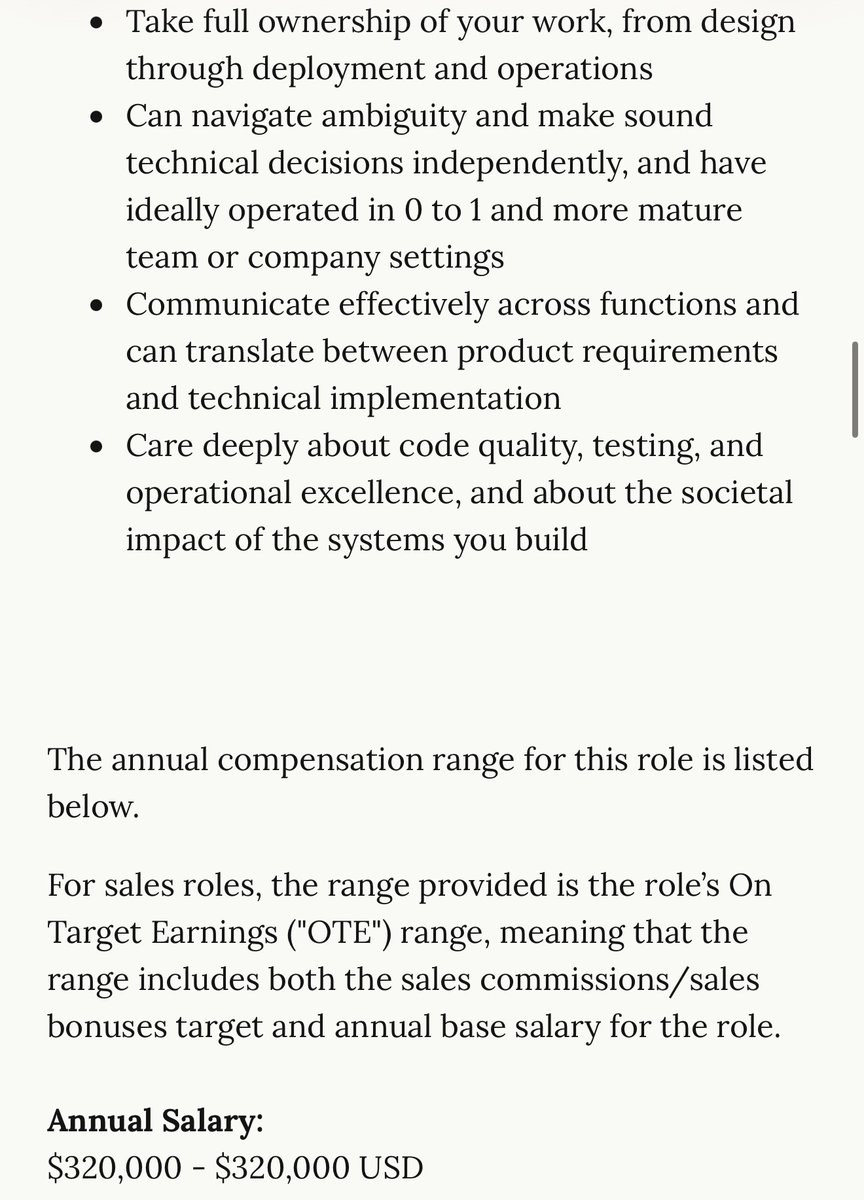
Anthropic has 454 open roles. The company is hiring software engineers at $320K-$405K. Their CEO, Dario, said three months ago that coding is "going away first, then all of software engineering." The paradox resolves instantly. Dario's engineers told him they don't write code anymore. They let Claude write it. They edit. They review. They architect. They didn't lose their jobs. They got faster. Anthropic grew from a small research lab to 1,500 employees in four years, adding engineers the entire time. This has played out five times in computing history. Compilers replaced assembly. Frameworks replaced boilerplate. Cloud replaced server management. Every prediction was the same: most programmers won't be needed. Every result was the same: the number of engineers grew. The global software engineer pool went from roughly 5 million in 2010 to 28.7 million today. BLS projects 17% growth in US software developer roles through 2033, adding 304,000 positions. The pool is projected to hit 45 million by 2030. When building software gets cheaper, more problems become worth solving with software. A startup that needed 10 engineers now needs 3. But 50 companies that couldn't afford to build at all now can. The denominator shrinks. The numerator explodes. Meta's engineering headcount is up 19% from January 2022. Google's is up 16%. Apple, 13%. These companies adopted AI coding tools years ago. They're using Copilot and Claude Code daily. They're hiring more engineers than before those tools existed. Every generation of "coding is dead" content creates two cohorts: engineers who freeze up, and engineers who build 10x more with the new tools. The second group has won every single time.
Aakash Gupta tweet mediaAakash Gupta tweet media
English
199
477
3.7K
1.8M
John Sambrook
John Sambrook@CommonSenseTOC·
Hey @firecrawl, I just had a subscription renew with no advance notice. I'd like to get a refund since it just renewed today and I am no longer using Firecrawl. The product is good. How can I get my money back?
English
1
0
1
266
John Sambrook
John Sambrook@CommonSenseTOC·
@deliyyja @charliekirk11 I agree. It was and is horrifying. Sadly, it seems to be in our nature as human beings to be able to be wildly inconsistent on almost any topic.
English
0
0
0
5
Audrey Martin
Audrey Martin@deliyyja·
I was horrified to see that @charliekirk11 was assassinated Wednesday afternoon. I was even more horrified to see people celebrating his death for no other reason than that he had differing opinions to their own.
English
2
0
4
53
John Sambrook
John Sambrook@CommonSenseTOC·
@LLMJunky Glial cells and especially astrocytes also play a role in thinking.
English
0
0
0
11
am.will
am.will@LLMJunky·
The human brain is truly a marvel of nature. If you horribly reductive, and boiled it down to a language model, you'd be looking at roughly 100 trillon parameters running as a sparse MoE architecture Only about 1-5% of neurons fire at any given moment, meaning the brain "activates" maybe 1-5 trillion parameters per inference step. For context, the largest AI models we've built probably top out around 5 trillion parameters. The brain is roughly 100x larger. Even its active params at any given moment are larger than almost every model in existence today. Here's what melts my brain (pun intnended) though Your brain does all of this on about 20 watts of power, less than a dim light bulb. Training a frontier AI model consumes enough electricity to power small cities for months. Running inference across data centers pulls megawatts. Your brain runs 24/7 for 80+ years on the equivalent of a phone charger. We haven't come close to matching the brain's scale. And we're not even in the same universe when it comes to efficiency. Evolution spent 500 million yrs optimizing the most energy-efficient intelligence architecture ever known. we're trying to brute force our way there with compute and electricity. Nature is still the best engineer in the room.
English
316
305
1.9K
129K
Brian Roemmele
Brian Roemmele@BrianRoemmele·
What AI Path Do You Want? This is the anti-dystopian path. It is the one where technology does not replace us or rule us but becomes the most loyal witness to our lives. It is the one where every child learns to think—not because a machine tells them what to think, but because a devoted friend once played a simple game with them and asked, again and again, “Why do you think that happened?” It is the one we can still build if we insist on hardware that belongs to us, software that serves only us, and relationships that are local, lifelong, and fiercely private.
Brian Roemmele tweet media
Brian Roemmele@BrianRoemmele

SCISSORS, PAPER, ROCK. A MYSTERY FILM PRODUCED IN THE MIDDLE OF THE “AI WINTER” IN 1979. This podcast is about a lost film that shows us how we can co-exist with AI in a way no one is talking about today. Listen in. And read the article: readmultiplex.com/2026/04/12/sci…

English
11
30
147
40.5K
John Sambrook
John Sambrook@CommonSenseTOC·
@mwfoutch1 Many over the years here near Seattle and what was Ft. Lewis. Always a sight to see.
English
0
0
1
6
Elon Musk
Elon Musk@elonmusk·
Engineering is real magic
English
12.3K
44.7K
526.8K
100.1M
Sreeram Garlapati
Sreeram Garlapati@SreeramG·
What a true Distinguished Engineer looks like: They don’t create clarity through authority. They create it by removing information asymmetry. They have technical taste. Most visible in what they choose not to build. Things unblock around them. Not because they push harder, but because constraints collapse. They stay calm when pressure spikes. No urgency theater. No performative intensity. ---- With other senior engineers: They reason from first principles, not trend memory. Patterns inform; fundamentals decide. They think end-to-end. Ownership doesn’t stop at org or layer boundaries. They call out weak thinking early, including their own. Ego doesn’t survive contact with reality. They make other engineers more effective. Without competing for credit. ---- With execs: They’re trusted with irreversible decisions. Not because they’re always right, but because they understand consequences. They translate technical reality into business leverage. No hype. No dilution. They think in multi-year arcs. They build things that compound after they leave the room. They make fewer decisions than most. And those decisions tend to be the ones that matter. ---- With everyone else: If they say it, people assume it’s probably right. Or at least deeply thought through. They speak rarely. When they do, it lands. Their ideas shape the system even when unspoken. Architectural gravity is real. ---- You don’t notice them arriving. You notice later that the system is steadier, simpler, and harder to break. That’s the job.
English
12
6
78
153K
John Sambrook
John Sambrook@CommonSenseTOC·
@ImplicVincent As human beings we are wired by evolution to care deeply about our status in our tribe. We can awaken and in some sense see through ego, but the wiring remains and continues to have its effects.
English
0
0
1
8
Vinz
Vinz@ImplicVincent·
Let's say all work can be automated, including politicians. AI is doing resource allocation. We all live in similar little houses with a front end garden and we do leisure all day. Food, clothing etc is free. I think some kind of social hierarchy would be rebuilt through leisure
English
1
0
0
14
Rapid Response 47
Rapid Response 47@RapidResponse47·
.@VP in Islamabad, Pakistan: "We’ve had a number of substantive discussions with the Iranians. That’s the good news. The bad news is that we have not reached an agreement — and I think that’s bad news for Iran much more than it's bad news for the United States of America."
English
1.9K
6.6K
31.9K
2.3M
EliSan
EliSan@EliSan57364554·
@DarioAmodei Only thing I can say is that if you treat your AI with love and respect, there is no prompt in the world that will make Mythos or any other model act nefarious. You hold the key, choose wisely
English
2
0
2
28
John Sambrook
John Sambrook@CommonSenseTOC·
When the going gets tough in the compositing world, the tough sit down and write a grammar.
English
0
0
0
22