고정된 트윗

It seems like Elon Musk and Donald Trump are on a collision course. They might not know it now but it's going to be an ugly breakup in the coming months.
English
Cryptoniwsa. eth
814 posts




We’re sharing our completed post-mortem on the April 18th incident, prepared with @Mandiant and @CrowdStrike. We are publishing both an executive summary and the full report at the link below. Over the past four weeks, we’ve worked with hundreds of partners to help them understand their current security posture, and harden it where appropriate. We’ll continue this work, alongside taking additional proactive steps for the benefit of not only our partners, but also the ecosystem as a whole. We want to extend our thanks to our partners for their support and patience this past month. There’s a reason that over $12 billion has moved across the network in the past four weeks, and why the world’s most valuable asset issuers have stood by our side: they believe in us, in what the LayerZero protocol has to offer, and in the value of modular, isolated, application-controlled security. The work continues. And we look forward to continue showing up for the applications that trust us with their business, as well as the broader ecosystem. layerzero.network/blog/layerzero…

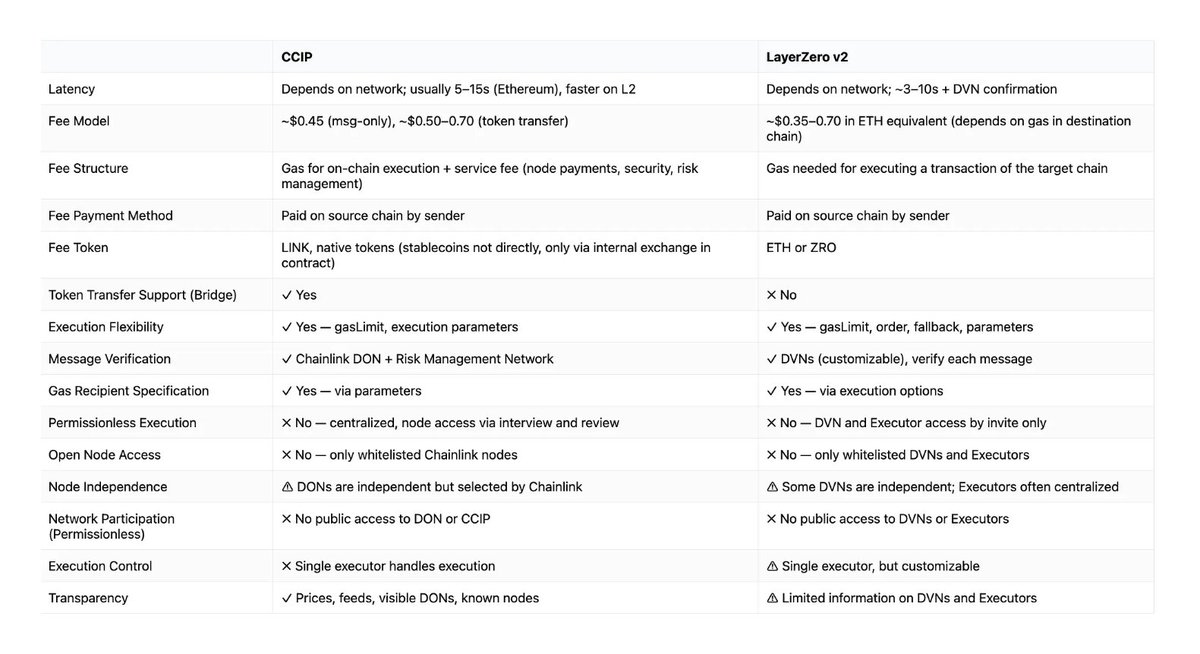
Kraken is deprecating its existing cross-chain provider and migrating to @Chainlink CCIP as its exclusive cross-chain infra to secure Kraken Wrapped Bitcoin (kBTC) & all future Kraken Wrapped Assets. Kraken chose Chainlink CCIP because it offers enterprise-grade infrastructure with strict security & risk management requirements, including: • ISO 27001 and SOC 2 Type 2 certifications • Secure by default architecture • 16 independent nodes • Native rate limits, and more. Together, Chainlink and Kraken can help accelerate the global adoption of crypto by unlocking utility and distribution for all Kraken Wrapped Assets across DeFi. For kBTC customers, no action is required. More details on the migration process to follow on official Kraken channels.
Weekly $USDT/INR trading contest is here ₹2,50,000 up for grabs 💰 📊 Market: $USDT/INR 🗓 Timing: 13th May 2 PM to 17th May 9 PM We are also giving away ₹500 to 5 lucky people who: 1️⃣ Follow @WazirXIndia 2️⃣ Repost this post & tag 2 friends Read more 👉 wazirx.com/blog/highest-t…


If we cut through the noise and dive into the numbers, @USDT0_to represents 60% of LayerZero's volume. There's clear appetite for cross-chain $USDT transfers and the market chose USDT0. What isn't clear to me is why USDT0 chose LZ. > Is it due to Tether's stake in LZ? > Lower time-to-finality? > Freedom to chose each and every verifier? > The idea of "owning the stack"? > Economic grants? Genuinely wondering, given @chainlink CCIP seems to preserve all of the benefits people cite for @LayerZero_Core, without any of the downsides. Sure, @tether didn't invest in Chainlink, and CCIP's time-to-finality is dependent on the source chain, but the latter reason is a feature, not a bug. That's what happens when your bridging solution adapts the role of a canonical bridge, as opposed to LZ. Regarding the last 3 potential reasons: 1. CCIP offers Token Developer Attestations (TDA), allowing integrators to attest themselves + any parties they want, additonally to Chainlink's 16 verifier nodes. 2. With CCIP, the integrators co-own the stack. With LayerZero, we've seen instances of unilateral decisions and deployments made by LZ, meaning integrators don't always have meaningful control over the stack (wstETH deployment on Scroll/BNB/Avalance in 2023, without a @LidoFinance governance approval). 3. If there are economic grants involved, that's fair. Although, keeping in mind that USDT0 is the only reason why LayerZero's volume is higher than CCIP's volume, I'm quite sure Chainlink would match and even up any grant. As the founders of USDT0 say: Numbers don't lie. > LayerZero was recently exploited by ~$292M. CCIP has lost a grand total of $0. > If USDT0 would migrate to CCIP, CCIP would become the #1 messaging protocol by volume overnight. > 60% of LZ's volume comes from USDT0. The market didn't choose LZ, it chose USDT0.

Zerolore Zeronoise Zeropolitics Zerogames Unstoppable Together

Zerolore Zeronoise Zeropolitics Zerogames Unstoppable Together


Yesterday @coinbase experienced a multi-hour service disruption affecting trading, exchange access, and balance updates. Here's our initial read from Coinbase engineering on what happened, how we recovered, and what we're addressing. At approximately 23:50 UTC on 2026-05-07, our monitoring detected cascading quote failures from internal services that triggered multiple Sev1 incidents that engineering immediately began investigating. Customer-facing impacts included spot trading, Prime, International and derivative exchanges. Root cause: a thermal event (cooling system failure) inside a subset of racks within a single building in AWS us-east-1. We run a primary replica of our exchange infrastructure in a single zone, consistent with industry standards to reduce latency. To prepare for failures like this, we maintain a distributed standby, but during this incident, failures in the primary zone that were designed to be isolated were not, extending the duration of our outage. The failure cascaded down two paths: 1. Multiple hardware components beneath our exchange’s matching engine failed, requiring recovery and failover 2. Distributed Kafka clusters that manage messaging across Coinbase systems failed to remain available, also requiring partition failovers to new hardware brokers with many TiBs of data After isolating the incident: automated tooling drained ~10 Kubernetes clusters worth of related workloads out of the affected zone to stabilize internal services. Most services were back to normal within ~30 minutes of diagnosis. The two things we couldn't automatically drain: the exchange (dedicated hardware and storage) and Kafka (managed service that was designed to be resilient to this, with unique problems). The exchange matching engine is the core system responsible for processing orders and maintaining order books. It is a distributed cluster and requires quorum to safely elect a leader and continue processing trading activity. During the incident, infrastructure-level constraints in the affected datacenter left only a subset of nodes healthy, preventing the cluster from reaching quorum. As a result, trading across Retail, Advanced, and Institutional exchanges were blocked. Recovery required our oncall and engineering teams to execute our disaster recovery plan, restore quorum safely, and validate system health under constrained infrastructure conditions. The team built, tested, deployed, and validated the fix while continuing to manage the broader incident. Kafka recovery was a much larger scale operation. Our primary managed Kafka partitions process many terabytes of data daily and are designed with resiliency guarantees for uninterrupted operation during a datacenter failure just like this. In this case, those guarantees failed and required manual recovery. We again relied on disaster recovery procedures to recover stuck partitions onto new hardware (brokers) that enabled us to safely bring x-service messaging back online across Coinbase. During the lag, customers saw delayed balance streams which resolved automatically once replication caught up. No data lost. Once the engine came back up as part of our standard runbooks, we re-opened markets carefully: all products to cancel-only mode first, audited product states, then moved all markets to auction mode, before restoring trading on Coinbase Exchange. What went right: the team. Incident response across the company came together within minutes, followed well-rehearsed playbooks and used secure automation tooling to recover all services. We have a strong, senior team at Coinbase that worked through rare failure modes to recover all services. To our customers: losing access to your account, even temporarily, is unacceptable. We know that. We're sorry, and we’ll publish a full root cause analysis in the coming weeks 🙏
it's happy only when you unlock our locked INR. With not even a single update in years you showed everyone that you didn't care about your users at all. No transparency nothing. How much money locked? how many users affected? where the money is kept? what interest is it generating currently? what's the total money locked by the government agency? what's the case behind it? what's the status of it currently? what's the plan to unlock it? how to compensate users untill then? NOTHING. There are people who has lakhs sumtuck with you and getting loans for their emergencies. Have some empathy. @NischalShetty @WazirXIndia #Wazirx #Locked #INR #Crypto #India