고정된 트윗

Here is an older essay on
@pittparents
that is still relevant today. We hear our sons are either ASD or AGP when neither is the case if they are heterosexual. pittparents.com/p/think-my-son…
English
Georgia4tea
6.1K posts







@IfindRetards The Wachowskis are living proof that for men, "trans" is a porn-induced fetish. They even said so themselves. x.com/i/status/18000…


After four years of co-founding @reduxx with @Slatzism, not only is this our most censored article -- We have offered $100 payout to anyone who can prove wrong even one of our thousands of articles

@RayAlexWilliams You haven’t addressed the basic complaint—the fact that you are disrespecting women with your paraphilia, or what you call “kink.” Women are not objects for your fetish. They are flesh and blood human beings. They deserve much more respect than you seem capable of giving.


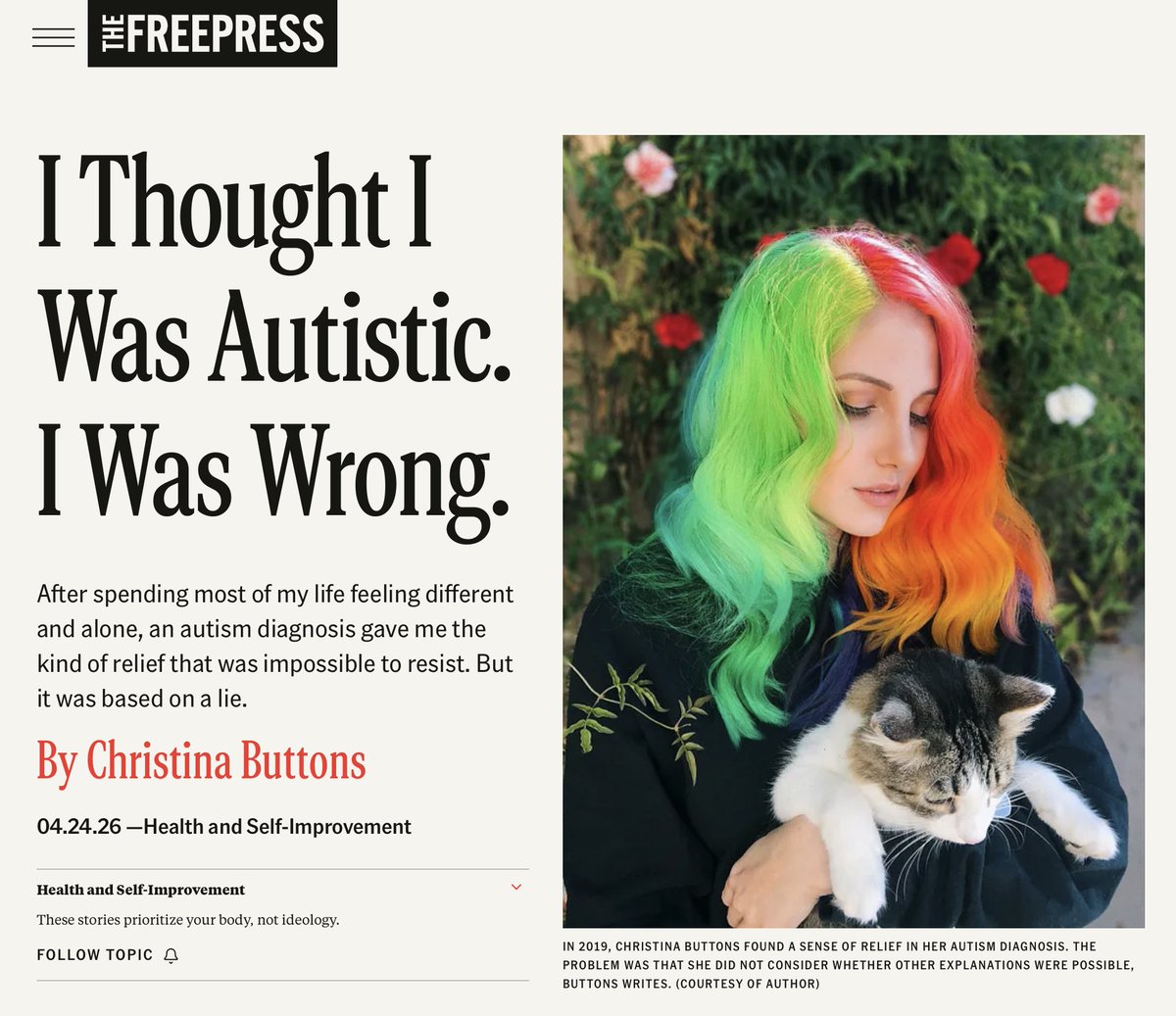
I thought I was autistic. I was wrong. I was 30 in 2019 when stories of women discovering they were autistic all along began appearing everywhere. They popularized a newer understanding of autism, with its own “female presentation.” It was framed as a scientific correction to a historical wrong against women, the kind of narrative the press finds irresistible. Like so many women, I felt immense relief when I was formally diagnosed. It offered an explanation for the mental health crises of my youth and the daily realities of my adult life. Then I spent a year in the online autism community. What I saw there, especially the way activists treated parents of severely impaired children, turned me into a critic of neurodiversity. But it was becoming a journalist in 2022, after discovering detransitioners’ stories, that forced me to question narratives about identity and diagnosis, including my own. Journalism also required the social skills autism says I should have lacked. From there, the rest unraveled: many traits I had come to associate with autism are not uncommon in the general population, but through the “female autism” framework, they looked like a meaningful pattern. I don’t think my story is unique. The same incentives that kept my diagnosis intact may also help explain why so many women are entering the autism category in adulthood. Read my first article for @thefp: thefp.com/p/i-thought-i-…

I thought I was autistic. I was wrong. I was 30 in 2019 when stories of women discovering they were autistic all along began appearing everywhere. They popularized a newer understanding of autism, with its own “female presentation.” It was framed as a scientific correction to a historical wrong against women, the kind of narrative the press finds irresistible. Like so many women, I felt immense relief when I was formally diagnosed. It offered an explanation for the mental health crises of my youth and the daily realities of my adult life. Then I spent a year in the online autism community. What I saw there, especially the way activists treated parents of severely impaired children, turned me into a critic of neurodiversity. But it was becoming a journalist in 2022, after discovering detransitioners’ stories, that forced me to question narratives about identity and diagnosis, including my own. Journalism also required the social skills autism says I should have lacked. From there, the rest unraveled: many traits I had come to associate with autism are not uncommon in the general population, but through the “female autism” framework, they looked like a meaningful pattern. I don’t think my story is unique. The same incentives that kept my diagnosis intact may also help explain why so many women are entering the autism category in adulthood. Read my first article for @thefp: thefp.com/p/i-thought-i-…