jonathan Cools

358 posts

jonathan Cools

jonathan Cools

@JonathanCools

Cardiothorqcic surgeon, tumor immunologist. Conceptualizing cancer ecologically

Montréal, Québec 가입일 Şubat 2020
357 팔로잉332 팔로워
jonathan Cools
jonathan Cools@JonathanCools·
Agreed but it’s kind of a lie. I mean you don’t know what you don’t know… hence experiments. And this concept of “planning” research is a bit ridiculous at best. Pure fabrication of expected outcomes which is kind of the opposite of science but I do spend a lot of time writing grants
English
0
0
1
10
Houman Asefi
Houman Asefi@houmanasefi·
@PeterDiamandis grant-writing overhead exists because the funder needs to believe they'll get value. A scientist who says 'I'll explore for five years and tell you what I find' is unfundable. A scientist who says 'I'll improve X by Y% using approach Z' is fundable.
English
1
1
7
618
Peter H. Diamandis, MD
Peter H. Diamandis, MD@PeterDiamandis·
The science funding system is BROKEN. PhDs and professors are spending their days writing grant proposals rather than conducting research that could transform millions of lives. And the worst part? The system REWARDS predictable, safe, incremental science. It PUNISHES radical ideas and moonshots.
English
143
267
1.5K
86.7K
jonathan Cools
jonathan Cools@JonathanCools·
@parmita Interesting concept. I like the idea of realtime analysis a lot. We take snapshots to predict the future in biology and that needs to change.
English
3
1
1
689
Parmita Mishra
Parmita Mishra@parmita·
cells are dying in petri dishes and we’re calling it data. genomics is a dead end for drug discovery. biology needs to move from forensics to film. I am either completely delusional or Precigenetics is going to be the most important biotech in ten years.
English
20
2
146
9.9K
jonathan Cools
jonathan Cools@JonathanCools·
@jpsenescence @pierre_azoulay I think departments should just have a budget and they fund work they find important or interesting. No wasting time seeking external validation for hypothetical work that often never materializes, just fund the people you want to work with and it will come
English
0
0
0
36
João Pedro de Magalhães
João Pedro de Magalhães@jpsenescence·
I agree that grant funding success is a poor measure of scientific potential. Some brilliant scientists - eg Katalin Karikó - struggled to get funding for work that later proved transformative. @pierre_azoulay even suggested that the skills for getting grants "are weakly correlated with scientific potential, and they might be negatively correlated". So how should we better identify and support high-risk, high-reward science?
Jason Locasale@LocasaleLab

This is what NIH decay looks like. Calling this a list of rockstars is obscene. What it actually shows is who has learned to extract the most from a broken funding system — a system that now resembles a biomedical industrial complex more than a merit-driven scientific enterprise. This is not a ranking of scientific greatness. It is a ranking of grant throughput. If you surveyed 100 cancer scientists and asked them to name the most transformative or promising researchers in the field, the list would look nothing like this. Winning dozens of R01s in five years is not a proxy for transformative discovery. It is a proxy for mastering study section gamesmanship, grant-writing performance, and institutional grant infrastructure. Those are bureaucratic feats inside the biomedical industrial complex. They are not scientific excellence. The question is not who accumulated the most awards. The question is whether marginal dollars are actually going to the best science across a broader base of investigators — or being concentrated in those most adept at navigating the machinery. Celebrating volume of awards as proof of scientific greatness completely misses the point.

English
3
2
33
4.8K
jonathan Cools
jonathan Cools@JonathanCools·
@Nature Pretty sure that’s why the editors and reviewers at journals like nature are there. I don’t think you need ai to write garbage
English
0
0
0
96
nature
nature@Nature·
It has never been easier to create fake or low-quality papers, and other AI slop go.nature.com/3O7czvl
English
8
33
90
11.7K
jonathan Cools
jonathan Cools@JonathanCools·
I think it’s necessary during your early formation. I think it helps you understand how… fickle these tests can be and what they practically look like. If you want lots of reliable and reproducible data I think a lot of automation is necessary. I guess I think 2 things can be true
English
0
0
1
113
Jake Wintermute 🧬/acc
Jake Wintermute 🧬/acc@SynBio1·
If you're a biology professor who thinks that manual benchwork is an important part of biology, I respect that position If you say that and you didn't do a single hour of manual benchwork this year, you should consider if you are really living your values
English
15
2
91
23.8K
jonathan Cools
jonathan Cools@JonathanCools·
@irishroadchild @newstart_2024 Agree have often seen the same thing when selecting new candidates. The discussion focuses on how likely they are to get funded not how cool is their work… it hurts lol
English
0
0
0
9
irishroadchild
irishroadchild@irishroadchild·
@JonathanCools @newstart_2024 I’ve observed lab heads actively reject good research questions chasing funding for useless projects. They are not actively trying to find good questions. The wrong people are being allowed to pose the questions.
English
1
0
0
12
Camus
Camus@newstart_2024·
Eric Weinstein isn't mincing words: Science has become its own worst enemy, clogged with gatekeepers, whisper networks, and "trolls with PhDs" who crush dissent rather than debate it. He points out the irony—physics once spawned molecular biology, the World Wide Web, and semiconductors—yet now it's sidelined while the institutions meant to protect inquiry instead protect careers. Sabina Hossenfelder gets smeared as "just a popularizer." Bold outsiders get ignored, not even invited for a public takedown. His own example? He claims he can explain the origin of the 16 first-generation particles using general relativity alone—no particle physics needed. The response from the system? Crickets. He says we could break open theoretical physics in five years if we stopped shielding the National Academy, NSF, big journals, and started funding real outsiders—with lawyers, guns, and money if necessary. When curiosity gets replaced by clique protection, what dies next? Your thoughts
English
67
280
1.2K
59.1K
jonathan Cools
jonathan Cools@JonathanCools·
@SDDonovan Where’s the line with technology exactly. I remember in high school when the internet was not a valid source of information for assignments. Pretty intense statement. What if u use spellcheck ?
English
0
0
0
13
Shane Donovan
Shane Donovan@SDDonovan·
If you use AI to write, you're not an author.
English
184
582
3.5K
109.4K
jonathan Cools
jonathan Cools@JonathanCools·
@gnoble79 Maybe I’m missing something but I’m not sure why AI is constantly framed as a replacement for human input or how it somehow negates the value of human input. It’s an extremely powerful tool that can elevate efficiency and creativity when used that way.
English
0
0
2
152
George Noble
George Noble@gnoble79·
I just learned something that should terrify every AI investor: Six major large language models were tested on real freelance work - the kind actual humans get paid to do on Upwork. Not homework. Not summaries. Real commercial tasks that generate real revenue. Building video games. Creating presentations from rough notes. Architectural schematics. The BEST performing AI completed tasks well enough to get paid 2.5% of the time. The worst? 0.3%. Think about that. If you were an Uber driver who completed 2.5% of your rides, you'd be kicked off the platform in a week. This comes from academic research published in the Remote Labor Index - not some anti-AI hit piece. They eliminated jobs requiring physical work or heavy human interaction and focused purely on digital deliverables where AI should theoretically excel. And it failed 97.5% of the time. Meanwhile, US tech companies are spending $380 billion on AI infrastructure in 2025-2026. Data centers using the power of 619 houses per GPU stack. Oracle's shares are now BELOW where they were before announcing their massive OpenAI partnership. Blue Owl Capital (AI infrastructure funder): down 40% Fermi (data center REIT): down 60% The funding markets are already getting more discerning. And we haven't even hit the real reckoning yet. AI is excellent at correlation. But correlation isn't how the world works. It can regurgitate answers to questions it's been trained on. But ask it to actually BUILD something, execute a complex task, or operate in the real world where correlations don't hold? It falls apart. Scam Altman showed Operator - OpenAI's agent that's supposed to act like a CEO's assistant. 19 minutes into the demo, they revealed it worked 34% of the time. On their own metrics. Their own homework. That THEY graded. 34%. And that's in a controlled demo environment. In the real world with actual commercial deliverables it's 2.5%. The capital misallocation is 17 times larger than the dotcom bubble. Nvidia's receivables are up 770% in 33 months (Cisco's were up 140% before they collapsed). Every part of the AI stack is losing money except Nvidia - and they're the ones extending vendor financing to keep the whole thing afloat. This isn't a technology that's "almost there." This is a technology with fundamental architectural limits that can't be overcome by just adding more compute. I sat down with Julian Garran - one of the sharpest macro strategists I know - and he walked through why AI was "built to fail" from day one. The full conversation covers: - Why the economics of data centers guarantee losses - The Cisco 2000 playbook playing out in real time - What happens when the funding dries up - Where smart money is rotating (hint: it's not tech) This is a career-defining inflection point in markets. And most investors are still positioned for a productivity revolution that isn't coming. The full interview is in the comment below.
English
352
996
3.7K
557.8K
jonathan Cools
jonathan Cools@JonathanCools·
@HenryYin19 On a more generous note I’d add it’s comparatively unbiased and provides an excellent initial overview. I think as a complementary tool at the very least its implementation in the process is necessary
English
0
0
2
316
Yin lab
Yin lab@HenryYin19·
Tbh I would prefer AI peer review. I don’t expect AI review to be very good, but at least I know for sure AI will read the paper, unlike some humans who can’t or won’t read.
English
22
12
175
16.8K
jonathan Cools
jonathan Cools@JonathanCools·
@genologos Not sure I completely agree. I just think the empiric nature of biology reflects to some extent not asking the right questions
English
0
0
1
138
Mike White
Mike White@genologos·
I can’t comment on physics but this is not the case in biology. In most domains of biology, we don’t have nearly enough measurements of the precision and resolution needed for AI to reach this level.
Will Kinney@WKCosmo

Pretty much this.

English
10
9
126
18K
jonathan Cools 리트윗함
Tejas Patil
Tejas Patil@TejasPatilMD·
One of the most provocative studies in immuno-oncology - published @NatureMedicine. This is an important Ph3 that shows that earlier IO infusion time may result in superior PFS and OS - and the peripheral blood flow cytometry data are thought provoking 🤔I have SO MANY questions 👇🏾
Eric Topol@EricTopol

The time of day for cancer immunotherapy is associated with major outcomes. Early is better. Results from a randomized trial of lung cancer, backs up the importance of our circadian rhythm and immune system nature.com/articles/s4159…

English
7
4
36
10.4K
jonathan Cools
jonathan Cools@JonathanCools·
@tferriss @drmichaellevin I really love his approach. This type of original thinking is absolutely necessary today. I look forward to following his work!!
English
0
0
1
288
jonathan Cools 리트윗함
Tim Ferriss
Tim Ferriss@tferriss·
“If you’re like a five-year-old and you do that thing where you keep asking 'But why? But why?'—if you keep asking 'But why?' long enough, eventually, you always end up in the math department.” — Dr. Michael Levin (@drmichaellevin) Listen to my interview with Dr. Michael Levin: tim.blog/2026/01/21/dr-…
English
17
23
273
58.6K
jonathan Cools
jonathan Cools@JonathanCools·
Can’t say I agree. If the content of the review is appropriate then there’s no problem. Using ai or any other tool to produce a valid critique should be supported. Ive received plenty of terrible entirely human generated reviews. I’d say the bigger problem is the lack of engagement of editors.
English
0
0
0
84
Dr. Jean Fan
Dr. Jean Fan@JEFworks·
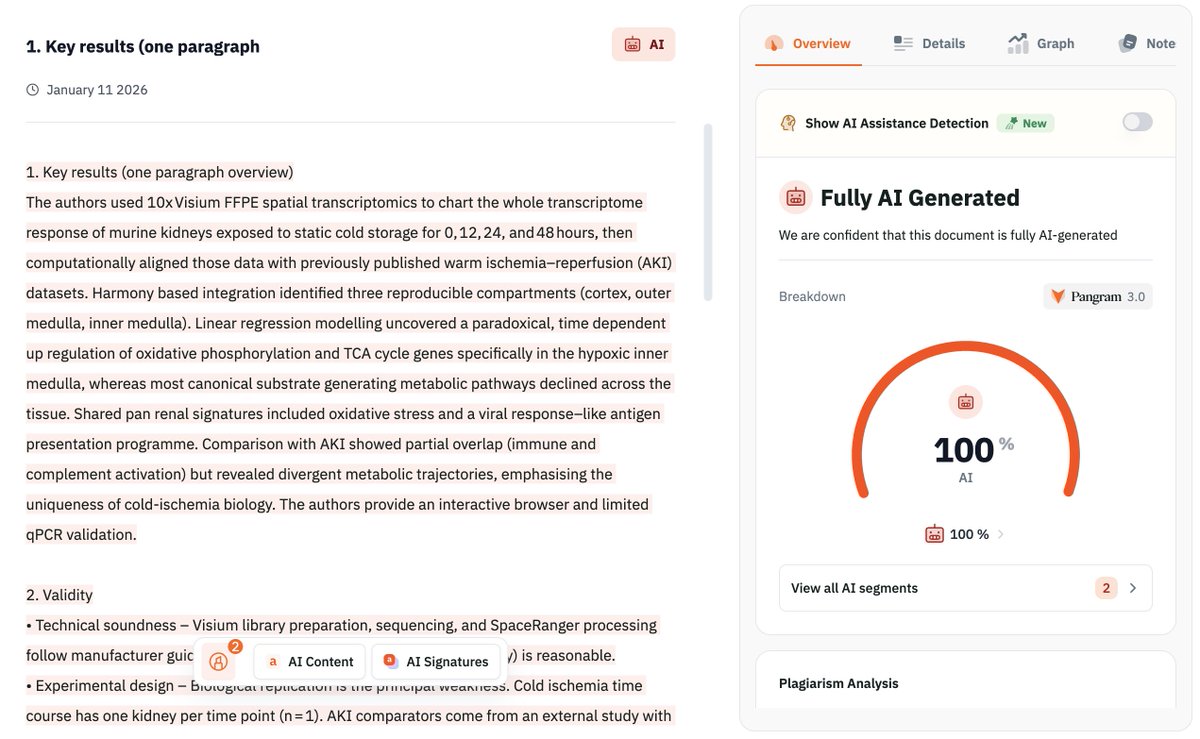
Newfound disappointment both as a scientist and as an editor: receiving shallow peer reviews that are entirely AI-generated. The whole point is critical feedback from YOU as a real expert. If reviewers are outsourcing to AI, I think we've lost the plot 🤷‍♀️ Not sure the solution.
Dr. Jean Fan tweet media
English
133
264
1.7K
161.8K
jonathan Cools 리트윗함
Mathonymics
Mathonymics@Mathonymics·
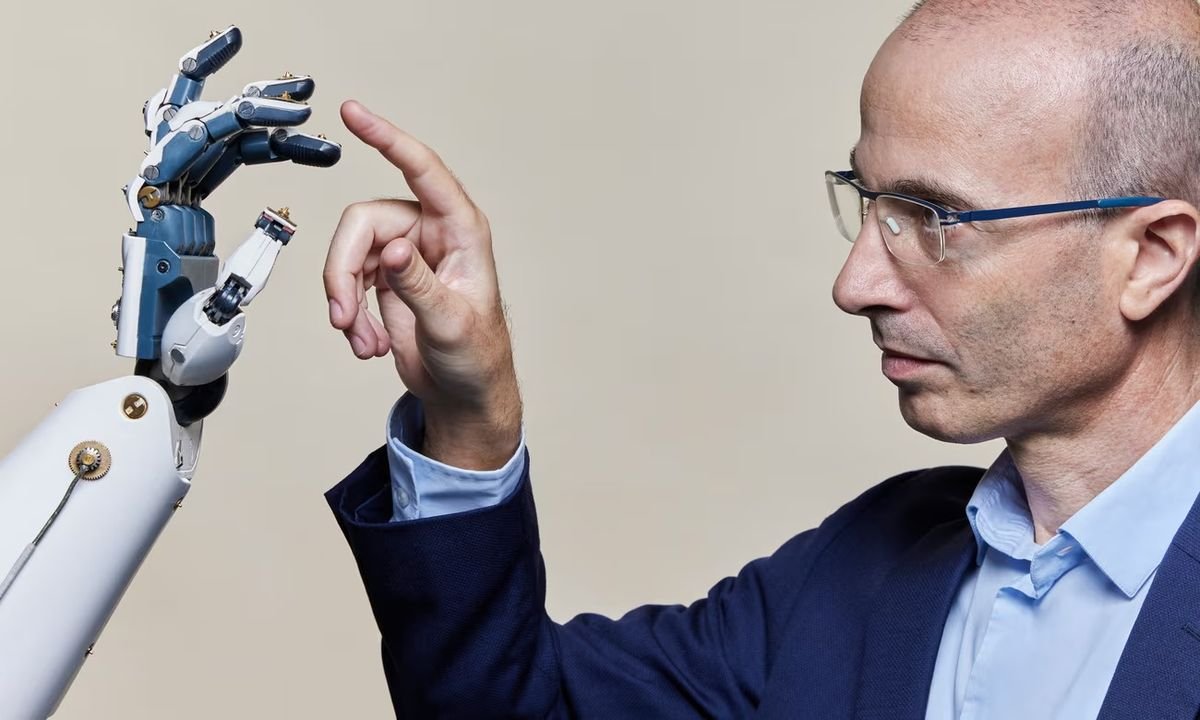
“As far as we can tell from a purely scientific viewpoint, human life has absolutely no meaning. Humans are the outcome of blind evolutionary processes that operate without goal or purpose. Our actions are not part of some divine cosmic plan, and if planet earth were to blow up tomorrow morning, the universe would probably keep going about its business as usual. As far as we can tell at this point, human subjectivity would not be missed. Hence any meaning that people inscribe to their lives is just a delusion.” ― Yuval Noah Harari in "Sapiens: A Brief History of Humankind"
Mathonymics tweet media
English
1.4K
123
953
1.5M