mbash

441 posts

mbash

mbash

@Mbash1212

가입일 Temmuz 2024
668 팔로잉39 팔로워
mbash 리트윗함
Francees
Francees@fransix59·
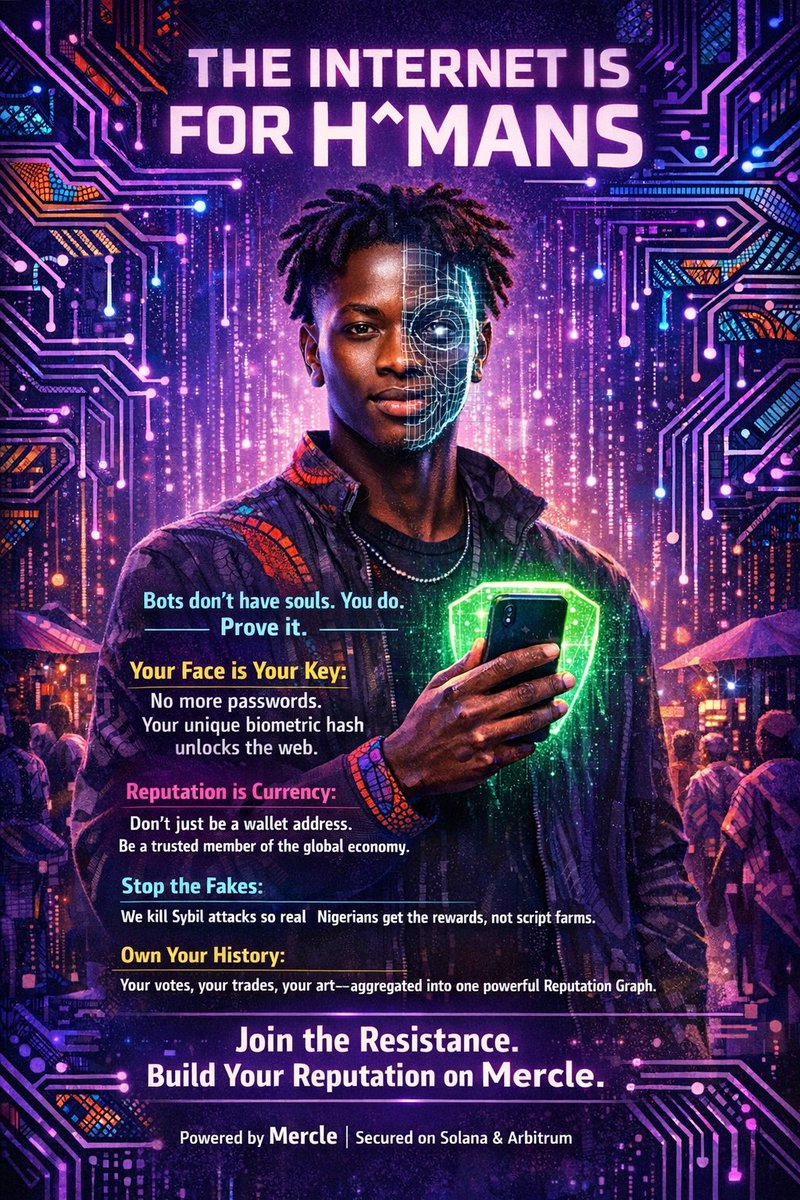
Why @0xmercle Matters: Building Human Trust in a Bot-Driven Internet As Web3 continues to grow, one challenge keeps surfacing across ecosystems: bots and Sybil attacks quietly draining value, fairness, and trust. Incentives get farmed, governance gets manipulated, and real users are pushed out. Mercle exists to solve this at the infrastructure level by enabling privacy-preserving verification of real humans on the internet. In digital economies, bots frequently exploit systems designed to reward participation, airdrop farming, referral abuse, play-to-earn manipulation, and reward draining. Mercle helps protect these financial ecosystems by ensuring that monetary value, points, and scarce digital assets are distributed to real people rather than automated networks. Beyond financial abuse, automated actors also target expensive infrastructure. Platforms offering GPU access, cloud credits, or AI compute often lose significant resources to fake accounts spinning up free trials at scale. Mercle prevents this by verifying human uniqueness, helping teams secure their infrastructure and reduce hidden operational costs. Trust is equally critical in social environments. Fake profiles and spam accounts degrade dating apps, review platforms, and professional networks, eventually driving away genuine users. Mercle strengthens social authenticity by ensuring interactions are backed by real humans, improving reputation systems and long-term engagement. Scarce opportunities are another major target for bots. Event tickets, limited NFT drops, DAO voting, and community incentives are frequently captured by scalpers and Sybil attackers. Mercle enforces fair access by supporting one-human-one-participation, preserving integrity in governance and community distribution without relying on centralized control. Many platforms also face compliance requirements without wanting to impose heavy KYC. In cases where age checks, uniqueness, or basic human verification are enough, Mercle provides a lightweight, privacy-first alternative that improves onboarding while still meeting regulatory expectations. At a higher level, Mercle is building a decentralized identity and reputation layer for the new internet, one designed to distinguish humans from bots and AI agents without exposing personal data. As automation accelerates, proof of humanity is becoming essential infrastructure. Mercle positions itself at the center of that future, enabling Web3 systems to scale securely, fairly, and sustainably.

Francees tweet media
English
30
3
43
726
mbash 리트윗함
Scott
Scott@OilyScott·
The Mercle Protocol Building the Internet for Humans in an AI World 🧵🧵 We’re at a collision point on the internet. Web3 is decentralizing value. AI is mass producing intelligence, content and interaction. But there’s a problem no one planned for 👇👇:
Scott tweet media
English
21
8
26
475
mbash
mbash@Mbash1212·
The future winner won’t be: identity-only, task-only, or AI-detection-only. It will be: identity + reputation + slashing + time. Spam dies when it’s unprofitable.
English
0
0
3
58
mbash
mbash@Mbash1212·
Mercle (@0xmercle) is interesting not because it rewards tasks, but because it prices behavior, not just identity. Spam only dies if negative EV exists.
English
1
0
3
61
mbash
mbash@Mbash1212·
Worldcoin proved something important: proving you’re human doesn’t stop spam. Verified humans can behave exactly like bots when incentives exist. 🧵👇🏿👇🏿👇🏿
English
1
1
4
67
mbash
mbash@Mbash1212·
@VitalikButerin Decentralized social is the right direction. Better communication tools should prioritize long-term value, open competition, and real human connection—not engagement farming or token speculation. Lens and Farcaster feel like early but necessary steps toward a healthier social.
English
0
0
0
5
vitalik.eth
vitalik.eth@VitalikButerin·
In 2026, I plan to be fully back to decentralized social. If we want a better society, we need better mass communication tools. We need mass communication tools that surface the best information and arguments and help people find points of agreement. We need mass communication tools that serve the user's long-term interest, not maximize short-term engagement. There is no simple trick that solves these problems. But there is one important place to start: more competition. Decentralization is the way to enable that: a shared data layer, with anyone being able to build their own client on top. In fact, since the start of the year I've been back to decentralized social already. Every post I've made this year, or read this year, I made or read with firefly.social, a multi-client that covers reading and posting to X, Lens, Farcaster and Bluesky (though bluesky has a 300 char limit, so they don't get to see my beautiful long rants). But crypto social projects has often gone the wrong way. Too often, we in crypto think that if you insert a speculative coin into something, that counts as "innovating", and moves the world forward. Mixing money and social is not inherently wrong: Substack shows that it's possible to create an economy that supports very high-quality content. But Substack is about _subscribing to creators_, not _creating price bubbles around them_. Over the past decade, we have seen many many attempts at incentivizing creators by creating price bubbles around them, and all fail by (i) rewarding not content quality, but pre-existing social capital, and (ii) the tokens all going to zero after one or two years anyway. Too many people make galaxy-brained arguments that creating new markets and new assets is automatically good because it "elicits information", when the rest of their product development actions clearly betray that they're not actually interested in maximizing people's ability to benefit from that information. That is not Hayekian info-utopia, that is corposlop. Hence, decentralized social should be run by people who deeply believe in the "social" part, and are motivated first and foremost by solving the problems of social. The Aave team has done a great job stewarding Lens up to this point. I'm excited about what will happen to Lens over the next year, because I think the new team coming in are people who actually are interested in the "social": even back when the decentralized social space barely existed, they were trying to figure out how to do encrypted tweets. I plan to post more there this year. I encourage everyone to spend more time in Lens, Farcaster and the broader decentralized social world this year. We need to move beyond everyone constantly tweeting inside a single global info warzone, and into a reopened frontier, where new and better forms of interaction become possible.
Lens@LC

Today, we’re proud to share that @masknetwork will steward the next chapter for Lens, bringing the strongest onchain SocialFi foundation to life through intuitive, consumer-ready applications.

English
921
658
4.3K
606.5K
mbash
mbash@Mbash1212·
@zachxbt @Optimism @useworldapp @world_chain_ Proof of humanity alone isn’t enough. Mercle (@0xmercle) adds reputation on top of verification, making it harder for verified humans to spam or farm incentives like bots — which is a more sustainable model for real credibility.
English
0
0
1
37
ZachXBT
ZachXBT@zachxbt·
The reason is World primarily targeted less developed countries where the airdrop allocation was more valuable in exchange for risking your biometric data. What happens when verified humans from developing countries spam AI slop / sybil globally due to financial incentives exactly the same as bots do? InfoFi has amplified this unsolved problem. People claiming airdrops or performing tasks for financial incentives does not make it the #1 wallet globally.
ZachXBT tweet mediaZachXBT tweet mediaZachXBT tweet media
English
42
32
606
37.4K
mbash
mbash@Mbash1212·
@VitalikButerin Simplicity is security — Ethereum should focus less on adding complexity and more on cleaning up, simplifying, and making the protocol easier to understand, maintain, and survive long-term.
English
0
0
1
8
vitalik.eth
vitalik.eth@VitalikButerin·
An important, and perenially underrated, aspect of "trustlessness", "passing the walkaway test" and "self-sovereignty" is protocol simplicity. Even if a protocol is super decentralized with hundreds of thousands of nodes, and it has 49% byzantine fault tolerance, and nodes fully verify everything with quantum-safe peerdas and starks, if the protocol is an unwieldy mess of hundreds of thousands of lines of code and five forms of PhD-level cryptography, ultimately that protocol fails all three tests: * It's not trustless because you have to trust a small class of high priests who tell you what properties the protocol has * It doesn't pass the walkaway test because if existing client teams go away, it's extremely hard for new teams to get up to the same level of quality * It's not self-sovereign because if even the most technical people can't inspect and understand the thing, it's not fully yours It's also less secure, because each part of the protocol, especially if it can interact with other parts in complicated ways, carries a risk of the protocol breaking. One of my fears with Ethereum protocol development is that we can be too eager to add new features to meet highly specific needs, even if those features bloat the protocol or add entire new types of interacting components or complicated cryptography as critical dependencies. This can be nice for short-term functionality gains, but it is highly destructive to preserving long-term self-sovereignty, and creating a hundred-year decentralized hyperstructure that transcends the rise and fall of empires and ideologies. The core problem is that if protocol changes are judged from the perspective of "how big are they as changes to the existing protocol", then the desire to preserve backwards compatibility means that additions happen much more often than subtractions, and the protocol inevitably bloats over time. To counteract this, the Ethereum development process needs an explicit "simplification" / "garbage collection" function. "Simplification" has three metrics: * Minimizing total lines of code in the protocol. An ideal protocol fits onto a single page - or at least a few pages * Avoiding unnecessary dependencies on fundamentally complex technical components. For example, a protocol whose security solely depends on hashes (even better: on exactly one hash function) is better than one that depends on hashes and lattices. Throwing in isogenies is worst of all, because (sorry to the truly brilliant hardworking nerds who figured that stuff out) nobody understands isogenies. * Adding more _invariants_: core properties that the protocol can rely on, for example EIP-6780 (selfdestruct removal) added the property that at most N storage slots can be changedakem per slot, significantly simplifying client development, and EIP-7825 (per-tx gas cap) added a maximum on the cost of processing one transaction, which greatly helps ZK-EVMs and parallel execution. Garbage collection can be piecemeal, or it can be large-scale. The piecemeal approach tries to take existing features, and streamline them so that they are simpler and make more sense. One example is the gas cost reforms in Glamsterdam, which make many gas costs that were previously arbitrary, instead depend on a small number of parameters that are clearly tied to resource consumption. One large-scale garbage collection was replacing PoW with PoS. Another is likely to happen as part of Lean consensus, opening the room to fix a large number of mistakes at the same time ( youtube.com/watch?v=10Ym34… ). Another approach is "Rosetta-style backwards compatibility", where features that are complex but little-used remain usable but are "demoted" from being part of the mandatory protocol and instead become smart contract code, so new client developers do not need to bother with them. Examples: * After we upgrade to full native account abstraction, all old tx types can be retired, and EOAs can be converted into smart contract wallets whose code can process all of those transaction types * We can replace existing precompiles (except those that are _really_ needed) with EVM or later RISC-V code * We can eventually change the VM from EVM to RISC-V (or other simpler VM); EVM could be turned into a smart contract in the new VM. Finally, we want to move away from client developers feeling the need to handle all older versions of the Ethereum protocol. That can be left to older client versions running in docker containers. In the long term, I hope that the rate of change to Ethereum can be slower. I think for various reasons that ultimately that _must_ happen. These first fifteen years should in part be viewed as an adolescence stage where we explored a lot of ideas and saw what works and what is useful and what is not. We should strive to avoid the parts that are not useful being a permanent drag on the Ethereum protocol. Basically, we want to improve Ethereum in a way that looks like this:
YouTube video
YouTube
vitalik.eth tweet media
English
664
525
3.7K
379K
mbash 리트윗함
pash
pash@pash161·
going forward we will be creating experiences that we feel would be good if only restricted to humans, motivation to do this is to create demand for mercle ID aka your digital human proof, here is our first experience, do let us know what you think about it: million.land
English
8
4
27
3.3K
mbash 리트윗함
Nikita Bier
Nikita Bier@nikitabier·
We are revising our developer API policies: We will no longer allow apps that reward users for posting on X (aka “infofi”). This has led to a tremendous amount of AI slop & reply spam on the platform. We have revoked API access from these apps, so your X experience should start improving soon (once the bots realize they’re not getting paid anymore). If your developer account was terminated, please reach out and we will assist in transitioning your business to Threads and Bluesky.
English
13K
4.4K
47.3K
14.1M
mbash
mbash@Mbash1212·
@VeryAI Identity alone isn’t enough anymore. We need Proof of Reality — real humans and real content. That’s the future VeryAI is building.
English
0
0
0
4
VeryAI
VeryAI@VeryAI·
Verifying who someone is no longer tells you whether what they share is real. For years, identity verification was enough. If an account was real, we trusted what came next. That worked when content was hard to fake. But today, a real person can generate or share fake images, videos, or audio in minutes. The account can be verified, but the content can still be false. This creates a new problem: platforms verify who is posting, but rarely verify what is being posted. That’s how trust and privacy breaks. Identity alone can’t solve this anymore, because it now requires two checks: - Proof of Personhood confirms a real human is involved. - Proof of Authenticity verifies whether the content reflects reality. Together, they form Proof of Reality. As AI erases the line between real and fake, trust needs more than assumptions. That’s why VeryAI exists.
English
16
12
61
5.5K
mbash
mbash@Mbash1212·
@VeryAI Exciting opportunities! Pushing the boundaries of AI, biometrics, and privacy—perfect for innovators ready to lead and create impact.
English
0
0
0
7
VeryAI
VeryAI@VeryAI·
We’re hiring in San Francisco or Remote. Join us to leverage biometrics and authentication for a privacy-first internet. —AI Researcher - work on the intersection of AI, biometrics, and authentication. —Head of Product / Product Lead - own product vision and execution for our Proof-of-Reality platform, working closely with research, engineering, and leadership Competitive compensation. High ownership. Exceptional talent.
English
41
34
592
86.4K
mbash
mbash@Mbash1212·
@VeryAI Reality will need verification. 2026 = Proof of Reality.
English
0
0
0
3
mbash
mbash@Mbash1212·
@aromavictor1 @SoSoValueCrypto Consistency always wins. 8 months of showing up pays off — wishing we all eat good and keep building beyond the airdrop 🙏
English
0
0
0
9
Aroma victor-zetarium
Aroma victor-zetarium@aromavictor1·
Nothing much but consistency...About 8 months of consistency...thanks to you all that use my link...you guys Effort made it easier than my own effort...I pray we all becomes eligible and Eat Good...make @SoSoValueCrypto a daily Habit and Not just an airdrop. 😊
Aroma victor-zetarium tweet media
English
34
7
170
7.3K